Chapter 1: Introduction
Motivation
I started writing this text in 2014 because the introduction I needed did not exist. The material I found on functional compilers was often dense and hard to approach, or written for an academic audience rather than people building software in industry. I wanted someone to walk me through a working compiler and explain the ideas as we needed them.
I slowly filled in the gaps in my own knowledge, but there was no reason others should have to take the same slow route. In the spirit of “be the change you want to see,” I decided to write the introduction I had been looking for. This book is my way of lowering the ladder for the next person.
We’ll build Fun, a strict functional language with inferred types, algebraic data, nominal records, and type classes. And building Fun is going to be fun! We’ll write it in Rust and take it all the way to native code through LLVM. Along the way we’ll build interpreters that let us run programs before we have a code generator, and check our translations as we go. The Haskell Report gives us a starting point for syntax and typing (Simon Marlow 2010).
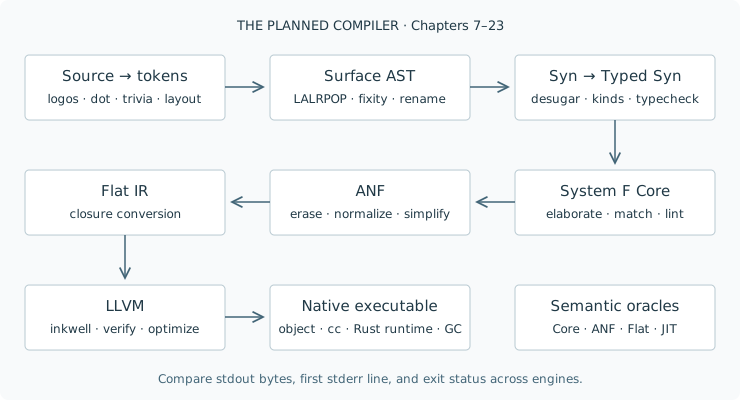
A compiler becomes easier to understand when each transformation has a small input language and a small output language. The early chapters study parsing, evaluation, and inference separately. From Chapter 7 onward each crate is a complete snapshot of the same compiler. Read a chapter together with its diff. Run an earlier snapshot whenever you want to revisit a simpler implementation.
Tool Setup
Use Apple Silicon macOS, or Linux on x86-64 or AArch64. We need Rust and Cargo to build the
chapters, just to run the repository recipes, a C compiler and Boehm GC for
the runtime, and LLVM 22 for native compilation and the JIT. The book has a
separate toolchain, installed by just bootstrap.
macOS
Install Apple’s command-line development tools and follow the
Homebrew installation instructions if brew is not already
available. Then install the system dependencies:
xcode-select --install
brew install git python just llvm@22 bdw-gc pkg-config
export LLVM_SYS_221_PREFIX="$(brew --prefix llvm@22)"
export GC_LIB_DIR="$(brew --prefix bdw-gc)/lib"
Wait for the command-line tools installer to finish before running the build.
Keep the two exports in your shell configuration if you want them in later
terminal sessions. llvm@22 is intentional. An unversioned LLVM package can
select a different ABI from the one used by our Rust bindings.
Ubuntu
These commands target Ubuntu 26.04 LTS, the current LTS when this edition was written. They also work with the supported Ubuntu 24.04 CI environment. Install the common tools, then use the official LLVM package installer to select version 22 explicitly:
sudo apt update
sudo apt install -y build-essential git curl wget ca-certificates \
  gnupg lsb-release software-properties-common python3 pkg-config \
  libgc-dev libssl-dev just
curl -fsSLo /tmp/wyah-llvm.sh https://apt.llvm.org/llvm.sh
sudo bash /tmp/wyah-llvm.sh 22
sudo apt install -y llvm-22-dev libpolly-22-dev
export LLVM_SYS_221_PREFIX=/usr/lib/llvm-22
The versioned LLVM prefix belongs in your shell configuration for later builds. The distribution’s default Rust package need not match the book’s pinned compiler, so install Rust through rustup next.
Rust and the Repository
Follow the canonical Rust installation guide. On either platform, its rustup installer is:
curl --proto '=https' --tlsv1.2 -sSf https://sh.rustup.rs | sh
. "$HOME/.cargo/env"
git clone https://github.com/sdiehl/write-you-a-haskell.git
cd write-you-a-haskell
rustup show
rustc --version
cargo --version
Inside this checkout, rust-toolchain.toml selects Rust 1.99.0 with Clippy and
rustfmt. Rustup installs the selected toolchain when needed. The
rustup book
explains how directory toolchains work. just is a command runner, not another
build system. Its installation guide
lists alternatives to the system packages above.
Now build a small chapter and the complete workspace:
cargo run -p ch02_calc -- repl
just build
cargo fmt --all -- --check
cargo clippy --workspace --all-targets -- -D warnings
For HTML and PDF, install the pinned book tools locally:
just bootstrap
just book
just pdf
Bootstrap installs mdBook, its preprocessors, Pandoc, and Typst under .tools.
The just recipes put .tools/bin on PATH. Fonts are already vendored in the
repository. Open book/build/html/index.html or
build/write-you-a-haskell.pdf. The published copies are the HTML at
https://sdiehl.github.io/write-you-a-haskell/ and the PDF beside it at
https://sdiehl.github.io/write-you-a-haskell/write-you-a-haskell.pdf, which is also the
asset on the repository’s latest GitHub release. The full compiler tests run with
cargo test --workspace and include long recursion and allocation regressions.
Nix Alternative
With Nix installed, the flake supplies the pinned Rust toolchain, LLVM 22, Boehm, a C compiler, and development tools for Apple Silicon macOS and both Linux architectures:
nix --extra-experimental-features 'nix-command flakes' develop
just build
just bootstrap
just pdf
The lock file fixes the package inputs. The shell sets the LLVM and GC paths,
so it replaces the platform package-installation steps above. Bootstrap still
installs the book’s exact tool versions into .tools.
Why Rust
When I first wrote this book in the mid-2010s, Haskell was an appealing way to explain a compiler. Algebraic data types, pattern matching, and a compact syntax made the transformations almost read like their mathematical definitions. But getting from those definitions to a complete native compiler already meant relying on libraries whose support was thin. In my experience, that maintenance problem has grown worse with time.
I still love Haskell’s surface language. I no longer consider it a good practical choice for building the compiler in this book. A compiler needs maintained bindings, diagnostics, testing tools, packaging, and a predictable runtime as well as elegant tree transformations. Implicit laziness also puts extra distance between the program I write and its allocation and evaluation behavior. Those costs matter when a compiler must process large inputs reliably.
Rust is my choice for this edition because of its much broader ecosystem and sustained investment in production tooling. It offers enums and pattern matching for our intermediate languages, explicit ownership for their storage, and direct access to LLVM and the native runtime. Cargo makes the chapter snapshots easy to build and test together. I want readers to spend their time learning compilation, with a toolchain they can continue using after the last chapter.
For this project, Rust is the best balance of expressive implementation code and
practical engineering. Perhaps there will be an OCaml edition one day. For now,
Haskell remains a language worth studying, while Rust is the language I want to
build in.
The original Haskell edition is preserved in the repository under the
haskell-edition tag.
Why not laziness?
Haskell’s strongest lessons survive without making every ordinary computation potentially lazy. Algebraic data, pattern matching, principal types, purity, and type classes are all worth keeping. Fun brings them together with call-by-value. Arguments are computed before a call, constructor fields before construction, and ordinary bindings before their bodies. This gives the reader a direct account of when work happens and where storage is needed.
I do not see implicit laziness as a productive default for a new language. A suspended expression may retain its environment long after its source binding looks finished. Forcing it can move both work and failure far from their cause. Sharing can avoid repeated work, but it introduces its own allocation and update protocol. Strictness analysis can recover efficient execution in many cases, yet that is substantial machinery to reconstruct a cost model we could have made explicit from the start. Chapter 5 studies the tradeoff in executable form.
Delayed computation is still useful. My preferred foundation for making it opt-in is call-by-push-value (CBPV). It separates values from computations. A computation can produce a value, and a value can hold a suspended computation. Explicit thunk and force operations mark the boundary. Both call-by-value and call-by-name can be expressed through these smaller operations (Levy 2001). The programmer or compiler can therefore specify where delay belongs instead of inheriting it everywhere.
CBPV does not by itself memoize a suspension. Call-by-need additionally requires sharing and an update that remembers the result. Forcing an ordinary thunk twice can run its computation twice. That distinction is precisely why I prefer this foundation for exploring laziness. Fun itself remains a strict call-by-value language. It implements neither CBPV nor lazy values. An explicit account of delay is a direction for a later language, beyond this book’s compiler.
Chapter roadmap
The tables below describe the complete book. Linked titles open each chapter. Chapters 2–6 are standalone languages. Chapters 7–24 are successive snapshots of Fun. Each row names the piece you will build, rather than a list of prerequisites.
Part I: Foundations
| No. | Topic | What you will build |
|---|---|---|
| 1 | Introduction | The workspace, test runner, chapter tools, and HTML/PDF book pipeline. |
| 2 | Parsing | An arithmetic language with logos, LALRPOP, a comparison Pratt parser, diagnostics, and a REPL. |
| 3 | Lambda Calculus | Substitution, de Bruijn indices, normal-order reduction, and strict closures. |
| 4 | Simply Typed Lambda Calculus | Annotated functions and a type checker that runs before evaluation. |
| 5 | Evaluation | Recursive functions, a constant-stack CEK machine, and a call-by-name comparison. |
| 6 | Hindley–Milner Inference | Polymorphic let inference, using both Algorithm W and level-based union-find. |
Part II: Frontend
| No. | Topic | What you will build |
|---|---|---|
| 7 | Design of Fun | The first Fun compiler, with source spans, diagnostics, pass sessions, Core, and a CLI. |
| 8 | Layout and the Extended Parser | Offside layout, comment-preserving formatting, signatures, fixities, and sections. |
| 9 | The Renamer | Unique names, lexical scopes, dependency components, and mutual recursion. |
| 10 | Typed Core and Core Lint | System F elaboration and independent Core lint to catch compiler mistakes. |
| 11 | Datatypes and Pattern Matching | Algebraic data, lists and tuples, nested patterns, equations, and guards. |
| 12 | Records | Nominal records with construction, updates, patterns, and resolved dot projection. |
| 13 | Kinds and Type Constructors | Higher-kinded constructors, inferred kinds, and checked type synonyms. |
| 14 | Type Classes | Constraints, instances, superclasses, defaults, dictionary passing, and Double. |
| 15 | Monads, Do Notation and IO | Higher-kinded control classes, do-notation, opaque IO, and effectful programs. |
| 16 | Pattern-Match Compilation | Decision trees and join points, with exhaustiveness and redundancy warnings. |
| 17 | The Prelude and Deriving | The full source Prelude and generated Eq, Ord, and Show instances. |
Part III: Backend
| No. | Topic | What you will build |
|---|---|---|
| 18 | A-Normal Form and Join Points | Type erasure, ANF, a small simplifier, and an iterative execution oracle. |
| 19 | Closure Conversion | Explicit environments, lifted functions, partial application, and a Flat IR oracle. |
| 20 | Data Representation and the Runtime | Tagged words, heap layouts, eval/apply, shared primitives, and a Boehm-backed runtime. |
| 21 | LLVM Code Generation | Native object emission, linking, tail calls, and tests against the interpreters. |
| 22 | JIT and the REPL | LLVM execution and a persistent REPL with type, kind, and compiler-pass inspection. |
| 23 | Optimization | Work preservation, reachable globals, and native numeric intermediates. |
| 24 | Precise GC (Optional) | Live-root tracking, a shadow stack, and a stress-tested copying collector. |
| 25 | Future Work | A guide to laziness, modules, richer types, optimization, and debugging extensions. |
Appendices collect the grammar, typing rules, intermediate representations, runtime ABI, and diagnostic index. A bibliography closes the book.
How We Will Build It
We begin with a calculator. It is small enough that we can follow an expression from the text we type to the answer it produces. We then build a few small languages to explore functions, evaluation, and types separately. Each has a complete Rust implementation you can run and change. You do not need to understand a whole compiler before you can experiment with one part of it.
In Chapter 7, those ideas come together in Fun. From there, each chapter starts with the previous chapter’s compiler and adds one piece. Records extend the language, type classes introduce a way to share operations across types, and later chapters teach the compiler to produce native code. Every chapter has its own crate, so you can keep an earlier version open beside the one you are studying.
Read the changes as well as the finished code. Each chapter lists its new and changed source files, with the important ones first. Comparing two snapshots lets you see what a feature actually asks of the compiler. You might need a new syntax node, a typing rule, and a translation into simpler operations. The book includes code from those source files, so the implementation you read is the one you run. Tests carry forward too, helping us check that adding a feature has not broken what already worked.
The theory arrives alongside the problems it helps us solve. We will try a small example, find the question it raises, and introduce enough notation to make the answer precise. You can work through the code and examples first, then return to a rule once you have seen it in action. No prior course in type theory is assumed. Familiarity with Rust enums, pattern matching, borrowing, and Cargo will help you follow the implementations.
Theory
A compiler rewrites a program several times before the computer can run it.
The challenge is to change how the program is written while keeping what it
does. If your program prints 42, the machine code we produce should also
print 42. If it asks for your name before greeting you, compilation must keep
those actions in that order.
We will build up those steps one at a time. First we work out how the source
text fits together. In 1 + 2 * 3, multiplication belongs inside the addition.
Then we check that the operations make sense, so adding a number to a function
is caught before the program runs. Later chapters translate the program into
simpler forms that are easier to turn into machine code.
How do we know we got a translation right? One useful trick is to write a small interpreter for each form and run the same examples through them. If they give different answers, we have found a compiler bug. Matching answers do not establish that every possible program works, but they give us a practical way to check our work as we go. Along the way, we will also learn how types and rules about evaluation help us reason about programs beyond the examples we can test (Pierce 2002).
Implementation
The repository is part of the book. Each chapter has a crate you can run, take apart, and change. If you’re wondering what a transformation really did, ask the compiler to dump its output and compare it with the input. That habit will tell you more than staring at the implementation and hoping for enlightenment.
We also want to keep the examples working as the compiler grows. testkit runs
small programs and checks their output, errors, and exit status. Later it runs
the same program through several execution engines. If two engines disagree,
we have something concrete to investigate.
#![allow(unused)]
fn main() {
/// The chapter supplies its binary and available engines; the runner owns policy.
pub struct Config<'a> {
    pub binary: &'a Path,
    pub programs: &'a Path,
    pub engines: &'a [Engine],
    pub timeout: Duration,
}
}
xtask handles the repetitive work of copying a chapter and checking its
inherited examples. The book itself includes Rust directly from the chapter
sources. You can follow an included function into the crate and experiment with
the code you’re reading. The HTML and PDF are built from the same chapters.
Running It
Install the pinned book tools with just bootstrap, then run:
$ cargo test --workspace
$ just book
$ just pdf
The HTML is in book/build/html/. The PDF is
build/write-you-a-haskell.pdf. Compiler --dump commands start in Chapter 2.
There is no compiler pass to dump in Chapter 1.
Further Reading
The Haskell Report is the language reference (Simon Marlow 2010). Pierce introduces the operational and typing judgments we will use (Pierce 2002). Kiselyov connects type generalization with dependency tracking, preparing for Chapter 6 (Kiselyov 2013). When you want to compare our choices with the real thing, Takenobu Tani’s GHC Reading Guide (pdf / github) is a map of the GHC source tree and its pipeline.
Chapter 2: Parsing
New files
src/lexer.rssrc/pratt.rssrc/ast.rssrc/eval.rsbuild.rssrc/diagnostic.rssrc/lib.rssrc/main.rsChanged files
None.
Motivation
We read 1 + 2 * 3 and know that the multiplication comes first. The computer
gets a string of characters. Before it can calculate anything, we have to teach
it how those characters fit together. That’s the parser’s job.
We’ll start with a calculator, small enough to follow all the way from source text to an answer. We’ll build its parser twice. LALRPOP lets us write down a grammar and generates the parsing machinery for us. A Pratt parser puts the operator-handling logic in a short Rust function. Seeing both is a useful way to discover what a parser generator is doing on our behalf.
The Language, Now
A program is one expression. It has decimal integer literals, names, +, -,
*, /, unary minus, parentheses, and a non-recursive let.
let x = 7 in (let y = x + 1 in y * y) - x
The binding is visible in its body, not its right-hand side. A nested binding
shadows an outer name. Multiplication and division bind above addition and
subtraction. All four operators associate left. Unary minus binds above them.
The / operator truncates integer division toward zero in this mini-language.
Full Fun will reserve / for fractional arithmetic and spell this operation
quot.
Theory
There are two plausible trees for 1 + 2 * 3. One adds first and returns 9.
The other multiplies first and returns 7. We want the second, so our grammar
needs to express that choice. We’ll separate sums, products, and atoms into
different rules. A sum can contain a whole product as an operand. Parentheses
let us start again from the full expression grammar when we want another
grouping.
Choosing a parsing strategy
There isn’t one parsing technique that wins at everything. Some approaches make the whole grammar easy to inspect. Others make it easy to write a little parser directly in the host language. Before choosing, it helps to separate three things we often bundle together. The grammar says what syntax we accept, the algorithm recognizes it, and the API determines how we write the parser.
| Approach | Main idea | Tradeoff for this book |
|---|---|---|
| LR(1) / LALR(1) | A generated state machine shifts tokens and reduces grammar productions. | A declarative whole-language grammar, with conflicts reported during generation. |
| Pratt | An expression parser uses binding powers to decide which operator owns the next operand. | Small, readable operator parsing. Declarations and blocks still need their own grammar. |
| Packrat | Memoize parsing results by rule and input position. | Predictable recognition time for a fixed suitable grammar, at the cost of a memo table. |
| Parser combinators | Compose small parsers using ordinary functions. | Convenient abstraction. Backtracking, memoization, and error behavior depend on the library. |
LR(1) scans left to right and constructs a rightmost derivation in reverse. Its state summarizes the prefix already read. One lookahead token helps decide whether to shift another token or reduce a completed production. The “1” does not limit expressions to one token. The parser’s stack retains arbitrarily deep syntactic context. Left recursion, such as a sum containing a smaller sum, fits this bottom-up process naturally.
LALR(1) merges LR(1) states with the same underlying LR(0) items, combining their lookahead sets. This reduces table size but can introduce conflicts absent from the unmerged grammar. Despite its name, our generator uses LR(1) by default. LALR(1) is an option. See the LALRPOP documentation. A conflict is useful feedback. The grammar needs attention before we can trust its generated parser.
Pratt parsing makes the operator decision local. After reading 1 + 2, the
parser compares the following * with the binding power of +. Multiplication
belongs inside the right operand, so 1 + 2 * 3 becomes 1 + (2 * 3). For
8 - 3 - 1, the right-operand threshold excludes an equal-strength subtraction,
giving (8 - 3) - 1. Prefix and infix uses of - can have different handlers.
This is an excellent fit for expressions, but does not by itself specify the
structure of a class declaration or a layout block.
Packrat parsing avoids repeated work during backtracking by remembering a rule’s success or failure at each position. It is commonly associated with parsing expression grammars (PEGs), whose alternatives use ordered choice. The first successful alternative wins. Reordering alternatives can therefore change the language. For a fixed grammar with bounded work per memoized entry, this gives linear recognition time and generally linear memo storage. Ordinary left-recursive rules need rewriting or a specialized extension. Ford’s packrat and PEG overview develops these choices.
Parser combinators are a way to write parsers, not one recognition algorithm. A sequencing combinator runs one parser after another. A choice combinator tries alternatives according to its library’s rules. A combinator library may commit, backtrack, or memoize. Its pleasant surface does not automatically give linear time, good recovery, or support for left recursion. Those remain design choices.
Why LALRPOP and a comparison Pratt parser?
LALRPOP gives us one inspectable grammar for the language as a whole, typed Rust actions for constructing the AST, and explicit recovery productions. Pratt gives us a compact second account of the calculator’s precedence rules. Implementing both here makes the grouping decisions concrete and gives us an independent comparison. The later compiler keeps LALRPOP. It does not run both parsers.
Haskell-style syntax also needs work around the grammar. In Chapter 8, logos recognizes tokens, marginalia retains comments and whitespace for formatting, and offsides translates indentation into block delimiters. The latter two libraries supply the trivia and Haskell-style layout support this frontend needs. LALRPOP then consumes that prepared token stream. Layout remains visible as a separate, testable transformation instead of being scattered through parser actions. This calculator has neither layout nor comment preservation yet.
User-declared fixities introduce a separate issue. A generated parser cannot have a different precedence table for each source file. Chapter 8 parses flat operator chains and resolves their grouping afterward. Neither a Pratt loop nor a parser generator removes the need to decide when those declarations become known.
Syntax and typing
A typing judgment already describes this small language. If two operands have
type Int, their sum has type Int:
We don’t need an inferencer yet, since integers are our only values. It does check lexical scope before evaluating. Pierce develops the distinction between syntax, typing, and evaluation (Pierce 2002). The Haskell Report is useful for comparison, although Fun’s later fixity rules are deliberately absent here (Simon Marlow 2010).
Implementation
lexer.rs uses logos to recognize tokens and retain byte spans. Keywords win over
identifiers of the same length. An invalid character or an out-of-range literal
produces E0001. ast.rs stores a span on each expression, making both parsers
comparable without losing source information.
#![allow(unused)]
fn main() {
/// Byte offsets into the single source file, including parentheses when present.
#[derive(Clone, Debug, PartialEq, Eq)]
pub struct Expr {
    pub kind: Kind,
    pub span: Range<usize>,
}

/// An error node exists only during recovery; the driver never evaluates it.
#[derive(Clone, Debug, PartialEq, Eq)]
pub enum Kind {
    Int(i64),
    Var(String),
    Neg(Box<Expr>),
    Binary(Op, Box<Expr>, Box<Expr>),
    Let(String, Box<Expr>, Box<Expr>),
    Error,
}

#[derive(Clone, Copy, Debug, PartialEq, Eq)]
pub enum Op {
    Add,
    Sub,
    Mul,
    Div,
}
}
The generated parser implements precedence with nonterminals. The complete grammar also handles bindings, parentheses, unary minus, and a recovery production.
Sum: Expr = {
    <a:Sum> "+" <b:Product> => Expr::binary(Op::Add, a, b),
    <a:Sum> "-" <b:Product> => Expr::binary(Op::Sub, a, b),
    Product,
};
Product: Expr = {
    <a:Product> "*" <b:Unary> => Expr::binary(Op::Mul, a, b),
    <a:Product> "/" <b:Unary> => Expr::binary(Op::Div, a, b),
    Unary,
};
An ! production inserts an error node and stores the recovery diagnostic. The
driver returns errors even when recovery produces a tree. The evaluator never
receives recovery nodes. diagnostic.rs prints a stable error-code line and
location, then lets ariadne render the source excerpt with byte indexing.
#![allow(unused)]
fn main() {
/// Parse and recover enough to report several syntax errors, then stop the pass.
pub fn parse(source: &str) -> Result<Expr, Vec<Diagnostic>> {
    let tokens = lexer::lex(source)?;
    let mut recovered = Vec::new();
    let parsed = parser::ExprParser::new()
        .parse(&mut recovered, tokens.into_iter().map(Ok));
    let mut errors: Vec<_> = recovered
        .into_iter()
        .map(|r| parse_error(r.error))
        .collect();
    match parsed {
        Ok(expr) if errors.is_empty() => Ok(expr),
        Ok(_) => Err(errors),
        Err(error) => {
            errors.push(parse_error(error));
            Err(errors)
        }
    }
}
}
The Pratt parser’s loop consumes operators whose binding power is high enough.
Parsing the right operand at power + 1 makes the operator left-associative.
Prefix parsing handles names, literals, parentheses, and negation. A separate
entry handles let.
#![allow(unused)]
fn main() {
fn infix(&mut self, min_power: u8) -> Result<Expr, Diagnostic> {
    let mut left = self.prefix()?;
    loop {
        let (op, power) = match self.peek() {
            Some(Token::Plus) => (Op::Add, 1),
            Some(Token::Minus) => (Op::Sub, 1),
            Some(Token::Star) => (Op::Mul, 3),
            Some(Token::Slash) => (Op::Div, 3),
            _ => break,
        };
        if power < min_power {
            break;
        }
        self.at += 1;
        let right = self.infix(power + 1)?;
        left = Expr::binary(op, left, right);
    }
    Ok(left)
}
}
eval.rs uses a stack of bindings, searched from the end, to model lexical scope.
It evaluates a binary operator’s left operand before its right operand and
restores the environment even if a binding body fails. Arithmetic uses wrapping
63-bit values from the start, avoiding dependence on Rust’s debug overflow checks.
The normalization function is included as a Rust item:
#![allow(unused)]
fn main() {
use crate::{
    ast::{Expr, Kind, Op},
    diagnostic::Diagnostic,
};
/// Check every variable occurrence without executing arithmetic.
pub fn check(expr: &Expr) -> Result<(), Vec<Diagnostic>> {
    fn visit(
        expr: &Expr,
        names: &mut Vec<String>,
        errors: &mut Vec<Diagnostic>,
    ) {
        match &expr.kind {
            Kind::Var(name) if !names.contains(name) => {
                errors.push(Diagnostic::new(
                    "E0101",
                    format!("unbound variable `{name}`"),
                    expr.span.clone(),
                ))
            }
            Kind::Neg(a) => visit(a, names, errors),
            Kind::Binary(_, a, b) => {
                visit(a, names, errors);
                visit(b, names, errors);
            }
            Kind::Let(name, a, b) => {
                visit(a, names, errors);
                names.push(name.clone());
                visit(b, names, errors);
                names.pop();
            }
            _ => {}
        }
    }
    let mut errors = Vec::new();
    visit(expr, &mut Vec::new(), &mut errors);
    if errors.is_empty() {
        Ok(())
    } else {
        Err(errors)
    }
}
/// The environment is a stack: the most recent binding shadows earlier names.
pub fn evaluate(
    expr: &Expr,
    env: &mut Vec<(String, i64)>,
) -> Result<i64, String> {
    match &expr.kind {
        Kind::Int(n) => Ok(normalize(*n)),
        Kind::Var(name) => env
            .iter()
            .rev()
            .find(|(key, _)| key == name)
            .map(|(_, value)| *value)
            .ok_or_else(|| format!("unbound variable `{name}`")),
        Kind::Neg(value) => {
            Ok(normalize(evaluate(value, env)?.wrapping_neg()))
        }
        Kind::Binary(op, left, right) => {
            let a = evaluate(left, env)?;
            let b = evaluate(right, env)?;
            Ok(normalize(match op {
                Op::Add => a.wrapping_add(b),
                Op::Sub => a.wrapping_sub(b),
                Op::Mul => a.wrapping_mul(b),
                Op::Div if b == 0 => return Err("divide by zero".into()),
                Op::Div => a / b,
            }))
        }
        Kind::Let(name, value, body) => {
            let value = evaluate(value, env)?;
            env.push((name.clone(), value));
            let result = evaluate(body, env);
            env.pop();
            result
        }
        Kind::Error => {
            Err("internal error: attempted to evaluate a recovery node"
                .into())
        }
    }
}
pub fn normalize(n: i64) -> i64 {
    (n << 1) >> 1
}
}
#![allow(unused)]
fn main() {
/// The environment is a stack: the most recent binding shadows earlier names.
pub fn evaluate(
expr: &Expr,
env: &mut Vec<(String, i64)>,
) -> Result<i64, String> {
match &expr.kind {
Kind::Int(n) => Ok(normalize(*n)),
Kind::Var(name) => env
.iter()
.rev()
.find(|(key, _)| key == name)
.map(|(_, value)| *value)
.ok_or_else(|| format!("unbound variable `{name}`")),
Kind::Neg(value) => {
Ok(normalize(evaluate(value, env)?.wrapping_neg()))
}
Kind::Binary(op, left, right) => {
let a = evaluate(left, env)?;
let b = evaluate(right, env)?;
Ok(normalize(match op {
Op::Add => a.wrapping_add(b),
Op::Sub => a.wrapping_sub(b),
Op::Mul => a.wrapping_mul(b),
Op::Div if b == 0 => return Err("divide by zero".into()),
Op::Div => a / b,
}))
}
Kind::Let(name, value, body) => {
let value = evaluate(value, env)?;
env.push((name.clone(), value));
let result = evaluate(body, env);
env.pop();
result
}
Kind::Error => {
Err("internal error: attempted to evaluate a recovery node"
.into())
}
}
}
}main.rs connects these pieces to commands and a REPL. Try both parsers on
the same expression and inspect their trees. The tests do this too, including
generated expressions with different groupings. Comparing the trees catches
mistakes that a coincidentally correct numerical answer could hide.
Running It
$ cd crates/ch02_calc
$ cargo run -q -- run tests/programs/precedence.fun
7
$ cargo run -q -- dump --pass=parse tests/programs/precedence.fun
(+ 1 (* 2 3))
$ cargo run -q -- run tests/programs/precedence.fun --parser=pratt
7
$ cargo run -q -- repl
Calc: :quit to exit, :parse EXPR to inspect the AST.
calc> let x = 6 in x * 7
42
calc> :quit
check verifies syntax and names without executing arithmetic. Thus 1 / 0
passes check but run reports fun: divide by zero and exits with status 1.
Use dump --pass=tokens to inspect lexer spans.
Exercises
- Easy. Predict both the value and the parse dump of
20 - 3 * 4 - 1, then run it. - Easy. Compare the spans of
1and(1). Explain why their values agree. - Medium. Change the Pratt parser’s right binding power to
power. Find the smallest subtraction expression that exposes the associativity change. - Medium. Write a malformed expression that reports two independent syntax errors. Explain where recovery can resume.
- Hard. Extend the generator to insert redundant parentheses and verify that evaluation remains unchanged.
Further Reading
Pierce separates syntax and semantics carefully (Pierce 2002). The Haskell Report specifies a much larger concrete syntax and fixity-resolution procedure (Simon Marlow 2010).
Chapter 3: Lambda Calculus
New files
src/names.rssrc/normal.rsChanged files
src/eval.rssrc/ast.rssrc/lexer.rssrc/lib.rssrc/main.rs
Motivation
Our calculator can name a number. What if we could name a computation and use it with different inputs? That’s a function, and adding functions takes us a surprisingly long way. With just lambdas and application we can express the pure untyped lambda calculus. Even data can be represented by functions, as we’ll see with Church encodings (Pierce 2002). That’s a remarkable amount of expressive power for two pieces of syntax!
There are a couple of details we need to get right. If two variables are both
called x, how do we know which one a function means? And when we call a
function, should we evaluate its argument first? We’ll build substitution and
closures ourselves so we can see the answers, rather than quietly borrowing
Rust’s answers.
The Language, Now
Programs remain single expressions. Lambdas have one parameter, application
associates left, and booleans control an if expression. Comparisons are integer
operations. There are no type annotations yet.
let twice = \f -> \x -> f (f x) in twice (\x -> x + 1) 0
A closure remembers the bindings present where its lambda was evaluated. In
let x = 1 in let f = \y -> x + y in let x = 100 in f 2, the result is 3.
Using the caller’s binding of x instead would give dynamic scope.
Theory
The Untyped Grammar
The pure untyped lambda calculus has just three forms. An expression is a variable, an application, or an abstraction. Read each vertical bar as “or”.
That’s the whole calculus! Our little language adds a few conveniences so we can experiment without encoding every number and boolean as a function.
Here is an integer and is one of +, -, *, /, ==,
<, or <=. Parentheses group expressions without adding a tree node.
The parser also has an Error placeholder for recovery, which isn’t a form
of an accepted program. “Untyped” means we have no static type checker yet,
not that every combination of these forms makes sense at runtime.
Reduction and Evaluation
Calling a lambda means replacing its parameter with the supplied argument.
This step is called beta reduction. For \x -> x + 1 applied to 41, we
replace x and get 41 + 1. So far, so good. The subtlety begins when names
repeat. We replace only free occurrences of the parameter in the body, and
rename an inner binder if it would capture a free name from the argument.
We’ll work through exactly that mistake below (Pierce 2002).
Evaluation order decides which reduction we do next. Normal order takes the leftmost outermost reducible expression, and our full reducer also continues under lambdas. Call-by-value first evaluates the function and its argument, then enters the body. A lambda itself is already a value.
The difference becomes visible when a function ignores an argument that would run forever. Normal order can skip that argument. Call-by-value gets stuck trying to compute it. The Y combinator gives us a particularly striking example. It computes factorial under normal order but exhausts our strict evaluator’s fuel. Running out of fuel means we’ve reached our experiment’s limit, not that we’ve proved the computation will never finish.
Why De Bruijn Indices?
Names help us read programs, but their spelling is incidental to binding.
\x -> x and \answer -> answer describe the same function. We call them
alpha-equivalent. Renaming a bound variable consistently changes nothing.
Comparing their syntax trees directly, however, finds different strings.
A compiler that rewrites named terms must keep distinguishing harmless renaming
from a change in which binder an occurrence refers to.
Consider this reduction of an open term, where y is free:
(\x -> \y -> x) y
Replacing x with y mechanically gives \y -> y. That is wrong. The function
should return the free y supplied as its argument, regardless of its own
parameter. Rename the inner parameter first:
(\x -> \z -> x) y
→ \z -> y
This is the capture problem our substitution function must solve. De Bruijn indices give binding a representation that does not depend on fresh spellings. Replace each bound occurrence with its distance to its binder, counting from zero. Count enclosing binders, not application nodes or source lines.
We write λ. body for an unnamed lambda in the examples below. Its numbers are
variable indices, not integer literals. This is explanatory notation, not input
syntax for the chapter’s parser.
| Named term | Indexed term | Reading |
|---|---|---|
\x -> x | λ. 0 | Return the nearest parameter. |
\x -> \y -> x | λ. λ. 1 | Skip y to reach x. |
\x -> \y -> y | λ. λ. 0 | Return y. |
\f -> \x -> f x | λ. λ. 1 0 | Apply the outer parameter to the inner one. |
\x -> \x -> x | λ. λ. 0 | The inner x shadows the outer one. |
For a longer example, walk into \f -> \x -> f (f x). Entering the first
lambda pushes f onto a scope stack. Entering the second pushes x:
scope, nearest first:  [x, f]
index:                  0  1

f (f x)                 1 (1 0)
\f -> \x -> f (f x)     λ. λ. 1 (1 0)
Both occurrences of f have index 1. Application adds no binder, so entering
(f x) does not change either index. Renaming the parameters to g and seed
produces exactly the same indexed tree. Alpha-equivalence has become ordinary
structural equality (Pierce 2002). This is useful in our printer tests. A
parse–print–parse round trip should preserve binding even if names change.
An open term still needs a way to represent free variables. Our Term type
keeps them as Free(name), separate from Bound(index). Thus \x -> x y
becomes Lam(App(Bound(0), Free("y"))). A non-recursive let introduces a binder
only in its body. In let x = x in x, the right-hand x is free and the final
x is bound:
Let(Free("x"), Bound(0))
Indices make renaming simple, but moving terms across binders still requires
care. Inside \a -> (\x -> \b -> x) a, the argument a has index 0 at its
original location. After reduction the result is \a -> \b -> a, where the
same occurrence needs index 1. Copying the old zero would accidentally select
b. An evaluator that substitutes directly into indexed terms needs shifting:
adjust references to surrounding binders when a term moves into or out of a
scope, while leaving its internally bound references alone.
Here we use indices for conversion and comparison. The normal-order reducer still substitutes in the named tree, and the strict evaluator uses closures. That keeps each example focused. Later Fun passes use unique names so their dumps remain readable. Nameless terms are a useful tool for understanding binding, not a requirement for every compiler IR.
S, K, and I: Functions Without Binders
A combinator is a lambda term with no free variables. It needs no bindings from its surroundings. Three small combinators are enough to express the functions of the pure untyped lambda calculus:
I = \x -> x
K = \x -> \y -> x
S = \f -> \g -> \x -> f x (g x)
| Reduction rule | Role |
|---|---|
I a → a | Pass the argument through. |
K a b → a | Keep the first argument. |
S f g a → f a (g a) | Supply an argument to both sides of an application. |
These capital letters are mathematical names. The executable tests use
lowercase s, k, and i as ordinary local bindings. Applications associate
left, so S f g a means ((S f) g) a. Each reduction rule needs all its displayed
arguments before it can fire.
I and K are easy to picture. S explains how an application can depend on
a shared input. Given f, g, and a, compute f a and g a, then apply the
first result to the second. The parentheses in f a (g a) matter.
Try choosing K for both functions:
S K K a
→ K a (K a)        apply the S rule
→ a                apply the K rule
So S K K behaves as I. That’s a beautiful little result. We can build
identity out of two operations that, at first glance, don’t look much like
identity at all. S and K suffice, though keeping I around makes expressions
easier to read. Try the chapter’s s k k (i 42) example and follow the reductions.
Why should these particular operations eliminate lambdas? For a body t, write
[x]t for a combinator expression that accepts x and produces t. Once inner
lambdas have been translated, there are three cases:
[x]x       = I
[x]t       = K t                  when x is not free in t
[x](p q)   = S ([x]p) ([x]q)       otherwise
If the body is the parameter itself, return it. If the body ignores the
parameter, use K to discard it. Otherwise the body is an application, and S
passes the parameter to both translated children. This procedure is called
bracket abstraction. Work from the innermost lambda outward. Translating a
closed pure lambda term eventually leaves only combinators and applications.
For example, remove the binder from \x -> f x, treating f as a free name:
[x](f x)
= S ([x]f) ([x]x)
= S (K f) I
Check the result by giving it an argument:
S (K f) I a
→ (K f a) (I a)
→ f (I a)
→ f a
The occurrence of x has disappeared. The free f remains, as it should.
De Bruijn indices retain binders and encode their references as distances.
Bracket abstraction removes the binders and expresses their work as application.
This gives us a small example of compilation between two representations of the
same computation.
There is a catch, and it is the same evaluation-order question we started
with. Normal order reduces K 42 omega to 42 even if omega runs forever.
Our strict evaluator tries to compute omega before entering K’s body, so it
never gets that far. These combinator equations describe rewriting in the pure
calculus. They don’t let a strict compiler discard arbitrary computations.
We’ll use SKI to understand binding and reduction, while Fun’s back end will
use closures. Closures also spare us the large application trees that a simple
combinator translation can produce.
Implementation
ast.rs adds lambdas, application, booleans, and conditionals. Its printer uses
precedence contexts and adds parentheses only where required to retain the tree.
The parser gives application higher precedence than arithmetic:
Application: Expr = {
    <a:Application> <b:Atom> => {
        let (start, end) = (a.span.start, b.span.end);
        Expr::new(Kind::App(Box::new(a), Box::new(b)), start, end)
    },
    Atom,
};
names.rs computes free variables and performs capture-avoiding substitution.
The helper below handles a binder. The recursive substitution handles each term
form. Fresh names avoid both free and bound names in the original body and the
replacement, preventing a new name from colliding with an inner lambda.
#![allow(unused)]
fn main() {
fn binder(
    name: &str,
    body: &Expr,
    target: &str,
    value: &Expr,
) -> (String, Expr) {
    if name == target {
        return (name.to_owned(), body.clone());
    }
    let mut name = name.to_owned();
    let mut body = body.clone();
    if free(value).contains(&name) && free(&body).contains(target) {
        let mut used = BTreeSet::from([target.to_owned()]);
        all_names(&body, &mut used);
        all_names(value, &mut used);
        let mut fresh = format!("{name}'");
        while used.contains(&fresh) {
            fresh.push('\'');
        }
        let variable = Expr::new(Kind::Var(fresh.clone()), 0, 0);
        body = substitute(&body, &name, &variable);
        name = fresh;
    }
    (name, substitute(&body, target, value))
}
}
The same module converts a named term to indices. A stack holds names from the
outermost to the innermost scope. A let right-hand side is converted before its
binder is pushed. That binder belongs only to the body.
#![allow(unused)]
fn main() {
/// Bound names are distances to binders; free names remain explicit.
#[derive(Clone, Debug, PartialEq, Eq)]
pub enum Term {
    Bound(usize),
    Free(String),
    Int(i64),
    Bool(bool),
    Lam(Box<Term>),
    App(Box<Term>, Box<Term>),
    Let(Box<Term>, Box<Term>),
    If(Box<Term>, Box<Term>, Box<Term>),
    Neg(Box<Term>),
    Binary(Op, Box<Term>, Box<Term>),
    Error,
}

/// Convert without substitution; alpha-equivalent expressions have equal terms.
pub fn debruijn(expr: &Expr, bound: &mut Vec<String>) -> Term {
    let mut go = |e: &Expr| Box::new(debruijn(e, bound));
    match &expr.kind {
        Kind::Var(n) => bound
            .iter()
            .rev()
            .position(|x| x == n)
            .map_or_else(|| Term::Free(n.clone()), Term::Bound),
        Kind::Lam(n, a) => {
            bound.push(n.clone());
            let body = debruijn(a, bound);
            bound.pop();
            Term::Lam(Box::new(body))
        }
        Kind::Let(n, a, b) => {
            let value = go(a);
            bound.push(n.clone());
            let body = debruijn(b, bound);
            bound.pop();
            Term::Let(value, Box::new(body))
        }
        Kind::App(a, b) => Term::App(go(a), go(b)),
        Kind::Binary(op, a, b) => Term::Binary(*op, go(a), go(b)),
        Kind::If(c, a, b) => Term::If(go(c), go(a), go(b)),
        Kind::Neg(a) => Term::Neg(go(a)),
        Kind::Int(n) => Term::Int(*n),
        Kind::Bool(b) => Term::Bool(*b),
        Kind::Error => Term::Error,
    }
}
}
normal.rs implements one small step. In the application case it substitutes
without first evaluating the argument. If the function is not a lambda, it steps
that function first, then the argument when no earlier redex exists.
#![allow(unused)]
fn main() {
Kind::App(function, argument) => {
    if let Kind::Lam(name, body) = &function.kind {
        return Ok(Some(substitute(body, name, argument)));
    }
    if let Some(next) = step(function)? {
        Kind::App(Box::new(next), argument.clone())
    } else if let Some(next) = step(argument)? {
        Kind::App(function.clone(), Box::new(next))
    } else {
        return Ok(None);
    }
}
}
reduce repeatedly calls step with a limit and a callback that displays each
term. This reducer can inspect open terms, including irreducible applications.
It is a term-rewriting demonstration rather than Fun’s eventual execution engine.
eval.rs instead stores a lambda’s environment in a closure:
#![allow(unused)]
fn main() {
/// Lexical bindings retained by a closure.
pub type Env = Vec<(String, Value)>;

#[derive(Clone, Debug)]
/// Runtime integers, booleans, and code paired with its lexical environment.
pub enum Value {
    Int(i64),
    Bool(bool),
    Closure(String, Rc<Expr>, Rc<Env>),
}
}
The call-by-value application case makes its order explicit:
#![allow(unused)]
fn main() {
Kind::App(function, argument) => {
    let function = evaluate(function, env, fuel)?;
    let argument = evaluate(argument, env, fuel)?;
    if let Value::Closure(name, body, captured) = function {
        let mut local = (*captured).clone();
        local.push((name, argument));
        evaluate(&body, &local, fuel)
    } else {
        Err("expected a function".into())
    }
}
}
The body runs in the captured environment extended with the argument. Each recursive visit consumes fuel. The CLI uses a larger host stack for these tree walkers. Chapter 5 replaces host recursion with an explicit machine. Neither fuel nor a larger stack is a substitute for that transformation.
Running It
$ cd crates/ch03_lambda
$ cargo run -q -- run tests/programs/church.fun
2
$ cargo run -q -- dump --pass=debruijn tests/programs/identity.fun
App(Lam(Bound(0)), Int(42))
$ cargo run -q -- repl
Lambda: :quit, :parse EXPR, :trace EXPR.
lambda> :trace (\x -> x) 42
(\x -> x) 42
42
lambda> :quit
Select normal order with run --engine=normal. Use --fuel=N when experimenting
with terms that might not finish. The two engines count different operations,
so the same fuel limit needn’t stop them at the same point. Try a function that
ignores a failing argument to see why their answers can differ.
Exercises
- Easy. Convert
\x -> \y -> y xto de Bruijn indices by hand. - Medium. Substitute the free name
yforxin\y -> \y' -> x y. Check the result’s free variables. - Medium. Translate
\x -> x xby bracket abstraction, then apply the result toI. Compare its reduction with the lambda term. - Medium. Trace
K I a band explain which argument is discarded. - Hard. Construct a fixed-point combinator suitable for call-by-value and compare its trace with Y.
Further Reading
Pierce treats substitution, reduction, and nameless terms (Pierce 2002). Felleisen and Friedman introduce the abstract-machine setting that we return to in Chapter 5 (Felleisen and Friedman 1986).
Chapter 4: Simply Typed Lambda Calculus
New files
src/types.rsChanged files
src/ast.rssrc/eval.rssrc/lexer.rssrc/lib.rssrc/main.rssrc/names.rssrc/normal.rs
Motivation
Our evaluator will happily try to run 1 True. It eventually discovers that
an integer isn’t a function, but we didn’t need to run the program to spot
that mistake. Could the compiler catch it for us?
A type checker does exactly this sort of reasoning. A function type tells us what a function accepts and what it returns. We check a call by comparing those types with the argument we’re about to pass. The rules are small enough to write down, and the Rust implementation will follow them closely.
For now we’ll ask the programmer to annotate lambda parameters. This gives us a clear starting point. In Chapter 6 we’ll teach the compiler to work out types for itself, including types that work for many different kinds of values.
The Language, Now
Types are Int, Bool, and arrows. Arrows associate right, so Int -> Bool -> Int
means Int -> (Bool -> Int). An arrow on the left needs parentheses.
let choose = \(b : Bool) -> \(x : Int) -> \(y : Int) ->
  if b then x else y
in choose True 10 20
We annotate every lambda parameter, but calls, arithmetic, and scope work as
before. Try calling an integer as a function again. This time E0201 comes from
the checker, before the evaluator gets involved. We’ve moved the discovery of
the mistake earlier in the process.
Theory
The Typed Grammar
The new ingredient is a type on each lambda parameter. First, here are the types we can write. A function’s input and output can themselves be functions.
The expressions are familiar from the previous chapter. The annotation in tells the checker what it may assume about .
As before, is an integer and is one of +, -, *, /,
==, <, or <=. We omit source spans and the parser’s recovery placeholder.
This grammar describes what we can parse. The typing rules below decide which
of those expressions we can safely run. For example, 1 True still has the
shape of an application, but it won’t have a typing derivation.
Typing and Safety
A typing environment maps names to types. Reading a variable looks up its nearest binding. A lambda extends that environment while checking its body. Application checks its argument against the function’s domain (Pierce 2002).
The condition of an if has type Bool. Both branches have the same type.
Arithmetic takes integers, while comparisons return booleans. A let checks its
right-hand side before extending the environment, so it remains non-recursive.
There is no implicit quantification. An identity annotated Int -> Int cannot
also accept Bool.
Two useful ideas explain what we’ve gained. Preservation says that taking an
evaluation step doesn’t change an expression’s type. If we start with an Int
expression, reducing it shouldn’t suddenly produce a function. The main proof
step for a lambda call shows that substituting a correctly typed argument keeps
the body’s type intact. This is the substitution lemma.
Progress says that a closed, well-typed expression is either a value or can
take a step. We won’t reach a nonsensical instruction such as calling 42.
Our division primitive needs a small qualification, since division by zero can
still report a runtime error. Types catch this language’s shape mistakes. They
don’t promise that every computation succeeds. Pierce develops the proofs
behind these claims (Pierce 2002).
Implementation
types.rs represents arrows recursively and prints them with the required
parentheses. There are no metavariables or substitution maps yet.
#![allow(unused)]
fn main() {
/// Simple types have no variables, schemes, or implicit quantification.
#[derive(Clone, Debug, PartialEq, Eq)]
pub enum Type {
    Int,
    Bool,
    Arrow(Box<Type>, Box<Type>),
}

impl Type {
    pub fn arrow(domain: Self, codomain: Self) -> Self {
        Self::Arrow(Box::new(domain), Box::new(codomain))
    }
}

impl fmt::Display for Type {
    fn fmt(&self, f: &mut fmt::Formatter<'_>) -> fmt::Result {
        match self {
            Self::Int => write!(f, "Int"),
            Self::Bool => write!(f, "Bool"),
            Self::Arrow(a, b) => {
                if matches!(**a, Self::Arrow(..)) {
                    write!(f, "({a})")?;
                } else {
                    write!(f, "{a}")?;
                }
                write!(f, " -> {b}")
            }
        }
    }
}
}
The grammar uses right recursion for the arrow’s codomain. The AST’s lambda
variant now stores a Type beside the parameter name, so a successfully parsed
lambda always has its annotation.
Type: Type = {
    <a:TypeAtom> "->" <b:Type> => Type::arrow(a, b),
    TypeAtom,
};
TypeAtom: Type = {
    "Int" => Type::Int, "Bool" => Type::Bool, "(" <Type> ")",
};
The checker mirrors the typing rules. Its environment is a stack, searched from the innermost binding outward. A scope is popped even if checking its body returns an error. Application first finds the function type, then checks the argument, giving a useful error at the argument rather than at the whole call.
#![allow(unused)]
fn main() {
fn infer(
    expr: &Expr,
    env: &mut Vec<(String, Type)>,
) -> Result<Type, Diagnostic> {
    match &expr.kind {
        Kind::Int(_) => Ok(Type::Int),
        Kind::Bool(_) => Ok(Type::Bool),
        Kind::Var(name) => env
            .iter()
            .rev()
            .find(|(n, _)| n == name)
            .map(|(_, ty)| ty.clone())
            .ok_or_else(|| {
                Diagnostic::new(
                    "E0101",
                    format!("unbound variable {name}"),
                    expr.span.clone(),
                )
            }),
        Kind::Lam(name, parameter, body) => {
            env.push((name.clone(), parameter.clone()));
            let result = infer(body, env);
            env.pop();
            Ok(Type::arrow(parameter.clone(), result?))
        }
        Kind::App(function, argument) => {
            let function_ty = infer(function, env)?;
            let Type::Arrow(domain, codomain) = function_ty else {
                return Err(mismatch(
                    function,
                    "a function type",
                    &function_ty,
                ));
            };
            expect(argument, infer(argument, env)?, &domain)?;
            Ok(*codomain)
        }
        Kind::Let(name, value, body) => {
            let ty = infer(value, env)?;
            env.push((name.clone(), ty));
            let result = infer(body, env);
            env.pop();
            result
        }
        Kind::If(condition, yes, no) => {
            expect(condition, infer(condition, env)?, &Type::Bool)?;
            let ty = infer(yes, env)?;
            expect(no, infer(no, env)?, &ty)?;
            Ok(ty)
        }
        Kind::Neg(value) => {
            expect(value, infer(value, env)?, &Type::Int)?;
            Ok(Type::Int)
        }
        Kind::Binary(op, left, right) => {
            expect(left, infer(left, env)?, &Type::Int)?;
            expect(right, infer(right, env)?, &Type::Int)?;
            Ok(match op {
                Op::Eq | Op::Lt | Op::Le => Type::Bool,
                _ => Type::Int,
            })
        }
        Kind::Error => Err(Diagnostic::new(
            "E0002",
            "unrecovered syntax error",
            expr.span.clone(),
        )),
    }
}
}
The small expect helper compares two simple types structurally. On a mismatch,
it reports both the expected and found types at the expression’s byte span.
Ariadne renders the source excerpt. This standalone checker stops at its first
type error. The earlier lexical and scope passes still collect their errors.
The evaluator ignores annotations and retains the closure representation from Chapter 3. Substitution, normal-order reduction, and de Bruijn conversion carry types through their lambda cases. This lets the preservation tests check every intermediate term, and keeps annotated terms distinct in nameless dumps.
Running It
$ cd crates/ch04_stlc
$ cargo run -q -- run tests/programs/typed-return.fun
42
$ cargo run -q -- dump --pass=types tests/programs/church.fun
Int
$ cargo run -q -- repl
STLC: :quit, :type EXPR, :parse EXPR, :trace EXPR.
stlc> :type \(f : Int -> Bool) -> \(x : Int) -> f x
(Int -> Bool) -> Int -> Bool
stlc> :quit
check checks without evaluating. Both execution engines check types first.
:trace also rejects ill-typed input before displaying reductions. A successful
check of 1 / 0 is expected. Its type is Int, even though execution fails.
Exercises
- Easy. Derive the type of the
chooseexample using the abstraction rule. - Easy. Explain why
(Int -> Bool) -> Intneeds its parentheses. - Medium. Write an application with a well-typed function and an argument of the wrong type. Check the diagnostic’s span.
- Hard. State the substitution lemma for this calculus, including the condition on the replacement term, and work through the lambda case.
Further Reading
Pierce gives the formal progress and preservation proofs (Pierce 2002).
Damas and Milner motivate the next step beyond simple types:
principal type schemes and polymorphic let (Damas and Milner 1982).
Takenobu Tani’s Type Introduction Illustrated for Casual Haskellers
(pdf
/ github) draws
the same ideas as pictures, from simple types up to the extensions GHC adds.
Chapter 5: Evaluation
New files
src/cek.rssrc/cbn.rsChanged files
src/eval.rssrc/types.rssrc/ast.rssrc/lexer.rssrc/lib.rssrc/main.rssrc/names.rssrc/normal.rs
Motivation
A recursive evaluator is a lovely way to explain evaluation. Each Rust call follows one more piece of the program. Unfortunately, each call can also use another piece of Rust’s stack. Our little language has inherited a limit we never intended to give it. A bigger stack buys us time, but the problem is still there.
We’ll fix this by writing down what the evaluator needs to do next. Instead of leaving that information in Rust call frames, we’ll store it in a data structure and drive the whole evaluator with a loop. This is the idea behind an abstract machine.
The machine we’ll use is called CEK. The C tells us what we’re evaluating, the E records the current variable bindings, and the K records what comes next (Felleisen and Friedman 1986). The name is more intimidating than the idea. We’re turning the evaluator’s implicit bookkeeping into something we can inspect.
The Language, Now
A recursive binding gives its type before its right-hand side. That right-hand
side must be syntactically a lambda. A value such as let rec x : Int = x in x
is rejected with E0120.
let rec sum : Int -> Int -> Int =
  \(acc : Int) -> \(n : Int) ->
    if n == 0 then acc else sum (acc + n) (n - 1)
in sum 0 100
The self name is available inside the function and its enclosing let body.
Its annotation is checked against the inferred right-hand-side type. fix is
also an explicit term form, binding tighter than application:
fix (\(self : Int -> Int) -> \(n : Int) ->
  if n == 0 then 1 else n * self (n - 1)) 6
Both examples are well typed, but only the sum is tail recursive. Multiplication must wait for each recursive factorial call to return.
Theory
A fixed point of a function satisfies an unfolding equation. fix f behaves
as f (fix f). Its type rule requires the argument to return the same type
that it accepts (Pierce 2002).
With fix, a well-typed program can run forever. Try
fix (\(x : Int) -> x) and watch it use up any fuel budget you give it.
The type checker hasn’t failed us. It never promised this recursive program
would terminate. Recursive let uses the same fixed-point idea, but requires
a function on the right-hand side so we know how to initialize it. Fun will
keep that restriction.
Call-by-value evaluates a function and its argument before entering its body. Call-by-name substitutes an unevaluated argument each time it is used and stops at a lambda. Call-by-need additionally shares the argument’s result, requiring a suspended computation and a memoized result. Our small comparison interpreter implements call-by-name without memoization. Its substitution code makes the absence of sharing explicit. Chapter 3’s full normal-order reducer also enters lambda bodies, unlike this weak call-by-name evaluator.
Fun chooses call-by-value to make order and allocation easier to follow through
its intermediate languages. Constructors will also be strict. A lambda remains
a value, so the language can represent an action without performing it yet.
Chapter 15 uses this property for IO. Laziness would require another runtime
representation and another account of effects and space usage, beyond this
book’s chosen compiler.
Implementation
The parser checks the recursive-binding restriction and lowers an accepted binding through this constructor:
#![allow(unused)]
fn main() {
/// Lower function-only recursive bindings to a fixed point with an annotated self parameter.
pub fn recursive(
    name: String,
    ty: Type,
    rhs: Expr,
    body: Expr,
    start: usize,
    end: usize,
) -> Result<Expr, Diagnostic> {
    if !matches!(rhs.kind, Kind::Lam(..)) {
        return Err(Diagnostic::new(
            "E0120",
            "recursive binding must be a function",
            rhs.span,
        ));
    }
    let self_function =
        Expr::new(Kind::Lam(name.clone(), ty, Box::new(rhs)), start, end);
    let fixed = Expr::new(Kind::Fix(Box::new(self_function)), start, end);
    Ok(Expr::new(
        Kind::Let(name, Box::new(fixed), Box::new(body)),
        start,
        end,
    ))
}
}
Value::Recursive stores the function used to construct a fixed point. Reading
that recursive variable applies the stored function to its recursive reference.
For a recursive function this rebuilds the closure in its original environment.
It does not form a Rust ownership cycle. Entering fix evaluates its defining
function immediately, so errors in that initialization are still strict.
This is a teaching implementation of explicit recursion, not a general lazy
binding mechanism.
cek.rs separates control from continuation frames. The frame variants are the
places where the tree evaluator would otherwise wait for a recursive call.
#![allow(unused)]
fn main() {
/// The remaining work after the current expression returns a value.
enum Frame {
    Argument(Rc<Expr>, Rc<Env>),
    Apply(Value),
    Let(String, Rc<Expr>, Rc<Env>),
    If(Rc<Expr>, Rc<Expr>, Rc<Env>),
    Neg,
    Left(Op, Rc<Expr>, Rc<Env>),
    Right(Op, i64),
    Fix,
}

/// Control alternates between evaluating an expression and returning a value.
enum Control {
    Expr(Rc<Expr>, Rc<Env>),
    Value(Value),
    Apply(Value, Value),
}

/// Statistics make tail-space behavior testable without relying on timing.
pub struct ResultValue {
    pub value: Value,
    pub steps: usize,
    pub max_continuations: usize,
}
}
An application first pushes an Argument frame while evaluating its function.
That frame then becomes an Apply frame while evaluating the argument. Once
both values are available, the machine enters the body in the closure’s captured
environment extended with the parameter. The application frames have already
been popped:
#![allow(unused)]
fn main() {
Control::Apply(
    Value::Closure(name, body, captured),
    argument,
) => {
    let mut env = (*captured).clone();
    env.push((name, argument));
    Control::Expr(body, Rc::new(env))
}
Control::Apply(_, _) => {
    return Err("expected a function".into());
}
}
Look at the sum again. Its recursive call already produces the answer, so there’s nothing to remember for the caller. Factorial still has a multiplication to finish. That pending work needs a frame.
Both versions now avoid growing Rust’s call stack. Only the tail-recursive version avoids growing our explicit continuation stack as well. We check this by comparing the maximum continuation depth of a short run with a million-call run. Finishing on one generously sized machine wouldn’t tell us nearly as much.
The complete transition loop follows the expression forms and pops one frame
when a value returns. max_continuations is measured before every transition,
and a fuel counter makes divergent examples safe to inspect. Fuel counts
machine transitions, so its numerical value differs from the tree evaluator’s
count of expression visits.
The tiny call-by-name evaluator uses substitution instead of an environment
for its application and let cases:
#![allow(unused)]
fn main() {
Kind::App(f, a) => {
    let function = evaluate(f, fuel)?;
    if let Kind::Lam(name, _, body) = function.kind {
        evaluate(&substitute(&body, &name, a), fuel)
    } else {
        Err("expected a function".into())
    }
}
Kind::Let(n, a, b) => evaluate(&substitute(b, n, a), fuel),
}
A call-by-need variant would replace this substitution with a shared cell whose first demand computes and saves the argument. We leave that implementation for future work. The production path here remains the strict machine, and the comparison interpreter is selected explicitly.
Running It
$ cd crates/ch05_eval
$ cargo run -q -- run tests/programs/sum-tail.fun
5050
$ cargo run -q -- run --engine=core tests/programs/factorial.fun
720
$ cargo run -q -- dump --pass=types tests/programs/fix-factorial.fun
Int
$ cargo run -q -- run --engine=cbn tests/programs/strict-argument.fun
1
$ cargo test -q a_million_tail_calls_use_bounded_continuations
The default engine is cek. core selects the recursive closure evaluator,
cbn selects the comparison interpreter, and normal retains the earlier
full reducer. --fuel=N bounds execution. Use a modest fuel budget for the
tree interpreters. CEK is the one that removes their dependence on the host stack.
The two strict engines should agree on both answers and failures. The
call-by-name comparison deliberately differs when an unused argument would
fail. Try it before reading the implementation and predict which error, if
any, you’ll see.
Exercises
- Easy. Draw the continuation frames for
1 + 2 * 3as each operand returns. - Medium. Change the tail sum into a non-tail sum and measure both maximum continuation depths.
- Medium. Explain why a closure must capture its definition environment rather than its caller’s environment.
- Hard. Give an expression for which call-by-name repeats substantial work that call-by-value computes once. Explain what sharing would change.
Further Reading
Felleisen and Friedman develop the abstract-machine account (Felleisen and Friedman 1986). Pierce relates evaluation strategies, typing, and fixed points (Pierce 2002). Appel develops the related technique of making continuations explicit during compilation (Appel 1992). Our ANF compiler returns to that connection later.
Chapter 6: Hindley–Milner Inference
New files
src/algorithm_w.rssrc/union_find.rsChanged files
src/types.rssrc/ast.rssrc/cbn.rssrc/cek.rssrc/eval.rssrc/lexer.rssrc/lib.rssrc/main.rssrc/names.rssrc/normal.rs
Motivation
Look at \x -> x. We haven’t said what type x has, but we already know
something useful. Whatever goes in is exactly what comes back out. Its type
must have the shape a -> a.
That’s pretty cool! We learned something about every possible call without
running the function once. An integer, a boolean, or another function would
all work. A type scheme lets each use choose its own a. Hindley–Milner
inference finds the most general scheme that the program permits (Damas and Milner 1982).
We’ll implement it in two ways. Algorithm W keeps an explicit record of the type substitutions it discovers (Damas and Milner 1982). Our second implementation updates mutable cells and uses levels to track which variables can be generalized. They solve the same equations, but make different implementation choices. Working through both will help us understand the algorithm before we choose the version we’ll carry into Fun.
The Language, Now
Poly has unannotated lambdas, application, polymorphic let, function-only
let rec, integers, booleans, conditionals, and arithmetic. The explicit fix
form remains available from the evaluation chapter for comparison exercises.
let id = \x -> x in
let first = id 1 in
id True
The two occurrences of id instantiate its scheme independently. Lambda
parameters behave differently. \f -> let first = f 1 in f True is rejected,
because f has one type throughout that lambda body.
We can drop the parameter annotations from the previous chapter. In particular, identity no longer has to choose between accepting integers and booleans. We’ll keep the evaluation machinery we already understand and concentrate on how the compiler discovers that freedom.
Theory
How to read a typing rule
A page of typing rules can look forbidding the first time you see one. The notation is mostly there to save us from repeating the same sentences. Each rule explains one piece of syntax. Start below the bar to see what we’re trying to establish, then look above it to see what we need to know about the parts. Pierce uses this style throughout his treatment of type systems (Pierce 2002).
Read this as “under the assumptions in gamma, expression e has type tau.” The symbols keep repeated sentences short:
| Notation | Meaning |
|---|---|
A program expression, such as x, 42, or f x. | |
| , , | A type, or a type variable standing for a type. |
| A type scheme, possibly quantifying type variables. | |
| The typing environment: names and the types or schemes we know for them. | |
Extend the environment with a local assumption about x. | |
| “Under these assumptions, we can establish …” | |
| A function accepting an and returning a . | |
| A scheme whose user may choose the type replacing . |
The colon asserts a type. It does not evaluate the expression. Gamma contains static assumptions, not runtime values. In this chapter it maps let-bound names to schemes and lambda parameters to monotypes, represented as schemes with no quantifiers. Greek variables in the rules are mathematical placeholders. The inferencer’s mutable metavariables are an implementation technique for finding which types satisfy the rules.
The horizontal bar means “if everything above holds, then the statement below
holds.” It is not division. A rule with an empty top has no premises. Integer
literals have type Int without consulting a subexpression.
For application, two facts must agree on the same input type:
If e1 accepts an integer and returns a boolean, e2 must be an integer and
the call returns a boolean. The repeated expresses that agreement.
During inference we discover it by unification. The rule describes a valid
relationship. It does not prescribe an order in which to solve the premises.
Build a small derivation
Consider \x -> x + 1. Give x a provisional type. The addition rule requires
both operands to be integers, which fixes that provisional type to Int.
Writing keeps the resulting tree compact:
The two leaves justify Add by lookup and the literal rule. The lambda rule then moves the assumption about the parameter into a function type:
Here means \x -> e. Lam gives our function type Int -> Int
and removes the body’s local assumption about x. Replacing 1 with True
breaks an Add premise, so we can’t complete the derivation.
From monotypes to schemes
The interesting part of let id = \x -> x in ... is that each use of id
gets to choose its own argument type. We record that permission in a scheme.
A monotype describes one type, perhaps with variables we haven’t solved yet.
A scheme marks which variables a caller may choose afresh. Making those fresh
copies is instantiation. Deciding which variables can safely be offered to
callers is generalization (Damas and Milner 1982).
We can’t generalize a variable that the surrounding scope still depends on. Otherwise a local function could pretend to accept any type while quietly using an outer value whose type was already fixed. A lambda parameter therefore starts with one monotype shared by all its uses.
Read Let in three steps. First infer the binding’s right-hand side, then generalize its type. Finally check the body with that scheme in scope. The equation for is a side condition defining that scheme, rather than another program to evaluate. A variable is free in a type or environment when it is not bound by a scheme’s quantifier. Only variables absent from the environment’s free variables may be generalized.
For let id = \x -> x in ..., the right-hand side has type
. If is independent of the surrounding environment,
we bind id to . Each lookup instantiates
this scheme afresh. id 1 chooses Int. id True chooses Bool. By contrast,
the parameter f in \f -> ... receives one monotype from Lam. All its uses
must satisfy that same type. Quantification belongs to the let rule, not to
every name that happens to denote a function.
Unification solves equality constraints between types. Two arrows unify by
unifying their domains, applying what that learned, and unifying their codomains.
A variable can be solved by a type only if it does not occur inside that type.
Without this occurs check, self-application would require an infinite type.
It is reported as E0202. Incompatible base types produce E0201.
A recursive function has one provisional monotype while its body is checked.
Only after that check may the surrounding let generalize it. Our lowering to
fix expresses this rule through the ordinary monomorphic self parameter.
There is no polymorphic recursion here. The environment-based generalization
rule and its efficient level-based form are developed in the cited accounts
[Kiselyov (2013); Rémy (1992)].
Poly has no mutable state, so a let right-hand side need not be a syntactic
value to generalize. For example, applying an identity to another identity still
produces a polymorphic binding. This unrestricted rule will also apply to Fun.
A Small Payoff
Composition is a lovely example of how much a short definition can say.
let compose = \f -> \g -> \x -> f (g x) in
compose (\x -> x + 1) (\x -> x * 2) 20
The result is 41. More interestingly, compose itself knows nothing about
integers. Its principal type is (b -> c) -> (a -> b) -> a -> c. The output of
g is the input of f, so those two positions share b. Nothing requires a,
b, and c to be the same type. Two applications in the definition give us
that whole story. This is the kind of thing that makes inference worth building.
Implementation
The algorithms share immutable output types and schemes, but no unifier or inference traversal. Variable identities are canonicalized by first occurrence only after inference. That makes their principal types comparable up to renaming.
#![allow(unused)]
fn main() {
/// Variables are fresh identities; algorithms choose their own representation of solutions.
#[derive(Clone, Debug, PartialEq, Eq)]
pub enum Type {
    Int,
    Bool,
    Var(u32),
    Arrow(Box<Type>, Box<Type>),
}

/// Quantified variables are freshened independently at every occurrence.
#[derive(Clone, Debug)]
pub struct Scheme {
    pub variables: Vec<u32>,
    pub ty: Type,
}

impl Scheme {
    pub fn mono(ty: Type) -> Self {
        Self {
            variables: vec![],
            ty,
        }
    }
}

impl Type {
    pub fn arrow(a: Self, b: Self) -> Self {
        Self::Arrow(Box::new(a), Box::new(b))
    }
    /// Rename by first occurrence, making principal types comparable up to alpha-renaming.
    pub fn canonical(&self) -> Self {
        fn go(ty: &Type, names: &mut BTreeMap<u32, u32>) -> Type {
            match ty {
                Type::Var(n) => {
                    let next = names.len() as u32;
                    Type::Var(*names.entry(*n).or_insert(next))
                }
                Type::Arrow(a, b) => {
                    Type::arrow(go(a, names), go(b, names))
                }
                other => other.clone(),
            }
        }
        go(self, &mut BTreeMap::new())
    }
}
}
Algorithm W
algorithm_w.rs separates substitution, instantiation, generalization, and
inference. The core rules extend to Poly’s arithmetic, conditional, and
fixed-point forms, with source spans retained for diagnostics.
A substitution maps variables to types. Composition means applying the earlier substitution first, then rewriting its result with the newer one. Applying a substitution to a scheme must protect the scheme’s quantified variables.
#![allow(unused)]
fn main() {
impl Subst {
    fn apply(&self, ty: &Type) -> Type {
        match ty {
            Type::Var(n) => {
                self.0.get(n).map_or_else(|| ty.clone(), |t| self.apply(t))
            }
            Type::Arrow(a, b) => Type::arrow(self.apply(a), self.apply(b)),
            other => other.clone(),
        }
    }
    /// self after earlier: every earlier range is rewritten by the newer substitution.
    fn compose(&self, earlier: &Self) -> Self {
        let mut result: BTreeMap<_, _> =
            earlier.0.iter().map(|(n, t)| (*n, self.apply(t))).collect();
        for (n, t) in &self.0 {
            result.entry(*n).or_insert_with(|| t.clone());
        }
        Self(result)
    }
    fn environment(&self, env: &Env) -> Env {
        env.iter()
            .map(|(name, scheme)| {
                let mut filtered = self.clone();
                for n in &scheme.variables {
                    filtered.0.remove(n);
                }
                (
                    name.clone(),
                    Scheme {
                        variables: scheme.variables.clone(),
                        ty: filtered.apply(&scheme.ty),
                    },
                )
            })
            .collect()
    }
}
}
Application threads information learned from the function into the environment used to infer its argument. It then unifies the function’s type with an arrow from the argument’s type to a fresh result.
#![allow(unused)]
fn main() {
Kind::App(f, a) => {
    let (s1, tf) = self.infer(env, f)?;
    let (s2, ta) = self.infer(&s1.environment(env), a)?;
    let result = self.fresh();
    let s3 = unify(
        &s2.apply(&tf),
        &Type::arrow(ta, result.clone()),
        expr,
    )?;
    Ok((s3.compose(&s2.compose(&s1)), s3.apply(&result)))
}
}
The let case applies the right-hand side’s substitution to the environment
before generalizing. Generalizing against the old environment would allow an
already constrained variable to escape.
#![allow(unused)]
fn main() {
Kind::Let(n, value, body) => {
    let (s1, t) = self.infer(env, value)?;
    let mut local = s1.environment(env);
    local.insert(n.clone(), generalize(&local, s1.apply(&t)));
    let (s2, result) = self.infer(&local, body)?;
    Ok((s2.compose(&s1), result))
}
}
Mutable solutions and levels
union_find.rs replaces the explicit substitution map with metavariable cells.
A cell records its creation level and an optional solution. Following a solved
variable compresses its path, so later visits can reach the resolved type sooner.
#![allow(unused)]
fn main() {
#[derive(Clone)]
struct Meta {
    level: u32,
    solution: Option<Type>,
}

#[derive(Default)]
struct Infer {
    level: u32,
    metas: Vec<Meta>,
}

impl Infer {
    fn fresh(&mut self) -> Type {
        let n = self.metas.len() as u32;
        self.metas.push(Meta {
            level: self.level,
            solution: None,
        });
        Type::Var(n)
    }
    fn zonk(&mut self, ty: &Type) -> Type {
        match ty {
            Type::Var(n) => {
                match self.metas[*n as usize].solution.clone() {
                    None => ty.clone(),
                    Some(t) => {
                        let t = self.zonk(&t);
                        self.metas[*n as usize].solution = Some(t.clone());
                        t
                    }
                }
            }
            Type::Arrow(a, b) => Type::arrow(self.zonk(a), self.zonk(b)),
            other => other.clone(),
        }
    }
}
Inferring a let right-hand side enters a deeper level. Before installing a
solution for an older metavariable, the occurs-check traversal lowers every
metavariable reachable from that solution to the older level. These variables
now belong to the outer scope, even if they were allocated inside the let.
#![allow(unused)]
fn main() {
/// One traversal rejects cycles and prevents younger variables escaping their scope.
fn occurs_and_lower(
    &mut self,
    n: u32,
    level: u32,
    ty: &Type,
    expr: &Expr,
) -> Result<(), Diagnostic> {
    match self.zonk(ty) {
        Type::Var(m) if m == n => Err(types::occurs(expr)),
        Type::Var(m) => {
            self.metas[m as usize].level =
                self.metas[m as usize].level.min(level);
            Ok(())
        }
        Type::Arrow(a, b) => {
            self.occurs_and_lower(n, level, &a, expr)?;
            self.occurs_and_lower(n, level, &b, expr)
        }
        _ => Ok(()),
    }
}
fn unify(
    &mut self,
    a: &Type,
    b: &Type,
    expr: &Expr,
) -> Result<(), Diagnostic> {
    let (a, b) = (self.zonk(a), self.zonk(b));
    match (&a, &b) {
        _ if a == b => Ok(()),
        (Type::Var(n), t) | (t, Type::Var(n)) => {
            self.occurs_and_lower(
                *n,
                self.metas[*n as usize].level,
                t,
                expr,
            )?;
            self.metas[*n as usize].solution = Some(t.clone());
            Ok(())
        }
        (Type::Arrow(a, b), Type::Arrow(c, d)) => {
            self.unify(a, c, expr)?;
            self.unify(b, d, expr)
        }
        _ => Err(types::mismatch(expr, &a, &b)),
    }
}
}
After returning to the enclosing level, generalization selects only unsolved variables whose levels are still deeper. It does not scan the environment. Every occurrence of a scheme replaces its quantified variables with fresh cells. Unquantified variables retain their identities and therefore their constraints.
#![allow(unused)]
fn main() {
Kind::Let(n, value, body) => {
    self.level += 1;
    let result = self.infer(env, value);
    self.level -= 1;
    let scheme = self.generalize(result?);
    env.push((n.clone(), scheme));
    let result = self.infer(env, body);
    env.pop();
    result
}
}
Try \x -> let y = \z -> x z in .... The type of y depends on x, so
we mustn’t let two calls choose unrelated types for it. Calling y with both
an integer and a boolean should fail. This is a useful example to keep beside
the level-lowering code. It shows exactly what goes wrong if we generalize too
much. We compare both inferencers on examples like this, including programs
that should be rejected.
Running It
$ cd crates/ch06_poly
$ cargo run -q -- run tests/programs/poly-id.fun
True
$ cargo run -q -- dump --pass=types tests/programs/missing-annotation.fun
a -> a
$ cargo run -q -- dump --pass=types-w tests/programs/missing-annotation.fun
a -> a
$ cargo run -q -- repl
Poly: :quit, :type EXPR, :parse EXPR, :trace EXPR.
poly> :type \f -> \x -> f x
(a -> b) -> a -> b
poly> :quit
types and the normal checking path use the level-based inferencer. types-w
selects Algorithm W’s independent result. Free variables in the displayed
principal type are implicitly quantified. Evaluation still uses the strict CEK
machine by default. Changing inference does not change its runtime values.
Exercises
- Easy. Infer the type of
\x -> \y -> xby writing down fresh variables first. - Medium. Trace the substitutions for
let id = \x -> x in id id. - Medium. Explain why
\f -> let a = f 1 in f Truefails while the openingidexample succeeds. - Hard. Draw the metavariable cells and levels for an inner function that captures an outer lambda parameter. Identify the unification that lowers a level.
Further Reading
Damas and Milner establish principal type schemes (Damas and Milner 1982). Kiselyov explains levels through the OCaml implementation (Kiselyov 2013), building on Rémy’s work (Rémy 1992). Pierce provides a broader introduction to typing judgments and derivations (Pierce 2002).
See my alternative writeup about just type systems for another route through these ideas.
Chapter 7: Design of Fun
New files
src/session.rssrc/core.rssrc/typecheck.rssrc/elaborate.rssrc/diagnostics/codes.rssrc/diagnostics/mod.rssrc/parse.rssrc/source.rsChanged files
src/eval.rssrc/ast.rssrc/lexer.rssrc/lib.rssrc/main.rssrc/names.rssrc/types.rs
Motivation
We’ve built a parser, explored how functions run, and taught a compiler to infer types. Now we can bring those pieces together. From this chapter onward we’ll be building Fun, the language we’ll eventually compile to native code. Each chapter keeps a runnable snapshot, so you can always return to a simpler version when you want to see where an idea began.
Some of the work here is the ordinary engineering that makes the interesting parts pleasant to build. When the type checker finds a mistake, it needs to point back to the source. When one pass fails, the next shouldn’t try to make sense of its unfinished output. We’ll give names, source locations, and errors a shared home, then connect our passes into a compiler we can keep extending.
The Language, Now
A program is an explicit brace block containing declarations. Semicolons separate declarations. A trailing semicolon is optional. Each declaration may refer to itself and to earlier declarations. Forward references and mutual recursion wait until Chapter 9.
{
  twice f x = f (f x);
  sum n = if n == 0 then 0 else n + sum (n - 1);
  main = twice (\x -> x + 1) (sum 10);
}
Local let uses braces too, with one binding in this snapshot. Recursive bindings
need no rec keyword. A self-reference identifies recursion, and the right-hand
side must be a lambda. let { x = x; } in x is rejected with E0120.
Char contains a Unicode scalar value, and String is a primitive UTF-8 string.
Strings concatenate with the monomorphic ++ operator. Integers accept hexadecimal
notation and underscores. Both line comments and nested block comments are
supported.
{ {- outer {- nested -} -} main = "Hello, " ++ "λ\n"; }
run still prints the value of main, including quotes and escapes for strings.
It does not yet execute IO. Integer div and mod are curried built-in
functions with floor semantics: div 7 (-3) is -3, and mod 7 (-3) is -2.
The old calculator’s truncating division fixture changes accordingly.
Theory
A source program and an executable intermediate language serve different purposes. The source tree keeps spelling, syntax, and source spans. Core keeps only the operations needed for evaluation. Elaborating one into the other makes language conveniences explicit. Later we add types to Core so that a separate checker can validate each transformation (Pierce 2002).
Strictness remains a semantic requirement. The function is evaluated before its
argument, operator operands are evaluated left to right, and a conditional
selects only one branch. Top-level values are initialized once, in declaration
order in this snapshot, before the final value of main is selected. Even an
unused failing initializer stops the program. Top-level function bodies wait
until application.
The current type system remains Hindley–Milner, using the level-based checker from Chapter 6 [Damas & Milner (1982); Kiselyov (2013)]. The recursive-binding restriction avoids constructing a value before its own initialization has completed. Recursive functions instead refer to their own closure when entered. Ordinary name scopes still use spelling-based maps here. Unique binding identities become operational in Chapter 9.
Implementation
Source and session state
source.rs gives a file its own identity and stores a line-start table. Spans
are half-open byte ranges, matching the lexer, while displayed columns count
Unicode scalar values. The file identity prevents equal offsets in different
files from being confused.
#![allow(unused)]
fn main() {
/// Index of a source file in a session's source map.
#[derive(Clone, Copy, Debug, PartialEq, Eq, Hash)]
pub struct FileId(pub u32);

/// Half-open byte offsets within one source file.
#[derive(Clone, Copy, Debug, PartialEq, Eq)]
pub struct Span {
    pub file: FileId,
    pub start: u32,
    pub end: u32,
}

impl Span {
    pub fn new(file: FileId, start: usize, end: usize) -> Self {
        Self {
            file,
            start: start.try_into().expect("source exceeds 4 GiB"),
            end: end.try_into().expect("source exceeds 4 GiB"),
        }
    }
    pub fn range(self) -> Range<usize> {
        self.start as usize..self.end as usize
    }
    pub fn through(self, other: Self) -> Self {
        assert_eq!(self.file, other.file);
        Self {
            end: other.end,
            ..self
        }
    }
}

/// Original text and line starts; columns count Unicode scalar values.
pub struct SourceFile {
    pub name: String,
    pub text: String,
    lines: Vec<usize>,
}

#[derive(Default)]
/// Owns every source used by this compilation, including future Prelude input.
pub struct SourceMap {
    pub files: Vec<SourceFile>,
}

impl SourceMap {
    pub fn add(&mut self, name: impl Into<String>, text: String) -> FileId {
        assert!(u32::try_from(text.len()).is_ok(), "source exceeds 4 GiB");
        let mut lines = vec![0];
        lines.extend(text.match_indices('\n').map(|(i, _)| i + 1));
        let id = FileId(
            self.files.len().try_into().expect("too many source files"),
        );
        self.files.push(SourceFile {
            name: name.into(),
            text,
            lines,
        });
        id
    }
    pub fn get(&self, file: FileId) -> &SourceFile {
        &self.files[file.0 as usize]
    }
    pub fn line_col(&self, span: Span) -> (usize, usize) {
        let file = self.get(span.file);
        let offset = span.start as usize;
        let line = file.lines.partition_point(|start| *start <= offset) - 1;
        (
            line + 1,
            file.text[file.lines[line]..offset].chars().count() + 1,
        )
    }
}
}
names.rs supplies a handwritten interner and fresh-name supply. Repeated
spellings share a Symbol. Repeated calls to the supply produce distinct
Name identities. These definitions establish the interface for the later
renamer without changing lexical scoping prematurely.
A session owns these facilities along with options and a diagnostic sink:
#![allow(unused)]
fn main() {
#[derive(Default)]
/// No pass needs a global interner, source map, or diagnostic sink.
pub struct Session {
    pub sources: SourceMap,
    pub interner: Interner,
    pub supply: Supply,
    pub options: Options,
    pub diagnostics: Vec<Diagnostic>,
}

impl Session {
    pub fn emit(&mut self, diagnostic: Diagnostic) {
        self.diagnostics.push(diagnostic);
    }
    pub fn finish<T>(&self, value: T) -> Result<T, Stop> {
        if self
            .diagnostics
            .iter()
            .any(|d| d.severity == Severity::Error)
        {
            Err(Stop)
        } else {
            Ok(value)
        }
    }
}
}
Each pass takes &mut Session and returns Result<Output, Stop>. A Stop carries
no second copy of the diagnostics. The driver renders the accumulated structured
errors and exits before calling the next pass. Lexing and duplicate-definition
checks collect errors. Inference stops where a type error prevents a meaningful
result.
diagnostics/codes.rs is the stable registry for errors and warnings, including
codes reserved for upcoming features. A diagnostic has a severity, message,
source labels, and notes. Ariadne renders it. The first two stderr lines remain
the stable code and primary source location used by the corpus runner.
Surface checking and Core
lexer.rs uses logos, including callbacks for nested comments and literal
escapes. Its reserved-word and operator tables also generate the HTML and PDF
syntax definitions through cargo xtask syntax. The book build checks these
outputs for drift.
parser.lalrpop builds spanned expressions and top-level bindings. Equation
parameters become nested lambdas, and duplicate parameters are rejected. The
checker processes declarations in source order. For a self-dependent binding,
it introduces a provisional monotype while checking the lambda, unifies the
result, then generalizes as in the previous chapter.
elaborate.rs lowers the checked tree into a separate Core representation:
#![allow(unused)]
fn main() {
#[derive(Clone, Debug, PartialEq, Eq)]
/// Immediate source values; strings are primitive UTF-8 values, not character lists.
pub enum Lit {
    Int(i64),
    Bool(bool),
    Char(char),
    String(String),
}

#[derive(Clone, Debug)]
/// The initial lambda Core; types, data constructors, and compiled cases arrive later.
pub enum Expr {
    Var(String),
    Lit(Lit),
    Lam(String, Box<Expr>),
    App(Box<Expr>, Box<Expr>),
    Let(Bind, Box<Expr>),
    If(Box<Expr>, Box<Expr>, Box<Expr>),
    Prim(Op, Vec<Expr>, Span),
}

#[derive(Clone, Debug)]
/// A recursive binding is guaranteed to have a lambda right-hand side.
pub struct Bind {
    pub name: String,
    pub rhs: Box<Expr>,
    pub recursive: bool,
}

#[derive(Clone, Debug)]
/// Globals retain source order in this chapter; SCC ordering arrives in Chapter 9.
pub struct Program {
    pub bindings: Vec<Bind>,
    pub main: String,
}
}
Operators become saturated primitive calls. Negation becomes subtraction from
zero. The initial built-in environment provides curried wrappers for div and
mod. --no-prelude removes those wrappers for isolated tests. The source
Prelude arrives with datatypes. Source names beginning with prim_ are rejected
with E0111 outside that future Prelude path.
--lint currently checks Core scope, primitive saturation, and the recursive
lambda invariant. It is structural lint, not a type checker. Chapter 10 will
replace it with the full System F check. The golden harness enables it on every
run.
Reference evaluation
eval.rs interprets Core directly. A recursive closure stores its self name
without creating a cyclic Rust environment. Application inserts that closure
into its captured environment before the parameter:
#![allow(unused)]
fn main() {
Expr::App(function, argument) => {
    let function = evaluate(function, env, fuel)?;
    let argument = evaluate(argument, env, fuel)?;
    if let Value::Closure {
        parameter,
        body,
        env,
        recursive,
    } = &function
    {
        let mut local = (**env).clone();
        if let Some(name) = recursive {
            local.push((name.clone(), function.clone()));
        }
        local.push((parameter.clone(), argument));
        evaluate(body, &local, fuel)
    } else {
        Err("internal error: non-function application".into())
    }
}
}
The program runner initializes every top-level binding in order and retains those values in its environment. Integers normalize to 63 bits after arithmetic, and division checks zero before computing its floor quotient and matching remainder. Character and string printing share the source literal escape rules.
This reference evaluator is a recursive tree walker on a 512 MiB thread stack. It has a fuel limit for experiments, but no constant-stack guarantee. The explicit machine from Chapter 5 returns as an ANF oracle in Chapter 18. Keeping Core’s reference interpreter direct makes the forthcoming elaboration passes easier to inspect.
Running It
$ cd crates/ch07_fun
$ cargo run -q -- run tests/programs/fun-top.fun
42
$ cargo run -q -- dump --pass=types tests/programs/fun-string.fun
main : String
$ cargo run -q -- dump --pass=core --no-prelude tests/programs/fun-char.fun
val main = 'λ'
$ cargo run -q -- repl
Fun: expressions, :type EXPR, :core EXPR, :quit.
fun> :type \x -> x
main : a -> a
fun> :quit
Try the tokens, parse, types, and core dumps on the same small program.
Each shows a different stage of the journey. You can use dump --pass=... or
the common --dump=... option. The REPL evaluates individual expressions for
now. Persistent definitions will arrive with the JIT.
Exercises
- Easy. Use
--dump=tokensto compare a nested comment with the operator-->. - Medium. Add an unused top-level initializer that divides by zero. Explain why
mainnever produces a value. - Medium. Inspect Core for a local recursive function and explain where the self reference becomes bound.
- Hard. Construct an invalid Core program that passes source parsing but could only be produced by a faulty compiler transformation. Extend a lint test to reject it.
Further Reading
The Haskell Report provides the lexical and scoping reference that Fun gradually adopts (Simon Marlow 2010). Pierce develops the typed intermediate-language perspective (Pierce 2002).
Chapter 8: Layout and the Extended Parser
New files
src/layout.rssrc/fixity.rssrc/format.rsChanged files
src/parse.rssrc/typecheck.rssrc/ast.rssrc/elaborate.rssrc/lexer.rssrc/lib.rssrc/main.rssrc/types.rs
Motivation
The braces were useful while we were getting started. By now they’re mostly making us type punctuation for structure we can already see in the indentation. Let’s make Fun a little nicer to write.
We’ll add layout, local helpers with where, type signatures, and user-defined
operators. Much of this can happen before evaluation. Indentation becomes
punctuation, sections become lambdas, and operator chains acquire their grouping
once we know the declared fixities. It’s a satisfying compiler trick. We can
make the source language more expressive while keeping its evaluator small.
The Language, Now
Braces and semicolons become optional when indentation supplies their boundaries.
A where block belongs to its equation. The equation’s parameters remain visible
inside it. Several local declarations may share a let block.
addTwo x = x + y
  where
    y = 2

main = let result = addTwo 40 in result
Signatures can appear before or after their binding within the same block. Type variables are implicitly quantified. A signature may specialize an inferred type, but it cannot make the implementation more polymorphic than it is.
id :: a -> a
id x = x

main = let { n :: Int; n = id 42; } in n
Operators may be defined in prefix or infix form. Their fixities apply throughout the file, even before the fixity declaration. An undeclared operator associates to the left at precedence 9. Named functions become operators inside backticks.
infixr 5 %%

a %% b = a * 10 + b

main = 1 %% 2 %% 3
This program prints 33 because it means 1 %% (2 %% 3). Sections supply one argument:
(40 +) and (+ 2) are functions. (- 2) instead means negation. Unary minus
has precedence 6, so -2 * 3 + 4 means (-(2 * 3)) + 4. Write parentheses around
negation used after an operator of precedence 6 or greater.
Theory
Layout is easier to understand once we stop treating whitespace as mysterious. We’re going to translate indentation into the braces and semicolons our parser already knows. The Haskell Report describes this translation (Simon Marlow 2010). Let’s do it by hand before looking at the adapter.
See the Invisible Delimiters
Think of indentation as a shorthand for punctuation. The first declaration in a block sets its left margin. Another declaration at that margin begins a new item. Moving back to an enclosing margin finishes the block.
scale x = result
  where
    doubled = x + x
    result = doubled * 3

main = let n = 7 in scale n
Before parsing, layout makes the omitted punctuation explicit. Here every brace and semicolon was inserted by the layout pass:
{ scale x = result
    where { doubled = x + x
          ; result = doubled * 3
          }
; main = let { n = 7 } in scale n
}
The file gets an outer pair of braces. doubled establishes the where block’s
indentation, and result at the same column gets a separator before it. main
is farther left, so layout closes the where block and separates the next
top-level declaration. The same-line in closes the let block even though
there was no dedent. The final brace closes the file at end of input. Writing
the braces yourself produces the same grouping.
The later pattern and IO chapters use the same mechanism after of and do:
main = do
  case flag of
    True -> putStrLn "yes"
    False -> putStrLn "no"
  putStrLn "done"
Its explicit form is:
{ main = do
    { case flag of
        { True -> putStrLn "yes"
        ; False -> putStrLn "no"
        }
    ; putStrLn "done"
    }
}
The dedent before the last action closes only the of block. That action is
still inside do. These constructs arrive later, but the rule for translating
their indentation is already the same. Use --dump=layout to see the actual
tokens, including the spans that distinguish inserted punctuation from source
characters.
Fixity resolution compares adjacent operators before constructing applications. A greater precedence binds first. Equal precedences require compatible associativities. Two left-associative operators reduce from the left, and two right-associative operators from the right. Non-associative operators and mixed associativities at the same precedence require parentheses (Simon Marlow 2010).
A signature makes a promise. If we write a -> a, we mean the function works
for any a its caller chooses. The checker mustn’t make that promise true by
quietly choosing a = Int.
We enforce this by replacing the signature’s quantified variables with rigid identities, called skolems. Inference variables can be solved, but a skolem stands for an arbitrary type and must stay arbitrary. We instantiate the inferred scheme with fresh flexible variables and try to unify it with the rigid signature. We also check that no skolem escapes into the surrounding scope. Together these checks tell us whether the inferred type supports the promise [Damas & Milner (1982); Pierce (2002)].
Implementation
Layout and trivia
The logos lexer emits comment tokens with their original text. TriviaLexer
records them in a side table and exposes only semantic tokens. LayoutLexer
then performs indentation insertion. The adapter groups explicit braces and
parentheses, recursively handling layout inside them, so a parenthesized let
still gets its own block.
#![allow(unused)]
fn main() {
pub fn layout(
    sess: &mut Session,
    file: FileId,
) -> Result<Vec<Spanned>, Stop> {
    let tokens = lexer::lex(sess, file)?;
    let source = &sess.sources.get(file).text;
    let eager = !matches!(tokens.first(), Some((_, Token::Open, _)));
    // offsides measures byte columns with fixed-width tabs. Give it a shadow
    // source whose byte positions are visual columns, then restore original spans.
    let (shadow, forward, backward) = visual_source(source);
    let tokens = tokens
        .into_iter()
        .map(|(lo, t, hi)| (forward[lo], t, forward[hi]))
        .collect::<Vec<_>>();
    match region(&shadow, &tokens, eager)
        .map(|tokens| {
            tokens
                .into_iter()
                .map(|(lo, t, hi)| (backward[lo], t, backward[hi]))
                .collect()
        })
        .map_err(|(lo, hi, message)| (backward[lo], backward[hi], message))
    {
        Ok(tokens) => Ok(tokens),
        Err((lo, hi, message)) => {
            sess.emit(Diagnostic::error(
                ErrorCode::Parse,
                message,
                Span::new(file, lo, hi),
            ));
            Err(Stop)
        }
    }
}
}
The library does not expose a let/in closure operation. The adapter tracks which
virtual frames have already closed at in, suppressing their later separators
and closing braces. It also handles empty blocks and redundant virtual separators
beside explicit semicolons. Tokens keep their original byte offsets. Inserted
punctuation has zero-width spans.
of and do participate in lexical layout tests now. Their language constructs
still wait for Chapters 11 and 15, respectively. The compiler does not accept
those expressions prematurely.
Operator chains
The grammar retains a first operand followed by operator/operand pairs. Parentheses remain explicit until the resolver has established their boundary. A stack resolves these chains. A distinguished unary entry gives negation its precedence.
#![allow(unused)]
fn main() {
fn chain(
    &mut self,
    first: Expr,
    pairs: Vec<(String, Expr)>,
) -> Result<Expr, Diagnostic> {
    let mut values = Vec::new();
    let mut operators: Vec<Option<String>> = Vec::new();
    self.operand(first, &mut values, &mut operators)?;
    for (op, value) in pairs {
        let next = self.fix(&op);
        while let Some(previous) = operators.last() {
            let prior =
                previous.as_ref().map(|p| self.fix(p)).unwrap_or(Fix {
                    precedence: 6,
                    assoc: Assoc::Left,
                });
            if prior.precedence < next.precedence {
                break;
            }
            if prior.precedence == next.precedence && previous.is_some()
            {
                if prior.assoc != next.assoc
                    || prior.assoc == Assoc::None
                {
                    return Err(self.error(value.span,"operators with conflicting fixities need parentheses"));
                }
                if prior.assoc == Assoc::Right {
                    break;
                }
            }
            let prior = operators.pop().unwrap();
            self.reduce(&mut values, prior);
        }
        operators.push(Some(op));
        self.operand(value, &mut values, &mut operators)?;
    }
    while let Some(op) = operators.pop() {
        self.reduce(&mut values, op);
    }
    Ok(values.pop().unwrap())
}
}
Sections become lambdas with generated names that source identifiers cannot spell. The current primitive operators remain direct arithmetic nodes when unshadowed. User operators become ordinary curried applications. Core therefore needs no new expression forms.
Checking signatures
Declarations are collected before signatures are attached to bindings. The checker first infers and generalizes a binding, then tests its signature in a trial store. A successful check specializes the live scheme used by subsequent occurrences. Recursive calls remain monomorphic during inference. Signature-guided polymorphic recursion arrives with the later signature checker.
#![allow(unused)]
fn main() {
fn check_signature(
    &mut self,
    inferred: &Scheme,
    declared: &Scheme,
    expr: &Expr,
) -> Result<Scheme, Diagnostic> {
    fn rigid(ty: &Type) -> Type {
        match ty {
            Type::Var(n) => Type::Skolem(*n),
            Type::Arrow(a, b) => Type::arrow(rigid(a), rigid(b)),
            t => t.clone(),
        }
    }
    fn has_skolem(ty: &Type) -> bool {
        match ty {
            Type::Skolem(_) => true,
            Type::Arrow(a, b) => has_skolem(a) || has_skolem(b),
            _ => false,
        }
    }
    let mut trial = self.clone();
    let actual = trial.instantiate(inferred);
    let expected = rigid(&declared.ty);
    let invalid = trial.unify(&actual, &expected, expr).is_err()
        || (0..self.metas.len()).any(|n| {
            self.metas[n].level <= self.level
                && has_skolem(&trial.zonk(&Type::Var(n as u32)))
        });
    if invalid {
        return Err(Diagnostic::error(
            ErrorCode::Signature,
            format!(
                "signature {} is not an instance of inferred type {}",
                declared.ty,
                inferred.ty.canonical()
            ),
            expr.span,
        ));
    }
    // Specialization can constrain variables captured from an outer scope.
    self.level += 1;
    let actual = self.instantiate(inferred);
    let expected = self.instantiate(declared);
    let result = self.unify(&actual, &expected, expr);
    self.level -= 1;
    result?;
    Ok(self.generalize(expected))
}
}
Formatting
The formatter uses marginalia’s document algebra and attached comment map. Its canonical output uses explicit blocks and keeps source parentheses. Comments move to separate leading lines at token boundaries, preserving their text and order. This avoids inserting punctuation inside a line comment.
#![allow(unused)]
fn main() {
pub fn format(sess: &mut Session, file: FileId) -> Result<String, Stop> {
    let parsed = parse::parse(sess, file)?;
    crate::fixity::resolve(sess, parsed)?;
    let (semantic, trivia) = lexer::trivia(sess, file)?;
    let tokens = layout::layout(sess, file)?;
    let source = &sess.sources.get(file).text;
    let mut comments = attach(
        source,
        &trivia,
        semantic.iter().map(|(lo, _, hi)| span(*lo, *hi)),
        AttachOptions::default(),
    );
    // Tokens are smaller anchors than statements. Put their comments on
    // separate leading lines so a trailing line comment cannot swallow a
    // newly inserted separator or a following `where`.
    for (lo, _, hi) in &semantic {
        let entry = comments.entry(span(*lo, *hi));
        entry.leading.append(&mut entry.trailing);
    }
    let mut cursor = 0;
    let doc = document(source, &tokens, &mut cursor, false);
    let rendered = pretty::render(&doc, &comments, RenderOpts::default());
    Ok(format!("{}\n", rendered.trim_end()))
}
}
The tests compare parsed trees after removing spans, rather than merely comparing
results of evaluation. Every syntactically valid corpus program must round-trip,
and formatting the output again must produce exactly the same bytes. Dedicated
cases retain nested block comments and comments beside where.
Running It
$ cd crates/ch08_layout
$ cargo run -q -- run tests/programs/layout/right-fixity.fun
33
$ cargo run -q -- dump --pass=fixity tests/programs/layout/negation.fun
{
  main = -(2 * 3) + 4;
}
$ cargo run -q -- fmt example.fun
$ cargo run -q -- fmt example.fun --check
The three dumps make a useful little tour. --dump=layout reveals the inserted
punctuation, --dump=parse shows operator chains before grouping, and
--dump=fixity shows the chosen grouping. Try changing only the indentation or
a fixity declaration and watch which stage first changes.
Exercises
- Introductory. predict the grouping of three operators with distinct fixities, then compare the fixity dump with your answer.
- Intermediate. Explain why
(1 + 2 *)is rejected and repair it with parentheses. - Intermediate. Add a formatter test with nested comments between an operator and its operand. Check both tree equality and comment retention.
- Advanced. Construct a local signature whose skolem would escape through a captured lambda parameter. Trace the trial-store check that rejects it.
- Advanced. Compare the restricted
inrule with the Report’s generalparse-error(t)rule. Identify syntax for which the latter would do more work.
Further Reading
The Report specifies layout and fixity resolution precisely (Simon Marlow 2010). Damas and Milner establish the principal-type property used by signature checks (Damas and Milner 1982). Pierce develops the distinction between polymorphic types and their instances in a broader type-theoretic setting (Pierce 2002).
Chapter 9: The Renamer
New files
src/rename.rssrc/scc.rssrc/renamed.rsChanged files
src/names.rssrc/typecheck.rssrc/ast.rssrc/core.rssrc/elaborate.rssrc/eval.rssrc/fixity.rssrc/lib.rssrc/main.rssrc/parse.rssrc/types.rs
Motivation
Two variables can both be called x and mean entirely different things. That’s
easy enough to follow in a small expression. It gets less comfortable when the
compiler starts moving expressions around. We’d like to settle which binding
each occurrence means once, then carry that answer through the rest of the
compiler.
That’s the renamer’s first job. Its second is to free us from writing helpers before the functions that use them. Some functions even call each other, so there is no possible ordering that puts every helper first. We’ll find those groups in a dependency graph and give the type checker the whole group at once.
The Language, Now
Top-level and local declarations may refer forward within their block. These two functions belong to the same recursive component:
even n = if n == 0 then True else odd (n - 1)

odd n = if n == 0 then False else even (n - 1)

main = even 100
Each binding block is one lexical scope. A local definition shadows a global
with the same spelling. Two definitions in the same block are an E0102 error.
Every member of a recursive component must have a function right-hand side.
Thus a = b; b = a is rejected with E0120, even if neither value is used.
Fixities also receive a scope check. A top-level fixity declaration must have a
matching definition in the file (E0130). An unbound variable reports E0101
and suggests an in-scope spelling when its edit distance is at most two.
Theory
A binding identity consists of an interned spelling and a fresh integer. The spelling serves diagnostics. The unique integer separates shadowed binders. Inference and Core use these identities, so neither has to repeat lexical lookup. This is the compiler counterpart of the binding distinctions explored in Chapter 3 (Pierce 2002).
Draw an arrow from a function to each binding in its block that it uses. If
even calls odd and odd calls even, we can follow arrows from either one
back to the other. They belong together. A strongly connected component is a
maximal group with this mutual-reachability property.
Now treat each group as one node. The resulting graph has no cycles, so we can process its dependencies first. That’s the order our type checker needs. A helper outside a recursive group can have its type generalized before its callers use it (Simon Marlow 2010).
Inside a recursive component, allocate one provisional monotype per binder and infer all bodies against them. Unify those provisional types with the results. Only then generalize the component. Outside the component, each occurrence can instantiate the resulting schemes independently. Signatures still check inferred types here. Signature-directed polymorphic recursion remains Chapter 14’s work.
Implementation
Name resolution
The surface tree retains a whole local declaration block until renaming. The renamer allocates all of that block’s identities before visiting any right-hand side. Each lambda introduces a smaller scope containing its parameter. Lookup searches scopes from the innermost outward.
#![allow(unused)]
fn main() {
pub fn rename(
    sess: &mut Session,
    program: ast::Program,
) -> Result<Program, Stop> {
    let program = crate::fixity::resolve(sess, program)?;
    for fixity in &program.fixities {
        for op in &fixity.operators {
            if !program.bindings.iter().any(|b| b.name == *op) {
                sess.emit(Diagnostic::error(
                    ErrorCode::OrphanFixity,
                    format!("fixity without a definition: {op}"),
                    fixity.span,
                ));
            }
        }
    }
    let mut primitives = Vec::new();
    let mut prelude = BTreeMap::new();
    if !sess.options.no_prelude {
        for op in [
            Op::Div,
            Op::Mod,
            Op::Add,
            Op::Sub,
            Op::Mul,
            Op::Append,
            Op::Eq,
            Op::Lt,
            Op::Le,
        ] {
            let id = sess.fresh_id(op.text());
            prelude.insert(op.text().into(), id.clone());
            primitives.push((op, id));
        }
    }
    let mut renamer = Renamer {
        sess,
        scopes: vec![prelude],
    };
    let groups = renamer.bindings(program.bindings);
    let main = renamer.lookup("main", program.span);
    renamer.sess.finish(Program {
        groups,
        primitives,
        main,
        span: program.span,
    })
}
}
The renamed tree is a separate IR. Its occurrences contain an Id, which keeps a
Name and its diagnostic spelling together. Dumps display names as x#12.
This small amount of repeated text keeps dumps readable after the source session
has gone away. Comparisons still include the allocated identity.
Errors accumulate during the walk. An unresolved occurrence receives a fresh placeholder so other bodies can still be checked for scope errors. The driver stops after the renaming pass, before any placeholder can reach evaluation.
Dependency components
Tarjan’s search assigns each vertex an index and records the lowest reachable index still active on the search stack. When the two indices agree, the vertex is the root of a complete component, which can be popped together.
#![allow(unused)]
fn main() {
fn visit(&mut self, v: usize) {
    self.index[v] = Some(self.next);
    self.low[v] = self.next;
    self.next += 1;
    self.stack.push(v);
    self.active[v] = true;
    for &w in &self.edges[v] {
        if self.index[w].is_none() {
            self.visit(w);
            self.low[v] = self.low[v].min(self.low[w]);
        } else if self.active[w] {
            self.low[v] = self.low[v].min(self.index[w].unwrap());
        }
    }
    if self.low[v] == self.index[v].unwrap() {
        let mut group = Vec::new();
        loop {
            let w = self.stack.pop().unwrap();
            self.active[w] = false;
            group.push(w);
            if w == v {
                break;
            }
        }
        group.sort_unstable();
        self.result.push(group);
    }
}
}
Our edges point toward dependencies, so completed components arrive in the order inference needs. We visit source indices in a fixed order to keep dumps reproducible. A group containing just one binding is recursive only if that binding refers to itself. As a check on Tarjan’s bookkeeping, the tests also find components by the much slower but direct method of testing mutual reachability.
Inference by group
The environment contains all provisional types while a recursive component is being inferred. Generalization waits until every body has contributed constraints. Signatures are checked against the inferred schemes, and specialization propagates through the shared component before the exported schemes are finalized.
#![allow(unused)]
fn main() {
fn group(
    &mut self,
    env: &mut Vec<(Id, Scheme)>,
    group: &BindGroup,
) -> Result<(), Diagnostic> {
    self.level += 1;
    let size = env.len();
    let provisional: Vec<_> = group
        .binds
        .iter()
        .map(|b| (b.id.clone(), self.fresh()))
        .collect();
    if group.recursive {
        env.extend(
            provisional
                .iter()
                .map(|(id, ty)| (id.clone(), Scheme::mono(ty.clone()))),
        );
    }
    let inferred = group
        .binds
        .iter()
        .zip(&provisional)
        .map(|(b, (_, expected))| {
            let ty = self.infer(env, &b.rhs)?;
            if group.recursive {
                self.unify(expected, &ty, &b.rhs)?;
            }
            Ok(ty)
        })
        .collect::<Result<Vec<_>, Diagnostic>>();
    env.truncate(size);
    self.level -= 1;
    let inferred = inferred?;
    for (binding, ty) in group.binds.iter().zip(&inferred) {
        if let Some(annotation) = &binding.annotation {
            let scheme = self.generalize(ty.clone());
            self.check_signature(&scheme, annotation, &binding.rhs)?;
        }
    }
    self.level += 1;
    for (binding, ty) in group.binds.iter().zip(&inferred) {
        if let Some(annotation) = &binding.annotation {
            let declared = self.instantiate(annotation);
            self.unify(ty, &declared, &binding.rhs)?;
        }
    }
    self.level -= 1;
    for (binding, ty) in group.binds.iter().zip(inferred) {
        env.push((binding.id.clone(), self.generalize(ty)));
    }
    Ok(())
}
}
That last step matters. If f and g call one another and f has an Int -> Int
signature, a shared argument type must also constrain g. Exporting an unconstrained
polymorphic scheme for g would be unsound. A regression test rejects a subsequent
g True call.
Recursive closures
The interpreter stores an immutable recipe for every recursive group: its lambda bodies and the outer environment. Entering one of these closures reconstructs the group’s bindings before adding the function argument. No closure needs a mutable pointer to itself, and there is no reference-counting cycle.
#![allow(unused)]
fn main() {
fn recursive_values(bindings: Rc<Vec<Bind>>, env: Rc<Env>) -> Env {
    let mut values = Vec::new();
    for binding in bindings.iter() {
        let Expr::Lam(parameter, body) = &*binding.rhs else {
            unreachable!("recursive lambda invariant")
        };
        let value = Value::Closure {
            parameter: parameter.clone(),
            body: Rc::new(*body.clone()),
            env: env.clone(),
            recursive: Some(bindings.clone()),
        };
        values.push((binding.name.clone(), value));
    }
    values
}
}
Top-level value initializers run once in dependency order. Functions are closures. Creating one does not run its body. Core lint now checks unique binder identities as well as scope, primitive saturation, and the recursive-lambda restriction.
Running It
$ cd crates/ch09_rename
$ cargo run -q -- run tests/programs/rename/mutual.fun
True
$ cargo run -q -- dump --pass=rename tests/programs/fun-forward.fun
nonrec { later#10 = 1; }
nonrec { main#9 = later#10; }
$ cargo xtask check-inherit 09
chapter 09: 101 inherited programs verified and chapter tests passed
Try moving the helper in a small program below its caller. It now works. Then make the two functions call each other and inspect the rename dump. You should see one recursive group, which tells the checker to infer them together.
Exercises
- Introductory. annotate each occurrence of
xin a nested-shadowing example with the binder it references. Compare with the rename dump. - Intermediate. Draw the dependency graph of a three-function recursive group with one non-recursive helper, then predict the emitted component order.
- Intermediate. Add a diagnostic test with two independent misspelled names and verify that the pass reports both.
- Advanced. Explain why the immutable closure recipe has no reference-counting cycle even when one of its functions returns another closure.
- Advanced. Identify where signature-directed polymorphic recursion will require the current component construction and checking strategy to change.
Further Reading
The Haskell Report describes binding groups and dependency analysis (Simon Marlow 2010). Pierce supplies the underlying treatment of variables, scope, and binding (Pierce 2002).
Chapter 10: Typed Core and Core Lint
New files
src/core_lint.rssrc/core_type.rsChanged files
src/core.rssrc/elaborate.rssrc/typecheck.rssrc/eval.rssrc/lib.rssrc/main.rssrc/rename.rssrc/renamed.rs
Motivation
The type checker has accepted our program. Excellent. Now the compiler gets to rewrite it, which gives us plenty of opportunities to introduce mistakes of our own. We might pass the wrong argument, forget a type instantiation, or reuse a variable identity. The source program being correct doesn’t help if we translate it incorrectly.
We’ll give Core explicit types and write a second checker for it. This checker has an easier job than inference. All the answers are already in the tree, so it only needs to verify that they fit together. When a transformation goes wrong, we can catch it close to where it happened. A compiler that checks its own homework is a rather useful thing to have.
The Language, Now
We can still write polymorphic functions without spelling out their type arguments.
id x = x

number = id 42

main = id True
In Core, the definition of id abstracts over a type variable. Its two uses apply
it first to Int and then to Bool. Those applications are real IR nodes rather
than comments on an untyped expression. The evaluator ignores their types, so this
program still prints True.
Theory
The source expression id 42 hides a small decision. We’re using identity at
Int. System F gives us a way to write that decision into the program. A
type abstraction introduces a type parameter, and a type application chooses
a type for it. Girard and Reynolds developed this explicit treatment of
polymorphism [Girard (1972); Reynolds (1974)].
Think of the two new forms alongside ordinary lambdas and calls. An ordinary lambda waits for a value. A type abstraction abstracts over a type. This analogy helps us read the rules, although the type arguments will disappear before runtime.
Every type binder has kind * in this chapter. Higher-kinded constructors will
extend the kind judgment later. Ordinary application still requires an arrow type.
A universally quantified function must first receive its type arguments.
Core supports full System F. Fun still exposes only HM polymorphism. Hand-built Core terms test that distinction without extending source syntax (Pierce 2002).
Implementation
The Core Datatypes
We can write the same language as a small grammar before looking at the Rust. Read each vertical bar as “or”. An expression is one of the forms below, and the right-hand column tells us what that form does.
Here and name local and global values, is a literal, and is a primitive. An overbar means a sequence, so stands for the primitive’s operands in evaluation order. We leave source spans out of the notation, though the Rust representation keeps them for diagnostics.
The types and binding groups have their own grammar.
A recursive group’s names are in scope throughout its right-hand sides. Lint
also checks that those right-hand sides describe functions, possibly wrapped
in type abstractions. In a nonrecursive binding, the new name is available only
in the body of the let.
Notice the two different lambdas. In ,
the capital chooses no value at all. It introduces the type parameter
used by the ordinary . Applying this identity to a type and then a
value gives .
That’s the explicit version of the source-level id 42 we started with.
A Core expression is a Rust enum. Each variable and term binder carries an
Id with its type, so lint can check the tree without rerunning inference.
#![allow(unused)]
fn main() {
pub use crate::core_type::Type;
use crate::{ast::Op, source::Span};
impl std::fmt::Display for Id {
    fn fmt(&self, f: &mut std::fmt::Formatter<'_>) -> std::fmt::Result {
        write!(f, "{} : {}", self.name, self.ty)
    }
}
#[derive(Clone, Debug, PartialEq, Eq)]
/// Immediate source values; strings are primitive UTF-8 values, not character lists.
pub enum Lit {
    Int(i64),
    Bool(bool),
    Char(char),
    String(String),
}
#[derive(Clone, Debug)]
/// System F Core makes type abstraction and instantiation explicit.
pub enum Expr {
    Var(Id),
    Global(Id),
    TyLam(u32, Box<Expr>),
    TyApp(Box<Expr>, Type),
    Lit(Lit),
    Lam(Id, Box<Expr>),
    App(Box<Expr>, Box<Expr>),
    Let(BindGroup, Box<Expr>),
    If(Box<Expr>, Box<Expr>, Box<Expr>),
    Prim(Op, Vec<Type>, Vec<Expr>, Span),
}
#[derive(Clone, Debug)]
/// A recursive binding is guaranteed to have a lambda right-hand side.
pub struct Bind {
    pub name: Id,
    pub rhs: Box<Expr>,
}
#[derive(Clone, Debug)]
/// An ordered component; recursive members are in scope in every right-hand side.
pub struct BindGroup {
    pub recursive: bool,
    pub binds: Vec<Bind>,
}
#[derive(Clone, Debug)]
/// Globals are initialized in dependency order, with explicit recursive components.
pub struct Program {
    pub groups: Vec<BindGroup>,
    pub main: Id,
}
impl std::fmt::Display for Expr {
    fn fmt(&self, f: &mut std::fmt::Formatter<'_>) -> std::fmt::Result {
        match self {
            Self::Var(n) => write!(f, "{}", n.name),
            Self::Global(n) => write!(f, "@{}", n.name),
            Self::TyLam(v, b) => write!(f, "(type-lambda t{v} {b})"),
            Self::TyApp(a, t) => write!(f, "(type-app {a} {t})"),
            Self::Lit(l) => write!(f, "{l}"),
            Self::Lam(n, b) => write!(f, "(lambda {n} {b})"),
            Self::App(a, b) => write!(f, "(app {a} {b})"),
            Self::Let(group, body) => write!(f, "(let {group} in {body})"),
            Self::If(c, a, b) => write!(f, "(if {c} {a} {b})"),
            Self::Prim(op, _, args, _) => {
                write!(f, "(prim {}", op.text())?;
                for a in args {
                    write!(f, " {a}")?;
                }
                write!(f, ")")
            }
        }
    }
}
impl std::fmt::Display for Lit {
    fn fmt(&self, f: &mut std::fmt::Formatter<'_>) -> std::fmt::Result {
        match self {
            Self::Int(n) => write!(f, "{n}"),
            Self::Bool(b) => {
                write!(f, "{}", if *b { "True" } else { "False" })
            }
            Self::Char(c) => {
                write!(f, "{}", crate::ast::quote(&c.to_string(), '\''))
            }
            Self::String(s) => write!(f, "{}", crate::ast::quote(s, '"')),
        }
    }
}
impl std::fmt::Display for BindGroup {
    fn fmt(&self, f: &mut std::fmt::Formatter<'_>) -> std::fmt::Result {
        write!(f, "{} {{", if self.recursive { "rec" } else { "nonrec" })?;
        for b in &self.binds {
            write!(f, " {} = {};", b.name, b.rhs)?;
        }
        write!(f, " }}")
    }
}
/// Independently typecheck System F Core after each Core-producing pass.
pub fn lint(program: &Program) -> Result<(), String> {
    crate::core_lint::lint(program)
}
impl Id {
    pub fn unique(&self) -> u32 {
        self.name.name.unique
    }
}
/// A Core identifier carries its independently checkable type.
#[derive(Clone, Debug, PartialEq, Eq)]
pub struct Id {
    pub name: crate::names::Id,
    pub ty: Type,
}
}
The expression constructors distinguish term-level functions (Lam, App)
from type-level abstraction and instantiation (TyLam, TyApp). Let keeps
the recursive components produced by the renamer. Prim carries explicit type
arguments, evaluated operands, and a source span for failures.
#![allow(unused)]
fn main() {
pub use crate::core_type::Type;
use crate::{ast::Op, source::Span};
/// A Core identifier carries its independently checkable type.
#[derive(Clone, Debug, PartialEq, Eq)]
pub struct Id {
    pub name: crate::names::Id,
    pub ty: Type,
}
impl std::fmt::Display for Id {
    fn fmt(&self, f: &mut std::fmt::Formatter<'_>) -> std::fmt::Result {
        write!(f, "{} : {}", self.name, self.ty)
    }
}
#[derive(Clone, Debug, PartialEq, Eq)]
/// Immediate source values; strings are primitive UTF-8 values, not character lists.
pub enum Lit {
    Int(i64),
    Bool(bool),
    Char(char),
    String(String),
}
#[derive(Clone, Debug)]
/// A recursive binding is guaranteed to have a lambda right-hand side.
pub struct Bind {
    pub name: Id,
    pub rhs: Box<Expr>,
}
#[derive(Clone, Debug)]
/// An ordered component; recursive members are in scope in every right-hand side.
pub struct BindGroup {
    pub recursive: bool,
    pub binds: Vec<Bind>,
}
#[derive(Clone, Debug)]
/// Globals are initialized in dependency order, with explicit recursive components.
pub struct Program {
    pub groups: Vec<BindGroup>,
    pub main: Id,
}
impl std::fmt::Display for Expr {
    fn fmt(&self, f: &mut std::fmt::Formatter<'_>) -> std::fmt::Result {
        match self {
            Self::Var(n) => write!(f, "{}", n.name),
            Self::Global(n) => write!(f, "@{}", n.name),
            Self::TyLam(v, b) => write!(f, "(type-lambda t{v} {b})"),
            Self::TyApp(a, t) => write!(f, "(type-app {a} {t})"),
            Self::Lit(l) => write!(f, "{l}"),
            Self::Lam(n, b) => write!(f, "(lambda {n} {b})"),
            Self::App(a, b) => write!(f, "(app {a} {b})"),
            Self::Let(group, body) => write!(f, "(let {group} in {body})"),
            Self::If(c, a, b) => write!(f, "(if {c} {a} {b})"),
            Self::Prim(op, _, args, _) => {
                write!(f, "(prim {}", op.text())?;
                for a in args {
                    write!(f, " {a}")?;
                }
                write!(f, ")")
            }
        }
    }
}
impl std::fmt::Display for Lit {
    fn fmt(&self, f: &mut std::fmt::Formatter<'_>) -> std::fmt::Result {
        match self {
            Self::Int(n) => write!(f, "{n}"),
            Self::Bool(b) => {
                write!(f, "{}", if *b { "True" } else { "False" })
            }
            Self::Char(c) => {
                write!(f, "{}", crate::ast::quote(&c.to_string(), '\''))
            }
            Self::String(s) => write!(f, "{}", crate::ast::quote(s, '"')),
        }
    }
}
impl std::fmt::Display for BindGroup {
    fn fmt(&self, f: &mut std::fmt::Formatter<'_>) -> std::fmt::Result {
        write!(f, "{} {{", if self.recursive { "rec" } else { "nonrec" })?;
        for b in &self.binds {
            write!(f, " {} = {};", b.name, b.rhs)?;
        }
        write!(f, " }}")
    }
}
/// Independently typecheck System F Core after each Core-producing pass.
pub fn lint(program: &Program) -> Result<(), String> {
    crate::core_lint::lint(program)
}
impl Id {
    pub fn unique(&self) -> u32 {
        self.name.name.unique
    }
}
#[derive(Clone, Debug)]
/// System F Core makes type abstraction and instantiation explicit.
pub enum Expr {
    Var(Id),
    Global(Id),
    TyLam(u32, Box<Expr>),
    TyApp(Box<Expr>, Type),
    Lit(Lit),
    Lam(Id, Box<Expr>),
    App(Box<Expr>, Box<Expr>),
    Let(BindGroup, Box<Expr>),
    If(Box<Expr>, Box<Expr>, Box<Expr>),
    Prim(Op, Vec<Type>, Vec<Expr>, Span),
}
}
Binding groups hold typed names and right-hand sides. A program is an ordered list of these groups together with the entry point:
#![allow(unused)]
fn main() {
pub use crate::core_type::Type;
use crate::{ast::Op, source::Span};
/// A Core identifier carries its independently checkable type.
#[derive(Clone, Debug, PartialEq, Eq)]
pub struct Id {
    pub name: crate::names::Id,
    pub ty: Type,
}
impl std::fmt::Display for Id {
    fn fmt(&self, f: &mut std::fmt::Formatter<'_>) -> std::fmt::Result {
        write!(f, "{} : {}", self.name, self.ty)
    }
}
#[derive(Clone, Debug, PartialEq, Eq)]
/// Immediate source values; strings are primitive UTF-8 values, not character lists.
pub enum Lit {
    Int(i64),
    Bool(bool),
    Char(char),
    String(String),
}
#[derive(Clone, Debug)]
/// System F Core makes type abstraction and instantiation explicit.
pub enum Expr {
    Var(Id),
    Global(Id),
    TyLam(u32, Box<Expr>),
    TyApp(Box<Expr>, Type),
    Lit(Lit),
    Lam(Id, Box<Expr>),
    App(Box<Expr>, Box<Expr>),
    Let(BindGroup, Box<Expr>),
    If(Box<Expr>, Box<Expr>, Box<Expr>),
    Prim(Op, Vec<Type>, Vec<Expr>, Span),
}
#[derive(Clone, Debug)]
/// An ordered component; recursive members are in scope in every right-hand side.
pub struct BindGroup {
    pub recursive: bool,
    pub binds: Vec<Bind>,
}
#[derive(Clone, Debug)]
/// Globals are initialized in dependency order, with explicit recursive components.
pub struct Program {
    pub groups: Vec<BindGroup>,
    pub main: Id,
}
impl std::fmt::Display for Expr {
    fn fmt(&self, f: &mut std::fmt::Formatter<'_>) -> std::fmt::Result {
        match self {
            Self::Var(n) => write!(f, "{}", n.name),
            Self::Global(n) => write!(f, "@{}", n.name),
            Self::TyLam(v, b) => write!(f, "(type-lambda t{v} {b})"),
            Self::TyApp(a, t) => write!(f, "(type-app {a} {t})"),
            Self::Lit(l) => write!(f, "{l}"),
            Self::Lam(n, b) => write!(f, "(lambda {n} {b})"),
            Self::App(a, b) => write!(f, "(app {a} {b})"),
            Self::Let(group, body) => write!(f, "(let {group} in {body})"),
            Self::If(c, a, b) => write!(f, "(if {c} {a} {b})"),
            Self::Prim(op, _, args, _) => {
                write!(f, "(prim {}", op.text())?;
                for a in args {
                    write!(f, " {a}")?;
                }
                write!(f, ")")
            }
        }
    }
}
impl std::fmt::Display for Lit {
    fn fmt(&self, f: &mut std::fmt::Formatter<'_>) -> std::fmt::Result {
        match self {
            Self::Int(n) => write!(f, "{n}"),
            Self::Bool(b) => {
                write!(f, "{}", if *b { "True" } else { "False" })
            }
            Self::Char(c) => {
                write!(f, "{}", crate::ast::quote(&c.to_string(), '\''))
            }
            Self::String(s) => write!(f, "{}", crate::ast::quote(s, '"')),
        }
    }
}
impl std::fmt::Display for BindGroup {
    fn fmt(&self, f: &mut std::fmt::Formatter<'_>) -> std::fmt::Result {
        write!(f, "{} {{", if self.recursive { "rec" } else { "nonrec" })?;
        for b in &self.binds {
            write!(f, " {} = {};", b.name, b.rhs)?;
        }
        write!(f, " }}")
    }
}
/// Independently typecheck System F Core after each Core-producing pass.
pub fn lint(program: &Program) -> Result<(), String> {
    crate::core_lint::lint(program)
}
impl Id {
    pub fn unique(&self) -> u32 {
        self.name.name.unique
    }
}
#[derive(Clone, Debug)]
/// A recursive binding is guaranteed to have a lambda right-hand side.
pub struct Bind {
    pub name: Id,
    pub rhs: Box<Expr>,
}
pub use crate::core_type::Type;
use crate::{ast::Op, source::Span};
/// A Core identifier carries its independently checkable type.
#[derive(Clone, Debug, PartialEq, Eq)]
pub struct Id {
    pub name: crate::names::Id,
    pub ty: Type,
}
impl std::fmt::Display for Id {
    fn fmt(&self, f: &mut std::fmt::Formatter<'_>) -> std::fmt::Result {
        write!(f, "{} : {}", self.name, self.ty)
    }
}
#[derive(Clone, Debug, PartialEq, Eq)]
/// Immediate source values; strings are primitive UTF-8 values, not character lists.
pub enum Lit {
    Int(i64),
    Bool(bool),
    Char(char),
    String(String),
}
#[derive(Clone, Debug)]
/// System F Core makes type abstraction and instantiation explicit.
pub enum Expr {
    Var(Id),
    Global(Id),
    TyLam(u32, Box<Expr>),
    TyApp(Box<Expr>, Type),
    Lit(Lit),
    Lam(Id, Box<Expr>),
    App(Box<Expr>, Box<Expr>),
    Let(BindGroup, Box<Expr>),
    If(Box<Expr>, Box<Expr>, Box<Expr>),
    Prim(Op, Vec<Type>, Vec<Expr>, Span),
}
#[derive(Clone, Debug)]
/// A recursive binding is guaranteed to have a lambda right-hand side.
pub struct Bind {
    pub name: Id,
    pub rhs: Box<Expr>,
}
#[derive(Clone, Debug)]
/// Globals are initialized in dependency order, with explicit recursive components.
pub struct Program {
    pub groups: Vec<BindGroup>,
    pub main: Id,
}
impl std::fmt::Display for Expr {
    fn fmt(&self, f: &mut std::fmt::Formatter<'_>) -> std::fmt::Result {
        match self {
            Self::Var(n) => write!(f, "{}", n.name),
            Self::Global(n) => write!(f, "@{}", n.name),
            Self::TyLam(v, b) => write!(f, "(type-lambda t{v} {b})"),
            Self::TyApp(a, t) => write!(f, "(type-app {a} {t})"),
            Self::Lit(l) => write!(f, "{l}"),
            Self::Lam(n, b) => write!(f, "(lambda {n} {b})"),
            Self::App(a, b) => write!(f, "(app {a} {b})"),
            Self::Let(group, body) => write!(f, "(let {group} in {body})"),
            Self::If(c, a, b) => write!(f, "(if {c} {a} {b})"),
            Self::Prim(op, _, args, _) => {
                write!(f, "(prim {}", op.text())?;
                for a in args {
                    write!(f, " {a}")?;
                }
                write!(f, ")")
            }
        }
    }
}
impl std::fmt::Display for Lit {
    fn fmt(&self, f: &mut std::fmt::Formatter<'_>) -> std::fmt::Result {
        match self {
            Self::Int(n) => write!(f, "{n}"),
            Self::Bool(b) => {
                write!(f, "{}", if *b { "True" } else { "False" })
            }
            Self::Char(c) => {
                write!(f, "{}", crate::ast::quote(&c.to_string(), '\''))
            }
            Self::String(s) => write!(f, "{}", crate::ast::quote(s, '"')),
        }
    }
}
impl std::fmt::Display for BindGroup {
    fn fmt(&self, f: &mut std::fmt::Formatter<'_>) -> std::fmt::Result {
        write!(f, "{} {{", if self.recursive { "rec" } else { "nonrec" })?;
        for b in &self.binds {
            write!(f, " {} = {};", b.name, b.rhs)?;
        }
        write!(f, " }}")
    }
}
/// Independently typecheck System F Core after each Core-producing pass.
pub fn lint(program: &Program) -> Result<(), String> {
    crate::core_lint::lint(program)
}
impl Id {
    pub fn unique(&self) -> u32 {
        self.name.name.unique
    }
}
#[derive(Clone, Debug)]
/// An ordered component; recursive members are in scope in every right-hand side.
pub struct BindGroup {
    pub recursive: bool,
    pub binds: Vec<Bind>,
}
pub use crate::core_type::Type;
use crate::{ast::Op, source::Span};
/// A Core identifier carries its independently checkable type.
#[derive(Clone, Debug, PartialEq, Eq)]
pub struct Id {
    pub name: crate::names::Id,
    pub ty: Type,
}
impl std::fmt::Display for Id {
    fn fmt(&self, f: &mut std::fmt::Formatter<'_>) -> std::fmt::Result {
        write!(f, "{} : {}", self.name, self.ty)
    }
}
#[derive(Clone, Debug, PartialEq, Eq)]
/// Immediate source values; strings are primitive UTF-8 values, not character lists.
pub enum Lit {
    Int(i64),
    Bool(bool),
    Char(char),
    String(String),
}
#[derive(Clone, Debug)]
/// System F Core makes type abstraction and instantiation explicit.
pub enum Expr {
    Var(Id),
    Global(Id),
    TyLam(u32, Box<Expr>),
    TyApp(Box<Expr>, Type),
    Lit(Lit),
    Lam(Id, Box<Expr>),
    App(Box<Expr>, Box<Expr>),
    Let(BindGroup, Box<Expr>),
    If(Box<Expr>, Box<Expr>, Box<Expr>),
    Prim(Op, Vec<Type>, Vec<Expr>, Span),
}
#[derive(Clone, Debug)]
/// A recursive binding is guaranteed to have a lambda right-hand side.
pub struct Bind {
    pub name: Id,
    pub rhs: Box<Expr>,
}
#[derive(Clone, Debug)]
/// An ordered component; recursive members are in scope in every right-hand side.
pub struct BindGroup {
    pub recursive: bool,
    pub binds: Vec<Bind>,
}
impl std::fmt::Display for Expr {
    fn fmt(&self, f: &mut std::fmt::Formatter<'_>) -> std::fmt::Result {
        match self {
            Self::Var(n) => write!(f, "{}", n.name),
            Self::Global(n) => write!(f, "@{}", n.name),
            Self::TyLam(v, b) => write!(f, "(type-lambda t{v} {b})"),
            Self::TyApp(a, t) => write!(f, "(type-app {a} {t})"),
            Self::Lit(l) => write!(f, "{l}"),
            Self::Lam(n, b) => write!(f, "(lambda {n} {b})"),
            Self::App(a, b) => write!(f, "(app {a} {b})"),
            Self::Let(group, body) => write!(f, "(let {group} in {body})"),
            Self::If(c, a, b) => write!(f, "(if {c} {a} {b})"),
            Self::Prim(op, _, args, _) => {
                write!(f, "(prim {}", op.text())?;
                for a in args {
                    write!(f, " {a}")?;
                }
                write!(f, ")")
            }
        }
    }
}
impl std::fmt::Display for Lit {
    fn fmt(&self, f: &mut std::fmt::Formatter<'_>) -> std::fmt::Result {
        match self {
            Self::Int(n) => write!(f, "{n}"),
            Self::Bool(b) => {
                write!(f, "{}", if *b { "True" } else { "False" })
            }
            Self::Char(c) => {
                write!(f, "{}", crate::ast::quote(&c.to_string(), '\''))
            }
            Self::String(s) => write!(f, "{}", crate::ast::quote(s, '"')),
        }
    }
}
impl std::fmt::Display for BindGroup {
    fn fmt(&self, f: &mut std::fmt::Formatter<'_>) -> std::fmt::Result {
        write!(f, "{} {{", if self.recursive { "rec" } else { "nonrec" })?;
        for b in &self.binds {
            write!(f, " {} = {};", b.name, b.rhs)?;
        }
        write!(f, " }}")
    }
}
/// Independently typecheck System F Core after each Core-producing pass.
pub fn lint(program: &Program) -> Result<(), String> {
    crate::core_lint::lint(program)
}
impl Id {
    pub fn unique(&self) -> u32 {
        self.name.name.unique
    }
}
#[derive(Clone, Debug)]
/// Globals are initialized in dependency order, with explicit recursive components.
pub struct Program {
    pub groups: Vec<BindGroup>,
    pub main: Id,
}
}
This chapter still has If. Datatype constructors and pattern matches arrive
in Chapter 11, and flat cases and join points arrive in Chapter 16. The smaller
enum here lets us establish typed elaboration and lint before adding those forms.
Recording inference results
Renamed expressions now have stable node numbers. The checker records the fresh type arguments used at each variable occurrence, the scheme of each binding, and the monotype of each lambda parameter. Before returning, it zonks all these types, so elaboration never needs access to the mutable metavariable store.
A variable occurrence inferred inside a recursive group initially sees a provisional monotype. Once the component is generalized, elaboration instantiates its recursive Core references at the corresponding generalized variables. Ordinary occurrences use the fresh arguments recorded during inference.
Elaborating polymorphism
Each generalized metavariable receives a fresh Core type identity. Binder types
wrap the converted monotype in Forall. Right-hand sides wrap their terms in the
matching TyLams. Local schemes can still mention type variables bound by an
outer function’s abstraction.
#![allow(unused)]
fn main() {
fn group(
    &mut self,
    group: &renamed::BindGroup,
    outer: &BTreeMap<u32, u32>,
    global: bool,
) -> BindGroup {
    for binding in &group.binds {
        self.binder(
            binding.id.clone(),
            &self.typed.schemes[&binding.id],
            outer,
            global,
        );
    }
    let binds = group
        .binds
        .iter()
        .map(|binding| {
            let binder = self.binders[&binding.id].clone();
            let mut variables = outer.clone();
            variables.extend(binder.quantifiers.iter().copied());
            let mut rhs = self.expression(&binding.rhs, &variables);
            for (_, variable) in binder.quantifiers.iter().rev() {
                rhs = Expr::TyLam(*variable, Box::new(rhs));
            }
            Bind {
                name: binder.id,
                rhs: Box::new(rhs),
            }
        })
        .collect();
    BindGroup {
        recursive: group.recursive,
        binds,
    }
}
}
Occurrences gain TyApps, and lambda parameters carry their converted types.
Core distinguishes global references from local variables. Its binder annotations
are checked against the declared environment, so attaching a plausible-looking
type to an otherwise wrong occurrence cannot evade lint.
An internal variable absent from every enclosing scheme needs a closed witness:
(\f -> 42) (\x -> x) is an example. We use Int for these erased annotations.
This does not default source expressions or resolve ambiguous class constraints.
Independent lint
The checker maintains term and type scopes, plus sets of binder identities already used. It checks arrow applications, primitive saturation, conditional branches, recursive function groups, and binder annotations. These are the explicit type abstraction and application rules:
#![allow(unused)]
fn main() {
Expr::TyLam(variable, body) => {
    if !self.seen_types.insert(*variable) {
        return Err(format!(
            "duplicate Core type binder t{variable}"
        ));
    }
    self.types.insert(*variable);
    let body = self.expression(body)?;
    self.types.remove(variable);
    Ok(Type::Forall(*variable, Box::new(body)))
}
Expr::TyApp(fun, argument) => {
    self.well_formed(argument)?;
    let function = self.expression(fun)?;
    let Type::Forall(variable, body) = function else {
        return Err(format!(
            "Core type application of non-polymorphic type {function}"
        ));
    };
    Ok(body.substitute(variable, argument))
}
}
Type application substitutes into the quantified body. Substitution must avoid capturing a free type variable in the argument, even for Core terms constructed outside our elaborator. The implementation freshens a conflicting binder:
#![allow(unused)]
fn main() {
pub fn substitute(&self, variable: u32, replacement: &Type) -> Type {
    match self {
        Self::Var(v) if *v == variable => replacement.clone(),
        Self::Arrow(a, b) => Self::arrow(
            a.substitute(variable, replacement),
            b.substitute(variable, replacement),
        ),
        Self::Forall(v, _) if *v == variable => self.clone(),
        Self::Forall(v, body) => {
            let (v, body) = if replacement.free().contains(v) {
                let fresh = self
                    .largest()
                    .max(replacement.largest())
                    .max(variable)
                    .checked_add(1)
                    .expect("type variable supply exhausted");
                (fresh, body.substitute(*v, &Self::Var(fresh)))
            } else {
                (*v, *body.clone())
            };
            Self::Forall(
                v,
                Box::new(body.substitute(variable, replacement)),
            )
        }
        _ => self.clone(),
    }
}
}
Type equality is alpha equivalence, so two forall types may use different fresh
identities and still denote the same type. In contrast, a free type variable must
refer to the same enclosing binder.
#![allow(unused)]
fn main() {
pub fn lint(program: &Program) -> Result<(), String> {
    let mut checker = Checker::default();
    for group in &program.groups {
        checker.group(group, true)?;
    }
    checker.expression(&Expr::Global(program.main.clone()))?;
    Ok(())
}
}
Aside. A compiler bug that drops
TyAppfrom an application of polymorphic identity producesCore application of non-function type forall t0. t0 -> t0. The source program may be valid. The generated Core is not. The malformed-Core tests check this failure directly, without rerunning source inference.
Erasure and strict execution
TyLam and TyApp do not allocate runtime objects. The interpreter steps through
them without substituting runtime values. This is erasure, rather than a separate
runtime evaluation strategy for System F.
In particular, a type abstraction does not delay a strict initializer. The unused
polymorphic binding below still fails before main is selected:
unused = (\x -> \y -> y) (div 1 0)

main = 42
Chapter 18 introduces an explicit erased IR. Corpus runs already enable --lint.
Running It
$ cd crates/ch10_core
$ cargo run -q -- run tests/programs/core/self-instantiation.fun --lint
42
$ cargo run -q -- dump --pass=core --no-prelude tests/programs/layout/signature.fun
nonrec { id#0 : forall t0. t0 -> t0 = (type-lambda t0 (lambda x#2 : t0 x#2)); }
nonrec { main#1 : Int = (app (type-app @id#0 Int) 42); }
$ cargo test -p ch10_core --test system_f
For a useful experiment, remove a type application from a small Core term and run lint. The source checker has no role in this test. We’re deliberately feeding the second checker a mistake that only the compiler could have made. It should reject the term before evaluation.
Exercises
- Introductory. identify every type abstraction and type application in the
Core dump for
id id 42. - Intermediate. Explain why a captured outer type variable remains free in a local binding’s scheme but is bound in the complete Core program.
- Intermediate. Construct a malformed Core primitive call with the right number of arguments but the wrong operand type.
- Advanced. Demonstrate a capture bug in type substitution if freshening is removed, then explain why alpha equivalence alone does not repair it.
Further Reading
Girard’s thesis and Reynolds’s paper are the original sources for explicit polymorphism [Girard (1972); Reynolds (1974)]. Pierce develops System F’s typing and substitution rules (Pierce 2002).
Chapter 11: Datatypes and Pattern Matching
New files
src/data.rssrc/syn.rssrc/desugar.rsChanged files
src/typecheck.rssrc/core.rssrc/elaborate.rssrc/ast.rssrc/core_lint.rssrc/core_type.rssrc/eval.rssrc/fixity.rssrc/layout.rssrc/lexer.rssrc/lib.rssrc/main.rssrc/parse.rssrc/rename.rssrc/renamed.rssrc/session.rssrc/types.rs
Motivation
Integers and functions have taken us a long way, but it’s time to build some proper data structures. A binary tree can be empty or contain a value and two subtrees. A lookup can fail or return a result. Algebraic datatypes let us say these things directly, without inventing special values to mean “nothing here”.
Pattern matching gives us an equally direct way to take the values apart. The shape of the data becomes the shape of the program. This is one of the beautiful parts of functional programming, and we’ll use it constantly from here on.
We’ll first implement matching by trying patterns in source order. That gives us a clear account of what a match means. In Chapter 16 we’ll turn the same matches into decision trees suitable for native code.
The Language, Now
Declarations introduce nominal types and their constructors. Constructor arguments are strict, and constructors can be passed around as curried functions.
data Tree a = Empty | Node (Tree a) a (Tree a)

size Empty = 0
size (Node left _ right) = 1 + size left + size right

main = size (Node Empty 42 Empty)
Read size beside the datatype. Empty contributes zero. A Node contributes
one, plus the sizes of its two children. The definition follows the data almost
word for word. That’s beautiful, and it scales to much more interesting trees.
We can mirror a tree just as directly.
data Tree a = Empty | Node (Tree a) a (Tree a)

mirror Empty = Empty
mirror (Node left x right) = Node (mirror right) x (mirror left)

main = mirror (Node Empty 1 (Node Empty 2 Empty))
Notice that mirror never examines x. Its type is Tree a -> Tree a, so it
works for trees of any element type. The recursion changes the shape while
leaving the values alone.
Equations may have nested constructor patterns, literals, wildcards, and as-patterns.
Lists, pairs, triples, and unit have dedicated syntax. Guards must have type Bool.
If all guards fail, matching continues with the next equation.
select all@(x : xs) | x < 0 = xs
select all = all

main = select [-1,2,3]
A where block belongs to its entire equation, including every guard. A case
alternative may also have guards and a where block. Pattern lambdas and strict,
non-recursive pattern bindings work as well: let (x,y) = (20,22) in x + y.
Types remain first-order here. A datatype parameter has kind *, so Tree Int is
valid but applying a parameter as in f Int waits for Chapter 13.
The initial Prelude is embedded from this actual Fun source:
data Bool = False | True

data Ordering = LT | EQ | GT

data Maybe a = Nothing | Just a

data Either a b = Left a | Right b

data [] a = [] | (:) a [a]

data () = ()

data (,) a b = (,) a b

data (,,) a b c = (,,) a b c
Theory
A datatype declaration supplies a polymorphic scheme for each constructor. For
example, Node has type Tree a -> a -> Tree a -> Tree a, quantified over a.
Each occurrence instantiates that scheme with fresh metavariables, just as a
polymorphic function occurrence does [Marlow (2010); Pierce (2002)].
For a constructor with instantiated field types, a pattern judgment returns the bindings introduced by its subpatterns:
The combined pattern environment must not bind a name twice. Each row is checked
against the same scrutinee types, and every successful right-hand side must have
the same result type. Guards additionally unify with Bool.
Fun evaluates fields before constructing a value. A failed match raises a runtime error. There are no lazy patterns or suspended constructor fields. Exhaustiveness and redundancy warnings require a separate analysis. They arrive with match compilation (Maranget 2007).
Implementation
Declaring names before checking fields
data.rs first allocates every type head, then converts constructor fields. This
permits mutually recursive datatypes. The immutable table stores each type’s arity,
each constructor’s scheme, and declaration-order tags. Duplicate names, unbound
field variables, and incorrect type arities are diagnosed before expression
inference begins.
The renamer resolves constructor names in expressions and patterns separately from ordinary variables. Pattern variables receive fresh identities for each row. Its scope then contains those variables and the row’s local declarations while visiting both guards and right-hand sides.
Lowering syntax into Syn
desugar.rs introduces an explicit pass between renaming and inference. Lists and
tuples become constructor applications. if becomes a two-row match on True and
False. Infix && and || first become conditionals. As first-class values those
operators are ordinary eta-expanded functions, whose arguments are evaluated by
call-by-value application.
A single equation containing only variable patterns can use ordinary lambdas and lets. Other equations become a lambda for each argument followed by a match:
#![allow(unused)]
fn main() {
let params: Vec<_> = (0..rows[0].patterns.len())
    .map(|_| self.sess.fresh_id("$match"))
    .collect();
let scruts = params
    .iter()
    .map(|id| self.node(Kind::Var(id.clone()), span))
    .collect();
let mut body = self.node(Kind::Match(scruts, rows), span);
for id in params.into_iter().rev() {
    body = self.node(Kind::Lam(id, Box::new(body)), span);
}
body
}
Strict pattern bindings use one checked bundle of their bound values, represented by nested pairs, followed by projections. The right-hand side is evaluated once. Its newly bound names are hidden while renaming that right-hand side, so an outer binding of the same spelling remains accessible. An unused top-level pattern binding still executes and can fail.
Inferring constructor patterns
The checker instantiates a constructor scheme, separates its field arrows from its result type, and unifies the result with the scrutinee. It then checks each subpattern against the corresponding instantiated field:
#![allow(unused)]
fn main() {
PatKind::Con(id, patterns) => {
    let info = self.data.con(id).clone();
    if patterns.len() != info.fields.len() {
        return Err(Diagnostic::error(
            ErrorCode::Mismatch,
            format!(
                "{} expects {} pattern fields",
                id.name,
                info.fields.len()
            ),
            pattern.span,
        ));
    }
    let mut ty = self.instantiate(&info.scheme);
    let mut fields = Vec::new();
    for _ in patterns {
        let Type::Arrow(a, b) = ty else {
            unreachable!("constructor arity")
        };
        fields.push(*a);
        ty = *b;
    }
    self.unify(expected, &ty, &site)?;
    for (pattern, ty) in patterns.iter().zip(fields) {
        self.pattern(env, pattern, &ty)?;
    }
}
}
Pattern variables enter the row environment monomorphically. Local bindings retain ordinary let-polymorphism. The checker records expression and pattern-binder types alongside the instantiation metadata already needed by System F elaboration.
Extending Core and lint
Elaboration eta-expands constructor values into lambdas whose bodies are saturated
Con nodes. Strict lets evaluate match scrutinees once and in source order. Core
keeps nested patterns until the decision-tree compiler is introduced:
#![allow(unused)]
fn main() {
/// Nested patterns remain until the decision-tree compiler in Chapter 16.
#[derive(Clone, Debug)]
pub enum Pat {
    Var(Id),
    Wild,
    As(Id, Box<Pat>),
    Con(crate::data::ConId, Vec<Pat>),
    Lit(Lit),
}

/// A guarded row falls through when all its Boolean tests fail.
#[derive(Clone, Debug)]
pub enum RowBody {
    Plain(Box<Expr>),
    Guarded(Vec<(Expr, Expr)>),
}

/// Row-local declarations run after patterns match and are shared by the guards.
#[derive(Clone, Debug)]
pub struct Row {
    pub pats: Vec<Pat>,
    pub locals: Vec<BindGroup>,
    pub body: RowBody,
    pub span: Span,
}

/// Scrutinees name strict preceding lets; the match records its result type and failure site.
#[derive(Clone, Debug)]
pub struct Match {
    pub scruts: Vec<Id>,
    pub rows: Vec<Row>,
    pub result: Type,
    pub span: Span,
}
}
Lint independently checks constructor type arguments, field counts and field types. For a constructor pattern it instantiates the declaration under the scrutinee’s type arguments, then checks each binder. Guards must be Boolean, and every row must produce the declared match result. Malformed-Core tests exercise these checks without asking the surface inferencer to validate their inputs.
Executing rows
The interpreter evaluates constructor fields left to right. Matching already evaluated values recursively tests constructors and literals, extending a private row environment with variables and as-patterns:
#![allow(unused)]
fn main() {
fn matches_pattern(p: &core::Pat, v: &Value, env: &mut Env) -> bool {
    match p {
        core::Pat::Wild => true,
        core::Pat::Var(id) => {
            env.push((id.clone(), v.clone()));
            true
        }
        core::Pat::As(id, p) => {
            env.push((id.clone(), v.clone()));
            matches_pattern(p, v, env)
        }
        core::Pat::Lit(l) => matches!(v,Value::Lit(actual) if l==actual),
        core::Pat::Con(id, ps) => match v {
            Value::Con(actual, vs)
                if id == actual && ps.len() == vs.len() =>
            {
                ps.iter().zip(vs).all(|(p, v)| matches_pattern(p, v, env))
            }
            _ => false,
        },
    }
}
}
A failed pattern discards that environment and tries the next row. A successful
pattern evaluates its where groups once, then tests guards in order. If all fail,
execution continues with the next row. Exhausting the rows reports
fun: pattern match failure at FILE:LINE:COL and exits with status 1.
The value printer uses constructor precedence, so a nested application prints as
Just (Left 3). Lists and tuples use their surface notation. A character list
prints as ['a','b'], while primitive strings keep double quotes.
Running It
$ cd crates/ch11_data
$ cargo run -q -- run tests/programs/data/tree.fun --lint
(True,False)
$ cargo run -q -- dump --pass=syn tests/programs/data/bool-data.fun
nonrec { not#9 = (lambda $match#11 (match $match#11 [ (True) -> False ] [ (False) -> True ])); }
nonrec { main#10 = (app (app (,) (app not#9 True)) (app not#9 False)); }
$ cargo test --test data
Guard fallthrough is worth experimenting with. Make the first pattern match but its guard fail, then check that the next equation runs. Also try an unused top-level pattern binding that fails. Strict evaluation means “unused” doesn’t make the match disappear. These examples exercise the parts that an ordinary successful tree traversal might miss.
Exercises
- Introductory. define a binary tree mirror function and test it on an asymmetric tree.
- Intermediate. Explain the type errors from a constructor pattern with too few fields and from two equations returning different types.
- Intermediate. Write two guards that fall through to a later equation.
Move their shared computation into
whereand inspect the Syn dump. - Advanced. Compare strict pattern binding with Haskell’s ordinary pattern binding. Construct a program whose termination or error behavior differs.
- Advanced. Design a lint test that swaps two differently typed constructor fields while preserving the field count.
Further Reading
The Haskell Report specifies datatype declarations, patterns, guards, and local scopes (Simon Marlow 2010). Pierce develops the connection between data introductions and eliminations (Pierce 2002). Maranget’s papers explain the later steps: warning analysis and decision-tree compilation [Maranget (2007); Maranget (2008)].
Chapter 12: Records
New files
None.
Changed files
src/typecheck.rssrc/data.rssrc/lexer.rssrc/elaborate.rssrc/ast.rssrc/core.rssrc/desugar.rssrc/eval.rssrc/fixity.rssrc/format.rssrc/main.rssrc/parse.rssrc/rename.rssrc/renamed.rs
Motivation
What does the third argument to a constructor mean? With a small point or pair, you can probably remember. With a configuration value containing half a dozen integers, it becomes a small memory test every time you read the code. Let’s give those fields names.
Fun’s records build on the datatypes we already have. We’ll use dot syntax to
read a field and require every record type to have just one constructor. This
avoids two awkward properties of traditional Haskell selectors. Access cannot
fail because we picked the wrong constructor, and field names don’t consume
ordinary function names. Two record types can both have an x field
[Marlow (2010); Mitchell & Fletcher (n.d.)].
The interesting work is in inference. When we see p.x, how much do we know
about p? We’ll arrange for information elsewhere in the expression to help
answer that question.
The Language, Now
data Point = Point { x :: Int, y :: Int }

move p = p { x = p.x + 1 }

main = move (Point { y = 4, x = 3 })
Construction must supply every field exactly once. Its expressions run in written
order, even when that differs from declaration order. Positional construction and
patterns remain available. A record pattern may omit fields, which become
wildcards: Point { x = n } binds only the first coordinate.
Projection and update bind more tightly than application. Thus f p.x means
f (p.x), and f p { x = 3 } means f (p { x = 3 }). The section (.x) is
shorthand for a lambda. Chained access such as shape.origin.x projects twice.
An update preserves the receiver’s complete type, including its type arguments.
data Label = Label { x :: String }

coordinate :: Point -> Int
coordinate p = p.x
The signature identifies which x is meant. The parenthesized expression
annotation (p :: Point).x works too. If only one record declares a field, the
checker can infer its receiver type without an annotation.
Theory
Two declarations with identical fields still describe different types. That
is what nominal means here. A Point doesn’t become some other record merely
because both happen to contain x and y. A structural or row-polymorphic
system could instead let a function accept any record with the fields it needs
(Pierce 2002). We’re choosing the nominal design so field access can resolve
to a particular constructor and slot before runtime.
Projection introduces a wanted constraint linking the receiver and result types:
Has is an internal checking obligation. It is never generalized into a scheme.
For a unique field name, the checker immediately unifies the receiver with that
record type, using fresh parameters. Otherwise it waits for the receiver’s nominal
head to become known. Before generalizing a binding group it repeats resolution
to a fixpoint. Any remaining field wanted produces E0245 and an annotation hint.
GHC’s record-dot proposal is useful prior art for the surface syntax. Its
HasField mechanism supports a different form of overloaded access. Fun’s field
solver always chooses a concrete nominal record before elaboration (Mitchell and Fletcher, n.d.).
Implementation
Classifying the dot
Whitespace is significant for this token. f.g means projection, while f . g
uses the ordinary composition operator. The post-pass compares original token
spans before trivia capture and layout can obscure adjacency:
#![allow(unused)]
fn main() {
/// Classify dot adjacency before trivia capture and layout can erase spacing.
fn projection_dots(
    file: FileId,
    tokens: &mut [Spanned],
    errors: &mut Vec<Diagnostic>,
) {
    for i in 1..tokens.len().saturating_sub(1) {
        if !matches!(&tokens[i].1,Token::Operator(op) if op==".")
            || tokens[i].2 != tokens[i + 1].0
            || !matches!(tokens[i + 1].1, Token::Ident(_))
        {
            continue;
        }
        if tokens[i - 1].2 != tokens[i].0 {
            continue;
        }
        if tokens[i - 1].1 == Token::Left {
            tokens[i].1 = Token::ProjSection;
            if !matches!(
                tokens[i + 2..].iter().find(|(_, t, _)| !matches!(
                    t,
                    Token::LineComment(_) | Token::BlockComment(_)
                )),
                Some((_, Token::Right, _))
            ) {
                errors.push(Diagnostic::error(
                    ErrorCode::ProjectionDot,
                    "a projection section must have the form (.field)",
                    Span::new(file, tokens[i].0, tokens[i].2),
                ));
            }
        } else if matches!(
            tokens[i - 1].1,
            Token::Ident(_)
                | Token::Right
                | Token::BracketClose
                | Token::Close
                | Token::Int(_)
                | Token::Char(_)
                | Token::String(_)
        ) {
            tokens[i].1 = Token::Proj;
        }
    }
}
}
The token preceding a projection must be an identifier, literal, or closing
delimiter. A dot immediately following ( and preceding a variable identifier is
a projection-section token. Other dots remain operators. In particular, the
same rule leaves x .y as an ordinary operator occurrence.
E0004 diagnoses malformed recognized sections such as (.x y). The formatter
keeps dot and label tokens adjacent and moves attached comments outside that
sequence. Both decisions are tested because a whitespace-only rewrite could
otherwise change the program’s meaning.
Keeping field metadata nominal
Each record constructor retains field labels alongside its field types. Datatype
validation rejects a record mixed with other constructors (E0240) and repeated
declaration labels (E0104). Named construction checks missing, duplicate, and
unknown fields with E0241, E0242, and E0243 respectively.
Record patterns are converted to positional constructor patterns during renaming. The renamer looks up each label’s slot and fills every omitted slot with a wildcard. Consequently the pattern checker and Core lint need no new record-pattern rule. No field is added to the value environment.
Solving field obligations
A wanted records the receiver type, label, fresh field type, source site, and inference level. Sites distinguish individual fields within an update:
#![allow(unused)]
fn main() {
/// A field site's position distinguishes updates of several named slots.
pub type FieldSite = (u32, usize);

/// Field constraints never enter a polymorphic scheme.
#[derive(Clone)]
struct FieldWanted {
    record: Type,
    label: String,
    field: Type,
    site: FieldSite,
    span: crate::source::Span,
    level: u32,
}
}
The projection inference branch creates that obligation and returns its fresh result type. Successful resolution later unifies the result with the instantiated field declaration:
#![allow(unused)]
fn main() {
Kind::Project(e, label) => {
    let record = self.infer(env, e)?;
    let field = self.fresh();
    self.field(
        record,
        label.clone(),
        field.clone(),
        (expr.node, 0),
        expr,
    )?;
    Ok(field)
}
}
solve_field either identifies a constructor and field slot, reports a type with
no such field (E0244), or leaves an unknown receiver unresolved. The surrounding
loop repeats because one resolved field may identify the receiver of another:
#![allow(unused)]
fn main() {
fn solve_fields(
    &mut self,
    complete: Option<u32>,
) -> Result<(), Diagnostic> {
    loop {
        let pending = std::mem::take(&mut self.wanted);
        let count = pending.len();
        for wanted in pending {
            if !self.solve_field(&wanted)? {
                self.wanted.push(wanted);
            }
        }
        if self.wanted.len() == count {
            break;
        }
    }
    if let Some(level) = complete
        && let Some(w) = self.wanted.iter().find(|w| w.level > level)
    {
        let mut error = Diagnostic::error(
            ErrorCode::AmbiguousField,
            format!("ambiguous field access .{}", w.label),
            w.span,
        );
        error.notes.push(
            "add a type annotation to identify the record type".into(),
        );
        return Err(error);
    }
    Ok(())
}
}
Signature-directed checking supplies lambda parameter types before their bodies are visited. This matters when a local binding accesses a shared field. The outer signature must be available before that local group is generalized. The existing rigid signature check still rejects an annotation that claims too much polymorphism.
Elaborating strict construction and access
Field order in source is independent of field order in memory. Construction therefore introduces a strict let for each supplied expression, then builds a constructor using those variables in declaration order:
#![allow(unused)]
fn main() {
Kind::Record(id, fields) => {
    let declaration =
        self.constructors[id.index as usize].clone();
    let arguments = self.typed.instantiations[&expr.node]
        .iter()
        .map(|t| convert(t, variables))
        .collect::<Vec<_>>();
    let mut values = vec![Expr::Lit(Lit::Int(0)); fields.len()];
    let mut locals = vec![];
    for (label, e) in fields {
        let index = declaration
            .labels
            .as_ref()
            .unwrap()
            .iter()
            .position(|n| n == label)
            .unwrap();
        let parameter = Id {
            name: self.sess.fresh_id("$field"),
            ty: instantiate(
                &declaration.fields[index],
                &declaration.parameters,
                &arguments,
            ),
        };
        locals.push(BindGroup {
            recursive: false,
            binds: vec![Bind {
                name: parameter.clone(),
                rhs: Box::new(self.expression(e, variables)),
            }],
        });
        values[index] = Expr::Var(parameter);
    }
    let mut body = Expr::Con(id.clone(), arguments, values);
    for local in locals.into_iter().rev() {
        body = Expr::Let(local, Box::new(body));
    }
    body
}
}
Projection evaluates its receiver once, matches its sole constructor, and returns
the selected field binder. Update uses the same match, evaluates replacement
expressions in source order, and rebuilds the constructor with unchanged fields
in their original slots. The result type equals the receiver type, so an update
cannot turn Box Int into Box Bool.
Core sees only constructs introduced in Chapter 11. Independent lint checks their
types, and the interpreter executes ordinary matches and constructors. Its value
printer consults the constructor’s labels to print Point {x = 3, y = 4} in
declaration order. Later native projection will become a field load.
Running It
$ cd crates/ch12_records
$ cargo run -q -- run tests/programs/records/nested.fun --lint
(3,Outer {inner = P {x = 10, y = 4}})
$ cargo run -q -- dump --pass=types tests/programs/records/shared-signature.fun
main : Int
$ cargo test --test records
Try giving a second record an x field and remove the annotation from a
projection. The ambiguity error shows why field names alone aren’t always
enough. Another useful experiment is to put different errors in a receiver and
an updated field. The first error should follow source evaluation order, even
though the final fields are stored in declaration order.
Exercises
- Introductory. define a polymorphic
Box arecord and infer the type of its projection section. - Intermediate. Add another record with the same field label, observe the ambiguity error, and resolve it with a signature.
- Intermediate. Explain why another uniquely named field can disambiguate an earlier unresolved access in the same binding group.
- Advanced. Write a construction whose source field order differs from its declaration order and whose first failure reveals the evaluation order.
- Advanced. Identify the parts of inference and generalization that would need to change to support row-polymorphic access. Do not add that feature here.
Further Reading
The Haskell Report describes traditional record construction, update, and selector functions (Simon Marlow 2010). GHC proposal 282 motivates record-dot syntax and its relationship to overloaded field access (Mitchell and Fletcher, n.d.). Pierce develops structural record typing, a useful comparison with Fun’s nominal choice (Pierce 2002).
Chapter 13: Kinds and Type Constructors
New files
src/kinds.rsChanged files
src/types.rssrc/typecheck.rssrc/core_lint.rssrc/ast.rssrc/core.rssrc/core_type.rssrc/data.rssrc/elaborate.rssrc/lexer.rssrc/lib.rssrc/main.rssrc/parse.rssrc/rename.rs
Motivation
Int describes a value. Maybe Int does too. But Maybe on its own is waiting
for another type before it can describe a value. We already handle this by
counting a datatype’s arguments. What happens when one of those arguments is
itself something like Maybe?
Consider a field with type f a. Here f must accept a type, while a fills
that argument. We need a way to describe their different jobs. These descriptions
are called kinds. They look reassuringly familiar, using arrows and * instead
of the richer collection of ordinary types.
Much of the machinery we need is already familiar too. We’ll infer kinds by solving equations, just as we inferred types. It’s a nice example of a compiler idea earning its keep a second time.
The Language, Now
data Wrap f a = Wrap (f a)

unwrap :: Wrap Maybe Int -> Maybe Int
unwrap (Wrap x) = x

main = unwrap (Wrap (Just 42))
Wrap has kind (* -> *) -> * -> *. A recursive declaration such as
data Fix f = Fix (f (Fix f)) gives Fix kind (* -> *) -> *. Declaration
dependencies are grouped into strongly connected components. Each component
is inferred before its unconstrained kind variables default to *.
type Pair a = (a,a)

type Count = Int

addPair :: Pair Count -> Count
addPair (x,y) = x + y

main = addPair (20,22)
A synonym introduces no constructor or runtime representation. It must be fully
applied, even where a partially applied datatype would have the right kind.
Cycles are rejected, including unused cycles. E0301 reports a kind mismatch,
E0302 a partial synonym, and E0303 a synonym cycle. The type constructors
[], (,), (,,), and (->) may appear unapplied where their kinds permit.
Theory
Read Maybe :: * -> * much like a function type. It accepts one type of
values and produces another. Applying it to Int :: * gives Maybe Int :: *.
The kind application rule writes down that same step.
Function arguments and results must each have kind *. A constructor field must
also have kind *: a value cannot inhabit the unapplied type constructor
Maybe. The distinction between kinds and types follows the presentation of
higher-order type operators in Pierce (Pierce 2002). Fun infers kinds but does
not add type-level lambdas or explicit kind annotations.
Synonym substitution follows the Haskell report’s fully applied convention
(Simon Marlow 2010). Expanding arguments before entering a synonym permits
Id (Id Int) without mistaking the repeated name for a declaration cycle.
A stack of definitions detects actual recursion during expansion.
Implementation
Kinds classify type constructors in the same way that types classify terms. The implementation combines kind unification, an occurs check, and dependency ordering to infer those classifications.
#![allow(unused)]
fn main() {
pub enum Kind {
    Star,
    Arrow(Box<Kind>, Box<Kind>),
    Meta(u32),
}
}
Store::unify follows solutions, compares arrow structure, and rejects a
metavariable occurring inside its own proposed solution. finish defaults
unsolved cells only after all fields in a declaration component were checked.
#![allow(unused)]
fn main() {
pub fn unify(
    &mut self,
    a: &Kind,
    b: &Kind,
    span: Span,
) -> Result<(), Diagnostic> {
    let (a, b) = (self.zonk(a), self.zonk(b));
    match (&a, &b) {
        _ if a == b => Ok(()),
        (Kind::Meta(n), k) | (k, Kind::Meta(n))
            if !self.occurs(*n, k) =>
        {
            self.solutions[*n as usize] = Some(k.clone());
            Ok(())
        }
        (Kind::Arrow(a, b), Kind::Arrow(c, d)) => {
            self.unify(a, c, span)?;
            self.unify(b, d, span)
        }
        _ => Err(Diagnostic::error(
            ErrorCode::Kind,
            format!("cannot unify kind {a} with {b}"),
            span,
        )),
    }
}
}
The declaration pass first installs every head, then reuses Chapter 9’s Tarjan implementation. Signatures infer implicit variable kinds against that closed table. The immutable datatype environment validates synonym use and converts the expanded syntax to inference types.
The type store now records a kind on each metavariable. Instantiating a scheme
copies its quantified kinds as well as freshening its variables. Unification of
f a with Maybe Int separates the final application from each side, solving
f = Maybe and a = Int without requiring either to be a value type.
Core keeps a kind table keyed by unique type binder identities. Lint independently
checks applications, constructor arguments, and function operands against it.
Internal type variables absent from every enclosing scheme receive a closed
witness of the right kind. These compiler-only type constants have no values or
source syntax and disappear at erasure. This extends the Int witness used in
Chapter 10 to kinds for which Int is unsuitable.
Running It
$ cd crates/ch13_kinds
$ cargo run -q -- run tests/programs/kinds/wrapper.fun --lint
Just 42
$ cargo run -q -- dump --pass=types tests/programs/kinds/wrapper.fun
main : Maybe Int
$ cargo run -q -- check tests/programs/kinds/synonym-self.fun
E0303
The last command fails and points to the bad kind application. Try a partially applied datatype constructor next, then a partially applied synonym. The former can be useful at a higher kind, while the latter is rejected by our synonym rules. Having the same apparent number of missing arguments doesn’t make the two declarations interchangeable.
Exercises
- Warm-up. Infer the kind of
data Compose f g a = Compose (f (g a)). - Intermediate. Explain why
data Bad f = Bad (f f)fails the occurs check. - Intermediate. Trace kind inference through mutually dependent declarations.
- Advanced. Find a term whose elaboration needs an internal witness of kind
* -> *, and inspect the corresponding Core application.
Further Reading
- Pierce’s treatment of type operators (Pierce 2002).
- The Haskell report’s datatype and synonym rules (Simon Marlow 2010).
- Higher-order type operators and System F-omega (Pierce 2002).
Chapter 14: Type Classes
New files
src/classes.rssrc/evidence.rssrc/elaborate/dictionaries.rssrc/primitives.rsChanged files
src/typecheck.rssrc/elaborate.rssrc/types.rssrc/ast.rssrc/core.rssrc/core_lint.rssrc/core_type.rssrc/data.rssrc/desugar.rssrc/eval.rssrc/fixity.rssrc/kinds.rssrc/lexer.rssrc/lib.rssrc/main.rssrc/parse.rssrc/rename.rssrc/renamed.rssrc/syn.rs
Motivation
How do we compare two lists? We compare their elements, which means we need to know how to compare those elements. We could pass an equality function into every list comparison. That works, but we’d soon spend a lot of our time passing around the same handful of operations.
Type classes let the compiler do that plumbing. We describe the operations in a class and provide implementations in instances. The compiler works out which implementation a call needs and passes it along.
The lovely part is that we don’t need a mysterious new runtime feature. A class becomes a record of functions, usually called a dictionary. Once we’ve made those arguments explicit, our existing Core interpreter can run the result. In this chapter we’ll follow that translation all the way through.
The Language, Now
Let’s define a class and give it an instance for integers.
class Value a where
  value :: a -> Int

instance Value Int where
  value x = x + 1

main = value 41
Class parameters may have higher kinds. A method unwrap :: f a -> a gives its
class parameter f kind * -> *. The remaining variable a is independently
polymorphic. Classes may have superclasses and default method bodies. Instance
methods accept ordinary equations, guards, and local where bindings.
The Prelude now defines Eq, Ord, Show, Num, Fractional, Semigroup, and
Monoid. Arithmetic and comparisons resolve to methods. Literals remain
monomorphic. 1 has type Int, while 1.0 has type Double. Consequently
1 + 2.0 fails. toDouble 1 + 2.0 succeeds. There is no defaulting.
same :: Ord a => a -> a -> Bool
same x y = x == y

main = same [1,2] [1,2]
Ord provides an Eq superclass, so the signature supplies enough evidence.
An absent instance reports E0210. Malformed or overlapping instances and missing
methods report E0211. A constraint whose variable is absent from the result
type reports E0230: for example, show Nothing cannot choose the element’s
Show instance. An explicit Maybe Int annotation resolves that ambiguity.
Double adds floating arithmetic, comparisons, conversions, and mathematical
functions. Primitive names remain private to the embedded Prelude. The source
still has no IO, so run prints the value of main. ++ still appends strings
in this chapter. List ++ belongs to the
complete Prelude chapter. <> already supports both strings and lists.
Theory
The type Eq a => a -> a -> Bool says we can compare two values of a if
someone supplies equality for a. The part before => is the context. When
we use a function with this type, inference creates a request for that equality
operation. We call this a wanted constraint.
Some requests have immediate answers, such as the instance for Int. Others
remain requests about a type variable. When we generalize a binding, those can
become part of its scheme so callers supply the answer. Constraints involving
an outer variable instead belong to the enclosing scope. Jones gives an
executable account of these operations (Jones 1999).
Finding an instance is only half the job. We also need something to pass at
runtime. That is the evidence for a constraint. An Ord a dictionary already
contains its Eq a superclass dictionary. Given Eq a, the list instance can
build a dictionary for Eq [a]. Following these steps constructs an ordinary
expression, made from dictionary variables, field selections, and instance
applications. There is no runtime search left to perform.
Signatures are checked with rigid skolems and their context as givens. Signed bindings may be used polymorphically inside their own bodies. Following the Haskell report (Simon Marlow 2010), type-inference dependencies omit edges to signed bindings. Runtime dependencies retain those edges, since recursive functions still need a shared recursive environment. These are two different uses of the same source dependency graph.
Generalization remains unrestricted. A constrained value such as comparison = (==) elaborates to a function taking a dictionary. Its body is evaluated when
that dictionary is supplied, so source-level sharing is lost. Fun accepts this
consequence of dictionary passing. Purity makes it sound.
Implementation
classes.rs implements superclass search, instance matching, and entailment.
The main inferencer continues to use mutable, level-based metavariables. The small
immutable map used to match an instance head is local to that lookup. It is not
an alternative substitution-based type checker.
#![allow(unused)]
fn main() {
pub enum Evidence {
    Given(usize, Vec<usize>),
    Instance(usize, Vec<Type>, Vec<Evidence>),
}
}
A given stores its position in the lexical dictionary environment and a path through superclass fields. An instance proof stores the selected instance, its type arguments, and proofs of its prerequisites.
#![allow(unused)]
fn main() {
pub fn resolve(
    &self,
    goal: &Predicate,
    givens: &[Predicate],
    span: Span,
) -> Result<Evidence, Diagnostic> {
    for (i, given) in givens.iter().enumerate() {
        if given.ty == goal.ty
            && let Some(path) =
                self.super_path(&given.class, &goal.class)
        {
            return Ok(Evidence::Given(i, path));
        }
    }
    let (i, args, context) =
        self.by_instance(goal).ok_or_else(|| {
            error(
                ErrorCode::NoInstance,
                format!("no instance for {} {}", goal.class, goal.ty),
                span,
            )
        })?;
    let proofs = context
        .iter()
        .map(|p| self.resolve(p, givens, span))
        .collect::<Result<Vec<_>, _>>()?;
    Ok(Evidence::Instance(i, args, proofs))
}
}
Class validation checks superclass cycles, method membership, extra method constraints, distinct variables in nominal instance heads, overlap, and superclass availability. Kind inference processes superclass dependencies before defaulting unconstrained class kinds. Instance contexts may mention only the head’s variables. Solving therefore descends into structurally smaller types.
Field constraints still run before class constraints at generalization. After
zonking, evidence.rs records the class proofs at variable occurrences while
their lexical givens are available. Elaboration consumes these checked proofs.
#![allow(unused)]
fn main() {
pub struct EvVar {
    pub node: u32,
    pub index: usize,
}
}
elaborate/dictionaries.rs declares one nominal Core dictionary type per class.
Its fields contain superclass dictionaries followed by methods. Method-local
quantifiers become System F polymorphism inside the field type. This does not
add rank-N signatures to the source language. Each instance becomes a global
value, abstracted over its type variables and context dictionaries. Method
selectors are ordinary matches on the dictionary constructor.
#![allow(unused)]
fn main() {
pub(super) fn dictionary_type(&self, class: &str, ty: Type) -> Type {
    let c = &self.constructors[self.dicts[class]];
    instantiate(&c.result, &c.parameters, &[ty])
}
}
Defaults get named globals, and each missing implementation is checked from a copy of its default body specialized to the instance. This keeps strict dictionary construction from tying a recursive value knot. Dictionary-introduced dependencies are ordered before evaluation. Recursive non-function initialization is rejected. The evaluator installs function closures before evaluating values, and each unconstrained top-level value is still evaluated once.
primitives.rs supplies fixed primitive signatures and implementations. Integer
operations retain 63-bit wrapping. Floating display uses shortest round-trip
digits with the specified positional range, signed exponents, and explicit
special values. Tests cover negative zero, boundary magnitudes, Unicode strings,
and failed conversions. The shared runtime chapter will move the non-trivial
operations into fun-rt.
Running It
$ cd crates/ch14_classes
$ cargo run -q -- run tests/programs/classes/minimal.fun --lint
42
$ cargo run -q -- dump --pass=types tests/programs/classes/principal-type.fun
main : Num a => a -> a -> a
$ cargo run -q -- check tests/programs/classes/mixed-literals.fun
E0201
The failing command also prints a labelled diagnostic. --dump=core exposes
$D dictionary types, $f instance globals, and explicit dictionary applications.
The small dictionary snapshots disable the Prelude to keep those examples
readable. Ordinary builds compile the embedded Prelude before the user’s scope.
Shadowing a Prelude name cannot change the Prelude’s own references.
Expression annotations also work without enclosing parentheses. There is one place to be careful. Inside a case guard, parenthesize an annotation so its type arrow can’t be confused with the arrow leading to the alternative’s body.
Exercises
- Warm-up. Inspect the dictionary arguments for equality on
[Maybe Int]. - Intermediate. Write an instance whose context is insufficient for its superclass, then identify the missing proof.
- Intermediate. Explain why
show Nothingis ambiguous butshow (Nothing :: Maybe Int)is not. - Advanced. Compare the type-inference and runtime dependency components of the polymorphic-recursion fixture.
- Advanced. Corrupt a superclass dictionary’s Core type and add a lint regression that does not invoke surface inference.
Further Reading
- Typing Haskell in Haskell (Jones 1999).
- Constructor classes and higher-kinded parameters (Jones 1993).
- Classes and instances in the language reference (Simon Marlow 2010).
- The Haskell report’s binding groups and instance restrictions (Simon Marlow 2010).
Chapter 15: Monads, Do Notation and IO
New files
src/io_lower.rsChanged files
src/desugar.rssrc/eval.rssrc/typecheck.rssrc/ast.rssrc/data.rssrc/elaborate.rssrc/fixity.rssrc/kinds.rssrc/layout.rssrc/lexer.rssrc/lib.rssrc/main.rssrc/primitives.rssrc/rename.rssrc/session.rs
Motivation
So far, our programs have had a rather limited relationship with the outside
world. The driver evaluates main, prints the answer, and goes home. Let’s
write programs that can ask a question, read a response, and decide what to do
next.
We want to keep ordinary expressions pure, so evaluating an IO value won’t perform its effects. We’ll represent an action as a value and run it at an explicit boundary. That distinction lets us build and combine actions using the functions we already know.
The type classes from Chapter 14 give us a way to describe these combinations.
Functor, Applicative, and Monad work with IO, but they also describe useful
operations on Maybe, Either, and lists. We’ll start with what the operations
do and expand the syntax by hand. There’s plenty to understand here without
adding mystique to the vocabulary.
The Language, Now
A complete program now has main :: IO (), whether that signature is written or
inferred. The smallest example calls the new Prelude printer:
main = putStrLn "hello"
do notation also works for ordinary data. Here the two binds extract values
from Just, and pure constructs the result in the same Maybe instance:
main = print (do { x <- Just 20; y <- Just 22; pure (x+y) })
A block must end with an expression. A statement x <- action binds x only in
the remaining statements. A statement let introduces local declarations
without an in. Patterns may be nested, including tuples, lists, as-patterns,
and nominal record patterns. A failed refutable pattern calls error with its
source location. Fun has no MonadFail, so failure is a runtime error even when
the surrounding monad is Maybe.
putStr, putStrLn, getLine, print, and exitWith provide the program’s
external interface. mapM, mapM_, sequence_, when, and unless express
common sequencing patterns. A missing or wrongly typed entry point reports
E0250. A body that violates its explicit signature can instead fail during
signature checking with E0203.
Theory
Suppose an action produces an a, and the rest of our program knows how to
use that a to make the next action. Bind connects the two. Its second argument
is a function because the next action may depend on the first result. Read
this type slowly from left to right (Jones 1993).
For IO, the source checker treats IO as an abstract nominal constructor. Core
represents an action as a function from unit to its result:
The unit argument gives us somewhere to put the delay. Constructing the
function doesn’t run its body. returnIO builds a function that returns its
saved value, while bindIO builds one that runs the first action and passes
the result to the next. The effectful primitives sit inside those bodies.
Only the trusted Prelude and compiler can use this representation. Source
programs see abstract IO a values, so they can’t apply an action to ()
and run it wherever they please. That boundary is what lets ordinary Fun
expressions remain pure.
Strictness still applies. Constructing putStrLn "hello" evaluates its string
argument and returns an action. It does not print. Constructing an action with
error "bad" as an eagerly demanded argument can fail before the action runs.
Sequencing controls effects, not evaluation of arbitrary pure arguments. The
Haskell report describes the analogous do translations (Simon Marlow 2010), but its
lazy evaluation must not be imported into Fun’s operational account.
The monad laws describe intended instance behavior. The compiler checks types, not those equations. In particular, equations involving nontermination need care in a strict language. Dictionary passing remains the mechanism from Chapter 14: no new class dispatch appears in the evaluator.
Implementation
The parser calls desugar::do_block before lexical renaming. Processing the
statements backwards makes the remaining block the continuation of each bind.
A variable pattern becomes a lambda directly. A refutable pattern introduces a
case with a failure alternative. Its temporary name cannot be written as a
source identifier.
#![allow(unused)]
fn main() {
use crate::{
data::{ConId, DataEnv},
diagnostics::{Diagnostic, ErrorCode},
renamed::{self, BindGroup, Expr, Kind, Pat, PatKind, Row, RowBody},
session::{Session, Stop},
source::Span,
syn,
};
struct Desugar<'a> {
sess: &'a mut Session,
data: &'a DataEnv,
}
impl Desugar<'_> {
fn node(&mut self, kind: Kind, span: Span) -> Expr {
Expr {
kind,
span,
node: self.sess.fresh_node(),
}
}
fn constructor(&mut self, name: &str, span: Span) -> ConId {
if let Some(info) = self.data.constructor(name) {
return info.id.clone();
}
self.sess.emit(Diagnostic::error(
ErrorCode::UnboundConstructor,
format!("sugar requires constructor {name} from the Prelude"),
span,
));
ConId {
index: 0,
name: name.into(),
}
}
fn tuple(&mut self, n: usize, span: Span) -> ConId {
if !matches!(n, 0 | 2 | 3) {
self.sess.emit(Diagnostic::error(
ErrorCode::Parse,
"only unit, pairs, and triples are supported",
span,
));
}
self.constructor(
&format!("({})", ",".repeat(n.saturating_sub(1))),
span,
)
}
fn pattern(&mut self, p: Pat) -> Pat {
let span = p.span;
let kind = match p.kind {
PatKind::List(ps) => {
let nil = self.constructor("[]", span);
let cons = self.constructor(":", span);
let mut tail = Pat {
kind: PatKind::Con(nil, vec![]),
span,
};
for p in ps.into_iter().rev() {
tail = Pat {
kind: PatKind::Con(
cons.clone(),
vec![self.pattern(p), tail],
),
span,
};
}
return tail;
}
PatKind::Tuple(ps) => PatKind::Con(
self.tuple(ps.len(), span),
ps.into_iter().map(|p| self.pattern(p)).collect(),
),
PatKind::Con(id, ps) => PatKind::Con(
id,
ps.into_iter().map(|p| self.pattern(p)).collect(),
),
PatKind::As(id, p) => {
PatKind::As(id, Box::new(self.pattern(*p)))
}
PatKind::Int(n) => PatKind::Int((n << 1) >> 1),
other => other,
};
Pat { kind, span }
}
fn groups(&mut self, groups: Vec<BindGroup>) -> Vec<BindGroup> {
groups
.into_iter()
.map(|mut g| {
for b in &mut g.binds {
b.rhs = self.expression(b.rhs.clone());
}
g
})
.collect()
}
fn row(&mut self, row: Row) -> Row {
let body = match row.body {
RowBody::Plain(e) => {
RowBody::Plain(Box::new(self.expression(*e)))
}
RowBody::Guarded(gs) => RowBody::Guarded(
gs.into_iter()
.map(|(g, e)| (self.expression(g), self.expression(e)))
.collect(),
),
};
Row {
patterns: row
.patterns
.into_iter()
.map(|p| self.pattern(p))
.collect(),
body,
locals: self.groups(row.locals),
span: row.span,
}
}
fn equations(&mut self, rows: Vec<Row>, span: Span) -> Expr {
let mut rows: Vec<_> =
rows.into_iter().map(|r| self.row(r)).collect();
if rows.len() == 1
&& rows[0]
.patterns
.iter()
.all(|p| matches!(p.kind, PatKind::Var(_)))
&& matches!(rows[0].body, RowBody::Plain(_))
{
let row = rows.pop().unwrap();
let RowBody::Plain(body) = row.body else {
unreachable!()
};
let mut body = *body;
if !row.locals.is_empty() {
body =
self.node(Kind::Let(row.locals, Box::new(body)), span);
}
for p in row.patterns.into_iter().rev() {
let PatKind::Var(id) = p.kind else {
unreachable!()
};
body = self.node(Kind::Lam(id, Box::new(body)), span);
}
return body;
}
// ANCHOR: equations-match
let params: Vec<_> = (0..rows[0].patterns.len())
.map(|_| self.sess.fresh_id("$match"))
.collect();
let scruts = params
.iter()
.map(|id| self.node(Kind::Var(id.clone()), span))
.collect();
let mut body = self.node(Kind::Match(scruts, rows), span);
for id in params.into_iter().rev() {
body = self.node(Kind::Lam(id, Box::new(body)), span);
}
body
// ANCHOR_END: equations-match
}
fn expression(&mut self, expr: Expr) -> Expr {
let mut work = vec![(Some(expr), None)];
let mut values: Vec<Expr> = Vec::new();
while let Some((expr, saved)) = work.pop() {
match expr {
Some(Expr {
kind: Kind::App(f, a),
node,
span,
}) => {
work.push((None, Some((node, span))));
work.push((Some(*a), None));
work.push((Some(*f), None));
}
Some(expr) => values.push(self.expression_leaf(expr)),
None => {
let a = values.pop().expect("application argument");
let f = values.pop().expect("application function");
let (node, span) = saved.expect("application metadata");
values.push(Expr {
node,
span,
kind: Kind::App(Box::new(f), Box::new(a)),
});
}
}
}
values.pop().expect("desugared root")
}
fn expression_leaf(&mut self, expr: Expr) -> Expr {
let span = expr.span;
let kind = match expr.kind {
Kind::Record(id, fields) => Kind::Record(
id,
fields
.into_iter()
.map(|(n, e)| (n, self.expression(e)))
.collect(),
),
Kind::Project(e, n) => {
Kind::Project(Box::new(self.expression(*e)), n)
}
Kind::Update(e, fields) => Kind::Update(
Box::new(self.expression(*e)),
fields
.into_iter()
.map(|(n, e)| (n, self.expression(e)))
.collect(),
),
Kind::Annotated(e, t) => {
Kind::Annotated(Box::new(self.expression(*e)), t)
}
Kind::Bool(b) => Kind::Con(
self.constructor(if b { "True" } else { "False" }, span),
),
Kind::Equations(rows) => return self.equations(rows, span),
Kind::PatternLam(patterns, body) => {
return self.equations(
vec![Row {
patterns,
body: RowBody::Plain(body),
locals: vec![],
span,
}],
span,
);
}
Kind::Case(e, rows) => Kind::Match(
vec![self.expression(*e)],
rows.into_iter().map(|r| self.row(r)).collect(),
),
Kind::If(c, a, b) => {
let c = self.expression(*c);
let a = self.expression(*a);
let b = self.expression(*b);
let rows = [("True", a), ("False", b)]
.into_iter()
.map(|(name, body)| Row {
patterns: vec![Pat {
kind: PatKind::Con(
self.constructor(name, span),
vec![],
),
span,
}],
body: RowBody::Plain(Box::new(body)),
locals: vec![],
span,
})
.collect();
Kind::Match(vec![c], rows)
}
Kind::List(es) => {
let nil = self.constructor("[]", span);
let cons = self.constructor(":", span);
let mut tail = self.node(Kind::Con(nil), span);
for e in es.into_iter().rev() {
let con = self.node(Kind::Con(cons.clone()), span);
let head = self.expression(e);
let app = self.node(
Kind::App(Box::new(con), Box::new(head)),
span,
);
tail = self.node(
Kind::App(Box::new(app), Box::new(tail)),
span,
);
}
return tail;
}
Kind::Tuple(es) => {
let id = self.tuple(es.len(), span);
let mut value = self.node(Kind::Con(id), span);
for e in es {
let e = self.expression(e);
value = self.node(
Kind::App(Box::new(value), Box::new(e)),
span,
);
}
return value;
}
Kind::Lam(id, b) => {
Kind::Lam(id, Box::new(self.expression(*b)))
}
Kind::App(a, b) => Kind::App(
Box::new(self.expression(*a)),
Box::new(self.expression(*b)),
),
Kind::Let(gs, b) => {
Kind::Let(self.groups(gs), Box::new(self.expression(*b)))
}
Kind::Neg(a) => Kind::Neg(Box::new(self.expression(*a))),
Kind::Binary(op, a, b) => Kind::Binary(
op,
Box::new(self.expression(*a)),
Box::new(self.expression(*b)),
),
Kind::Match(..) => {
unreachable!("Match is produced by this pass")
}
other => other,
};
Expr {
kind,
span,
node: expr.node,
}
}
}
/// Produce Syn after names are resolved, preserving row scopes and guard order.
pub fn desugar(
sess: &mut Session,
program: renamed::Program,
) -> Result<syn::Program, Stop> {
let groups = {
let mut pass = Desugar {
sess,
data: &program.data,
};
pass.groups(program.groups)
};
sess.finish(syn::Program {
classes: program.classes,
data: program.data,
groups,
primitives: program.primitives,
main: program.main,
span: program.span,
})
}
/// Statements are lowered before name resolution so ordinary lexical scopes apply.
pub enum Statement {
Expr(crate::ast::Expr),
Bind(crate::ast::Pat, crate::ast::Expr),
Let(Vec<crate::ast::Binding>),
}
pub fn do_pattern(
e: crate::ast::Expr,
) -> Result<crate::ast::Pat, Diagnostic> {
use crate::ast::{Kind as K, Pat as P, PatKind as PK};
let span = e.span;
let kind = match e.kind {
K::Chain(a, pairs, None) if pairs.is_empty() => {
return do_pattern(*a);
}
K::Chain(a, pairs, None)
if pairs.iter().all(|(op, _)| op == ":") =>
{
let mut elements = vec![do_pattern(*a)?];
for (_, e) in pairs {
elements.push(do_pattern(e)?);
}
let mut tail = elements.pop().unwrap();
for head in elements.into_iter().rev() {
tail = P {
kind: PK::Con(":".into(), vec![head, tail]),
span,
};
}
return Ok(tail);
}
K::PatternAs(n, p) => PK::As(n, Box::new(do_pattern(*p)?)),
K::Paren(a) => return do_pattern(*a),
K::Var(n) if n == "_" => PK::Wild,
K::Var(n) if n.starts_with(char::is_uppercase) => {
PK::Con(n, vec![])
}
K::Var(n) => PK::Var(n),
K::App(a, b) => {
let mut p = do_pattern(*a)?;
if let PK::Con(_, ps) = &mut p.kind {
ps.push(do_pattern(*b)?);
return Ok(p);
} else {
return Err(Diagnostic::error(
ErrorCode::Parse,
"invalid do pattern",
span,
));
}
}
K::Int(n) => PK::Int(n),
K::Double(n) => PK::Double(n),
K::Char(c) => PK::Char(c),
K::String(s) => PK::String(s),
K::Neg(a) => {
if let K::Int(n) = a.kind {
PK::Int(-n)
} else {
return Err(Diagnostic::error(
ErrorCode::Parse,
"invalid negative pattern",
span,
));
}
}
K::List(es) => PK::List(
es.into_iter().map(do_pattern).collect::<Result<_, _>>()?,
),
K::Tuple(es) => PK::Tuple(
es.into_iter().map(do_pattern).collect::<Result<_, _>>()?,
),
K::Update(a, fs) => {
fn record(
mut p: P,
fields: Vec<(String, P)>,
) -> Result<P, Diagnostic> {
p.kind = match p.kind {
PK::As(n, p) => {
PK::As(n, Box::new(record(*p, fields)?))
}
PK::Con(n, ps) if ps.is_empty() => {
PK::Record(n, fields)
}
_ => {
return Err(Diagnostic::error(
ErrorCode::Parse,
"invalid record pattern",
p.span,
));
}
};
Ok(p)
}
let fields = fs
.into_iter()
.map(|(n, e)| Ok((n, do_pattern(e)?)))
.collect::<Result<_, Diagnostic>>()?;
return record(do_pattern(*a)?, fields);
}
K::Record(n, fs) => PK::Record(
n,
fs.into_iter()
.map(|(n, e)| Ok((n, do_pattern(e)?)))
.collect::<Result<_, Diagnostic>>()?,
),
_ => {
return Err(Diagnostic::error(
ErrorCode::Parse,
"invalid do pattern",
span,
));
}
};
Ok(P { kind, span })
}
/// Expand do syntax into ordinary applications, matches, and local bindings.
pub fn do_block(
statements: Vec<Statement>,
span: Span,
) -> Result<crate::ast::Expr, Diagnostic> {
use crate::ast::{
Expr as E, Kind as K, Pat as P, PatKind as PK, Row as R,
RowBody as B,
};
let node = |kind| E { kind, span };
let app = |a, b| node(K::App(Box::new(a), Box::new(b)));
let mut statements = statements;
let Some(Statement::Expr(mut body)) = statements.pop() else {
return Err(Diagnostic::error(
ErrorCode::Parse,
"do must end with an expression",
span,
));
};
for statement in statements.into_iter().rev() {
body = match statement {
Statement::Expr(e) => {
app(app(node(K::Var(">>".into())), e), body)
}
Statement::Let(bs) => node(K::LetGroup(bs, Box::new(body))),
Statement::Bind(p, e) => {
let continuation = match &p.kind {
PK::Var(n) => node(K::Lam(n.clone(), Box::new(body))),
PK::Wild => node(K::Lam("$do".into(), Box::new(body))),
_ => {
let site = p.span;
let rows = vec![
R {
patterns: vec![p],
body: B::Plain(Box::new(body)),
locals: vec![],
span: site,
},
R {
patterns: vec![P {
kind: PK::Wild,
span: site,
}],
body: B::Plain(Box::new(E {
kind: K::DoFail,
span: site,
})),
locals: vec![],
span: site,
},
];
node(K::Lam(
"$do".into(),
Box::new(node(K::Case(
Box::new(node(K::Var("$do".into()))),
rows,
))),
))
}
};
app(app(node(K::Var(">>=".into())), e), continuation)
}
};
}
Ok(body)
}
}This placement differs from a separate post-renaming desugaring pass: generated
bindings go through the same scope checker as handwritten ones. The helper
do_pattern validates the pattern-shaped syntax on the left of <-. The
span-bearing DoFail node is later translated into an ordinary error call with
its file, line, and column. No do node reaches Core.
Only the Prelude’s trusted FileId lets the checker relate its IO implementation
to unit-taking functions. User-visible schemes remain nominal. After
elaboration, io_lower::lower traverses all Core types before lint: binder
types, type applications, constructor fields, match result types, and dictionary
types. Replacing only IO a at the outermost level would miss higher-kinded
uses such as a Monad IO dictionary. The traversal also replaces the unapplied
constructor IO with the partially applied function constructor (->) ().
The runner first installs function closures and evaluates strict top-level values in dependency order, then applies the entry point to unit:
#![allow(unused)]
fn main() {
use crate::{
ast::Op,
core::{self, Bind, BindGroup, Expr, Id, Lit},
};
use std::{cell::RefCell, rc::Rc};
/// Language termination is separate from an ordinary runtime failure.
#[derive(Debug, Clone, PartialEq, Eq)]
pub enum Failure {
Runtime(String),
Exit(i32),
}
impl From<String> for Failure {
fn from(s: String) -> Self {
Self::Runtime(s)
}
}
impl From<&str> for Failure {
fn from(s: &str) -> Self {
Self::Runtime(s.into())
}
}
impl std::fmt::Display for Failure {
fn fmt(&self, f: &mut std::fmt::Formatter<'_>) -> std::fmt::Result {
match self {
Self::Runtime(s) => write!(f, "{s}"),
Self::Exit(n) => write!(f, "exit {n}"),
}
}
}
type Env = Vec<(Id, Value)>;
#[derive(Clone, Debug)]
/// A closure captures outer declarations and an optional immutable recursive-group recipe.
pub enum Value {
Lit(Lit),
Con(crate::data::ConId, Vec<Value>, Option<Vec<String>>),
Closure {
parameter: Id,
body: Rc<Expr>,
env: Rc<Env>,
recursive: Option<Rc<Vec<Bind>>>,
},
}
impl std::fmt::Display for Value {
fn fmt(&self, f: &mut std::fmt::Formatter<'_>) -> std::fmt::Result {
self.print(f, 0)
}
}
impl Value {
fn print(
&self,
f: &mut std::fmt::Formatter<'_>,
precedence: u8,
) -> std::fmt::Result {
match self {
Self::Lit(Lit::Double(n))
if f64::from_bits(*n).is_sign_negative()
&& precedence > 6 =>
{
write!(
f,
"({})",
crate::primitives::show_double(f64::from_bits(*n))
)
}
Self::Lit(Lit::Int(n)) if *n < 0 && precedence > 6 => {
write!(f, "({n})")
}
Self::Lit(l) => write!(f, "{l}"),
Self::Closure { .. } => write!(f, "<function>"),
Self::Con(id, fields, Some(labels)) => {
if precedence > 10 {
write!(f, "(")?;
}
write!(f, "{} {{", id.name)?;
for (i, (name, value)) in
labels.iter().zip(fields).enumerate()
{
if i > 0 {
write!(f, ", ")?;
}
write!(f, "{name} = ")?;
value.print(f, 0)?;
}
write!(f, "}}")?;
if precedence > 10 {
write!(f, ")")?;
}
Ok(())
}
Self::Con(id, fields, None) => match id.name.as_str() {
"[]" => write!(f, "[]"),
":" => {
write!(f, "[")?;
let mut value = self;
let mut first = true;
while let Self::Con(c, fs, _) = value {
if c.name == "[]" {
break;
}
if !first {
write!(f, ",")?;
}
first = false;
fs[0].print(f, 0)?;
value = &fs[1];
}
write!(f, "]")
}
"()" | "(,)" | "(,,)" => {
write!(f, "(")?;
for (i, v) in fields.iter().enumerate() {
if i > 0 {
write!(f, ",")?;
}
v.print(f, 0)?;
}
write!(f, ")")
}
_ => {
let parens = precedence > 10 && !fields.is_empty();
if parens {
write!(f, "(")?;
}
write!(f, "{}", id.name)?;
for v in fields {
write!(f, " ")?;
v.print(f, 11)?;
}
if parens {
write!(f, ")")?;
}
Ok(())
}
},
}
}
}
pub fn normalize(n: i64) -> i64 {
(n << 1) >> 1
}
/// Rebuild a recursive group's closures from a shared immutable recipe. The
/// recipe captures the outer environment, never the closures themselves.
// ANCHOR: recursive-closures
fn recursive_values(bindings: Rc<Vec<Bind>>, env: Rc<Env>) -> Env {
let mut values = Vec::new();
for binding in bindings.iter() {
let mut rhs = &*binding.rhs;
while let Expr::TyLam(_, inner) = rhs {
rhs = inner;
}
let Expr::Lam(parameter, body) = rhs else {
unreachable!("recursive lambda invariant")
};
let value = Value::Closure {
parameter: parameter.clone(),
body: Rc::new(*body.clone()),
env: env.clone(),
recursive: Some(bindings.clone()),
};
values.push((binding.name.clone(), value));
}
values
}
fn bind_group(
group: &BindGroup,
env: &mut Env,
fuel: &mut usize,
program: &core::Program,
globals: &RefCell<Env>,
) -> Result<(), Failure> {
if group.recursive {
env.extend(recursive_values(
Rc::new(group.binds.clone()),
Rc::new(env.clone()),
));
} else {
for binding in &group.binds {
let value =
evaluate(&binding.rhs, env, fuel, program, globals)?;
env.push((binding.name.clone(), value));
}
}
Ok(())
}
fn evaluate(
expr: &Expr,
env: &Env,
fuel: &mut usize,
program: &core::Program,
globals: &RefCell<Env>,
) -> Result<Value, Failure> {
*fuel = fuel.checked_sub(1).ok_or("step limit exceeded")?;
match expr {
Expr::Lit(l) => Ok(Value::Lit(l.clone())),
Expr::TyLam(_, body) | Expr::TyApp(body, _) => {
evaluate(body, env, fuel, program, globals)
}
Expr::Global(n) => globals
.borrow()
.iter()
.find(|(id, _)| id.unique() == n.unique())
.map(|(_, v)| v.clone())
.ok_or_else(|| {
Failure::Runtime(format!(
"internal error: uninitialized global {n}"
))
}),
Expr::Var(n) => env
.iter()
.rev()
.find(|(name, _)| name == n)
.map(|(_, v)| v.clone())
.ok_or_else(|| {
Failure::Runtime(format!("internal error: unbound {n}"))
}),
Expr::Lam(parameter, body) => Ok(Value::Closure {
parameter: parameter.clone(),
body: Rc::new(*body.clone()),
env: Rc::new(env.clone()),
recursive: None,
}),
// ANCHOR: application
Expr::App(function, argument) => {
let function = evaluate(function, env, fuel, program, globals)?;
let argument = evaluate(argument, env, fuel, program, globals)?;
if let Value::Closure {
parameter,
body,
env,
recursive,
} = &function
{
let mut local = (**env).clone();
if let Some(bindings) = recursive {
local.extend(recursive_values(
bindings.clone(),
env.clone(),
));
}
local.push((parameter.clone(), argument));
evaluate(body, &local, fuel, program, globals)
} else {
Err("internal error: non-function application".into())
}
}
// ANCHOR_END: application
Expr::Let(group, body) => {
let mut local = env.clone();
bind_group(group, &mut local, fuel, program, globals)?;
evaluate(body, &local, fuel, program, globals)
}
Expr::Con(id, _, fields) => Ok(Value::Con(
id.clone(),
fields
.iter()
.map(|e| evaluate(e, env, fuel, program, globals))
.collect::<Result<_, _>>()?,
program.constructors[id.index as usize].labels.clone(),
)),
Expr::PatternFail(span, _) => Err(failure(program, *span).into()),
Expr::Match(m) => {
let values = m
.scruts
.iter()
.map(|id| {
evaluate(
&Expr::Var(id.clone()),
env,
fuel,
program,
globals,
)
})
.collect::<Result<Vec<_>, _>>()?;
for row in &m.rows {
let mut local = env.clone();
if !row
.pats
.iter()
.zip(&values)
.all(|(p, v)| matches_pattern(p, v, &mut local))
{
continue;
}
for group in &row.locals {
bind_group(group, &mut local, fuel, program, globals)?;
}
match &row.body {
core::RowBody::Plain(e) => {
return evaluate(e, &local, fuel, program, globals);
}
core::RowBody::Guarded(gs) => {
for (g, e) in gs {
let value = evaluate(
g, &local, fuel, program, globals,
)?;
if matches!(value,Value::Con(id,_,_) if id.name=="True")
{
return evaluate(
e, &local, fuel, program, globals,
);
}
}
}
}
}
Err(failure(program, m.span).into())
}
Expr::Prim(op, _, args, _) => {
let values = args
.iter()
.map(|a| evaluate(a, env, fuel, program, globals))
.collect::<Result<Vec<_>, _>>()?;
primitive(*op, &values, program, globals)
}
}
}
fn primitive(
op: Op,
args: &[Value],
program: &core::Program,
_globals: &RefCell<Env>,
) -> Result<Value, Failure> {
if let Op::Runtime(p) = op {
return crate::primitives::evaluate(p, args, program);
}
if let [Value::Lit(Lit::String(a)), Value::Lit(Lit::String(b))] = args
&& op == Op::Append
{
return Ok(Value::Lit(Lit::String(format!("{a}{b}"))));
}
let [Value::Lit(Lit::Int(a)), Value::Lit(Lit::Int(b))] = args else {
return Err("internal error: primitive operands".into());
};
if matches!(op, Op::Eq | Op::Lt | Op::Le) {
let yes = match op {
Op::Eq => a == b,
Op::Lt => a < b,
_ => a <= b,
};
let name = if yes { "True" } else { "False" };
let c = program
.constructors
.iter()
.find(|c| c.id.name == name)
.ok_or("internal error: missing Bool constructor")?;
return Ok(Value::Con(c.id.clone(), vec![], c.labels.clone()));
}
let value = match op {
Op::Runtime(p) => {
return crate::primitives::evaluate(p, args, program);
}
Op::Add => Lit::Int(normalize(a.wrapping_add(*b))),
Op::Sub => Lit::Int(normalize(a.wrapping_sub(*b))),
Op::Mul => Lit::Int(normalize(a.wrapping_mul(*b))),
Op::Eq | Op::Lt | Op::Le => unreachable!(),
Op::Div | Op::Mod => {
if *b == 0 {
return Err("divide by zero".into());
}
let (mut q, mut r) = (a / b, a % b);
if r != 0 && (r < 0) != (*b < 0) {
q -= 1;
r += b;
}
Lit::Int(normalize(if op == Op::Div { q } else { r }))
}
Op::Append => {
return Err("internal error: string append on Int".into());
}
};
Ok(Value::Lit(value))
}
/// Evaluate top-level values exactly once in dependency order, then select main's value.
fn execute(
program: &core::Program,
mut fuel: usize,
io: bool,
) -> Result<String, Failure> {
let globals = RefCell::new(vec![]);
for group in &program.groups {
for b in &group.binds {
if core::is_function(&b.rhs) {
let value = evaluate(
&b.rhs,
&vec![],
&mut fuel,
program,
&globals,
)?;
globals.borrow_mut().push((b.name.clone(), value));
}
}
}
for group in &program.groups {
for b in &group.binds {
if !core::is_function(&b.rhs) {
let value = evaluate(
&b.rhs,
&vec![],
&mut fuel,
program,
&globals,
)?;
globals.borrow_mut().push((b.name.clone(), value));
}
}
}
let value = globals
.borrow()
.iter()
.find(|(n, _)| n.unique() == program.main.unique())
.map(|(_, v)| v.clone())
.ok_or("internal error: missing main")?;
if io {
let unit = program
.constructors
.iter()
.find(|c| c.id.name == "()")
.unwrap();
let action = Expr::App(
Box::new(Expr::Global(program.main.clone())),
Box::new(Expr::Con(unit.id.clone(), vec![], vec![])),
);
evaluate(&action, &vec![], &mut fuel, program, &globals)?;
Ok(String::new())
} else {
Ok(value.to_string())
}
}
/// Evaluate a pure fragment; retained for compiler tests and REPL inspection.
pub fn run(program: &core::Program, fuel: usize) -> Result<String, String> {
execute(program, fuel, false).map_err(|e| e.to_string())
}
fn failure(program: &core::Program, span: crate::source::Span) -> String {
let site = program
.locations
.iter()
.find(|(s, _)| *s == span)
.map(|(_, s)| s.as_str())
.unwrap_or("<unknown>:1:1");
format!("pattern match failure at {site}")
}
fn matches_pattern(p: &core::Pat, v: &Value, env: &mut Env) -> bool {
match p {
core::Pat::Wild => true,
core::Pat::Var(id) => {
env.push((id.clone(), v.clone()));
true
}
core::Pat::As(id, p) => {
env.push((id.clone(), v.clone()));
matches_pattern(p, v, env)
}
core::Pat::Lit(Lit::Double(n)) => {
matches!(v,Value::Lit(Lit::Double(m)) if f64::from_bits(*n)==f64::from_bits(*m))
}
core::Pat::Lit(l) => matches!(v,Value::Lit(actual) if l==actual),
core::Pat::Con(id, ps) => match v {
Value::Con(actual, vs, _)
if id == actual && ps.len() == vs.len() =>
{
ps.iter().zip(vs).all(|(p, v)| matches_pattern(p, v, env))
}
_ => false,
},
}
}
/// Initialize globals, then run the checked IO action exactly once.
pub fn run_io(program: &core::Program, fuel: usize) -> Result<(), Failure> {
execute(program, fuel, true).map(|_| ())
}
}An unused top-level action is still a value initialized at startup. Its body is not entered, as this regression demonstrates:
unused = putStrLn "bad"

main = putStrLn "ok"
The evaluator distinguishes a language error from a requested process exit.
This distinction prevents exitWith 7 from being printed as an error message:
#![allow(unused)]
fn main() {
use crate::{
ast::Op,
core::{self, Bind, BindGroup, Expr, Id, Lit},
};
use std::{cell::RefCell, rc::Rc};
impl From<String> for Failure {
fn from(s: String) -> Self {
Self::Runtime(s)
}
}
impl From<&str> for Failure {
fn from(s: &str) -> Self {
Self::Runtime(s.into())
}
}
impl std::fmt::Display for Failure {
fn fmt(&self, f: &mut std::fmt::Formatter<'_>) -> std::fmt::Result {
match self {
Self::Runtime(s) => write!(f, "{s}"),
Self::Exit(n) => write!(f, "exit {n}"),
}
}
}
type Env = Vec<(Id, Value)>;
#[derive(Clone, Debug)]
/// A closure captures outer declarations and an optional immutable recursive-group recipe.
pub enum Value {
Lit(Lit),
Con(crate::data::ConId, Vec<Value>, Option<Vec<String>>),
Closure {
parameter: Id,
body: Rc<Expr>,
env: Rc<Env>,
recursive: Option<Rc<Vec<Bind>>>,
},
}
impl std::fmt::Display for Value {
fn fmt(&self, f: &mut std::fmt::Formatter<'_>) -> std::fmt::Result {
self.print(f, 0)
}
}
impl Value {
fn print(
&self,
f: &mut std::fmt::Formatter<'_>,
precedence: u8,
) -> std::fmt::Result {
match self {
Self::Lit(Lit::Double(n))
if f64::from_bits(*n).is_sign_negative()
&& precedence > 6 =>
{
write!(
f,
"({})",
crate::primitives::show_double(f64::from_bits(*n))
)
}
Self::Lit(Lit::Int(n)) if *n < 0 && precedence > 6 => {
write!(f, "({n})")
}
Self::Lit(l) => write!(f, "{l}"),
Self::Closure { .. } => write!(f, "<function>"),
Self::Con(id, fields, Some(labels)) => {
if precedence > 10 {
write!(f, "(")?;
}
write!(f, "{} {{", id.name)?;
for (i, (name, value)) in
labels.iter().zip(fields).enumerate()
{
if i > 0 {
write!(f, ", ")?;
}
write!(f, "{name} = ")?;
value.print(f, 0)?;
}
write!(f, "}}")?;
if precedence > 10 {
write!(f, ")")?;
}
Ok(())
}
Self::Con(id, fields, None) => match id.name.as_str() {
"[]" => write!(f, "[]"),
":" => {
write!(f, "[")?;
let mut value = self;
let mut first = true;
while let Self::Con(c, fs, _) = value {
if c.name == "[]" {
break;
}
if !first {
write!(f, ",")?;
}
first = false;
fs[0].print(f, 0)?;
value = &fs[1];
}
write!(f, "]")
}
"()" | "(,)" | "(,,)" => {
write!(f, "(")?;
for (i, v) in fields.iter().enumerate() {
if i > 0 {
write!(f, ",")?;
}
v.print(f, 0)?;
}
write!(f, ")")
}
_ => {
let parens = precedence > 10 && !fields.is_empty();
if parens {
write!(f, "(")?;
}
write!(f, "{}", id.name)?;
for v in fields {
write!(f, " ")?;
v.print(f, 11)?;
}
if parens {
write!(f, ")")?;
}
Ok(())
}
},
}
}
}
pub fn normalize(n: i64) -> i64 {
(n << 1) >> 1
}
/// Rebuild a recursive group's closures from a shared immutable recipe. The
/// recipe captures the outer environment, never the closures themselves.
// ANCHOR: recursive-closures
fn recursive_values(bindings: Rc<Vec<Bind>>, env: Rc<Env>) -> Env {
let mut values = Vec::new();
for binding in bindings.iter() {
let mut rhs = &*binding.rhs;
while let Expr::TyLam(_, inner) = rhs {
rhs = inner;
}
let Expr::Lam(parameter, body) = rhs else {
unreachable!("recursive lambda invariant")
};
let value = Value::Closure {
parameter: parameter.clone(),
body: Rc::new(*body.clone()),
env: env.clone(),
recursive: Some(bindings.clone()),
};
values.push((binding.name.clone(), value));
}
values
}
fn bind_group(
group: &BindGroup,
env: &mut Env,
fuel: &mut usize,
program: &core::Program,
globals: &RefCell<Env>,
) -> Result<(), Failure> {
if group.recursive {
env.extend(recursive_values(
Rc::new(group.binds.clone()),
Rc::new(env.clone()),
));
} else {
for binding in &group.binds {
let value =
evaluate(&binding.rhs, env, fuel, program, globals)?;
env.push((binding.name.clone(), value));
}
}
Ok(())
}
fn evaluate(
expr: &Expr,
env: &Env,
fuel: &mut usize,
program: &core::Program,
globals: &RefCell<Env>,
) -> Result<Value, Failure> {
*fuel = fuel.checked_sub(1).ok_or("step limit exceeded")?;
match expr {
Expr::Lit(l) => Ok(Value::Lit(l.clone())),
Expr::TyLam(_, body) | Expr::TyApp(body, _) => {
evaluate(body, env, fuel, program, globals)
}
Expr::Global(n) => globals
.borrow()
.iter()
.find(|(id, _)| id.unique() == n.unique())
.map(|(_, v)| v.clone())
.ok_or_else(|| {
Failure::Runtime(format!(
"internal error: uninitialized global {n}"
))
}),
Expr::Var(n) => env
.iter()
.rev()
.find(|(name, _)| name == n)
.map(|(_, v)| v.clone())
.ok_or_else(|| {
Failure::Runtime(format!("internal error: unbound {n}"))
}),
Expr::Lam(parameter, body) => Ok(Value::Closure {
parameter: parameter.clone(),
body: Rc::new(*body.clone()),
env: Rc::new(env.clone()),
recursive: None,
}),
// ANCHOR: application
Expr::App(function, argument) => {
let function = evaluate(function, env, fuel, program, globals)?;
let argument = evaluate(argument, env, fuel, program, globals)?;
if let Value::Closure {
parameter,
body,
env,
recursive,
} = &function
{
let mut local = (**env).clone();
if let Some(bindings) = recursive {
local.extend(recursive_values(
bindings.clone(),
env.clone(),
));
}
local.push((parameter.clone(), argument));
evaluate(body, &local, fuel, program, globals)
} else {
Err("internal error: non-function application".into())
}
}
// ANCHOR_END: application
Expr::Let(group, body) => {
let mut local = env.clone();
bind_group(group, &mut local, fuel, program, globals)?;
evaluate(body, &local, fuel, program, globals)
}
Expr::Con(id, _, fields) => Ok(Value::Con(
id.clone(),
fields
.iter()
.map(|e| evaluate(e, env, fuel, program, globals))
.collect::<Result<_, _>>()?,
program.constructors[id.index as usize].labels.clone(),
)),
Expr::PatternFail(span, _) => Err(failure(program, *span).into()),
Expr::Match(m) => {
let values = m
.scruts
.iter()
.map(|id| {
evaluate(
&Expr::Var(id.clone()),
env,
fuel,
program,
globals,
)
})
.collect::<Result<Vec<_>, _>>()?;
for row in &m.rows {
let mut local = env.clone();
if !row
.pats
.iter()
.zip(&values)
.all(|(p, v)| matches_pattern(p, v, &mut local))
{
continue;
}
for group in &row.locals {
bind_group(group, &mut local, fuel, program, globals)?;
}
match &row.body {
core::RowBody::Plain(e) => {
return evaluate(e, &local, fuel, program, globals);
}
core::RowBody::Guarded(gs) => {
for (g, e) in gs {
let value = evaluate(
g, &local, fuel, program, globals,
)?;
if matches!(value,Value::Con(id,_,_) if id.name=="True")
{
return evaluate(
e, &local, fuel, program, globals,
);
}
}
}
}
}
Err(failure(program, m.span).into())
}
Expr::Prim(op, _, args, _) => {
let values = args
.iter()
.map(|a| evaluate(a, env, fuel, program, globals))
.collect::<Result<Vec<_>, _>>()?;
primitive(*op, &values, program, globals)
}
}
}
fn primitive(
op: Op,
args: &[Value],
program: &core::Program,
_globals: &RefCell<Env>,
) -> Result<Value, Failure> {
if let Op::Runtime(p) = op {
return crate::primitives::evaluate(p, args, program);
}
if let [Value::Lit(Lit::String(a)), Value::Lit(Lit::String(b))] = args
&& op == Op::Append
{
return Ok(Value::Lit(Lit::String(format!("{a}{b}"))));
}
let [Value::Lit(Lit::Int(a)), Value::Lit(Lit::Int(b))] = args else {
return Err("internal error: primitive operands".into());
};
if matches!(op, Op::Eq | Op::Lt | Op::Le) {
let yes = match op {
Op::Eq => a == b,
Op::Lt => a < b,
_ => a <= b,
};
let name = if yes { "True" } else { "False" };
let c = program
.constructors
.iter()
.find(|c| c.id.name == name)
.ok_or("internal error: missing Bool constructor")?;
return Ok(Value::Con(c.id.clone(), vec![], c.labels.clone()));
}
let value = match op {
Op::Runtime(p) => {
return crate::primitives::evaluate(p, args, program);
}
Op::Add => Lit::Int(normalize(a.wrapping_add(*b))),
Op::Sub => Lit::Int(normalize(a.wrapping_sub(*b))),
Op::Mul => Lit::Int(normalize(a.wrapping_mul(*b))),
Op::Eq | Op::Lt | Op::Le => unreachable!(),
Op::Div | Op::Mod => {
if *b == 0 {
return Err("divide by zero".into());
}
let (mut q, mut r) = (a / b, a % b);
if r != 0 && (r < 0) != (*b < 0) {
q -= 1;
r += b;
}
Lit::Int(normalize(if op == Op::Div { q } else { r }))
}
Op::Append => {
return Err("internal error: string append on Int".into());
}
};
Ok(Value::Lit(value))
}
/// Evaluate top-level values exactly once in dependency order, then select main's value.
fn execute(
program: &core::Program,
mut fuel: usize,
io: bool,
) -> Result<String, Failure> {
let globals = RefCell::new(vec![]);
for group in &program.groups {
for b in &group.binds {
if core::is_function(&b.rhs) {
let value = evaluate(
&b.rhs,
&vec![],
&mut fuel,
program,
&globals,
)?;
globals.borrow_mut().push((b.name.clone(), value));
}
}
}
for group in &program.groups {
for b in &group.binds {
if !core::is_function(&b.rhs) {
let value = evaluate(
&b.rhs,
&vec![],
&mut fuel,
program,
&globals,
)?;
globals.borrow_mut().push((b.name.clone(), value));
}
}
}
let value = globals
.borrow()
.iter()
.find(|(n, _)| n.unique() == program.main.unique())
.map(|(_, v)| v.clone())
.ok_or("internal error: missing main")?;
if io {
let unit = program
.constructors
.iter()
.find(|c| c.id.name == "()")
.unwrap();
let action = Expr::App(
Box::new(Expr::Global(program.main.clone())),
Box::new(Expr::Con(unit.id.clone(), vec![], vec![])),
);
evaluate(&action, &vec![], &mut fuel, program, &globals)?;
Ok(String::new())
} else {
Ok(value.to_string())
}
}
/// Evaluate a pure fragment; retained for compiler tests and REPL inspection.
pub fn run(program: &core::Program, fuel: usize) -> Result<String, String> {
execute(program, fuel, false).map_err(|e| e.to_string())
}
/// Initialize globals, then run the checked IO action exactly once.
pub fn run_io(program: &core::Program, fuel: usize) -> Result<(), Failure> {
execute(program, fuel, true).map(|_| ())
}
fn failure(program: &core::Program, span: crate::source::Span) -> String {
let site = program
.locations
.iter()
.find(|(s, _)| *s == span)
.map(|(_, s)| s.as_str())
.unwrap_or("<unknown>:1:1");
format!("pattern match failure at {site}")
}
fn matches_pattern(p: &core::Pat, v: &Value, env: &mut Env) -> bool {
match p {
core::Pat::Wild => true,
core::Pat::Var(id) => {
env.push((id.clone(), v.clone()));
true
}
core::Pat::As(id, p) => {
env.push((id.clone(), v.clone()));
matches_pattern(p, v, env)
}
core::Pat::Lit(Lit::Double(n)) => {
matches!(v,Value::Lit(Lit::Double(m)) if f64::from_bits(*n)==f64::from_bits(*m))
}
core::Pat::Lit(l) => matches!(v,Value::Lit(actual) if l==actual),
core::Pat::Con(id, ps) => match v {
Value::Con(actual, vs, _)
if id == actual && ps.len() == vs.len() =>
{
ps.iter().zip(vs).all(|(p, v)| matches_pattern(p, v, env))
}
_ => false,
},
}
}
/// Language termination is separate from an ordinary runtime failure.
#[derive(Debug, Clone, PartialEq, Eq)]
pub enum Failure {
Runtime(String),
Exit(i32),
}
}The driver flushes stdout at completion and before runtime diagnostics. Input
primitives flush before reading, so a prompt reaches the user before the program
blocks. The test runner accepts .in files and sends identical input to each
engine. A pipe-handshake regression checks flushing independently of terminal
buffering.
Existing programs need a small adjustment here. The driver no longer prints
main for us, so we put the printing in the program itself. If a value has no
Show instance, we’ll need to supply one or choose something printable from it.
The old value printer remains available through --print-value for inspecting
compiler fragments.
Running It
From the repository root, enter the chapter crate. These commands print an explicit action’s output and its inferred entry-point type:
$ cd crates/ch15_io
$ cargo run -q -- run tests/programs/io/hello.fun --lint
hello
$ cargo run -q -- dump --pass=types tests/programs/io/hello.fun
main : IO ()
$ cargo run -q -- run tests/programs/io/deferred.fun --lint
ok
Use --pass=core to find the dictionary arguments and the lambda taking unit.
It’s worth comparing an unused print action with one that is actually sequenced
by main. Both are values, but only the latter’s body runs. The Core interpreter
is still our execution engine in this chapter.
Exercises
- Warm-up. Replace the second
Justin the example with a suitably annotatedNothing. Explain why its continuation is not called. - Warm-up. Compare constructing an unused print action with constructing one
whose string argument calls
error. - Intermediate. Trace the generated scopes for a do block containing a
let, a tuple bind, and a shadowing bind. - Intermediate. Inspect a
Monad IOdictionary in Core and identify every type affected by IO lowering. - Advanced. Extend the pipe-handshake test to issue two prompts and verify the order without relying on a terminal’s line buffering.
Further Reading
- The report’s do expressions and monadic library (Simon Marlow 2010).
- Higher-kinded constructor classes (Jones 1993).
- Dictionary passing and qualified types (Jones 1999).
Chapter 16: Pattern-Match Compilation
New files
src/match_compile.rssrc/usefulness.rssrc/env.rsChanged files
src/core.rssrc/core_lint.rssrc/eval.rssrc/io_lower.rssrc/lib.rssrc/main.rs
Motivation
Our interpreter tries patterns from top to bottom, which makes their meaning easy to follow. A native compiler needs to turn that process into instructions that inspect tags, load fields, and branch. We could translate each pattern separately, but we’d often inspect the same value again and again.
Instead, we’ll look at the patterns together. Put them in a matrix, choose a useful test, and divide the remaining work according to its result. This gives us a decision tree. Join points let different paths share the code they reach, including the next clause when a guard fails.
We can also ask whether any inputs slip through the patterns, or whether an earlier clause has already caught everything a later clause could match. It’s a pleasing connection. Understanding the shapes of values helps us both run patterns and explain mistakes in them.
The Language, Now
There is no new source syntax. Earlier programs keep the same results, including guards that fail after their patterns match:
f (Just x) | x < 0 = 0
f (Just x) = x
f Nothing = 99

main = print (f (Just 42))
The first clause recognizes Just 42, but its guard fails. Execution must try
the second clause and return 42. It must not report pattern failure or skip
to the Nothing clause. Local where bindings remain in scope for the guards
and right-hand side of their own equation.
The checker can now show us holes in a match. W0001 includes example inputs
that aren’t covered, and W0002 points out a clause that earlier clauses have
made unreachable. These are warnings, so the program can still run. Encountering
an uncovered input at runtime still reports
fun: pattern match failure at FILE:LINE:COL.
Theory
Think of a match as a matrix whose rows are clauses and whose columns are
scrutinees. Specializing a column for constructor C keeps rows that can match
C, removes that constructor, and inserts its fields as new columns. A default
matrix retains rows whose selected pattern can match any other value. This is
the decision-tree approach described by Maranget (Maranget 2008).
Fun chooses the first column containing a refutable pattern in the first row. That simple heuristic is deterministic and easy to trace. It is not a claim to minimize the number of tests for every matrix. Wildcards, variables, and as-patterns do not inspect a value. Their bindings are recorded for the eventual clause body. Constructor patterns expose fields only after their tag has matched.
Finite datatypes have known constructor families. Integer and character literals need a default path because a finite set of tested literals cannot exhaust their value domain. String patterns become equality tests. Double patterns also use primitive equality, preserving the language’s floating comparison behavior, including equality of positive and negative zero.
Usefulness asks whether a candidate pattern vector admits a value not matched
by preceding covering rows (Maranget 2007). A useless source row is redundant.
A useful all-wildcard candidate supplies a missing-case witness. Guards complicate
coverage because a matching pattern may still fall through. The implementation treats
a guarded row as covering only when one guard is literally True. It does not
attempt to prove arbitrary Boolean expressions.
One Question, Two Checks
There’s a neat way to turn both warnings into the same question. Does this
pattern match anything the earlier patterns missed? Maranget calls such a
pattern useful. We’ll write U(P, q) for this question, with earlier rows
P and candidate pattern vector q. A witness is an actual shape that slips
past P and matches q (Maranget 2007).
For reachability, P contains the covering rows before the current clause and
q is that clause’s pattern vector. For exhaustiveness, P contains all
covering rows and q is an all-wildcard vector. The first query asks whether a
clause adds any cases. The second asks whether anything is still missing.
It’s the rows together that determine coverage. A clause can be unreachable
even when no single earlier clause covers it completely.
Consider a function with two arguments, Maybe Bool and Bool:
choose Nothing     _     = 0
choose (Just True) _     = 1
choose (Just _)    False = 2
Ignore the right-hand sides and retain the argument columns:
| Row | First Argument | Second Argument |
|---|---|---|
| 1 | Nothing | _ |
| 2 | Just True | _ |
| 3 | Just _ | False |
Ask whether (_, _) is useful. The first column contains both constructors of
Maybe, so examine each constructor family member. Specializing for Nothing
discards rows 2 and 3 and leaves a wildcard for the second argument. That branch
is covered. Specializing for Just discards row 1 and replaces the first column
with the constructor’s single field:
| Row | Value Inside Just | Second Argument |
|---|---|---|
| 2 | True | _ |
| 3 | _ | False |
The True branch is covered by row 2. In the False branch, only row 3 remains,
and it covers a second argument of False. The uncovered second argument is
True. Rebuilding the constructor around the field gives the witness
(Just False, True) for the original argument vector. Adding
choose (Just False) True = 3 completes this match. Any subsequent clause is
unreachable, even though no original clause alone covered every input.
Specialization and the Default Matrix
usefulness.rs implements the search on the first column. The selected pattern
and constructor family determine the next problem:
- Constructor candidate. For
C(p1, ..., pk), keep rows headed byCor a wildcard. ReplaceCby its fields. Expand a wildcard tokwildcards. Drop rows headed by other constructors, and make the same expansion in the query. - Wildcard candidate, complete family. If every constructor of the column’s datatype appears, specialize for each. Any useful branch supplies a witness.
- Wildcard candidate, incomplete family. Search the default matrix: retain only wildcard-headed rows and drop their first column. A useful suffix can be prefixed by a missing constructor. Literal domains are handled through this path, choosing a literal absent from the tested heads.
The zero-column case distinguishes an empty matrix from an empty row. With no rows, nothing covers the remaining empty vector, so it is useful. With an empty row, an earlier clause already matches everything left, so it is not useful. These small base cases let the search handle nested constructors without enumerating all values of a recursive datatype.
On return, the algorithm rebuilds each stripped constructor around the witness
fields. Fun’s useful therefore returns an optional pattern vector, rather than
just a Boolean. The warning driver can print a concrete missing shape, add that
shape to its temporary coverage matrix, and search again for up to three examples.
Guards and the Limits of Coverage
A guarded clause can be unreachable because earlier clauses already cover its
patterns. It can’t usually establish coverage itself, since its guard might fail.
Fun checks the row against earlier coverage, then adds it only if it is unguarded
or has a syntactically literal True guard. It does not solve arbitrary guard
expressions. Consequently a reported gap can reflect this conservative policy,
and a useful pattern does not prove that its guard will ever succeed.
The analysis uses typed constructor families and treats variables as wildcards. As-pattern names do not change coverage. It does not prove that recursive field types are inhabited. Compilation and checking remain separate. The decision tree must preserve clause order and guard fallthrough regardless of these warnings.
Sharing the Decision Tree
A join point names a continuation local to an expression. Its parameters carry the values needed by the shared body, and every jump is a fully applied tail transfer. Unlike an ordinary function, a join cannot escape or be passed as a value. This distinction anticipates the later use of joins in ANF (Maurer et al. 2017).
Implementation
The compiler’s internal row separates the remaining patterns from the eventual
right-hand side. values records the values bound along the current decision
path. target and params identify the shared clause body.
#![allow(unused)]
fn main() {
use crate::{
    core::{self, Alt, AltCon, Expr, Id, Pat, RowBody, Type},
    names,
    session::{Session, Stop},
    source::Span,
};
use std::collections::BTreeMap;
struct Compiler<'a> {
    sess: &'a mut Session,
    constructors: Vec<core::ConDecl>,
    truths: std::collections::BTreeSet<u32>,
}
impl Compiler<'_> {
    fn fresh(&mut self, ty: Type) -> Id {
        Id {
            name: self.sess.fresh_id("$case"),
            ty,
        }
    }
    fn fields(&self, con: &crate::data::ConId, ty: &Type) -> Vec<Type> {
        let c = &self.constructors[con.index as usize];
        let args = match ty {
            Type::Con(_, args) => args.as_slice(),
            Type::Bool => &[],
            _ => unreachable!("typed data scrutinee"),
        };
        c.fields
            .iter()
            .map(|t| crate::elaborate::instantiate(t, &c.parameters, args))
            .collect()
    }
    fn boolean(
        &mut self,
        test: Expr,
        yes: Expr,
        no: Expr,
        result: &Type,
    ) -> Expr {
        let truth = self
            .constructors
            .iter()
            .find(|c| c.id.name == "True")
            .unwrap()
            .id
            .clone();
        Expr::Case(
            Box::new(test),
            self.fresh(Type::Bool),
            result.clone(),
            vec![
                Alt {
                    con: AltCon::Con(truth),
                    binders: vec![],
                    rhs: yes,
                },
                Alt {
                    con: AltCon::Default,
                    binders: vec![],
                    rhs: no,
                },
            ],
        )
    }
    fn group(&mut self, g: core::BindGroup) -> core::BindGroup {
        core::BindGroup {
            recursive: g.recursive,
            binds: g
                .binds
                .into_iter()
                .map(|mut b| {
                    b.rhs = Box::new(self.expr(*b.rhs));
                    b
                })
                .collect(),
        }
    }
    fn expr(&mut self, e: Expr) -> Expr {
        match e {
            Expr::Match(m) => self.compile(m),
            Expr::Lam(i, b) => Expr::Lam(i, Box::new(self.expr(*b))),
            Expr::TyLam(v, b) => Expr::TyLam(v, Box::new(self.expr(*b))),
            Expr::TyApp(b, t) => Expr::TyApp(Box::new(self.expr(*b)), t),
            e @ Expr::App(..) => {
                let mut work = vec![Some(e)];
                let mut output = Vec::new();
                while let Some(job) = work.pop() {
                    match job {
                        Some(Expr::App(a, b)) => {
                            work.push(None);
                            work.push(Some(*b));
                            work.push(Some(*a));
                        }
                        Some(e) => output.push(self.expr(e)),
                        None => {
                            let b = output.pop().unwrap();
                            let a = output.pop().unwrap();
                            output
                                .push(Expr::App(Box::new(a), Box::new(b)));
                        }
                    }
                }
                output.pop().unwrap()
            }
            Expr::Let(g, b) => {
                Expr::Let(self.group(g), Box::new(self.expr(*b)))
            }
            Expr::Con(c, ts, args) => Expr::Con(
                c,
                ts,
                args.into_iter().map(|e| self.expr(e)).collect(),
            ),
            Expr::Prim(p, ts, args, s) => Expr::Prim(
                p,
                ts,
                args.into_iter().map(|e| self.expr(e)).collect(),
                s,
            ),
            other => other,
        }
    }
    fn compile(&mut self, m: core::Match) -> Expr {
        crate::usefulness::warn(
            self.sess,
            &m,
            &self.constructors,
            &self.truths,
        );
        let mut rows = vec![];
        let mut bodies = vec![];
        for r in m.rows {
            let mut params = vec![];
            for p in &r.pats {
                binders(p, &mut params)
            }
            let target = self.sess.fresh_id("$rhs");
            rows.push(Row {
                pats: r.pats,
                values: BTreeMap::new(),
                target: target.clone(),
                params: params.clone(),
            });
            bodies.push((target, params, r.locals, r.body));
        }
        let mut definitions = vec![];
        for (index, (target, params, locals, body)) in
            bodies.into_iter().enumerate().rev()
        {
            let fail = self.sess.fresh_id("$fail");
            let mut body = match body {
                RowBody::Plain(e) => self.expr(*e),
                RowBody::Guarded(gs) => {
                    let residual = self.tree(
                        m.scruts.clone(),
                        rows[index + 1..].to_vec(),
                        &m.result,
                        m.span,
                    );
                    definitions.push((fail.clone(), vec![], residual));
                    let mut fallback =
                        Expr::Jump(fail.clone(), vec![], m.result.clone());
                    for (g, e) in gs.into_iter().rev() {
                        let g = self.expr(g);
                        let e = self.expr(e);
                        fallback = self.boolean(g, e, fallback, &m.result)
                    }
                    fallback
                }
            };
            for g in locals.into_iter().rev() {
                body = Expr::Let(self.group(g), Box::new(body))
            }
            definitions.push((target, params, body));
        }
        let mut body = self.tree(m.scruts, rows, &m.result, m.span);
        for (id, params, rhs) in definitions.into_iter().rev() {
            body = Expr::Join(id, params, Box::new(rhs), Box::new(body))
        }
        body
    }
    fn tree(
        &mut self,
        scruts: Vec<Id>,
        mut rows: Vec<Row>,
        result: &Type,
        span: Span,
    ) -> Expr {
        if rows.is_empty() {
            return Expr::PatternFail(span, result.clone());
        }
        // Bind variables/as-patterns without copying their unique Core binders.
        for row in &mut rows {
            for (p, s) in row.pats.iter_mut().zip(&scruts) {
                loop {
                    match p.clone() {
                        Pat::Var(id) => {
                            row.values.insert(id.unique(), s.clone());
                            *p = Pat::Wild;
                            break;
                        }
                        Pat::As(id, inner) => {
                            row.values.insert(id.unique(), s.clone());
                            *p = *inner
                        }
                        _ => break,
                    }
                }
            }
        }
        let Some(column) =
            rows[0].pats.iter().position(|p| !matches!(p, Pat::Wild))
        else {
            let row = &rows[0];
            return Expr::Jump(
                row.target.clone(),
                row.params
                    .iter()
                    .map(|p| Expr::Var(row.values[&p.unique()].clone()))
                    .collect(),
                result.clone(),
            );
        };
        let scrut = scruts[column].clone();
        let mut heads = vec![];
        for row in &rows {
            let head = match &row.pats[column] {
                Pat::Con(c, _) => AltCon::Con(c.clone()),
                Pat::Lit(l) => AltCon::Lit(l.clone()),
                _ => continue,
            };
            if !heads.contains(&head) {
                heads.push(head)
            }
        }
        let mut alts = vec![];
        for head in heads {
            let fields = match &head {
                AltCon::Con(c) => self.fields(c, &scrut.ty),
                _ => vec![],
            };
            let params = fields
                .into_iter()
                .map(|t| self.fresh(t))
                .collect::<Vec<_>>();
            let mut specialized = vec![];
            for mut row in rows.clone() {
                let p = row.pats.remove(column);
                let fields = match (&head, p) {
                    (_, Pat::Wild) => vec![Pat::Wild; params.len()],
                    (AltCon::Con(c), Pat::Con(d, ps)) if *c == d => ps,
                    (AltCon::Lit(a), Pat::Lit(b)) if *a == b => vec![],
                    _ => continue,
                };
                row.pats.splice(column..column, fields);
                specialized.push(row)
            }
            let mut columns = scruts.clone();
            columns.splice(column..=column, params.clone());
            let rhs = self.tree(columns, specialized, result, span);
            alts.push(Alt {
                con: head,
                binders: params,
                rhs,
            });
        }
        let mut defaults = vec![];
        for mut row in rows {
            if matches!(row.pats[column], Pat::Wild) {
                row.pats.remove(column);
                defaults.push(row)
            }
        }
        let mut columns = scruts;
        columns.remove(column);
        let fallback = self.tree(columns, defaults, result, span);
        if matches!(scrut.ty, Type::String | Type::Double) {
            let mut body = fallback;
            for alt in alts.into_iter().rev() {
                let AltCon::Lit(l) = alt.con else {
                    unreachable!()
                };
                let primitive = if matches!(scrut.ty, Type::String) {
                    crate::primitives::Prim::StrEq
                } else {
                    crate::primitives::Prim::DblEq
                };
                let test = Expr::Prim(
                    crate::ast::Op::Runtime(primitive),
                    vec![],
                    vec![Expr::Var(scrut.clone()), Expr::Lit(l)],
                    span,
                );
                body = self.boolean(test, alt.rhs, body, result);
            }
            body
        } else {
            alts.push(Alt {
                con: AltCon::Default,
                binders: vec![],
                rhs: fallback,
            });
            Expr::Case(
                Box::new(Expr::Var(scrut.clone())),
                self.fresh(scrut.ty),
                result.clone(),
                alts,
            )
        }
    }
}
fn binders(p: &Pat, out: &mut Vec<Id>) {
    match p {
        Pat::Var(i) => out.push(i.clone()),
        Pat::As(i, p) => {
            out.push(i.clone());
            binders(p, out)
        }
        Pat::Con(_, ps) => {
            for p in ps {
                binders(p, out)
            }
        }
        _ => {}
    }
}
/// Compile every nested match; generated binders come from the shared unique supply.
pub fn compile(
    sess: &mut Session,
    mut program: core::Program,
) -> Result<core::Program, Stop> {
    let mut compiler = Compiler {
        sess,
        constructors: program.constructors.clone(),
        truths: program.groups.iter().flat_map(|g| &g.binds)
            .filter(|b| matches!(&*b.rhs, Expr::Con(c, _, _) if c.name == "True"))
            .map(|b| b.name.unique()).collect(),
    };
    program.groups = program
        .groups
        .into_iter()
        .map(|g| compiler.group(g))
        .collect();
    compiler.sess.finish(program)
}
#[derive(Clone)]
struct Row {
    pats: Vec<Pat>,
    values: BTreeMap<u32, Id>,
    target: names::Id,
    params: Vec<Id>,
}
}
Before building tests, Compiler::compile assigns each clause a parameterized
right-hand-side join. It also compiles the residual matrix following that clause
into a failure join. Guards run in order. If all fail, a jump enters that residual
matrix. Several leaves can therefore reach one clause body without copying it,
and several failed guards can use one fallback.
A constructor branch must bind fields at the scrutinee’s actual type arguments. The helper looks up the declaration and substitutes its parameters:
#![allow(unused)]
fn main() {
fn fields(&self, con: &crate::data::ConId, ty: &Type) -> Vec<Type> {
    let c = &self.constructors[con.index as usize];
    let args = match ty {
        Type::Con(_, args) => args.as_slice(),
        Type::Bool => &[],
        _ => unreachable!("typed data scrutinee"),
    };
    c.fields
        .iter()
        .map(|t| crate::elaborate::instantiate(t, &c.parameters, args))
        .collect()
}
}
For example, specializing Just at Maybe Int binds an Int, not the declaration’s
uninstantiated type variable. The same rule matters for a record projection:
its single-constructor match now becomes a tag branch and ordinary field binders.
Core lint independently checks these instantiated types.
Compiler::tree handles the matrix recursively. An empty matrix becomes
PatternFail. A first row with no refutable patterns jumps to its clause join,
passing the values accumulated for its binders. Otherwise the selected column
produces a flat Case, or equality tests for string and Double literals, with
specialized subtrees and a default subtree.
The warning pass uses the original nested patterns, before that representation is lost. Its specialization helper is the matrix operation traced above:
#![allow(unused)]
fn main() {
use crate::{
    core::{ConDecl, Lit, Match, Pat, RowBody, Type},
    diagnostics::{Diagnostic, ErrorCode, Severity},
    session::Session,
};
fn peel(p: &Pat) -> &Pat {
    if let Pat::As(_, p) = p { peel(p) } else { p }
}
fn wild(p: &Pat) -> bool {
    matches!(peel(p), Pat::Wild | Pat::Var(_))
}
fn same(a: &Pat, b: &Pat) -> bool {
    match (peel(a), peel(b)) {
        (Pat::Con(a, _), Pat::Con(b, _)) => a == b,
        (Pat::Lit(Lit::Double(a)), Pat::Lit(Lit::Double(b))) => {
            f64::from_bits(*a) == f64::from_bits(*b)
        }
        (Pat::Lit(a), Pat::Lit(b)) => a == b,
        _ => false,
    }
}
fn fields(head: &Pat, ty: &Type, cons: &[ConDecl]) -> Vec<Type> {
    match peel(head) {
        Pat::Con(id, _) => {
            let c = &cons[id.index as usize];
            let args = match ty {
                Type::Con(_, args) => args.as_slice(),
                _ => &[],
            };
            c.fields
                .iter()
                .map(|t| {
                    crate::elaborate::instantiate(t, &c.parameters, args)
                })
                .collect()
        }
        _ => vec![],
    }
}
fn family(ty: &Type, cons: &[ConDecl]) -> Vec<Pat> {
    cons.iter()
        .filter(|c| match (&c.result, ty) {
            (Type::Bool, Type::Bool) => true,
            (Type::Con(a, _), Type::Con(b, _)) => a == b,
            _ => false,
        })
        .map(|c| Pat::Con(c.id.clone(), vec![Pat::Wild; c.fields.len()]))
        .collect()
}
/// Return a witness matched by the query but not by any covering row.
pub fn useful(
    matrix: &[Vec<Pat>],
    query: &[Pat],
    types: &[Type],
    cons: &[ConDecl],
) -> Option<Vec<Pat>> {
    if query.is_empty() {
        return matrix.is_empty().then(Vec::new);
    }
    let q = peel(&query[0]);
    if !wild(q) {
        let mut ts = fields(q, &types[0], cons);
        let n = ts.len();
        ts.extend_from_slice(&types[1..]);
        let mut qs = match q {
            Pat::Con(_, ps) => ps.clone(),
            _ => vec![],
        };
        qs.extend_from_slice(&query[1..]);
        let mut witness =
            useful(&specialize(matrix, q, n), &qs, &ts, cons)?;
        let children = witness.drain(..n).collect();
        let p = match q {
            Pat::Con(c, _) => Pat::Con(c.clone(), children),
            _ => q.clone(),
        };
        witness.insert(0, p);
        return Some(witness);
    }
    let heads = matrix
        .iter()
        .filter(|r| !wild(&r[0]))
        .map(|r| peel(&r[0]).clone())
        .collect::<Vec<_>>();
    let all = family(&types[0], cons);
    if !all.is_empty()
        && all.iter().all(|h| heads.iter().any(|p| same(h, p)))
    {
        for head in all {
            let mut ts = fields(&head, &types[0], cons);
            let n = ts.len();
            ts.extend_from_slice(&types[1..]);
            let mut qs = vec![Pat::Wild; n];
            qs.extend_from_slice(&query[1..]);
            if let Some(mut w) =
                useful(&specialize(matrix, &head, n), &qs, &ts, cons)
            {
                let children = w.drain(..n).collect();
                let Pat::Con(c, _) = head else { unreachable!() };
                w.insert(0, Pat::Con(c, children));
                return Some(w);
            }
        }
        None
    } else {
        let defaults = matrix
            .iter()
            .filter(|r| wild(&r[0]))
            .map(|r| r[1..].to_vec())
            .collect::<Vec<_>>();
        let mut witness =
            useful(&defaults, &query[1..], &types[1..], cons)?;
        let missing = all
            .into_iter()
            .find(|h| !heads.iter().any(|p| same(h, p)))
            .unwrap_or_else(|| {
                for n in 0..=heads.len() {
                    let p = match types[0] {
                        Type::Int => Pat::Lit(Lit::Int(n as i64)),
                        Type::Char => Pat::Lit(Lit::Char(
                            char::from_u32(97 + n as u32).unwrap_or('\0'),
                        )),
                        Type::String => {
                            Pat::Lit(Lit::String("x".repeat(n)))
                        }
                        Type::Double => {
                            Pat::Lit(Lit::Double((n as f64).to_bits()))
                        }
                        _ => return Pat::Wild,
                    };
                    if !heads.iter().any(|h| same(&p, h)) {
                        return p;
                    }
                }
                unreachable!()
            });
        witness.insert(0, missing);
        Some(witness)
    }
}
fn covers(
    body: &RowBody,
    truths: &std::collections::BTreeSet<u32>,
) -> bool {
    match body {
        RowBody::Plain(_) => true,
        RowBody::Guarded(gs) => gs.iter().any(|(g, _)| match g {
            crate::core::Expr::Con(c, _, _) => c.name == "True",
            crate::core::Expr::Global(id) => truths.contains(&id.unique()),
            _ => false,
        }),
    }
}
/// Warnings do not alter the decision tree; unmatched execution still fails at runtime.
pub fn warn(
    sess: &mut Session,
    m: &Match,
    cons: &[ConDecl],
    truths: &std::collections::BTreeSet<u32>,
) {
    let types = m.scruts.iter().map(|i| i.ty.clone()).collect::<Vec<_>>();
    let mut matrix = vec![];
    for (index, row) in m.rows.iter().enumerate() {
        if useful(&matrix, &row.pats, &types, cons).is_none()
            && !(index > 0 && m.rows[index - 1].span == row.span)
        {
            let mut d = Diagnostic::error(
                ErrorCode::Redundant,
                "clause can never match",
                row.span,
            );
            d.severity = Severity::Warning;
            sess.emit(d);
        }
        if covers(&row.body, truths) {
            matrix.push(row.pats.clone())
        }
    }
    let mut missing = vec![];
    for _ in 0..3 {
        let Some(p) =
            useful(&matrix, &vec![Pat::Wild; types.len()], &types, cons)
        else {
            break;
        };
        missing.push(
            p.iter()
                .map(ToString::to_string)
                .collect::<Vec<_>>()
                .join(" "),
        );
        matrix.push(p)
    }
    if !missing.is_empty() {
        let mut d = Diagnostic::error(
            ErrorCode::NonExhaustive,
            "non-exhaustive pattern match",
            m.span,
        );
        d.severity = Severity::Warning;
        d.notes.push(format!("missing: {}", missing.join("; ")));
        sess.emit(d)
    }
}
fn specialize(
    matrix: &[Vec<Pat>],
    head: &Pat,
    arity: usize,
) -> Vec<Vec<Pat>> {
    matrix
        .iter()
        .filter_map(|row| {
            let mut fields = if wild(&row[0]) {
                vec![Pat::Wild; arity]
            } else if same(&row[0], head) {
                match peel(&row[0]) {
                    Pat::Con(_, ps) => ps.clone(),
                    _ => vec![],
                }
            } else {
                return None;
            };
            fields.extend_from_slice(&row[1..]);
            Some(fields)
        })
        .collect()
}
}
useful carries the candidate vector and column types alongside the matrix.
Its driver repeatedly asks for useful witnesses and records diagnostics:
#![allow(unused)]
fn main() {
use crate::{
    core::{ConDecl, Lit, Match, Pat, RowBody, Type},
    diagnostics::{Diagnostic, ErrorCode, Severity},
    session::Session,
};
fn peel(p: &Pat) -> &Pat {
    if let Pat::As(_, p) = p { peel(p) } else { p }
}
fn wild(p: &Pat) -> bool {
    matches!(peel(p), Pat::Wild | Pat::Var(_))
}
fn same(a: &Pat, b: &Pat) -> bool {
    match (peel(a), peel(b)) {
        (Pat::Con(a, _), Pat::Con(b, _)) => a == b,
        (Pat::Lit(Lit::Double(a)), Pat::Lit(Lit::Double(b))) => {
            f64::from_bits(*a) == f64::from_bits(*b)
        }
        (Pat::Lit(a), Pat::Lit(b)) => a == b,
        _ => false,
    }
}
fn specialize(
    matrix: &[Vec<Pat>],
    head: &Pat,
    arity: usize,
) -> Vec<Vec<Pat>> {
    matrix
        .iter()
        .filter_map(|row| {
            let mut fields = if wild(&row[0]) {
                vec![Pat::Wild; arity]
            } else if same(&row[0], head) {
                match peel(&row[0]) {
                    Pat::Con(_, ps) => ps.clone(),
                    _ => vec![],
                }
            } else {
                return None;
            };
            fields.extend_from_slice(&row[1..]);
            Some(fields)
        })
        .collect()
}
fn fields(head: &Pat, ty: &Type, cons: &[ConDecl]) -> Vec<Type> {
    match peel(head) {
        Pat::Con(id, _) => {
            let c = &cons[id.index as usize];
            let args = match ty {
                Type::Con(_, args) => args.as_slice(),
                _ => &[],
            };
            c.fields
                .iter()
                .map(|t| {
                    crate::elaborate::instantiate(t, &c.parameters, args)
                })
                .collect()
        }
        _ => vec![],
    }
}
fn family(ty: &Type, cons: &[ConDecl]) -> Vec<Pat> {
    cons.iter()
        .filter(|c| match (&c.result, ty) {
            (Type::Bool, Type::Bool) => true,
            (Type::Con(a, _), Type::Con(b, _)) => a == b,
            _ => false,
        })
        .map(|c| Pat::Con(c.id.clone(), vec![Pat::Wild; c.fields.len()]))
        .collect()
}
/// Return a witness matched by the query but not by any covering row.
pub fn useful(
    matrix: &[Vec<Pat>],
    query: &[Pat],
    types: &[Type],
    cons: &[ConDecl],
) -> Option<Vec<Pat>> {
    if query.is_empty() {
        return matrix.is_empty().then(Vec::new);
    }
    let q = peel(&query[0]);
    if !wild(q) {
        let mut ts = fields(q, &types[0], cons);
        let n = ts.len();
        ts.extend_from_slice(&types[1..]);
        let mut qs = match q {
            Pat::Con(_, ps) => ps.clone(),
            _ => vec![],
        };
        qs.extend_from_slice(&query[1..]);
        let mut witness =
            useful(&specialize(matrix, q, n), &qs, &ts, cons)?;
        let children = witness.drain(..n).collect();
        let p = match q {
            Pat::Con(c, _) => Pat::Con(c.clone(), children),
            _ => q.clone(),
        };
        witness.insert(0, p);
        return Some(witness);
    }
    let heads = matrix
        .iter()
        .filter(|r| !wild(&r[0]))
        .map(|r| peel(&r[0]).clone())
        .collect::<Vec<_>>();
    let all = family(&types[0], cons);
    if !all.is_empty()
        && all.iter().all(|h| heads.iter().any(|p| same(h, p)))
    {
        for head in all {
            let mut ts = fields(&head, &types[0], cons);
            let n = ts.len();
            ts.extend_from_slice(&types[1..]);
            let mut qs = vec![Pat::Wild; n];
            qs.extend_from_slice(&query[1..]);
            if let Some(mut w) =
                useful(&specialize(matrix, &head, n), &qs, &ts, cons)
            {
                let children = w.drain(..n).collect();
                let Pat::Con(c, _) = head else { unreachable!() };
                w.insert(0, Pat::Con(c, children));
                return Some(w);
            }
        }
        None
    } else {
        let defaults = matrix
            .iter()
            .filter(|r| wild(&r[0]))
            .map(|r| r[1..].to_vec())
            .collect::<Vec<_>>();
        let mut witness =
            useful(&defaults, &query[1..], &types[1..], cons)?;
        let missing = all
            .into_iter()
            .find(|h| !heads.iter().any(|p| same(h, p)))
            .unwrap_or_else(|| {
                for n in 0..=heads.len() {
                    let p = match types[0] {
                        Type::Int => Pat::Lit(Lit::Int(n as i64)),
                        Type::Char => Pat::Lit(Lit::Char(
                            char::from_u32(97 + n as u32).unwrap_or('\0'),
                        )),
                        Type::String => {
                            Pat::Lit(Lit::String("x".repeat(n)))
                        }
                        Type::Double => {
                            Pat::Lit(Lit::Double((n as f64).to_bits()))
                        }
                        _ => return Pat::Wild,
                    };
                    if !heads.iter().any(|h| same(&p, h)) {
                        return p;
                    }
                }
                unreachable!()
            });
        witness.insert(0, missing);
        Some(witness)
    }
}
fn covers(
    body: &RowBody,
    truths: &std::collections::BTreeSet<u32>,
) -> bool {
    match body {
        RowBody::Plain(_) => true,
        RowBody::Guarded(gs) => gs.iter().any(|(g, _)| match g {
            crate::core::Expr::Con(c, _, _) => c.name == "True",
            crate::core::Expr::Global(id) => truths.contains(&id.unique()),
            _ => false,
        }),
    }
}
/// Warnings do not alter the decision tree; unmatched execution still fails at runtime.
pub fn warn(
    sess: &mut Session,
    m: &Match,
    cons: &[ConDecl],
    truths: &std::collections::BTreeSet<u32>,
) {
    let types = m.scruts.iter().map(|i| i.ty.clone()).collect::<Vec<_>>();
    let mut matrix = vec![];
    for (index, row) in m.rows.iter().enumerate() {
        if useful(&matrix, &row.pats, &types, cons).is_none()
            && !(index > 0 && m.rows[index - 1].span == row.span)
        {
            let mut d = Diagnostic::error(
                ErrorCode::Redundant,
                "clause can never match",
                row.span,
            );
            d.severity = Severity::Warning;
            sess.emit(d);
        }
        if covers(&row.body, truths) {
            matrix.push(row.pats.clone())
        }
    }
    let mut missing = vec![];
    for _ in 0..3 {
        let Some(p) =
            useful(&matrix, &vec![Pat::Wild; types.len()], &types, cons)
        else {
            break;
        };
        missing.push(
            p.iter()
                .map(ToString::to_string)
                .collect::<Vec<_>>()
                .join(" "),
        );
        matrix.push(p)
    }
    if !missing.is_empty() {
        let mut d = Diagnostic::error(
            ErrorCode::NonExhaustive,
            "non-exhaustive pattern match",
            m.span,
        );
        d.severity = Severity::Warning;
        d.notes.push(format!("missing: {}", missing.join("; ")));
        sess.emit(d)
    }
}
}
Generated do-pattern fallback rows share the originating span. The diagnostic pass suppresses redundant warnings for those synthetic adjacent rows, while retaining warnings for source clauses. Warning analysis does not choose the runtime branches. A mistake in a warning must not silently change evaluation.
Core lint now checks flat alternative shape, constructor field types, globally unique binders, and join argument types and arities. A jump must be in tail position relative to its join. Entering a non-tail subexpression clears the available outer joins. The subexpression may establish its own local joins. The Core interpreter keeps evaluation and return frames in an explicit vector. A source call changes the current expression and environment rather than calling Rust recursively. A jump unwinds frames to its lexical join and transfers control to that body. Closures borrow code through stable indices, so calling a function does not clone its syntax tree. Constructor and environment destruction also use a worklist, preventing a long list from overflowing the stack when released. Tests run non-tail recursion and list reclamation on a 256 KiB host stack.
Saved environments share an immutable balanced tree. Capturing a scope copies
one Rc, while adding a binding copies only the search path. env.rs implements
the update with a work vector. This keeps a growing scope from being copied in
full whenever the interpreter saves a continuation. Recursive closures refer to
a machine-owned group by index, so calls reuse the group without creating a
reference-count cycle.
Running It
$ cd crates/ch16_match
$ cargo run -q -- run tests/programs/match/guard-fallback.fun --lint
42
$ cargo run -q -- dump --pass=types tests/programs/match/guard-fallback.fun
main : IO ()
For the transformation itself, dump the same file with --pass=core and then
--pass=match. The former retains nested Match. The latter exposes flat
Case, right-hand-side joins, and guard-failure jumps. The dumps include the
Prelude, so the small no-Prelude cases in tests/matches.rs are useful for
studying one decision tree at a time.
We check the translation by running matches both before and after compilation. Coverage needs its own check. For small Boolean patterns we can enumerate all possible inputs and compare that direct answer with the usefulness algorithm. This catches a different kind of mistake from a wrong runtime branch.
Exercises
- Warm-up. Draw the decision tree for the example and mark the failing guard’s destination.
- Intermediate. Add a wildcard clause before a constructor clause and predict the redundant-clause warning before running the checker.
- Intermediate. Specialize a two-column matrix whose first row begins with a variable and whose second pattern is a constructor.
- Advanced. Change the column heuristic in an experimental copy. Compare tree sizes while keeping the full before/after execution corpus unchanged.
- Advanced. Construct malformed Core that jumps to an outer join from a non-tail expression, and explain the continuation that would be discarded.
Further Reading
- Decision trees and column-selection heuristics (Maranget 2008).
- Usefulness, exhaustiveness, and redundancy (Maranget 2007).
- Join points as a compiler intermediate representation (Maurer et al. 2017).
- Source pattern and guard semantics (Simon Marlow 2010).
For a standalone Rust treatment of the same matrix operations, see Patternkit. Fun keeps its implementation in the chapter so that the checking algorithm remains visible here.
Chapter 17: The Prelude and Deriving
New files
src/derive.rsChanged files
src/primitives.rssrc/desugar.rssrc/ast.rssrc/core_lint.rssrc/eval.rssrc/lexer.rssrc/lib.rssrc/main.rssrc/rename.rs
Motivation
A language starts to feel like a language when you can reach for map, foldr,
or maybe without writing them yourself every time. We now have enough Fun to
write its standard library in Fun. That’s a good milestone!
We’ll also teach the compiler to write the repetitive parts. Given a datatype,
deriving generates an ordinary instance for equality, ordering, or display.
The generated code goes through the same checker as code we’d write by hand.
There’s no secret equality operation in the interpreter waiting to rescue it.
This chapter brings the interpreted language together. Take a little time to play with it before we head into the back end. Small library functions are also excellent compiler examples. Their types and definitions often tell the whole story in just a few lines.
The Language, Now
A datatype may request deriving Eq or a nonempty parenthesized list drawn from
Eq, Ord, and Show. This example constructs
its record fields in a different order from their declaration:
data P a = P {x :: a, y :: Int} deriving (Eq, Ord, Show)

main = print (Just (P {y=2,x=Left 1} :: P (Either Int Bool)))
Derived equality compares constructors and then their fields. Ordering uses
constructor declaration order, followed by lexicographic field order. Derived
Show prints record fields in declaration order, regardless of construction
order, and inserts parentheses around nested constructor applications where
needed. Lists use comma-separated brackets. [Char] is still a list, not a
string. Functions have no derived comparison or display instance.
The completed Prelude provides list folds and traversals, finite generation,
string splitting and joining, numeric conversions, character operations, and
monadic control. [a..b] is an inclusive Int range. iterateN produces a
bounded sequence. Infinite lists are unavailable because constructor fields are
strict. foldl' and foldl have the same strict behavior here.
Use ++ to append lists and <> to append strings. Numeric literals still
have fixed types, so sum and product operate on Int lists. Their starting
values are integer literals, and Fun’s Num class has no operation for turning
a literal into an arbitrary numeric type.
Putting Small Functions Together
Now we can write something compact enough to read in one breath.
total = sum . map (\x -> x * x) . filter even

main = print (total [1..10])
This prints 220. Read the composition from right to left. Keep the even
numbers, square each one, then add them up. Each function does one familiar job,
and (.) connects the result of one to the input of the next. We don’t have to
name a loop index or describe how to advance through the list.
That is a beautiful way to express the calculation. It doesn’t mean the work has vanished. Fun is strict, and this program builds intermediate lists. Later optimizations could remove them, but the useful separation is already here. We can understand what the program means before choosing how to make it faster.
Theory
Imagine writing equality for a tree by hand. Empty trees are equal. Two nodes are equal when their corresponding fields are equal. Different constructors aren’t equal. The datatype declaration already tells us enough to write those clauses, so let’s have the compiler write them.
That’s deriving. We generate an ordinary instance, then check it just as we
would check a handwritten one. The Haskell Report specifies the structural
behavior (Simon Marlow 2010). We adapt it to Fun’s records, primitive strings, and
smaller Show interface.
A parameter used in a field usually introduces a corresponding instance
constraint. A phantom parameter does not. For data Token a = Token Int,
equality needs no Eq a dictionary because no value of type a is examined.
Type synonyms must be expanded before deciding which parameters occur in
fields. The normal instance solver then checks whether the generated context
actually suffices for every field operation (Jones 1999). Deriving is not an
escape from those checks.
Printing constructors has a small but important wrinkle. Just (Left 3) needs
parentheses, but Left 3 on its own doesn’t. A function of type a -> String
can’t see where its result will be used. We need to pass that surrounding
precedence in as well.
Fun’s Show dictionary has an internal _showsPrec method for this purpose.
Handwritten instances inherit a default, while derived instances implement it
structurally. Top-level show starts at precedence zero. Positional constructor
arguments use eleven, which asks nested constructor applications to parenthesize
themselves. Record fields use ordinary show inside their labelled braces.
Strictness changes another familiar library definition. An ordinary top-level
undefined = error "undefined" would fail during startup, even if unused.
Instead, an unshadowed reference to the Prelude’s undefined is a scoped
abbreviation for applying a unit-taking helper. This preserves failure at the
use site without introducing a thunk or a lazy binding. The evaluation-strategy
distinction from Chapter 5 remains essential (Pierce 2002).
Implementation
derive::derive runs immediately before class collection and lexical renaming.
Generated terms retain the datatype’s source span, so a rejected field operation
can point back to the declaration. The pass expands aliases when collecting
used parameters, selects one of three generators, and appends ordinary instance
declarations:
#![allow(unused)]
fn main() {
use crate::{
    ast::*,
    diagnostics::{Diagnostic, ErrorCode},
    session::{Session, Stop},
    source::Span,
};
use std::collections::BTreeSet;
struct Builder {
    span: Span,
}
impl Builder {
    fn expr(&self, kind: Kind) -> Expr {
        Expr {
            kind,
            span: self.span,
        }
    }
    fn var(&self, name: &str) -> Expr {
        self.expr(Kind::Var(name.into()))
    }
    fn string(&self, text: &str) -> Expr {
        self.expr(Kind::String(text.into()))
    }
    fn call(&self, name: &str, args: Vec<Expr>) -> Expr {
        args.into_iter().fold(self.var(name), |f, x| {
            self.expr(Kind::App(Box::new(f), Box::new(x)))
        })
    }
    fn pat(&self, name: &str) -> Pat {
        Pat {
            kind: PatKind::Var(name.into()),
            span: self.span,
        }
    }
    fn constructor(&self, c: &ConstructorDecl, prefix: &str) -> Pat {
        Pat {
            kind: PatKind::Con(
                c.name.clone(),
                (0..c.fields.len())
                    .map(|i| self.pat(&format!("{prefix}{i}")))
                    .collect(),
            ),
            span: self.span,
        }
    }
    fn row(&self, patterns: Vec<Pat>, expr: Expr) -> Row {
        Row {
            patterns,
            body: RowBody::Plain(Box::new(expr)),
            locals: vec![],
            span: self.span,
        }
    }
    fn binding(&self, name: &str, rows: Vec<Row>) -> Binding {
        Binding {
            name: name.into(),
            rhs: self.expr(Kind::Equations(rows)),
            nonrecursive: vec![],
            span: self.span,
        }
    }
    fn append(&self, pieces: Vec<Expr>) -> Expr {
        pieces
            .into_iter()
            .reduce(|a, b| self.call("<>", vec![a, b]))
            .unwrap_or_else(|| self.string(""))
    }
    fn eq(&self, d: &DataDecl) -> Binding {
        let mut rows = vec![];
        for (i, a) in d.constructors.iter().enumerate() {
            for (j, b) in d.constructors.iter().enumerate() {
                let mut rhs =
                    self.var(if i == j { "True" } else { "False" });
                if i == j {
                    for k in (0..a.fields.len()).rev() {
                        let test = self.call(
                            "==",
                            vec![
                                self.var(&format!("x{k}")),
                                self.var(&format!("y{k}")),
                            ],
                        );
                        rhs = self.expr(Kind::If(
                            Box::new(test),
                            Box::new(rhs),
                            Box::new(self.var("False")),
                        ));
                    }
                }
                rows.push(self.row(
                    vec![
                        self.constructor(a, "x"),
                        self.constructor(b, "y"),
                    ],
                    rhs,
                ));
            }
        }
        self.binding("==", rows)
    }
    fn ord(&self, d: &DataDecl) -> Binding {
        let mut rows = vec![];
        for (i, a) in d.constructors.iter().enumerate() {
            for (j, b) in d.constructors.iter().enumerate() {
                let mut rhs = self.var(if i < j {
                    "LT"
                } else if i > j {
                    "GT"
                } else {
                    "EQ"
                });
                if i == j {
                    for k in (0..a.fields.len()).rev() {
                        let comparison = self.call(
                            "compare",
                            vec![
                                self.var(&format!("x{k}")),
                                self.var(&format!("y{k}")),
                            ],
                        );
                        let equal = Pat {
                            kind: PatKind::Con("EQ".into(), vec![]),
                            span: self.span,
                        };
                        rhs = self.expr(Kind::Case(
                            Box::new(comparison),
                            vec![
                                self.row(vec![equal], rhs),
                                self.row(
                                    vec![self.pat("order")],
                                    self.var("order"),
                                ),
                            ],
                        ));
                    }
                }
                rows.push(self.row(
                    vec![
                        self.constructor(a, "x"),
                        self.constructor(b, "y"),
                    ],
                    rhs,
                ));
            }
        }
        self.binding("compare", rows)
    }
    fn show(&self, d: &DataDecl) -> Vec<Binding> {
        let mut rows = vec![];
        for c in &d.constructors {
            let mut pieces = vec![self.string(&c.name)];
            if let Some(labels) = &c.labels {
                pieces.push(self.string(" {"));
                for (i, label) in labels.iter().enumerate() {
                    pieces.push(self.string(&format!(
                        "{}{label} = ",
                        if i == 0 { "" } else { ", " }
                    )));
                    pieces.push(
                        self.call("show", vec![self.var(&format!("x{i}"))]),
                    );
                }
                pieces.push(self.string("}"));
            } else {
                for i in 0..c.fields.len() {
                    pieces.push(self.string(" "));
                    pieces.push(self.call(
                        "_showsPrec",
                        vec![
                            self.expr(Kind::Int(11)),
                            self.var(&format!("x{i}")),
                        ],
                    ));
                }
            }
            let mut rhs = self.append(pieces);
            if !c.fields.is_empty() {
                let test = self.call(
                    ">",
                    vec![self.var("p"), self.expr(Kind::Int(10))],
                );
                rhs = self.call("_showParen", vec![test, rhs]);
            }
            rows.push(
                self.row(
                    vec![self.pat("p"), self.constructor(c, "x")],
                    rhs,
                ),
            );
        }
        let show = self.binding(
            "show",
            vec![self.row(
                vec![self.pat("value")],
                self.call(
                    "_showsPrec",
                    vec![self.expr(Kind::Int(0)), self.var("value")],
                ),
            )],
        );
        vec![show, self.binding("_showsPrec", rows)]
    }
}
fn variables(ty: &TypeSyntax, out: &mut BTreeSet<String>) {
    match ty {
        TypeSyntax::Name(n) => {
            out.insert(n.clone());
        }
        TypeSyntax::App(a, b) | TypeSyntax::Arrow(a, b) => {
            variables(a, out);
            variables(b, out);
        }
        TypeSyntax::Qualified(_, t) => variables(t, out),
    }
}
/// Generate only Eq, Ord and Show. Generated terms retain the declaration span.
pub fn derive(
    sess: &mut Session,
    program: &mut Program,
) -> Result<(), Stop> {
    for d in &program.data {
        if d.deriving.is_empty() {
            continue;
        }
        let build = Builder { span: d.span };
        let mut used = BTreeSet::new();
        for c in &d.constructors {
            for ty in &c.fields {
                let expanded =
                    crate::kinds::expand(ty, &program.aliases, d.span)
                        .map_err(|e| {
                            sess.emit(e);
                            Stop
                        })?;
                variables(&expanded, &mut used);
            }
        }
        for class in &d.deriving {
            let methods = match class.as_str() {
                "Eq" => vec![build.eq(d)],
                "Ord" => vec![build.ord(d)],
                "Show" => build.show(d),
                _ => {
                    sess.emit(Diagnostic::error(
                        ErrorCode::Instance,
                        "only Eq, Ord and Show can be derived",
                        d.span,
                    ));
                    return Err(Stop);
                }
            };
            let context = d
                .parameters
                .iter()
                .filter(|p| used.contains(*p))
                .map(|p| PredicateSyntax {
                    class: class.clone(),
                    variable: p.clone(),
                })
                .collect();
            let head = d.parameters.iter().fold(
                TypeSyntax::Name(d.name.clone()),
                |a, p| {
                    TypeSyntax::App(
                        Box::new(a),
                        Box::new(TypeSyntax::Name(p.clone())),
                    )
                },
            );
            program.instances.push(InstanceDecl {
                class: class.clone(),
                head,
                context,
                methods,
                span: d.span,
            });
        }
    }
    Ok(())
}
}
The builders construct the existing surface expression and pattern types.
Equality generates a clause for each pair of constructors. Unequal constructors
return False. Matching constructors compare fields from left to right, stopping
at the first unequal pair:
#![allow(unused)]
fn main() {
fn eq(&self, d: &DataDecl) -> Binding {
    let mut rows = vec![];
    for (i, a) in d.constructors.iter().enumerate() {
        for (j, b) in d.constructors.iter().enumerate() {
            let mut rhs =
                self.var(if i == j { "True" } else { "False" });
            if i == j {
                for k in (0..a.fields.len()).rev() {
                    let test = self.call(
                        "==",
                        vec![
                            self.var(&format!("x{k}")),
                            self.var(&format!("y{k}")),
                        ],
                    );
                    rhs = self.expr(Kind::If(
                        Box::new(test),
                        Box::new(rhs),
                        Box::new(self.var("False")),
                    ));
                }
            }
            rows.push(self.row(
                vec![
                    self.constructor(a, "x"),
                    self.constructor(b, "y"),
                ],
                rhs,
            ));
        }
    }
    self.binding("==", rows)
}
}
Ordering follows the same constructor-pair structure. For a matching pair it
compares each field, continuing only when the result is EQ. Show instead
builds string expressions from constructor names, field labels, punctuation,
and recursive _showsPrec calls. These expressions pass through ordinary
renaming, inference, dictionary elaboration, match compilation, and Core lint.
Requesting an unsupported class reports E0211. Requesting Ord without the
required equality evidence also fails through the existing instance checks.
The library lives in prelude.fun, embedded ahead of the user program. Its
private helper references are resolved within that scope, so a user binding
cannot silently change the implementation of a Prelude function. Inclusive
ranges check the upper bound before incrementing. A range ending at the largest
63-bit integer must terminate rather than wrap around.
Character classification and simple case conversion use checked-in Unicode
17.0.0 tables in unicode.fun. tools/unicode.py records the upstream source
and its digest, and the data license is retained. The generated tables are
ordinary compact Fun strings. General-category predicates and simple case
mappings therefore execute through the language rather than adding a large
set of new primitives. isDigit deliberately recognizes ASCII decimal digits.
Not every character with a Unicode numeric classification satisfies it.
A library also teaches us where the compiler is doing unnecessary work. Walking
a list shouldn’t copy its entire tail at every step. We share immutable
constructor field vectors with Rc, and Core lint removes local bindings on
scope exit instead of copying its whole environment. These are useful reminders
to look at the cost of our Rust representation as well as the Fun program.
Running It
$ cd crates/ch17_prelude
$ cargo run -q -- run tests/programs/prelude/derive-show-record.fun --lint
Just (P {x = Left 1, y = 2})
$ cargo run -q -- dump --pass=types tests/programs/prelude/derive-show-record.fun
main : IO ()
The output demonstrates both declaration-order record fields and parentheses
around the record constructor beneath Just. --pass=core shows the generated
instance dictionaries. --pass=match shows their compiled structural tests.
The separate derive-show-tree and derive-show-literals fixtures cover nested
applications and escaping.
Library edge cases make good experiments. Try a singleton range at the largest
Int, an empty list passed to a fold, or a derived instance with a phantom
parameter. The little examples are doing real work here. A boundary case can
explain a library definition more clearly than a long ordinary input.
Exercises
- Warm-up. Derive
Eq,Ord, andShowfor a two-constructor tree and compare the result with a handwritten instance. - Intermediate. Add an unused datatype parameter and inspect whether its dictionary appears in the derived instance context.
- Intermediate. Trace the precedence passed while displaying
Just (Left (Just 3)). - Intermediate. Test a singleton range at the maximum
Intand explain why the order of the bound check and increment matters. - Advanced. Measure constructor-tail copying on a Unicode lookup before and after immutable field-vector sharing, without changing the Fun program.
Further Reading
- Standard derived instances and the Prelude (Simon Marlow 2010).
- Instance contexts and entailment (Jones 1999).
- Classes and derived instances in the Haskell Report (Simon Marlow 2010).
- Operational semantics and evaluation strategies (Pierce 2002).
Chapter 18: A-Normal Form and Join Points
New files
src/erase.rssrc/anf.rssrc/anf_simplify.rssrc/anf_machine.rssrc/anf_lint.rsChanged files
src/lib.rssrc/main.rs
Motivation
Consider f (g x) (h y). To run it, we need to evaluate the function and its
arguments in the right order, keep the result of g x while computing h y,
and finally make the call. Our interpreter has been doing that bookkeeping
for us. A code generator needs to see the steps.
A-normal form, usually shortened to ANF, writes those intermediate results down as named bindings. Function calls and other operations then take simple operands rather than nested computations. The name sounds rather grand for what amounts to introducing some useful local variables.
This also gives us a good place to bring back the CEK machine from Chapter 5. We’ll run ANF with an explicit continuation stack, now with all of Fun’s data, dictionaries, IO, and join points. We can compare its answers with Core while getting the program ready for native code.
The Language, Now
Let’s follow a case expression whose result is used by another computation.
main = print (3 + (case Just 4 of { Just x -> x; Nothing -> 0 }))
Whichever alternative returns a value, the program must add three and print
once. ANF makes that common continuation explicit as a join rather than copying
it into each alternative. The new --engine=anf selects the iterative machine
and is the default. --engine=core retains the reference interpreter.
--no-simplify exposes the ANF produced before the optional rewrites. Both forms
must preserve stdout, the first stderr line, and process status. In particular,
strict evaluation still runs an unused binding’s initializer. A failing division
cannot disappear merely because its result has no uses.
Theory
In f (g x) (h y), the interesting work is in the calls. The names themselves
just refer to values. ANF makes that distinction part of the syntax. An atom
is a literal or a reference to an available value. A right-hand side performs
one operation on atoms, and a Let gives the result a name. Nested evaluation
has become an explicit sequence (Flanagan et al. 1993).
Conversion receives a context describing what to do with a result. At the end of a function it returns the atom. Inside an expression it binds the atom and continues. At the end of a case alternative it can jump to a shared continuation. This representation keeps joins local and second-class, following the motivation for join points discussed by Maurer and colleagues (Maurer et al. 2017). It does not turn every function into a function that explicitly receives a continuation.
Type erasure is justified by the role of System F’s type abstractions and applications: they select and describe computations but do not themselves perform runtime work (Pierce 2002). Dictionary arguments are different. They contain actual method implementations and must remain as ordinary values. IO already has its unit-function representation before erasure.
Tail position is a property of the remaining work. If a function call supplies the current function’s result directly, the machine needs no return frame for that activation. A non-tail call must remember its pending computation. Constant host-stack use therefore does not imply constant memory for every recursive program. Pending non-tail work can still grow the explicit continuation stack. This is the practical advantage of making the CEK continuation visible (Felleisen and Friedman 1986).
Implementation
erase::erase preserves the order of global initialization while removing
executable type information. A postorder worklist drops TyLam and TyApp,
keeps dictionary terms, and rejects any nested Match that escaped the previous
pass. Read-only constructor and location metadata remains available for
primitives, printers, and diagnostics.
#![allow(unused)]
fn main() {
use crate::{ast::Op, core, data::ConId, names::Id, source::Span};
#[derive(Clone, Debug)]
/// Untyped Core retains strict evaluation order and lexical join points.
pub enum Expr {
    Var(Id),
    Global(Id),
    Lit(core::Lit),
    Lam(Id, Box<Expr>),
    App(Box<Expr>, Box<Expr>),
    Let(bool, Vec<(Id, Expr)>, Box<Expr>),
    Con(ConId, Vec<Expr>),
    Prim(Op, Vec<Expr>, Span),
    Case(Box<Expr>, Id, Vec<(core::AltCon, Vec<Id>, Expr)>),
    Join(Id, Vec<Id>, Box<Expr>, Box<Expr>),
    Jump(Id, Vec<Expr>),
    Fail(Span),
}
#[derive(Clone, Debug)]
/// Ordered globals and runtime constructor/location metadata.
pub struct Program {
    pub globals: Vec<(Id, Expr)>,
    pub metadata: core::Program,
}
/// Postorder erasure uses an explicit worklist, including long constructor spines.
fn expr(root: &core::Expr) -> Expr {
    use core::Expr as C;
    let mut todo = vec![(root, false)];
    let mut results: Vec<Expr> = vec![];
    while let Some((e, done)) = todo.pop() {
        let children: Vec<&core::Expr> = match e {
            C::Lam(_, e) | C::TyLam(_, e) | C::TyApp(e, _) => vec![e],
            C::App(f, a) => vec![f, a],
            C::Let(g, b) => g
                .binds
                .iter()
                .map(|b| b.rhs.as_ref())
                .chain(std::iter::once(b.as_ref()))
                .collect(),
            C::Con(_, _, es) | C::Prim(_, _, es, _) | C::Jump(_, es, _) => {
                es.iter().collect()
            }
            C::Case(e, _, _, alts) => std::iter::once(e.as_ref())
                .chain(alts.iter().map(|a| &a.rhs))
                .collect(),
            C::Join(_, _, b, r) => vec![b, r],
            C::Match(_) => panic!("match compilation precedes erasure"),
            _ => vec![],
        };
        if !done {
            todo.push((e, true));
            todo.extend(children.into_iter().rev().map(|c| (c, false)));
            continue;
        }
        let start = results.len() - children.len();
        let mut parts = results.split_off(start).into_iter();

        let result = match e {
            C::Var(i) => Expr::Var(i.name.clone()),
            C::Global(i) => Expr::Global(i.name.clone()),
            C::Lit(l) => Expr::Lit(l.clone()),
            C::TyLam(..) | C::TyApp(..) => parts.next().unwrap(),
            C::Lam(i, _) => {
                Expr::Lam(i.name.clone(), Box::new(parts.next().unwrap()))
            }
            C::App(..) => Expr::App(
                Box::new(parts.next().unwrap()),
                Box::new(parts.next().unwrap()),
            ),
            C::Let(g, _) => {
                let bs = g
                    .binds
                    .iter()
                    .map(|b| (b.name.name.clone(), parts.next().unwrap()))
                    .collect();
                Expr::Let(g.recursive, bs, Box::new(parts.next().unwrap()))
            }
            C::Con(c, _, _) => Expr::Con(c.clone(), parts.collect()),
            C::Prim(p, _, _, s) => Expr::Prim(*p, parts.collect(), *s),
            C::Case(_, i, _, alts) => {
                let e = parts.next().unwrap();
                let alts = alts
                    .iter()
                    .map(|a| {
                        (
                            a.con.clone(),
                            a.binders
                                .iter()
                                .map(|i| i.name.clone())
                                .collect(),
                            parts.next().unwrap(),
                        )
                    })
                    .collect();
                Expr::Case(Box::new(e), i.name.clone(), alts)
            }
            C::Join(j, ps, _, _) => Expr::Join(
                j.clone(),
                ps.iter().map(|i| i.name.clone()).collect(),
                Box::new(parts.next().unwrap()),
                Box::new(parts.next().unwrap()),
            ),
            C::Jump(j, _, _) => Expr::Jump(j.clone(), parts.collect()),
            C::PatternFail(s, _) => Expr::Fail(*s),
            C::Match(_) => {
                unreachable!("match compilation precedes erasure")
            }
        };
        results.push(result);
    }
    results.pop().unwrap()
}
/// Compact syntax uses an explicit print stack and bounded indentation. Debug's
/// indentation grows with depth and makes even a linear tree quadratic in bytes.
impl std::fmt::Display for Expr {
    fn fmt(&self, f: &mut std::fmt::Formatter<'_>) -> std::fmt::Result {
        enum Work<'a> {
            Expr(&'a Expr),
            Text(String),
        }
        let mut todo = vec![Work::Expr(self)];
        while let Some(work) = todo.pop() {
            match work {
                Work::Text(s) => write!(f, "{s}")?,
                Work::Expr(e) => {
                    let mut parts = vec![];
                    match e {
                        Expr::Var(v) => write!(f, "{v}")?,
                        Expr::Global(v) => write!(f, "@{v}")?,
                        Expr::Lit(l) => write!(f, "{l}")?,
                        Expr::Lam(v, b) => {
                            write!(f, "(lambda {v}. ")?;
                            parts.push(Work::Expr(b));
                            parts.push(Work::Text(")".into()));
                        }
                        Expr::App(a, b) => {
                            write!(f, "(")?;
                            parts.extend([
                                Work::Expr(a),
                                Work::Text(" ".into()),
                                Work::Expr(b),
                                Work::Text(")".into()),
                            ]);
                        }
                        Expr::Con(c, es) => {
                            write!(f, "({}", c.name)?;
                            for e in es {
                                parts.push(Work::Text(" ".into()));
                                parts.push(Work::Expr(e));
                            }
                            parts.push(Work::Text(")".into()));
                        }
                        Expr::Prim(p, es, _) => {
                            write!(f, "({}", p.text())?;
                            for e in es {
                                parts.push(Work::Text(" ".into()));
                                parts.push(Work::Expr(e));
                            }
                            parts.push(Work::Text(")".into()));
                        }
                        Expr::Jump(j, es) => {
                            write!(f, "(jump {j}")?;
                            for e in es {
                                parts.push(Work::Text(" ".into()));
                                parts.push(Work::Expr(e));
                            }
                            parts.push(Work::Text(")".into()));
                        }
                        Expr::Let(rec, bs, b) => {
                            write!(
                                f,
                                "(let{} ",
                                if *rec { "rec" } else { "" }
                            )?;
                            for (v, e) in bs {
                                parts.push(Work::Text(format!("{v} = ")));
                                parts.push(Work::Expr(e));
                                parts.push(Work::Text(";\n".into()));
                            }
                            parts.extend([
                                Work::Text("in ".into()),
                                Work::Expr(b),
                                Work::Text(")".into()),
                            ]);
                        }
                        Expr::Case(e, v, alts) => {
                            write!(f, "(case ")?;
                            parts.extend([
                                Work::Expr(e),
                                Work::Text(format!(" as {v} {{\n")),
                            ]);
                            for (c, ps, e) in alts {
                                let c = match c {
                                    core::AltCon::Con(c) => c.name.clone(),
                                    core::AltCon::Lit(l) => l.to_string(),
                                    core::AltCon::Default => "_".into(),
                                };
                                parts.push(Work::Text(c));
                                for p in ps {
                                    parts.push(Work::Text(format!(" {p}")));
                                }
                                parts.extend([
                                    Work::Text(" -> ".into()),
                                    Work::Expr(e),
                                    Work::Text(";\n".into()),
                                ]);
                            }
                            parts.push(Work::Text("})".into()));
                        }
                        Expr::Join(j, ps, b, r) => {
                            write!(f, "(join {j}")?;
                            for p in ps {
                                write!(f, " {p}")?;
                            }
                            write!(f, " = ")?;
                            parts.extend([
                                Work::Expr(b),
                                Work::Text("\nin ".into()),
                                Work::Expr(r),
                                Work::Text(")".into()),
                            ]);
                        }
                        Expr::Fail(s) => write!(f, "fail {s:?}")?,
                    }
                    todo.extend(parts.into_iter().rev());
                }
            }
        }
        Ok(())
    }
}
/// Destroy an owned erased tree without recursively following Box edges.
pub fn discard(root: Expr) {
    let mut todo = vec![root];
    while let Some(e) = todo.pop() {
        match e {
            Expr::Lam(_, b) => todo.push(*b),
            Expr::App(a, b) | Expr::Join(_, _, a, b) => {
                todo.push(*a);
                todo.push(*b);
            }
            Expr::Let(_, bs, b) => {
                todo.push(*b);
                todo.extend(bs.into_iter().map(|(_, e)| e));
            }
            Expr::Con(_, es) | Expr::Prim(_, es, _) | Expr::Jump(_, es) => {
                todo.extend(es)
            }
            Expr::Case(e, _, alts) => {
                todo.push(*e);
                todo.extend(alts.into_iter().map(|(_, _, e)| e));
            }
            _ => {}
        }
    }
}
/// Erase executable types only; read-only metadata supports diagnostics and printers.
pub fn erase(mut program: core::Program) -> Program {
    let globals = program
        .groups
        .iter()
        .flat_map(|g| &g.binds)
        .map(|b| (b.name.name.clone(), expr(&b.rhs)))
        .collect();
    // Consuming Core must not recursively destroy its nested expressions.
    let mut todo = program
        .groups
        .drain(..)
        .flat_map(|g| g.binds.into_iter().map(|b| *b.rhs))
        .collect::<Vec<_>>();
    while let Some(e) = todo.pop() {
        use core::Expr as C;
        match e {
            C::Lam(_, b) | C::TyLam(_, b) | C::TyApp(b, _) => todo.push(*b),
            C::App(a, b) | C::Join(_, _, a, b) => {
                todo.push(*a);
                todo.push(*b);
            }
            C::Let(g, b) => {
                todo.push(*b);
                todo.extend(g.binds.into_iter().map(|b| *b.rhs));
            }
            C::Con(_, _, es) | C::Prim(_, _, es, _) | C::Jump(_, es, _) => {
                todo.extend(es)
            }
            C::Case(e, _, _, alts) => {
                todo.push(*e);
                todo.extend(alts.into_iter().map(|a| a.rhs));
            }
            C::Match(_) => {
                unreachable!("match compilation precedes erasure")
            }
            _ => {}
        }
    }
    Program {
        globals,
        metadata: program,
    }
}
}
The ANF Grammar
Here is the control language in symbolic form. We use for an atom, for a right-hand side, and for a complete ANF body. Each row corresponds to a Rust variant below.
An overbar means a sequence. The name identifies a join point, while is an alternative’s constructor tag, literal, or default marker. Constructor alternatives bind their fields to . Literal and default alternatives have no field binders.
The smaller pieces explain the “normal form” part of the name. An operand is always an atom, never another call waiting to happen.
Here names a constructor and a primitive. Primitive source spans are omitted from the grammar. Unlike Core’s lambdas, these lambdas can take several parameters, and there are no type abstractions or type applications left.
The distinction between a call and a tail call is now visible in the syntax. saves work to do after the call. has no such body. A jump also has no following body, but stays inside the current function and transfers to a local join point.
The ANF control language separates ordinary bindings, recursive closures,
branches, joins, and terminal transfers. Fail preserves the source span of a
pattern failure:
#![allow(unused)]
fn main() {
use crate::{
ast::Op,
core::{self, AltCon, Lit},
data::ConId,
erase,
names::Id,
session::Session,
source::Span,
};
use std::{collections::BTreeMap, rc::Rc};
/// An erased binder keeps its unique identity and diagnostic spelling.
pub type Var = Id;
/// Syntax is immutable and shared between closures and machine states.
pub type Body = Rc<Anf>;
#[derive(Clone, Debug, PartialEq, Eq)]
/// Atoms cannot perform work or fail when read from a well-scoped environment.
pub enum Atom {
Var(Var),
Global(Id),
Lit(Lit),
}
#[derive(Clone, Debug)]
/// Lambda parameters are merged only across syntactically adjacent lambdas.
pub struct Lambda {
pub params: Vec<Var>,
pub body: Body,
}
#[derive(Clone, Debug)]
/// One strict computation whose operands have already been evaluated.
pub enum Rhs {
Atom(Atom),
Call(Atom, Vec<Atom>),
Con(ConId, Vec<Atom>),
Prim(Op, Vec<Atom>, Span),
Lambda(Lambda),
Field(Atom, u32),
}
#[derive(Clone, Debug)]
/// Global initialization order is preserved from typed Core.
pub struct Program {
pub globals: Vec<(Id, Body)>,
pub metadata: core::Program,
}
#[derive(Clone)]
enum Context {
Return,
Jump(Id),
Bind(Var, Body),
}
struct Convert<'a> {
sess: &'a mut Session,
arities: BTreeMap<Id, usize>,
}
fn arity(mut e: &erase::Expr) -> usize {
let mut n = 0;
while let erase::Expr::Lam(_, b) = e {
n += 1;
e = b;
}
n
}
fn collect(e: &erase::Expr, out: &mut BTreeMap<Id, usize>) {
use erase::Expr as E;
let mut todo = vec![e];
while let Some(e) = todo.pop() {
match e {
E::Let(_, bs, b) => {
for (v, e) in bs {
let n = arity(e);
if n > 0 {
out.insert(v.clone(), n);
}
todo.push(e);
}
todo.push(b);
}
E::Lam(_, b) => todo.push(b),
E::App(a, b) | E::Join(_, _, a, b) => {
todo.push(a);
todo.push(b);
}
E::Con(_, es) | E::Prim(_, es, _) | E::Jump(_, es) => {
todo.extend(es)
}
E::Case(e, _, alts) => {
todo.push(e);
todo.extend(alts.iter().map(|(_, _, e)| e));
}
_ => {}
}
}
}
impl Convert<'_> {
fn fresh(&mut self) -> Var {
self.sess.fresh_id("$a")
}
fn finish(&mut self, a: Atom, k: Context) -> Body {
Rc::new(match k {
Context::Return => Anf::Ret(a),
Context::Jump(j) => Anf::Jump(j, vec![a]),
Context::Bind(v, b) => Anf::Let(v, Rhs::Atom(a), b),
})
}
fn rhs(&mut self, r: Rhs, k: Context) -> Body {
if let Context::Bind(v, b) = k {
return Rc::new(Anf::Let(v, r, b));
}
if let (Rhs::Call(f, args), Context::Return) = (&r, &k) {
return Rc::new(Anf::TailCall(f.clone(), args.clone()));
}
let v = self.fresh();
let rest = self.finish(Atom::Var(v.clone()), k);
Rc::new(Anf::Let(v, r, rest))
}
/// Tasks hold pending compiler work. Neither expression depth nor the
/// number of operands adds a Rust call frame.
fn expr(&mut self, e: erase::Expr, k: Context) -> Body {
use erase::Expr as E;
enum Work {
Expr(erase::Expr, Context),
Bindings(Vec<(Var, erase::Expr)>),
Lambda(Vec<Var>, Context),
Rec(Vec<(Var, Vec<Var>)>),
Case(
erase::Expr,
Var,
Vec<(AltCon, Vec<Var>)>,
Option<(Id, Var, Body)>,
),
Join(Id, Vec<Var>, Option<(Id, Var, Body)>),
Call(erase::Expr, Var, Vec<erase::Expr>, Var),
}
fn peel(mut e: erase::Expr) -> (Vec<Var>, erase::Expr) {
let mut ps = vec![];
while let E::Lam(v, b) = e {
ps.push(v);
e = *b;
}
(ps, e)
}
fn branch(
k: Context,
sess: &mut Session,
) -> (Context, Option<(Id, Var, Body)>) {
match k {
Context::Bind(v, b) => {
let j = sess.fresh_id("$cont");
(Context::Jump(j.clone()), Some((j, v, b)))
}
k => (k, None),
}
}
fn wrap(body: Body, cont: Option<(Id, Var, Body)>) -> Body {
match cont {
Some((j, v, b)) => Rc::new(Anf::Join(j, vec![v], b, body)),
None => body,
}
}
let mut todo = vec![Work::Expr(e, k)];
let mut results: Vec<Body> = vec![];
while let Some(work) = todo.pop() {
match work {
Work::Bindings(mut bs) => {
if let Some((v, e)) = bs.pop() {
let b = results.pop().unwrap();
todo.push(Work::Bindings(bs));
todo.push(Work::Expr(e, Context::Bind(v, b)));
}
}
Work::Lambda(params, k) => {
let body = results.pop().unwrap();
results.push(
self.rhs(Rhs::Lambda(Lambda { params, body }), k),
);
}
Work::Rec(bs) => {
let bodies =
results.split_off(results.len() - bs.len());
let rest = results.pop().unwrap();
let bs = bs
.into_iter()
.zip(bodies)
.map(|((v, params), body)| {
(v, Lambda { params, body })
})
.collect();
results.push(Rc::new(Anf::LetRec(bs, rest)));
}
Work::Case(e, v, heads, cont) => {
let bodies =
results.split_off(results.len() - heads.len());
let alts = heads
.into_iter()
.zip(bodies)
.map(|((c, ps), b)| (c, ps, b))
.collect();
let b = wrap(
Rc::new(Anf::Case(Atom::Var(v.clone()), alts)),
cont,
);
todo.push(Work::Expr(e, Context::Bind(v, b)));
}
Work::Join(j, ps, cont) => {
let rest = results.pop().unwrap();
let body = results.pop().unwrap();
results.push(wrap(
Rc::new(Anf::Join(j, ps, body, rest)),
cont,
));
}
Work::Call(head, f, args, result) => {
let rest = results.pop().unwrap();
let vars: Vec<_> =
args.iter().map(|_| self.fresh()).collect();
let atoms =
vars.iter().cloned().map(Atom::Var).collect();
let b = self.rhs(
Rhs::Call(Atom::Var(f.clone()), atoms),
Context::Bind(result, rest),
);
let bs = std::iter::once((f, head))
.chain(vars.into_iter().zip(args))
.collect();
results.push(b);
todo.push(Work::Bindings(bs));
}
Work::Expr(e, k) => {
match e {
E::Var(v) => {
results.push(self.finish(Atom::Var(v), k))
}
E::Global(v) => {
results.push(self.finish(Atom::Global(v), k))
}
E::Lit(l) => {
results.push(self.finish(Atom::Lit(l), k))
}
node @ E::Lam(..) => {
let (ps, body) = peel(node);
todo.push(Work::Lambda(ps, k));
todo.push(Work::Expr(body, Context::Return));
}
node @ E::App(..) => {
let mut head = node;
let mut args = vec![];
while let E::App(f, a) = head {
args.push(*a);
head = *f;
}
args.reverse();
let known = match &head {
E::Var(v) | E::Global(v) => {
self.arities.get(v).copied()
}
E::Lam(..) => Some(arity(&head)),
_ => None,
};
// Unknown calls execute before evaluating their next argument.
let n = known.unwrap_or(1).min(args.len());
let extra = args.split_off(n);
let f = self.fresh();
if extra.is_empty() {
let vars: Vec<_> = args
.iter()
.map(|_| self.fresh())
.collect();
let atoms = vars
.iter()
.cloned()
.map(Atom::Var)
.collect();
results.push(self.rhs(
Rhs::Call(Atom::Var(f.clone()), atoms),
k,
));
todo.push(Work::Bindings(
std::iter::once((f, head))
.chain(vars.into_iter().zip(args))
.collect(),
));
} else {
let result = self.fresh();
let application = extra.into_iter().fold(
E::Var(result.clone()),
|f, a| E::App(Box::new(f), Box::new(a)),
);
todo.push(Work::Call(
head, f, args, result,
));
todo.push(Work::Expr(application, k));
}
}
E::Let(rec, bs, b) => {
if rec {
let (heads, bodies): (Vec<_>, Vec<_>) = bs
.into_iter()
.map(|(v, e)| {
let (ps, e) = peel(e);
((v, ps), e)
})
.unzip();
todo.push(Work::Rec(heads));
todo.extend(bodies.into_iter().rev().map(
|e| Work::Expr(e, Context::Return),
));
} else {
todo.push(Work::Bindings(bs));
}
todo.push(Work::Expr(*b, k));
}
node @ (E::Con(..) | E::Prim(..) | E::Jump(..)) => {
let args = match &node {
E::Con(_, es)
| E::Prim(_, es, _)
| E::Jump(_, es) => es,
_ => unreachable!(),
};
let vars: Vec<_> =
args.iter().map(|_| self.fresh()).collect();
let atoms = vars
.iter()
.cloned()
.map(Atom::Var)
.collect();
let (args, body) = match node {
E::Con(c, es) => {
(es, self.rhs(Rhs::Con(c, atoms), k))
}
E::Prim(p, es, s) => (
es,
self.rhs(Rhs::Prim(p, atoms, s), k),
),
E::Jump(j, es) => {
(es, Rc::new(Anf::Jump(j, atoms)))
}
_ => unreachable!(),
};
results.push(body);
todo.push(Work::Bindings(
vars.into_iter().zip(args).collect(),
));
}
E::Case(e, v, alts) => {
let (k, cont) = branch(k, self.sess);
let (heads, bodies): (Vec<_>, Vec<_>) = alts
.into_iter()
.map(|(c, ps, b)| ((c, ps), b))
.unzip();
todo.push(Work::Case(*e, v, heads, cont));
todo.extend(
bodies
.into_iter()
.rev()
.map(|e| Work::Expr(e, k.clone())),
);
}
E::Join(j, ps, b, r) => {
let (k, cont) = branch(k, self.sess);
todo.push(Work::Join(j, ps, cont));
todo.push(Work::Expr(*r, k.clone()));
todo.push(Work::Expr(*b, k));
}
E::Fail(s) => results.push(Rc::new(Anf::Fail(s))),
}
}
}
}
assert_eq!(results.len(), 1);
results.pop().unwrap()
}
}
/// Normalize left-to-right, sharing every non-tail continuation exactly once.
pub fn convert(sess: &mut Session, program: erase::Program) -> Program {
let mut arities = BTreeMap::new();
for (v, e) in &program.globals {
if arity(e) > 0 {
arities.insert(v.clone(), arity(e));
}
collect(e, &mut arities);
}
let mut c = Convert { sess, arities };
let globals = program
.globals
.into_iter()
.map(|(v, e)| (v, c.expr(e, Context::Return)))
.collect();
Program {
globals,
metadata: program.metadata,
}
}
impl std::fmt::Display for Atom {
fn fmt(&self, f: &mut std::fmt::Formatter<'_>) -> std::fmt::Result {
match self {
Self::Var(v) => write!(f, "{v}"),
Self::Global(v) => write!(f, "@{v}"),
Self::Lit(l) => write!(f, "{l}"),
}
}
}
fn list<T: std::fmt::Display>(items: &[T]) -> String {
items
.iter()
.map(ToString::to_string)
.collect::<Vec<_>>()
.join(", ")
}
impl std::fmt::Display for Rhs {
fn fmt(&self, f: &mut std::fmt::Formatter<'_>) -> std::fmt::Result {
match self {
Self::Atom(a) => write!(f, "{a}"),
Self::Call(a, args) => write!(f, "call {a}({})", list(args)),
Self::Con(c, args) => write!(f, "{}({})", c.name, list(args)),
Self::Prim(p, args, _) => {
write!(f, "{}({})", p.text(), list(args))
}
Self::Lambda(l) => {
write!(f, "lambda ({}) {{ {} }}", list(&l.params), l.body)
}
Self::Field(a, i) => write!(f, "field {a}[{i}]"),
}
}
}
impl std::fmt::Display for Anf {
fn fmt(&self, f: &mut std::fmt::Formatter<'_>) -> std::fmt::Result {
enum Work<'a> {
Body(&'a Anf),
Rhs(&'a Rhs),
Text(String),
}
let mut todo = vec![Work::Body(self)];
while let Some(work) = todo.pop() {
let mut parts = vec![];
match work {
Work::Text(s) => write!(f, "{s}")?,
Work::Rhs(Rhs::Lambda(l)) => {
write!(f, "lambda ({}) {{ ", list(&l.params))?;
parts.extend([
Work::Body(&l.body),
Work::Text(" }".into()),
]);
}
Work::Rhs(r) => write!(f, "{r}")?,
Work::Body(b) => match b {
Self::Let(v, r, b) => {
write!(f, "let {v} = ")?;
parts.extend([
Work::Rhs(r),
Work::Text(";\n".into()),
Work::Body(b),
]);
}
Self::LetRec(bs, b) => {
for (v, l) in bs {
parts.extend([
Work::Text(format!(
"rec {v}({}) = {{ ",
list(&l.params)
)),
Work::Body(&l.body),
Work::Text(" }\n".into()),
]);
}
parts.push(Work::Body(b));
}
Self::Join(j, ps, b, r) => {
write!(f, "join {j}({}) = {{ ", list(ps))?;
parts.extend([
Work::Body(b),
Work::Text(" };\n".into()),
Work::Body(r),
]);
}
Self::Jump(j, args) => {
write!(f, "jump {j}({})", list(args))?
}
Self::Case(a, alts) => {
writeln!(f, "case {a} {{")?;
for (c, ps, b) in alts {
let head = match c {
AltCon::Con(c) => c.name.clone(),
AltCon::Lit(l) => l.to_string(),
AltCon::Default => "_".into(),
};
parts.extend([
Work::Text(format!(
"{head}({}) -> {{ ",
list(ps)
)),
Work::Body(b),
Work::Text(" }\n".into()),
]);
}
parts.push(Work::Text("}".into()));
}
Self::Ret(a) => write!(f, "return {a}")?,
Self::TailCall(fun, args) => {
write!(f, "tail {fun}({})", list(args))?
}
Self::Fail(s) => write!(f, "fail {s:?}")?,
},
}
todo.extend(parts.into_iter().rev());
}
Ok(())
}
}
/// Drain child edges explicitly when the last owner releases a deep ANF tree.
impl Drop for Anf {
fn drop(&mut self) {
fn edges(node: &mut Anf, todo: &mut Vec<Body>) {
fn take(b: &mut Body) -> Body {
std::mem::replace(
b,
Rc::new(Anf::Ret(Atom::Lit(Lit::Int(0)))),
)
}
match node {
Anf::Let(_, r, b) => {
todo.push(take(b));
if let Rhs::Lambda(l) = r {
todo.push(take(&mut l.body));
}
}
Anf::LetRec(bs, b) => {
todo.push(take(b));
todo.extend(bs.drain(..).map(|(_, l)| l.body));
}
Anf::Join(_, _, b, r) => {
todo.push(take(b));
todo.push(take(r));
}
Anf::Case(_, alts) => {
todo.extend(alts.drain(..).map(|(_, _, b)| b))
}
_ => {}
}
}
let mut todo = vec![];
edges(self, &mut todo);
while let Some(b) = todo.pop() {
if let Ok(mut node) = Rc::try_unwrap(b) {
edges(&mut node, &mut todo);
// Empty this node before Drop runs again on the local variable.
// Its remaining children are only leaf placeholders.
}
}
}
}
#[derive(Clone, Debug)]
/// Jumps transfer within a function; tail calls replace its activation.
pub enum Anf {
Let(Var, Rhs, Body),
LetRec(Vec<(Var, Lambda)>, Body),
Join(Id, Vec<Var>, Body, Body),
Jump(Id, Vec<Atom>),
Case(Atom, Vec<(AltCon, Vec<Var>, Body)>),
Ret(Atom),
TailCall(Atom, Vec<Atom>),
Fail(Span),
}
}The converter’s context has only three cases. finish interprets a context once
the result has become an atom. Pending conversions live in a work vector, so a
long expression does not become a long chain of Rust calls:
#![allow(unused)]
fn main() {
use crate::{
ast::Op,
core::{self, AltCon, Lit},
data::ConId,
erase,
names::Id,
session::Session,
source::Span,
};
use std::{collections::BTreeMap, rc::Rc};
/// An erased binder keeps its unique identity and diagnostic spelling.
pub type Var = Id;
/// Syntax is immutable and shared between closures and machine states.
pub type Body = Rc<Anf>;
#[derive(Clone, Debug, PartialEq, Eq)]
/// Atoms cannot perform work or fail when read from a well-scoped environment.
pub enum Atom {
Var(Var),
Global(Id),
Lit(Lit),
}
#[derive(Clone, Debug)]
/// Lambda parameters are merged only across syntactically adjacent lambdas.
pub struct Lambda {
pub params: Vec<Var>,
pub body: Body,
}
#[derive(Clone, Debug)]
/// One strict computation whose operands have already been evaluated.
pub enum Rhs {
Atom(Atom),
Call(Atom, Vec<Atom>),
Con(ConId, Vec<Atom>),
Prim(Op, Vec<Atom>, Span),
Lambda(Lambda),
Field(Atom, u32),
}
#[derive(Clone, Debug)]
/// Jumps transfer within a function; tail calls replace its activation.
pub enum Anf {
Let(Var, Rhs, Body),
LetRec(Vec<(Var, Lambda)>, Body),
Join(Id, Vec<Var>, Body, Body),
Jump(Id, Vec<Atom>),
Case(Atom, Vec<(AltCon, Vec<Var>, Body)>),
Ret(Atom),
TailCall(Atom, Vec<Atom>),
Fail(Span),
}
#[derive(Clone, Debug)]
/// Global initialization order is preserved from typed Core.
pub struct Program {
pub globals: Vec<(Id, Body)>,
pub metadata: core::Program,
}
struct Convert<'a> {
sess: &'a mut Session,
arities: BTreeMap<Id, usize>,
}
fn arity(mut e: &erase::Expr) -> usize {
let mut n = 0;
while let erase::Expr::Lam(_, b) = e {
n += 1;
e = b;
}
n
}
fn collect(e: &erase::Expr, out: &mut BTreeMap<Id, usize>) {
use erase::Expr as E;
let mut todo = vec![e];
while let Some(e) = todo.pop() {
match e {
E::Let(_, bs, b) => {
for (v, e) in bs {
let n = arity(e);
if n > 0 {
out.insert(v.clone(), n);
}
todo.push(e);
}
todo.push(b);
}
E::Lam(_, b) => todo.push(b),
E::App(a, b) | E::Join(_, _, a, b) => {
todo.push(a);
todo.push(b);
}
E::Con(_, es) | E::Prim(_, es, _) | E::Jump(_, es) => {
todo.extend(es)
}
E::Case(e, _, alts) => {
todo.push(e);
todo.extend(alts.iter().map(|(_, _, e)| e));
}
_ => {}
}
}
}
impl Convert<'_> {
fn fresh(&mut self) -> Var {
self.sess.fresh_id("$a")
}
fn finish(&mut self, a: Atom, k: Context) -> Body {
Rc::new(match k {
Context::Return => Anf::Ret(a),
Context::Jump(j) => Anf::Jump(j, vec![a]),
Context::Bind(v, b) => Anf::Let(v, Rhs::Atom(a), b),
})
}
fn rhs(&mut self, r: Rhs, k: Context) -> Body {
if let Context::Bind(v, b) = k {
return Rc::new(Anf::Let(v, r, b));
}
if let (Rhs::Call(f, args), Context::Return) = (&r, &k) {
return Rc::new(Anf::TailCall(f.clone(), args.clone()));
}
let v = self.fresh();
let rest = self.finish(Atom::Var(v.clone()), k);
Rc::new(Anf::Let(v, r, rest))
}
/// Tasks hold pending compiler work. Neither expression depth nor the
/// number of operands adds a Rust call frame.
fn expr(&mut self, e: erase::Expr, k: Context) -> Body {
use erase::Expr as E;
enum Work {
Expr(erase::Expr, Context),
Bindings(Vec<(Var, erase::Expr)>),
Lambda(Vec<Var>, Context),
Rec(Vec<(Var, Vec<Var>)>),
Case(
erase::Expr,
Var,
Vec<(AltCon, Vec<Var>)>,
Option<(Id, Var, Body)>,
),
Join(Id, Vec<Var>, Option<(Id, Var, Body)>),
Call(erase::Expr, Var, Vec<erase::Expr>, Var),
}
fn peel(mut e: erase::Expr) -> (Vec<Var>, erase::Expr) {
let mut ps = vec![];
while let E::Lam(v, b) = e {
ps.push(v);
e = *b;
}
(ps, e)
}
fn branch(
k: Context,
sess: &mut Session,
) -> (Context, Option<(Id, Var, Body)>) {
match k {
Context::Bind(v, b) => {
let j = sess.fresh_id("$cont");
(Context::Jump(j.clone()), Some((j, v, b)))
}
k => (k, None),
}
}
fn wrap(body: Body, cont: Option<(Id, Var, Body)>) -> Body {
match cont {
Some((j, v, b)) => Rc::new(Anf::Join(j, vec![v], b, body)),
None => body,
}
}
let mut todo = vec![Work::Expr(e, k)];
let mut results: Vec<Body> = vec![];
while let Some(work) = todo.pop() {
match work {
Work::Bindings(mut bs) => {
if let Some((v, e)) = bs.pop() {
let b = results.pop().unwrap();
todo.push(Work::Bindings(bs));
todo.push(Work::Expr(e, Context::Bind(v, b)));
}
}
Work::Lambda(params, k) => {
let body = results.pop().unwrap();
results.push(
self.rhs(Rhs::Lambda(Lambda { params, body }), k),
);
}
Work::Rec(bs) => {
let bodies =
results.split_off(results.len() - bs.len());
let rest = results.pop().unwrap();
let bs = bs
.into_iter()
.zip(bodies)
.map(|((v, params), body)| {
(v, Lambda { params, body })
})
.collect();
results.push(Rc::new(Anf::LetRec(bs, rest)));
}
Work::Case(e, v, heads, cont) => {
let bodies =
results.split_off(results.len() - heads.len());
let alts = heads
.into_iter()
.zip(bodies)
.map(|((c, ps), b)| (c, ps, b))
.collect();
let b = wrap(
Rc::new(Anf::Case(Atom::Var(v.clone()), alts)),
cont,
);
todo.push(Work::Expr(e, Context::Bind(v, b)));
}
Work::Join(j, ps, cont) => {
let rest = results.pop().unwrap();
let body = results.pop().unwrap();
results.push(wrap(
Rc::new(Anf::Join(j, ps, body, rest)),
cont,
));
}
Work::Call(head, f, args, result) => {
let rest = results.pop().unwrap();
let vars: Vec<_> =
args.iter().map(|_| self.fresh()).collect();
let atoms =
vars.iter().cloned().map(Atom::Var).collect();
let b = self.rhs(
Rhs::Call(Atom::Var(f.clone()), atoms),
Context::Bind(result, rest),
);
let bs = std::iter::once((f, head))
.chain(vars.into_iter().zip(args))
.collect();
results.push(b);
todo.push(Work::Bindings(bs));
}
Work::Expr(e, k) => {
match e {
E::Var(v) => {
results.push(self.finish(Atom::Var(v), k))
}
E::Global(v) => {
results.push(self.finish(Atom::Global(v), k))
}
E::Lit(l) => {
results.push(self.finish(Atom::Lit(l), k))
}
node @ E::Lam(..) => {
let (ps, body) = peel(node);
todo.push(Work::Lambda(ps, k));
todo.push(Work::Expr(body, Context::Return));
}
node @ E::App(..) => {
let mut head = node;
let mut args = vec![];
while let E::App(f, a) = head {
args.push(*a);
head = *f;
}
args.reverse();
let known = match &head {
E::Var(v) | E::Global(v) => {
self.arities.get(v).copied()
}
E::Lam(..) => Some(arity(&head)),
_ => None,
};
// Unknown calls execute before evaluating their next argument.
let n = known.unwrap_or(1).min(args.len());
let extra = args.split_off(n);
let f = self.fresh();
if extra.is_empty() {
let vars: Vec<_> = args
.iter()
.map(|_| self.fresh())
.collect();
let atoms = vars
.iter()
.cloned()
.map(Atom::Var)
.collect();
results.push(self.rhs(
Rhs::Call(Atom::Var(f.clone()), atoms),
k,
));
todo.push(Work::Bindings(
std::iter::once((f, head))
.chain(vars.into_iter().zip(args))
.collect(),
));
} else {
let result = self.fresh();
let application = extra.into_iter().fold(
E::Var(result.clone()),
|f, a| E::App(Box::new(f), Box::new(a)),
);
todo.push(Work::Call(
head, f, args, result,
));
todo.push(Work::Expr(application, k));
}
}
E::Let(rec, bs, b) => {
if rec {
let (heads, bodies): (Vec<_>, Vec<_>) = bs
.into_iter()
.map(|(v, e)| {
let (ps, e) = peel(e);
((v, ps), e)
})
.unzip();
todo.push(Work::Rec(heads));
todo.extend(bodies.into_iter().rev().map(
|e| Work::Expr(e, Context::Return),
));
} else {
todo.push(Work::Bindings(bs));
}
todo.push(Work::Expr(*b, k));
}
node @ (E::Con(..) | E::Prim(..) | E::Jump(..)) => {
let args = match &node {
E::Con(_, es)
| E::Prim(_, es, _)
| E::Jump(_, es) => es,
_ => unreachable!(),
};
let vars: Vec<_> =
args.iter().map(|_| self.fresh()).collect();
let atoms = vars
.iter()
.cloned()
.map(Atom::Var)
.collect();
let (args, body) = match node {
E::Con(c, es) => {
(es, self.rhs(Rhs::Con(c, atoms), k))
}
E::Prim(p, es, s) => (
es,
self.rhs(Rhs::Prim(p, atoms, s), k),
),
E::Jump(j, es) => {
(es, Rc::new(Anf::Jump(j, atoms)))
}
_ => unreachable!(),
};
results.push(body);
todo.push(Work::Bindings(
vars.into_iter().zip(args).collect(),
));
}
E::Case(e, v, alts) => {
let (k, cont) = branch(k, self.sess);
let (heads, bodies): (Vec<_>, Vec<_>) = alts
.into_iter()
.map(|(c, ps, b)| ((c, ps), b))
.unzip();
todo.push(Work::Case(*e, v, heads, cont));
todo.extend(
bodies
.into_iter()
.rev()
.map(|e| Work::Expr(e, k.clone())),
);
}
E::Join(j, ps, b, r) => {
let (k, cont) = branch(k, self.sess);
todo.push(Work::Join(j, ps, cont));
todo.push(Work::Expr(*r, k.clone()));
todo.push(Work::Expr(*b, k));
}
E::Fail(s) => results.push(Rc::new(Anf::Fail(s))),
}
}
}
}
assert_eq!(results.len(), 1);
results.pop().unwrap()
}
}
/// Normalize left-to-right, sharing every non-tail continuation exactly once.
pub fn convert(sess: &mut Session, program: erase::Program) -> Program {
let mut arities = BTreeMap::new();
for (v, e) in &program.globals {
if arity(e) > 0 {
arities.insert(v.clone(), arity(e));
}
collect(e, &mut arities);
}
let mut c = Convert { sess, arities };
let globals = program
.globals
.into_iter()
.map(|(v, e)| (v, c.expr(e, Context::Return)))
.collect();
Program {
globals,
metadata: program.metadata,
}
}
impl std::fmt::Display for Atom {
fn fmt(&self, f: &mut std::fmt::Formatter<'_>) -> std::fmt::Result {
match self {
Self::Var(v) => write!(f, "{v}"),
Self::Global(v) => write!(f, "@{v}"),
Self::Lit(l) => write!(f, "{l}"),
}
}
}
fn list<T: std::fmt::Display>(items: &[T]) -> String {
items
.iter()
.map(ToString::to_string)
.collect::<Vec<_>>()
.join(", ")
}
impl std::fmt::Display for Rhs {
fn fmt(&self, f: &mut std::fmt::Formatter<'_>) -> std::fmt::Result {
match self {
Self::Atom(a) => write!(f, "{a}"),
Self::Call(a, args) => write!(f, "call {a}({})", list(args)),
Self::Con(c, args) => write!(f, "{}({})", c.name, list(args)),
Self::Prim(p, args, _) => {
write!(f, "{}({})", p.text(), list(args))
}
Self::Lambda(l) => {
write!(f, "lambda ({}) {{ {} }}", list(&l.params), l.body)
}
Self::Field(a, i) => write!(f, "field {a}[{i}]"),
}
}
}
impl std::fmt::Display for Anf {
fn fmt(&self, f: &mut std::fmt::Formatter<'_>) -> std::fmt::Result {
enum Work<'a> {
Body(&'a Anf),
Rhs(&'a Rhs),
Text(String),
}
let mut todo = vec![Work::Body(self)];
while let Some(work) = todo.pop() {
let mut parts = vec![];
match work {
Work::Text(s) => write!(f, "{s}")?,
Work::Rhs(Rhs::Lambda(l)) => {
write!(f, "lambda ({}) {{ ", list(&l.params))?;
parts.extend([
Work::Body(&l.body),
Work::Text(" }".into()),
]);
}
Work::Rhs(r) => write!(f, "{r}")?,
Work::Body(b) => match b {
Self::Let(v, r, b) => {
write!(f, "let {v} = ")?;
parts.extend([
Work::Rhs(r),
Work::Text(";\n".into()),
Work::Body(b),
]);
}
Self::LetRec(bs, b) => {
for (v, l) in bs {
parts.extend([
Work::Text(format!(
"rec {v}({}) = {{ ",
list(&l.params)
)),
Work::Body(&l.body),
Work::Text(" }\n".into()),
]);
}
parts.push(Work::Body(b));
}
Self::Join(j, ps, b, r) => {
write!(f, "join {j}({}) = {{ ", list(ps))?;
parts.extend([
Work::Body(b),
Work::Text(" };\n".into()),
Work::Body(r),
]);
}
Self::Jump(j, args) => {
write!(f, "jump {j}({})", list(args))?
}
Self::Case(a, alts) => {
writeln!(f, "case {a} {{")?;
for (c, ps, b) in alts {
let head = match c {
AltCon::Con(c) => c.name.clone(),
AltCon::Lit(l) => l.to_string(),
AltCon::Default => "_".into(),
};
parts.extend([
Work::Text(format!(
"{head}({}) -> {{ ",
list(ps)
)),
Work::Body(b),
Work::Text(" }\n".into()),
]);
}
parts.push(Work::Text("}".into()));
}
Self::Ret(a) => write!(f, "return {a}")?,
Self::TailCall(fun, args) => {
write!(f, "tail {fun}({})", list(args))?
}
Self::Fail(s) => write!(f, "fail {s:?}")?,
},
}
todo.extend(parts.into_iter().rev());
}
Ok(())
}
}
/// Drain child edges explicitly when the last owner releases a deep ANF tree.
impl Drop for Anf {
fn drop(&mut self) {
fn edges(node: &mut Anf, todo: &mut Vec<Body>) {
fn take(b: &mut Body) -> Body {
std::mem::replace(
b,
Rc::new(Anf::Ret(Atom::Lit(Lit::Int(0)))),
)
}
match node {
Anf::Let(_, r, b) => {
todo.push(take(b));
if let Rhs::Lambda(l) = r {
todo.push(take(&mut l.body));
}
}
Anf::LetRec(bs, b) => {
todo.push(take(b));
todo.extend(bs.drain(..).map(|(_, l)| l.body));
}
Anf::Join(_, _, b, r) => {
todo.push(take(b));
todo.push(take(r));
}
Anf::Case(_, alts) => {
todo.extend(alts.drain(..).map(|(_, _, b)| b))
}
_ => {}
}
}
let mut todo = vec![];
edges(self, &mut todo);
while let Some(b) = todo.pop() {
if let Ok(mut node) = Rc::try_unwrap(b) {
edges(&mut node, &mut todo);
// Empty this node before Drop runs again on the local variable.
// Its remaining children are only leaf placeholders.
}
}
}
}
#[derive(Clone)]
enum Context {
Return,
Jump(Id),
Bind(Var, Body),
}
fn finish(&mut self, a: Atom, k: Context) -> Body {
Rc::new(match k {
Context::Return => Anf::Ret(a),
Context::Jump(j) => Anf::Jump(j, vec![a]),
Context::Bind(v, b) => Anf::Let(v, Rhs::Atom(a), b),
})
}
}For a non-tail case, conversion gives the remaining context a fresh join parameter and converts each alternative with a jump context. Existing Core joins survive. Adjacent lambdas merge into a multi-parameter lambda. This is syntactic arity, not arity inferred from a function type.
Application conversion must respect the order of curried calls. In f a b,
the call f a may fail before b is evaluated. Combining both arguments into a
single eager batch would change which error appears first. The converter batches
only up to a known syntactic arity. Unknown calls consume one argument at a time,
and over-application preserves the boundary after the known prefix. The
known-prefix-error regression checks this ordering explicitly.
anf_simplify propagates atoms, selects known-constructor branches, removes
unused total right-hand sides, and reduces immediately applied saturated
lambdas. Calls, effects, and potentially failing primitives are retained. The
beta rule also checks whether the function escapes: passing a function to itself,
as in the inherited id id example, means its binding cannot simply be deleted.
Structural ANF lint independently checks names, scopes, join arities, and fresh
binders before execution.
The machine is a loop over code, application, and return states. Its frames remember a non-tail binding continuation or arguments left after an oversaturated call:
#![allow(unused)]
fn main() {
use crate::{
anf::{self, Anf, Atom, Body, Lambda, Rhs, Var},
ast::Op,
core::{AltCon, Lit},
data::ConId,
eval::Failure,
};
use std::{collections::BTreeMap, rc::Rc};
type Env = crate::env::Env<u32, Value>;
type Joins = BTreeMap<u32, Rc<Join>>;
#[derive(Clone, Debug)]
/// Strict data, lexical closures, and partial applications.
pub enum Value {
Lit(Lit),
Con(ConId, Rc<Vec<Value>>, Option<Vec<String>>),
Closure(Rc<Closure>),
Pap(Rc<Value>, Vec<Value>),
}
impl Drop for Value {
fn drop(&mut self) {
fn children(value: &mut Value, todo: &mut Vec<Value>) {
match value {
Value::Con(_, fields, _) => {
if !fields.is_empty()
&& let Ok(values) = Rc::try_unwrap(
std::mem::replace(fields, Rc::new(vec![])),
)
{
todo.extend(values);
}
}
Value::Pap(base, args) => {
todo.append(args);
if let Some(value) = Rc::get_mut(base) {
todo.push(std::mem::replace(
value,
Value::Lit(Lit::Int(0)),
));
}
}
Value::Closure(c) => {
if let Some(c) = Rc::get_mut(c)
&& let Some(env) = Rc::get_mut(&mut c.env)
{
env.drain_unique(todo);
}
}
_ => {}
}
}
let mut todo = vec![];
children(self, &mut todo);
while let Some(mut value) = todo.pop() {
children(&mut value, &mut todo);
}
}
}
#[derive(Clone, Debug)]
/// Recursive groups are shared by index, avoiding reference-count cycles.
pub struct Closure {
lambda: Lambda,
env: Rc<Env>,
recursive: Option<usize>,
}
#[derive(Clone)]
struct Join {
params: Vec<Var>,
body: Body,
env: Env,
joins: Joins,
}
enum Frame {
Bind(Var, Body, Env, Joins),
Apply(Vec<Value>),
}
#[derive(Clone, Copy, Debug, Default)]
/// Continuation depth counts pending non-tail calls, not recursive tail transfers.
pub struct Stats {
pub steps: usize,
pub max_continuations: usize,
}
struct Machine<'a> {
groups: Vec<Env>,
program: &'a anf::Program,
globals: Env,
env: Env,
joins: Joins,
stack: Vec<Frame>,
fuel: usize,
stats: Stats,
}
fn key(v: &Var) -> u32 {
v.name.unique
}
fn closure(
lambda: Lambda,
env: Rc<Env>,
recursive: Option<usize>,
) -> Value {
Value::Closure(Rc::new(Closure {
lambda,
env,
recursive,
}))
}
fn function(body: &Body) -> Option<Lambda> {
if let Anf::Let(v, Rhs::Lambda(l), b) = body.as_ref()
&& matches!(b.as_ref(),Anf::Ret(Atom::Var(w)) if v==w)
{
Some(l.clone())
} else {
None
}
}
impl Machine<'_> {
fn atom(&self, a: &Atom) -> Result<Value, Failure> {
match a {
Atom::Lit(l) => Ok(Value::Lit(l.clone())),
Atom::Var(v) => {
self.env.get(&key(v)).cloned().ok_or_else(|| {
format!("internal error: unbound ANF variable {v}")
.into()
})
}
Atom::Global(v) => {
self.globals.get(&key(v)).cloned().ok_or_else(|| {
format!("internal error: uninitialized ANF global {v}")
.into()
})
}
}
}
fn atoms(&self, args: &[Atom]) -> Result<Vec<Value>, Failure> {
args.iter().map(|a| self.atom(a)).collect()
}
fn rhs(&self, r: &Rhs) -> Result<Value, Failure> {
match r {
Rhs::Atom(a) => self.atom(a),
Rhs::Con(c, args) => Ok(Value::Con(
c.clone(),
Rc::new(self.atoms(args)?),
self.program.metadata.constructors[c.index as usize]
.labels
.clone(),
)),
Rhs::Lambda(l) => {
Ok(closure(l.clone(), Rc::new(self.env.clone()), None))
}
Rhs::Field(a, i) => match &self.atom(a)? {
Value::Con(_, fields, _) => {
fields.get(*i as usize).cloned().ok_or_else(|| {
"internal error: invalid field index".into()
})
}
_ => Err("internal error: field on non-constructor".into()),
},
Rhs::Prim(op, args, _) => {
let p = match op {
Op::Runtime(p) => *p,
Op::Add => crate::primitives::Prim::IntAdd,
Op::Sub => crate::primitives::Prim::IntSub,
Op::Mul => crate::primitives::Prim::IntMul,
Op::Div => crate::primitives::Prim::IntDiv,
Op::Mod => crate::primitives::Prim::IntMod,
Op::Eq => crate::primitives::Prim::IntEq,
Op::Lt => crate::primitives::Prim::IntLt,
Op::Le => crate::primitives::Prim::IntLe,
Op::Append => crate::primitives::Prim::StrAppend,
};
let values = self.atoms(args)?;
let args = values
.iter()
.map(to_core)
.collect::<Result<Vec<_>, _>>()?;
crate::primitives::evaluate(
p,
&args,
&self.program.metadata,
)
.map(from_core)
}
Rhs::Call(..) => unreachable!("calls are machine transitions"),
}
}
fn run(&mut self, mut state: State) -> Result<Value, Failure> {
loop {
if self.fuel == 0 {
return Err("step limit exceeded".into());
}
self.fuel -= 1;
self.stats.steps += 1;
self.stats.max_continuations =
self.stats.max_continuations.max(self.stack.len());
state = match state {
State::Code(body) => match body.as_ref() {
Anf::Ret(a) => State::Return(self.atom(a)?),
Anf::TailCall(f, args) => {
State::Apply(self.atom(f)?, self.atoms(args)?)
}
Anf::Let(v, Rhs::Call(f, args), rest) => {
let f = self.atom(f)?;
let args = self.atoms(args)?;
self.stack.push(Frame::Bind(
v.clone(),
rest.clone(),
std::mem::take(&mut self.env),
std::mem::take(&mut self.joins),
));
State::Apply(f, args)
}
Anf::Let(v, r, rest) => {
let value = self.rhs(r)?;
self.env.insert(key(v), value);
State::Code(rest.clone())
}
Anf::LetRec(bindings, rest) => {
let index = self.groups.len();
let env = Rc::new(self.env.clone());
for (v, l) in bindings {
self.env.insert(
key(v),
closure(
l.clone(),
env.clone(),
Some(index),
),
);
}
self.groups.push(self.env.clone());
State::Code(rest.clone())
}
Anf::Join(j, params, body, rest) => {
let join = Join {
params: params.clone(),
body: body.clone(),
env: self.env.clone(),
joins: self.joins.clone(),
};
self.joins.insert(key(j), Rc::new(join));
State::Code(rest.clone())
}
Anf::Jump(j, args) => {
let values = self.atoms(args)?;
let join =
self.joins.get(&key(j)).cloned().ok_or(
"internal error: unbound ANF join",
)?;
if values.len() != join.params.len() {
return Err(
"internal error: ANF jump arity".into()
);
}
self.env = join.env.clone();
self.joins = join.joins.clone();
self.env.extend(
join.params.iter().map(key).zip(values),
);
State::Code(join.body.clone())
}
Anf::Case(a, alts) => {
let value = self.atom(a)?;
let mut chosen = None;
for (c, ps, b) in alts {
let fields = match (c, &value) {
(AltCon::Default, _) => Some(vec![]),
(
AltCon::Con(c),
Value::Con(d, fields, _),
) if c == d => Some((**fields).clone()),
(AltCon::Lit(a), Value::Lit(b))
if a == b =>
{
Some(vec![])
}
_ => None,
};
if let Some(fields) = fields {
self.env
.extend(ps.iter().map(key).zip(fields));
chosen = Some(b.clone());
break;
}
}
State::Code(chosen.ok_or(
"internal error: ANF case has no alternative",
)?)
}
Anf::Fail(span) => {
let site = self
.program
.metadata
.locations
.iter()
.find(|(s, _)| s == span)
.map(|(_, s)| s.as_str())
.unwrap_or("<unknown>:1:1");
return Err(format!(
"pattern match failure at {site}"
)
.into());
}
},
State::Apply(f, args) => match &f {
Value::Pap(base, earlier) => {
let mut earlier = earlier.clone();
earlier.extend(args);
State::Apply((**base).clone(), earlier)
}
Value::Closure(c) => {
let arity = c.lambda.params.len();
if args.len() < arity {
State::Return(Value::Pap(
Rc::new(Value::Closure(c.clone())),
args,
))
} else {
let mut args = args;
let extra = args.split_off(arity);
if !extra.is_empty() {
self.stack.push(Frame::Apply(extra));
}
self.env = (*c.env).clone();
self.joins.clear();
if let Some(index) = c.recursive {
self.env = self.groups[index].clone();
}
self.env.extend(
c.lambda.params.iter().map(key).zip(args),
);
State::Code(c.lambda.body.clone())
}
}
_ => {
return Err(
"internal error: application of non-function"
.into(),
);
}
},
State::Return(value) => match self.stack.pop() {
None => return Ok(value),
Some(Frame::Apply(args)) => State::Apply(value, args),
Some(Frame::Bind(v, b, mut env, joins)) => {
env.insert(key(&v), value);
self.env = env;
self.joins = joins;
State::Code(b)
}
},
};
}
}
}
/// Independent control flow, with shared monomorphic primitive definitions.
pub fn run(
program: &anf::Program,
fuel: usize,
io: bool,
) -> Result<(Value, Stats), Failure> {
let mut m = Machine {
groups: vec![],
program,
globals: Env::new(),
env: Env::new(),
joins: Joins::new(),
stack: vec![],
fuel,
stats: Stats::default(),
};
for (v, b) in &program.globals {
if let Some(l) = function(b) {
m.globals
.insert(key(v), closure(l, Rc::new(Env::new()), None));
}
}
for (v, b) in &program.globals {
if function(b).is_none() {
m.env.clear();
m.joins.clear();
let value = m.run(State::Code(b.clone()))?;
m.globals.insert(key(v), value);
}
}
let main = m
.globals
.get(&program.metadata.main.unique())
.cloned()
.ok_or("internal error: missing main")?;
let value = if io {
let unit = program
.metadata
.constructors
.iter()
.find(|c| c.id.name == "()")
.ok_or("internal error: missing unit")?;
m.run(State::Apply(
main,
vec![Value::Con(unit.id.clone(), Rc::new(vec![]), None)],
))?
} else {
main
};
Ok((value, m.stats))
}
fn to_core(v: &Value) -> Result<crate::eval::Value, Failure> {
Ok(match v {
Value::Lit(l) => crate::eval::Value::Lit(l.clone()),
Value::Con(c, fields, labels) => crate::eval::Value::Con(
c.clone(),
Rc::new(fields.iter().map(to_core).collect::<Result<_, _>>()?),
labels.clone(),
),
_ => {
return Err(
"internal error: function passed to a data primitive"
.into(),
);
}
})
}
fn from_core(v: crate::eval::Value) -> Value {
match &v {
crate::eval::Value::Lit(l) => Value::Lit(l.clone()),
crate::eval::Value::Con(c, fields, labels) => Value::Con(
c.clone(),
Rc::new(fields.iter().cloned().map(from_core).collect()),
labels.clone(),
),
_ => unreachable!("primitive cannot return a closure"),
}
}
impl std::fmt::Display for Value {
fn fmt(&self, f: &mut std::fmt::Formatter<'_>) -> std::fmt::Result {
self.print(f, 0)
}
}
impl Value {
fn print(
&self,
f: &mut std::fmt::Formatter<'_>,
precedence: u8,
) -> std::fmt::Result {
match self {
Self::Lit(Lit::Double(n))
if f64::from_bits(*n).is_sign_negative()
&& precedence > 6 =>
{
write!(
f,
"({})",
crate::primitives::show_double(f64::from_bits(*n))
)
}
Self::Lit(Lit::Int(n)) if *n < 0 && precedence > 6 => {
write!(f, "({n})")
}
Self::Lit(l) => write!(f, "{l}"),
Self::Closure(_) | Self::Pap(..) => write!(f, "<function>"),
Self::Con(id, fields, Some(labels)) => {
if precedence > 10 {
write!(f, "(")?;
}
write!(f, "{} {{", id.name)?;
for (i, (name, value)) in
labels.iter().zip(fields.iter()).enumerate()
{
if i > 0 {
write!(f, ", ")?;
}
write!(f, "{name} = ")?;
value.print(f, 0)?;
}
write!(f, "}}")?;
if precedence > 10 {
write!(f, ")")?;
}
Ok(())
}
Self::Con(id, fields, None) => match id.name.as_str() {
"[]" => write!(f, "[]"),
":" => {
write!(f, "[")?;
let mut value = self;
let mut first = true;
while let Self::Con(c, fs, _) = value {
if c.name == "[]" {
break;
}
if !first {
write!(f, ",")?;
}
first = false;
fs[0].print(f, 0)?;
value = &fs[1];
}
write!(f, "]")
}
"()" | "(,)" | "(,,)" => {
write!(f, "(")?;
for (i, v) in fields.iter().enumerate() {
if i > 0 {
write!(f, ",")?;
}
v.print(f, 0)?;
}
write!(f, ")")
}
_ => {
let parens = precedence > 10 && !fields.is_empty();
if parens {
write!(f, "(")?;
}
write!(f, "{}", id.name)?;
for v in fields.iter() {
write!(f, " ")?;
v.print(f, 11)?;
}
if parens {
write!(f, ")")?;
}
Ok(())
}
},
}
}
}
enum State {
Code(Body),
Apply(Value, Vec<Value>),
Return(Value),
}
use crate::{
anf::{self, Anf, Atom, Body, Lambda, Rhs, Var},
ast::Op,
core::{AltCon, Lit},
data::ConId,
eval::Failure,
};
use std::{collections::BTreeMap, rc::Rc};
type Env = crate::env::Env<u32, Value>;
type Joins = BTreeMap<u32, Rc<Join>>;
#[derive(Clone, Debug)]
/// Strict data, lexical closures, and partial applications.
pub enum Value {
Lit(Lit),
Con(ConId, Rc<Vec<Value>>, Option<Vec<String>>),
Closure(Rc<Closure>),
Pap(Rc<Value>, Vec<Value>),
}
impl Drop for Value {
fn drop(&mut self) {
fn children(value: &mut Value, todo: &mut Vec<Value>) {
match value {
Value::Con(_, fields, _) => {
if !fields.is_empty()
&& let Ok(values) = Rc::try_unwrap(
std::mem::replace(fields, Rc::new(vec![])),
)
{
todo.extend(values);
}
}
Value::Pap(base, args) => {
todo.append(args);
if let Some(value) = Rc::get_mut(base) {
todo.push(std::mem::replace(
value,
Value::Lit(Lit::Int(0)),
));
}
}
Value::Closure(c) => {
if let Some(c) = Rc::get_mut(c)
&& let Some(env) = Rc::get_mut(&mut c.env)
{
env.drain_unique(todo);
}
}
_ => {}
}
}
let mut todo = vec![];
children(self, &mut todo);
while let Some(mut value) = todo.pop() {
children(&mut value, &mut todo);
}
}
}
#[derive(Clone, Debug)]
/// Recursive groups are shared by index, avoiding reference-count cycles.
pub struct Closure {
lambda: Lambda,
env: Rc<Env>,
recursive: Option<usize>,
}
#[derive(Clone)]
struct Join {
params: Vec<Var>,
body: Body,
env: Env,
joins: Joins,
}
enum State {
Code(Body),
Apply(Value, Vec<Value>),
Return(Value),
}
#[derive(Clone, Copy, Debug, Default)]
/// Continuation depth counts pending non-tail calls, not recursive tail transfers.
pub struct Stats {
pub steps: usize,
pub max_continuations: usize,
}
struct Machine<'a> {
groups: Vec<Env>,
program: &'a anf::Program,
globals: Env,
env: Env,
joins: Joins,
stack: Vec<Frame>,
fuel: usize,
stats: Stats,
}
fn key(v: &Var) -> u32 {
v.name.unique
}
fn closure(
lambda: Lambda,
env: Rc<Env>,
recursive: Option<usize>,
) -> Value {
Value::Closure(Rc::new(Closure {
lambda,
env,
recursive,
}))
}
fn function(body: &Body) -> Option<Lambda> {
if let Anf::Let(v, Rhs::Lambda(l), b) = body.as_ref()
&& matches!(b.as_ref(),Anf::Ret(Atom::Var(w)) if v==w)
{
Some(l.clone())
} else {
None
}
}
impl Machine<'_> {
fn atom(&self, a: &Atom) -> Result<Value, Failure> {
match a {
Atom::Lit(l) => Ok(Value::Lit(l.clone())),
Atom::Var(v) => {
self.env.get(&key(v)).cloned().ok_or_else(|| {
format!("internal error: unbound ANF variable {v}")
.into()
})
}
Atom::Global(v) => {
self.globals.get(&key(v)).cloned().ok_or_else(|| {
format!("internal error: uninitialized ANF global {v}")
.into()
})
}
}
}
fn atoms(&self, args: &[Atom]) -> Result<Vec<Value>, Failure> {
args.iter().map(|a| self.atom(a)).collect()
}
fn rhs(&self, r: &Rhs) -> Result<Value, Failure> {
match r {
Rhs::Atom(a) => self.atom(a),
Rhs::Con(c, args) => Ok(Value::Con(
c.clone(),
Rc::new(self.atoms(args)?),
self.program.metadata.constructors[c.index as usize]
.labels
.clone(),
)),
Rhs::Lambda(l) => {
Ok(closure(l.clone(), Rc::new(self.env.clone()), None))
}
Rhs::Field(a, i) => match &self.atom(a)? {
Value::Con(_, fields, _) => {
fields.get(*i as usize).cloned().ok_or_else(|| {
"internal error: invalid field index".into()
})
}
_ => Err("internal error: field on non-constructor".into()),
},
Rhs::Prim(op, args, _) => {
let p = match op {
Op::Runtime(p) => *p,
Op::Add => crate::primitives::Prim::IntAdd,
Op::Sub => crate::primitives::Prim::IntSub,
Op::Mul => crate::primitives::Prim::IntMul,
Op::Div => crate::primitives::Prim::IntDiv,
Op::Mod => crate::primitives::Prim::IntMod,
Op::Eq => crate::primitives::Prim::IntEq,
Op::Lt => crate::primitives::Prim::IntLt,
Op::Le => crate::primitives::Prim::IntLe,
Op::Append => crate::primitives::Prim::StrAppend,
};
let values = self.atoms(args)?;
let args = values
.iter()
.map(to_core)
.collect::<Result<Vec<_>, _>>()?;
crate::primitives::evaluate(
p,
&args,
&self.program.metadata,
)
.map(from_core)
}
Rhs::Call(..) => unreachable!("calls are machine transitions"),
}
}
fn run(&mut self, mut state: State) -> Result<Value, Failure> {
loop {
if self.fuel == 0 {
return Err("step limit exceeded".into());
}
self.fuel -= 1;
self.stats.steps += 1;
self.stats.max_continuations =
self.stats.max_continuations.max(self.stack.len());
state = match state {
State::Code(body) => match body.as_ref() {
Anf::Ret(a) => State::Return(self.atom(a)?),
Anf::TailCall(f, args) => {
State::Apply(self.atom(f)?, self.atoms(args)?)
}
Anf::Let(v, Rhs::Call(f, args), rest) => {
let f = self.atom(f)?;
let args = self.atoms(args)?;
self.stack.push(Frame::Bind(
v.clone(),
rest.clone(),
std::mem::take(&mut self.env),
std::mem::take(&mut self.joins),
));
State::Apply(f, args)
}
Anf::Let(v, r, rest) => {
let value = self.rhs(r)?;
self.env.insert(key(v), value);
State::Code(rest.clone())
}
Anf::LetRec(bindings, rest) => {
let index = self.groups.len();
let env = Rc::new(self.env.clone());
for (v, l) in bindings {
self.env.insert(
key(v),
closure(
l.clone(),
env.clone(),
Some(index),
),
);
}
self.groups.push(self.env.clone());
State::Code(rest.clone())
}
Anf::Join(j, params, body, rest) => {
let join = Join {
params: params.clone(),
body: body.clone(),
env: self.env.clone(),
joins: self.joins.clone(),
};
self.joins.insert(key(j), Rc::new(join));
State::Code(rest.clone())
}
Anf::Jump(j, args) => {
let values = self.atoms(args)?;
let join =
self.joins.get(&key(j)).cloned().ok_or(
"internal error: unbound ANF join",
)?;
if values.len() != join.params.len() {
return Err(
"internal error: ANF jump arity".into()
);
}
self.env = join.env.clone();
self.joins = join.joins.clone();
self.env.extend(
join.params.iter().map(key).zip(values),
);
State::Code(join.body.clone())
}
Anf::Case(a, alts) => {
let value = self.atom(a)?;
let mut chosen = None;
for (c, ps, b) in alts {
let fields = match (c, &value) {
(AltCon::Default, _) => Some(vec![]),
(
AltCon::Con(c),
Value::Con(d, fields, _),
) if c == d => Some((**fields).clone()),
(AltCon::Lit(a), Value::Lit(b))
if a == b =>
{
Some(vec![])
}
_ => None,
};
if let Some(fields) = fields {
self.env
.extend(ps.iter().map(key).zip(fields));
chosen = Some(b.clone());
break;
}
}
State::Code(chosen.ok_or(
"internal error: ANF case has no alternative",
)?)
}
Anf::Fail(span) => {
let site = self
.program
.metadata
.locations
.iter()
.find(|(s, _)| s == span)
.map(|(_, s)| s.as_str())
.unwrap_or("<unknown>:1:1");
return Err(format!(
"pattern match failure at {site}"
)
.into());
}
},
State::Apply(f, args) => match &f {
Value::Pap(base, earlier) => {
let mut earlier = earlier.clone();
earlier.extend(args);
State::Apply((**base).clone(), earlier)
}
Value::Closure(c) => {
let arity = c.lambda.params.len();
if args.len() < arity {
State::Return(Value::Pap(
Rc::new(Value::Closure(c.clone())),
args,
))
} else {
let mut args = args;
let extra = args.split_off(arity);
if !extra.is_empty() {
self.stack.push(Frame::Apply(extra));
}
self.env = (*c.env).clone();
self.joins.clear();
if let Some(index) = c.recursive {
self.env = self.groups[index].clone();
}
self.env.extend(
c.lambda.params.iter().map(key).zip(args),
);
State::Code(c.lambda.body.clone())
}
}
_ => {
return Err(
"internal error: application of non-function"
.into(),
);
}
},
State::Return(value) => match self.stack.pop() {
None => return Ok(value),
Some(Frame::Apply(args)) => State::Apply(value, args),
Some(Frame::Bind(v, b, mut env, joins)) => {
env.insert(key(&v), value);
self.env = env;
self.joins = joins;
State::Code(b)
}
},
};
}
}
}
/// Independent control flow, with shared monomorphic primitive definitions.
pub fn run(
program: &anf::Program,
fuel: usize,
io: bool,
) -> Result<(Value, Stats), Failure> {
let mut m = Machine {
groups: vec![],
program,
globals: Env::new(),
env: Env::new(),
joins: Joins::new(),
stack: vec![],
fuel,
stats: Stats::default(),
};
for (v, b) in &program.globals {
if let Some(l) = function(b) {
m.globals
.insert(key(v), closure(l, Rc::new(Env::new()), None));
}
}
for (v, b) in &program.globals {
if function(b).is_none() {
m.env.clear();
m.joins.clear();
let value = m.run(State::Code(b.clone()))?;
m.globals.insert(key(v), value);
}
}
let main = m
.globals
.get(&program.metadata.main.unique())
.cloned()
.ok_or("internal error: missing main")?;
let value = if io {
let unit = program
.metadata
.constructors
.iter()
.find(|c| c.id.name == "()")
.ok_or("internal error: missing unit")?;
m.run(State::Apply(
main,
vec![Value::Con(unit.id.clone(), Rc::new(vec![]), None)],
))?
} else {
main
};
Ok((value, m.stats))
}
fn to_core(v: &Value) -> Result<crate::eval::Value, Failure> {
Ok(match v {
Value::Lit(l) => crate::eval::Value::Lit(l.clone()),
Value::Con(c, fields, labels) => crate::eval::Value::Con(
c.clone(),
Rc::new(fields.iter().map(to_core).collect::<Result<_, _>>()?),
labels.clone(),
),
_ => {
return Err(
"internal error: function passed to a data primitive"
.into(),
);
}
})
}
fn from_core(v: crate::eval::Value) -> Value {
match &v {
crate::eval::Value::Lit(l) => Value::Lit(l.clone()),
crate::eval::Value::Con(c, fields, labels) => Value::Con(
c.clone(),
Rc::new(fields.iter().cloned().map(from_core).collect()),
labels.clone(),
),
_ => unreachable!("primitive cannot return a closure"),
}
}
impl std::fmt::Display for Value {
fn fmt(&self, f: &mut std::fmt::Formatter<'_>) -> std::fmt::Result {
self.print(f, 0)
}
}
impl Value {
fn print(
&self,
f: &mut std::fmt::Formatter<'_>,
precedence: u8,
) -> std::fmt::Result {
match self {
Self::Lit(Lit::Double(n))
if f64::from_bits(*n).is_sign_negative()
&& precedence > 6 =>
{
write!(
f,
"({})",
crate::primitives::show_double(f64::from_bits(*n))
)
}
Self::Lit(Lit::Int(n)) if *n < 0 && precedence > 6 => {
write!(f, "({n})")
}
Self::Lit(l) => write!(f, "{l}"),
Self::Closure(_) | Self::Pap(..) => write!(f, "<function>"),
Self::Con(id, fields, Some(labels)) => {
if precedence > 10 {
write!(f, "(")?;
}
write!(f, "{} {{", id.name)?;
for (i, (name, value)) in
labels.iter().zip(fields.iter()).enumerate()
{
if i > 0 {
write!(f, ", ")?;
}
write!(f, "{name} = ")?;
value.print(f, 0)?;
}
write!(f, "}}")?;
if precedence > 10 {
write!(f, ")")?;
}
Ok(())
}
Self::Con(id, fields, None) => match id.name.as_str() {
"[]" => write!(f, "[]"),
":" => {
write!(f, "[")?;
let mut value = self;
let mut first = true;
while let Self::Con(c, fs, _) = value {
if c.name == "[]" {
break;
}
if !first {
write!(f, ",")?;
}
first = false;
fs[0].print(f, 0)?;
value = &fs[1];
}
write!(f, "]")
}
"()" | "(,)" | "(,,)" => {
write!(f, "(")?;
for (i, v) in fields.iter().enumerate() {
if i > 0 {
write!(f, ",")?;
}
v.print(f, 0)?;
}
write!(f, ")")
}
_ => {
let parens = precedence > 10 && !fields.is_empty();
if parens {
write!(f, "(")?;
}
write!(f, "{}", id.name)?;
for v in fields.iter() {
write!(f, " ")?;
v.print(f, 11)?;
}
if parens {
write!(f, ")")?;
}
Ok(())
}
},
}
}
}
enum Frame {
Bind(Var, Body, Env, Joins),
Apply(Vec<Value>),
}
}Closures carry a lambda and a shared lexical environment. Recursive groups are built once in a machine-owned table. Their closures hold the group’s index, which avoids reference-count cycles and rebuilding closures at every call. Applying too few arguments returns a partial application. Excess arguments are applied to the returned function. Tail calls replace the current state, and jumps enter a lexically captured join environment. Neither transfer recursively invokes the Rust interpreter. Primitive values cross a data-only adapter to the existing primitive implementation. Control flow does not call the Core evaluator.
Running It
$ cd crates/ch18_anf
$ cargo run -q -- run tests/programs/anf/case-continuation.fun --lint
7
$ cargo run -q -- dump --pass=types tests/programs/anf/case-continuation.fun
main : IO ()
Use --pass=erase to see type-free Core and --pass=anf to see named operations.
Repeat the latter with --no-simplify to distinguish conversion from rewriting.
Repeat execution with --engine=core to compare the reference result. Dumps
include the Prelude. The small snapshots in tests/anf.rs isolate individual
transformations such as a non-tail case and a guard-failure join.
Alongside the handwritten examples, testkit/src/gen.rs generates small
well-typed programs containing arithmetic, local bindings, branches, recursion,
and lists. Both engines must agree with an independent wrapping-integer
calculation. We save the source and seed of a failure so an unexpected answer
becomes a program we can debug.
A million-call sum is a useful test of the machine’s control flow. We measure the number of pending continuations, rather than just checking that it finishes. A tail call should replace the current computation. A non-tail call may add pending work to the heap-allocated continuation stack. Neither needs another Rust call frame. Core uses its own explicit machine, so comparing it with ANF also checks that conversion hasn’t changed the answer.
Exercises
- Warm-up. Locate the continuation after the example’s case in an unsimplified ANF dump.
- Intermediate. Make two arguments fail with different messages and check which must run first for a known call and an unknown call.
- Intermediate. Explain why removing an unused division can be wrong even though integer division has no IO effects.
- Advanced. Instrument the machine on tail-recursive and non-tail-recursive sums and compare maximum continuation depth.
- Advanced. Extend the deterministic generator with one new well-typed construct and an independent expected-result calculation.
Further Reading
- Direct representations and continuation-based compilation (Flanagan et al. 1993).
- Join points and shared continuations (Maurer et al. 2017).
- The CEK machine’s control, environment, and continuation (Felleisen and Friedman 1986).
- Continuation-based compiler construction (Appel 1992).
- Polymorphism and type erasure (Pierce 2002).
Chapter 19: Closure Conversion
New files
src/closure.rssrc/flat.rssrc/flat_machine.rssrc/flat_lint.rsChanged files
src/lib.rssrc/main.rs
Motivation
A function can outlive the call that created it. That is easy to write in Fun, but it leaves our back end with a question. Where do the variables from that old call live now?
Our interpreters answered by storing an environment with each function. We’ll make the same idea explicit in the program we compile. Each lambda becomes a function in a program-wide table. Its closure carries the values that function needs from the surrounding scope.
We’ll also work out how to call these functions. When we know the target, we can call it directly. When a function arrives as an argument or comes back from another call, we need to inspect its closure. Partial application adds one more interesting case. We’ll model all of this in a Flat interpreter before we start laying out the objects in native memory.
The Language, Now
Here’s a small function that remembers x and can be passed to map.
make x = \y -> x+y

main = print (map (make 20) [1,2,3])
Every call of the returned function needs the supplied value 20. Here ANF
uncurrying merges the adjacent lambdas into one global function, so its partial
application retains that value in a PAP. The overloaded addition also needs a
Num dictionary. Local lambdas separated by a binding or branch instead require
explicit captured environments. Partial application, oversaturated application,
recursive local functions, and class dictionaries used as values must all keep
working. --engine=flat is now the default. Core and ANF remain selectable.
A closure environment is compiler-created storage. The source language gains no mutable field or reference operation. The only mutation introduced here initializes capture slots for a recursive group before user code can observe the closures.
Theory
Free-variable analysis identifies the values a lambda needs beyond its own parameters. Globals need no local capture slot because the program can address them directly. For each remaining free variable, conversion chooses a stable slot, stores the value when constructing the closure, and replaces lexical access with an environment load in the lifted function.
Closure conversion and lambda lifting are related but different choices. Closure conversion packages captured values into an environment. Lambda lifting can instead add them as explicit function parameters when call sites permit it (Appel 1992). This chapter keeps one environment mechanism for local functions, even non-escaping ones. Optional lambda lifting is deferred. A known local call can still bypass general apply while passing its environment explicitly.
A source function can be called a little at a time. Our lifted machine function expects a fixed number of arguments. How do we reconcile those two views?
If the function’s syntactic arity is n and we have fewer arguments, we save
them in a partial application, or PAP. If we have exactly n, we enter the
function. If we have more, we call it with n and apply the leftover arguments
to the function it returns. That’s the eval/apply protocol in miniature
(Marlow and Peyton Jones 2004). A single calling mechanism now handles all three cases.
Mutual recursion gives us a chicken-and-egg problem. If even captures odd
and odd captures even, which closure can we build first? We’ll allocate both
with placeholder capture slots, then fill the slots once both addresses exist.
No source code can call them until this initialization is finished. Requiring
recursive bindings to be functions makes this possible without trying to
evaluate an unfinished recursive value.
Implementation
The Flat Grammar
Flat keeps ANF’s explicit control flow, but functions now live in a separate function table. There is no lambda form inside an executable body. Instead, we allocate a closure that names a lifted function and stores its captures.
We keep the ANF notation for atoms , join names , alternative tags , and sequences marked with an overbar. The name identifies a lifted function. Its optional environment operand is either an atom or absent. A known call names its code directly. An unknown call must inspect a closure or PAP to find out what to do.
Here is a constructor, a primitive, and a slot index. Primitive
source spans are omitted. patch is an internal operation used while tying
recursive closures together, not mutable state available to a Fun program.
The LetRec from ANF has disappeared into allocations followed by these patches.
Lifted Functions and Calls
Flat IR removes lambda expressions from executable bodies. Each lifted function records its parameters, optional environment parameter, body, and ordered capture list:
#![allow(unused)]
fn main() {
pub use crate::anf::{Atom, Var};
use crate::{
    ast::Op,
    core::{self, AltCon},
    data::ConId,
    source::Span,
};
use std::rc::Rc;
#[derive(Clone, Copy, Debug, PartialEq, Eq, PartialOrd, Ord)]
/// An index into this program's lifted function table.
pub struct FuncId(pub u32);
pub type Body = Rc<Flat>;
#[derive(Clone, Debug)]
/// Function globals are installed before ordered strict value initializers run.
pub struct GlobalInit {
    pub name: Var,
    pub function: Option<FuncId>,
    pub body: Body,
}
#[derive(Clone, Debug)]
pub struct Program {
    pub funcs: Vec<Func>,
    pub globals: Vec<GlobalInit>,
    pub metadata: core::Program,
}
#[derive(Clone, Debug)]
/// PatchClosure is a compiler-only operation used after all letrec allocations.
pub enum Rhs {
    Atom(Atom),
    CallKnown(FuncId, Option<Atom>, Vec<Atom>),
    CallUnknown(Atom, Vec<Atom>),
    AllocCon(ConId, Vec<Atom>),
    AllocClosure(FuncId, Vec<Atom>),
    EnvField(Var, u32),
    Field(Atom, u32),
    Prim(Op, Vec<Atom>, Span),
    PatchClosure(Atom, u32, Atom),
}
#[derive(Clone, Debug)]
/// Control transfers are explicit and joins remain local to each function.
pub enum Flat {
    Let(Var, Rhs, Body),
    Case(Atom, Vec<(AltCon, Vec<Var>, Body)>),
    Join(Var, Vec<Var>, Body, Body),
    Jump(Var, Vec<Atom>),
    Ret(Atom),
    TailCallKnown(FuncId, Option<Atom>, Vec<Atom>),
    TailCallUnknown(Atom, Vec<Atom>),
    Fail(Span),
}
impl std::fmt::Display for FuncId {
    fn fmt(&self, f: &mut std::fmt::Formatter<'_>) -> std::fmt::Result {
        write!(f, "f{}", self.0)
    }
}
fn list<T: std::fmt::Display>(xs: &[T]) -> String {
    xs.iter()
        .map(ToString::to_string)
        .collect::<Vec<_>>()
        .join(", ")
}
impl std::fmt::Display for Rhs {
    fn fmt(&self, f: &mut std::fmt::Formatter<'_>) -> std::fmt::Result {
        match self {
            Self::Atom(a) => write!(f, "{a}"),
            Self::CallKnown(id, env, args) => write!(
                f,
                "call {id}[{}]({})",
                env.as_ref().map(ToString::to_string).unwrap_or_default(),
                list(args)
            ),
            Self::CallUnknown(a, args) => {
                write!(f, "apply {a}({})", list(args))
            }
            Self::AllocCon(c, args) => {
                write!(f, "{}({})", c.name, list(args))
            }
            Self::AllocClosure(id, args) => {
                write!(f, "closure {id}[{}]", list(args))
            }
            Self::EnvField(v, i) => write!(f, "env {v}[{i}]"),
            Self::Field(a, i) => write!(f, "field {a}[{i}]"),
            Self::Prim(p, args, _) => {
                write!(f, "{}({})", p.text(), list(args))
            }
            Self::PatchClosure(a, i, v) => {
                write!(f, "patch {a}[{i}] = {v}")
            }
        }
    }
}
impl std::fmt::Display for Flat {
    fn fmt(&self, f: &mut std::fmt::Formatter<'_>) -> std::fmt::Result {
        match self {
            Self::Let(v, r, b) => write!(f, "let {v} = {r};\n{b}"),
            Self::Join(j, ps, b, r) => {
                write!(f, "join {j}({}) = {{ {b} }};\n{r}", list(ps))
            }
            Self::Jump(j, args) => write!(f, "jump {j}({})", list(args)),
            Self::Ret(a) => write!(f, "return {a}"),
            Self::TailCallKnown(id, env, args) => write!(
                f,
                "tail {id}[{}]({})",
                env.as_ref().map(ToString::to_string).unwrap_or_default(),
                list(args)
            ),
            Self::TailCallUnknown(a, args) => {
                write!(f, "tail-apply {a}({})", list(args))
            }
            Self::Fail(s) => write!(f, "fail {s:?}"),
            Self::Case(a, alts) => {
                writeln!(f, "case {a} {{")?;
                for (c, ps, b) in alts {
                    let head = match c {
                        AltCon::Con(c) => c.name.clone(),
                        AltCon::Lit(l) => l.to_string(),
                        AltCon::Default => "_".into(),
                    };
                    writeln!(f, "{head}({}) -> {{ {b} }}", list(ps))?;
                }
                write!(f, "}}")
            }
        }
    }
}
#[derive(Clone, Debug)]
/// Only lifted local lambdas receive an environment parameter.
pub struct Func {
    pub name: FuncId,
    pub source: Var,
    pub env: Option<Var>,
    pub params: Vec<Var>,
    pub body: Body,
    pub captures: Vec<Var>,
}
}
closure::convert collects lambda definitions, computes free variables, and
analyzes uses. Capture order follows unique-name order, so dumps and slot indexes
are deterministic. Top-level function entries have no environment parameter.
Lifted local entries do, even when their environment is empty. Prefix
EnvField bindings load captures at the start of each local function.
A call is known only when its argument count matches the syntactic arity and its head is a global function or a non-escaping local lambda. Merely having a function type is insufficient. The actual decision is small enough to inspect:
#![allow(unused)]
fn main() {
fn known(&self, a: &Atom, n: usize) -> Option<(FuncId, Option<Atom>)> {
    let (Atom::Var(v) | Atom::Global(v)) = a else {
        return None;
    };
    let info = self.infos.get(v)?;
    (n == info.lambda.params.len() && (info.global || !info.escapes))
        .then(|| (info.id, (!info.global).then(|| a.clone())))
}
}
Escape analysis regards saturated use as a callee differently from returning,
storing, or passing the function as an argument. A known local call still carries
its closure as an environment operand. Other calls use CallUnknown. Tail
position selects the corresponding tail-call form. Partial application therefore
continues through apply even when the source spelling names a familiar function.
The right-hand-side language makes allocation and access visible:
#![allow(unused)]
fn main() {
pub use crate::anf::{Atom, Var};
use crate::{
    ast::Op,
    core::{self, AltCon},
    data::ConId,
    source::Span,
};
use std::rc::Rc;
#[derive(Clone, Copy, Debug, PartialEq, Eq, PartialOrd, Ord)]
/// An index into this program's lifted function table.
pub struct FuncId(pub u32);
pub type Body = Rc<Flat>;
#[derive(Clone, Debug)]
/// Only lifted local lambdas receive an environment parameter.
pub struct Func {
    pub name: FuncId,
    pub source: Var,
    pub env: Option<Var>,
    pub params: Vec<Var>,
    pub body: Body,
    pub captures: Vec<Var>,
}
#[derive(Clone, Debug)]
/// Function globals are installed before ordered strict value initializers run.
pub struct GlobalInit {
    pub name: Var,
    pub function: Option<FuncId>,
    pub body: Body,
}
#[derive(Clone, Debug)]
pub struct Program {
    pub funcs: Vec<Func>,
    pub globals: Vec<GlobalInit>,
    pub metadata: core::Program,
}
#[derive(Clone, Debug)]
/// Control transfers are explicit and joins remain local to each function.
pub enum Flat {
    Let(Var, Rhs, Body),
    Case(Atom, Vec<(AltCon, Vec<Var>, Body)>),
    Join(Var, Vec<Var>, Body, Body),
    Jump(Var, Vec<Atom>),
    Ret(Atom),
    TailCallKnown(FuncId, Option<Atom>, Vec<Atom>),
    TailCallUnknown(Atom, Vec<Atom>),
    Fail(Span),
}
impl std::fmt::Display for FuncId {
    fn fmt(&self, f: &mut std::fmt::Formatter<'_>) -> std::fmt::Result {
        write!(f, "f{}", self.0)
    }
}
fn list<T: std::fmt::Display>(xs: &[T]) -> String {
    xs.iter()
        .map(ToString::to_string)
        .collect::<Vec<_>>()
        .join(", ")
}
impl std::fmt::Display for Rhs {
    fn fmt(&self, f: &mut std::fmt::Formatter<'_>) -> std::fmt::Result {
        match self {
            Self::Atom(a) => write!(f, "{a}"),
            Self::CallKnown(id, env, args) => write!(
                f,
                "call {id}[{}]({})",
                env.as_ref().map(ToString::to_string).unwrap_or_default(),
                list(args)
            ),
            Self::CallUnknown(a, args) => {
                write!(f, "apply {a}({})", list(args))
            }
            Self::AllocCon(c, args) => {
                write!(f, "{}({})", c.name, list(args))
            }
            Self::AllocClosure(id, args) => {
                write!(f, "closure {id}[{}]", list(args))
            }
            Self::EnvField(v, i) => write!(f, "env {v}[{i}]"),
            Self::Field(a, i) => write!(f, "field {a}[{i}]"),
            Self::Prim(p, args, _) => {
                write!(f, "{}({})", p.text(), list(args))
            }
            Self::PatchClosure(a, i, v) => {
                write!(f, "patch {a}[{i}] = {v}")
            }
        }
    }
}
impl std::fmt::Display for Flat {
    fn fmt(&self, f: &mut std::fmt::Formatter<'_>) -> std::fmt::Result {
        match self {
            Self::Let(v, r, b) => write!(f, "let {v} = {r};\n{b}"),
            Self::Join(j, ps, b, r) => {
                write!(f, "join {j}({}) = {{ {b} }};\n{r}", list(ps))
            }
            Self::Jump(j, args) => write!(f, "jump {j}({})", list(args)),
            Self::Ret(a) => write!(f, "return {a}"),
            Self::TailCallKnown(id, env, args) => write!(
                f,
                "tail {id}[{}]({})",
                env.as_ref().map(ToString::to_string).unwrap_or_default(),
                list(args)
            ),
            Self::TailCallUnknown(a, args) => {
                write!(f, "tail-apply {a}({})", list(args))
            }
            Self::Fail(s) => write!(f, "fail {s:?}"),
            Self::Case(a, alts) => {
                writeln!(f, "case {a} {{")?;
                for (c, ps, b) in alts {
                    let head = match c {
                        AltCon::Con(c) => c.name.clone(),
                        AltCon::Lit(l) => l.to_string(),
                        AltCon::Default => "_".into(),
                    };
                    writeln!(f, "{head}({}) -> {{ {b} }}", list(ps))?;
                }
                write!(f, "}}")
            }
        }
    }
}
#[derive(Clone, Debug)]
/// PatchClosure is a compiler-only operation used after all letrec allocations.
pub enum Rhs {
    Atom(Atom),
    CallKnown(FuncId, Option<Atom>, Vec<Atom>),
    CallUnknown(Atom, Vec<Atom>),
    AllocCon(ConId, Vec<Atom>),
    AllocClosure(FuncId, Vec<Atom>),
    EnvField(Var, u32),
    Field(Atom, u32),
    Prim(Op, Vec<Atom>, Span),
    PatchClosure(Atom, u32, Atom),
}
}
For a LetRec, conversion emits every AllocClosure before any PatchClosure.
The initial capture slots contain placeholder integer literals in the
IR. After patching, each contains its actual captured value. Patch operations
return unit into unused temporary binders. All patches precede the converted
body, so no source expression can call a partially initialized closure.
Flat lint checks each lifted function independently. It rejects an implicit free variable, unknown function identity, incorrect known-call arity, missing or unexpected environment operand, out-of-bounds environment load, or invalid join transfer. Capture binder identities can recur in different functions, since each environment load rebinds the name in a separate function scope.
The Flat machine owns an indexed arena of closure records. A closure value is an arena index. Environment slots contain ordinary interpreter values, including other closure indexes. That permits recursive cycles without reference-count cycles. PAPs store a function value and supplied arguments. The arena lives for one execution and models object relationships. It does not yet model reclamation.
Execution is an iterative loop with separate code, known-call, apply, and return states. Known calls validate the entry’s arity and environment. Apply flattens PAP arguments, handles short and exact calls, and keeps excess arguments in an explicit continuation. Joins remain lexical control transfers within a function. Primitive operands cross a data adapter, but evaluation never delegates a Flat body to the Core or ANF interpreter. Agreement is meaningful because the three engines implement control flow independently.
Running It
$ cd crates/ch19_closure
$ cargo run -q -- run tests/programs/closure/capture-return.fun --lint
[21,22,23]
$ cargo run -q -- dump --pass=types tests/programs/closure/capture-return.fun
main : IO ()
Dump this file with --pass=flat to find the partial application of make.
The global entry has no environment. Apply saves its dictionary and integer
arguments in a PAP. In contrast, escape-recursive.fun returns a local recursive
closure capturing an outer value, and known-local.fun uses direct local calls. pap-chain.fun supplies arguments in
stages. over-application.fun supplies arguments to a function whose result is
itself a function. The small Flat snapshots in tests/anf.rs omit unrelated
Prelude functions by selecting reachable code.
Try supplying arguments in stages, returning a local function, and making two local functions call each other while both capture an outer value. These all look natural in source, but exercise different parts of the closure machinery. Core, ANF, and Flat should agree on their results. The Flat machine also checks that a long tail-recursive sum keeps a bounded number of pending continuations.
Exercises
- Warm-up. Trace how uncurrying and partial application preserve the example’s
integer argument and
Numdictionary. - Intermediate. Change a local function from saturated-only use to returning it as a value. Explain the resulting call classification.
- Intermediate. Trace a PAP receiving another argument, followed by an oversaturated call whose first result is a closure.
- Advanced. Construct mutually recursive local functions that also capture an outer integer. Draw their environment graph after patching.
- Advanced. Prototype lambda lifting for non-escaping functions and compare allocation counts while retaining differential agreement.
Further Reading
- Eval/apply, partial application, and calling conventions (Marlow and Peyton Jones 2004).
- Closure conversion in a complete compiler (Appel 1992).
- Strict functional implementation and value representation (Leroy 1990).
- Local joins versus first-class continuations (Maurer et al. 2017).
Chapter 20: Data Representation and the Runtime
New files
rt/src/layout.rsrt/src/abi.rsrt/src/heap.rsrt/src/apply.rsrt/src/primitives.rsrt/build.rsrt/src/lib.rsChanged files
src/primitives.rssrc/lib.rssrc/main.rs
Motivation
Our interpreters have enjoyed a useful luxury. Rust enums describe their values, and Rust helps manage their storage. The machine code we’re about to generate won’t have those enums. We need to decide exactly what an integer, a list node, or a closure looks like in memory.
Polymorphism makes the question especially interesting. One compiled id
function should accept an integer, a string, or a tree. We’d like to pass all
of them through the same calling convention. A uniform machine word gives us
that common representation, with a little tagging to distinguish immediate
values from pointers.
We’ll build the runtime before connecting LLVM. This lets us inspect the memory layout and application protocol on their own. The interpreters will also reuse its primitive operations. We shouldn’t need three slightly different ideas of how to print a floating-point number.
The Language, Now
The programs we write don’t change here. Our new representation must still give us wrapping 63-bit integers, Unicode characters, UTF-8 strings, and strict constructor fields. Changing how a value fits in memory shouldn’t change what a Fun program can observe.
This inherited program exercises floating display for NaN, infinity, and signed zero:
_old = (0.0/0.0,1.0/0.0,-0.0)

main = print _old
The runtime is available as fun-rt-20, built both as an rlib for the compiler
and a staticlib for external linking. The chapter compiler still runs Core,
ANF, or Flat. Linking the runtime into a C test does not yet provide fun build.
LLVM object generation is the next chapter’s task.
Theory
A value is a 64-bit word. An immediate has low bit one. An aligned pointer has low bit zero. Encoding an integer shifts it left one bit and sets the tag, leaving 63 signed bits. Decoding uses an arithmetic shift. The same immediate encoding holds character scalar values and nullary constructor tags.
#![allow(unused)]
fn main() {
pub type Word = u64;
pub const WORD_BYTES: usize = 8;
pub const INT_MIN: i64 = -(1_i64 << 62);
pub const INT_MAX: i64 = (1_i64 << 62) - 1;
pub const CON: u8 = 0;
pub const CLOSURE: u8 = 1;
pub const PAP: u8 = 2;
pub const DOUBLE: u8 = 3;
pub const STRING: u8 = 4;
pub const FORWARD: u8 = 5;
pub const FALSE: Word = immediate(0);
pub const TRUE: Word = immediate(1);
pub const NIL: Word = immediate(0);
pub const UNIT: Word = immediate(0);
pub const NOTHING: Word = immediate(0);
pub const LT: Word = immediate(0);
pub const EQ: Word = immediate(1);
pub const GT: Word = immediate(2);
pub const CONS_TAG: u32 = 1;
pub const JUST_TAG: u32 = 1;
pub const CLOSURE_CODE: usize = 0;
pub const CLOSURE_ARITY: usize = 1;
pub const CLOSURE_CAPTURES: usize = 2;
pub const PAP_CLOSURE: usize = 0;
pub const PAP_COUNT: usize = 1;
pub const PAP_ARGS: usize = 2;
pub const fn normalize(n: i64) -> i64 {
    (n << 1) >> 1
}
pub const fn signed(w: Word) -> i64 {
    (w as i64) >> 1
}
pub const fn immediate(tag: u32) -> Word {
    ((tag as Word) << 1) | 1
}
pub const fn is_immediate(w: Word) -> bool {
    w & 1 != 0
}
/// Bits 0..8: kind, 8..32: tag, 32..64: payload word count.
pub const fn header(kind: u8, tag: u32, size: u32) -> Word {
    assert!(tag <= 0x00ff_ffff);
    kind as Word | ((tag as Word) << 8) | ((size as Word) << 32)
}
pub const fn kind(h: Word) -> u8 {
    h as u8
}
pub const fn tag(h: Word) -> u32 {
    ((h >> 8) & 0x00ff_ffff) as u32
}
pub const fn size(h: Word) -> usize {
    (h >> 32) as usize
}
pub const fn integer(n: i64) -> Word {
    ((n as u64) << 1) | 1
}
pub type Word = u64;
pub const WORD_BYTES: usize = 8;
pub const INT_MIN: i64 = -(1_i64 << 62);
pub const INT_MAX: i64 = (1_i64 << 62) - 1;
pub const CON: u8 = 0;
pub const CLOSURE: u8 = 1;
pub const PAP: u8 = 2;
pub const DOUBLE: u8 = 3;
pub const STRING: u8 = 4;
pub const FORWARD: u8 = 5;
pub const FALSE: Word = immediate(0);
pub const TRUE: Word = immediate(1);
pub const NIL: Word = immediate(0);
pub const UNIT: Word = immediate(0);
pub const NOTHING: Word = immediate(0);
pub const LT: Word = immediate(0);
pub const EQ: Word = immediate(1);
pub const GT: Word = immediate(2);
pub const CONS_TAG: u32 = 1;
pub const JUST_TAG: u32 = 1;
pub const CLOSURE_CODE: usize = 0;
pub const CLOSURE_ARITY: usize = 1;
pub const CLOSURE_CAPTURES: usize = 2;
pub const PAP_CLOSURE: usize = 0;
pub const PAP_COUNT: usize = 1;
pub const PAP_ARGS: usize = 2;
pub const fn normalize(n: i64) -> i64 {
    (n << 1) >> 1
}
pub const fn integer(n: i64) -> Word {
    ((n as u64) << 1) | 1
}
pub const fn immediate(tag: u32) -> Word {
    ((tag as Word) << 1) | 1
}
pub const fn is_immediate(w: Word) -> bool {
    w & 1 != 0
}
/// Bits 0..8: kind, 8..32: tag, 32..64: payload word count.
pub const fn header(kind: u8, tag: u32, size: u32) -> Word {
    assert!(tag <= 0x00ff_ffff);
    kind as Word | ((tag as Word) << 8) | ((size as Word) << 32)
}
pub const fn kind(h: Word) -> u8 {
    h as u8
}
pub const fn tag(h: Word) -> u32 {
    ((h >> 8) & 0x00ff_ffff) as u32
}
pub const fn size(h: Word) -> usize {
    (h >> 32) as usize
}
pub const fn signed(w: Word) -> i64 {
    (w as i64) >> 1
}
}
Notice something odd about word 1. It can represent unit, False, the empty
list, or Nothing. That isn’t an ambiguity the runtime has to resolve. The
type checker already established which interpretation the program can use.
We don’t inspect a list as though it were a boolean.
This is what makes the uniform representation useful. A polymorphic function can pass words around without needing a different memory layout for every instantiation. Tagging and boxing give strict functional implementations a practical way to make that work (Leroy 1990).
Heap objects begin with a header. Its low eight bits identify the object kind, the next 24 bits carry a constructor tag, and the high 32 bits count payload words. Constructor tags are local to a datatype and follow declaration order. The fixed Prelude tags keep runtime-created lists and optional values compatible with compiler-created ones.
Boehm finds potential pointers by inspecting words in memory (Boehm and Weiser 1988). That saves us from describing every live pointer in the generated code. The tradeoff is that an unrelated bit pattern can look like an address and keep an otherwise dead object alive. The collector also can’t freely move an object when it doesn’t know which apparent pointers are real references to update.
A precise moving collector needs our help. We’ll build that cooperation in Chapter 24, using an explicit account of roots. Henderson and the GC handbook develop this distinction [Henderson (2002); Jones et al. (2023)].
Implementation
rt/src/layout.rs is the shared ABI definition, re-exported by the compiler as
runtime_layout to avoid its existing offside-layout module. Header construction
checks that the constructor tag fits:
#![allow(unused)]
fn main() {
pub type Word = u64;
pub const WORD_BYTES: usize = 8;
pub const INT_MIN: i64 = -(1_i64 << 62);
pub const INT_MAX: i64 = (1_i64 << 62) - 1;
pub const CON: u8 = 0;
pub const CLOSURE: u8 = 1;
pub const PAP: u8 = 2;
pub const DOUBLE: u8 = 3;
pub const STRING: u8 = 4;
pub const FORWARD: u8 = 5;
pub const FALSE: Word = immediate(0);
pub const TRUE: Word = immediate(1);
pub const NIL: Word = immediate(0);
pub const UNIT: Word = immediate(0);
pub const NOTHING: Word = immediate(0);
pub const LT: Word = immediate(0);
pub const EQ: Word = immediate(1);
pub const GT: Word = immediate(2);
pub const CONS_TAG: u32 = 1;
pub const JUST_TAG: u32 = 1;
pub const CLOSURE_CODE: usize = 0;
pub const CLOSURE_ARITY: usize = 1;
pub const CLOSURE_CAPTURES: usize = 2;
pub const PAP_CLOSURE: usize = 0;
pub const PAP_COUNT: usize = 1;
pub const PAP_ARGS: usize = 2;
pub const fn normalize(n: i64) -> i64 {
    (n << 1) >> 1
}
pub const fn integer(n: i64) -> Word {
    ((n as u64) << 1) | 1
}
pub const fn signed(w: Word) -> i64 {
    (w as i64) >> 1
}
pub const fn immediate(tag: u32) -> Word {
    ((tag as Word) << 1) | 1
}
pub const fn is_immediate(w: Word) -> bool {
    w & 1 != 0
}
pub const fn kind(h: Word) -> u8 {
    h as u8
}
pub const fn tag(h: Word) -> u32 {
    ((h >> 8) & 0x00ff_ffff) as u32
}
pub const fn size(h: Word) -> usize {
    (h >> 32) as usize
}
/// Bits 0..8: kind, 8..32: tag, 32..64: payload word count.
pub const fn header(kind: u8, tag: u32, size: u32) -> Word {
    assert!(tag <= 0x00ff_ffff);
    kind as Word | ((tag as Word) << 8) | ((size as Word) << 32)
}
}
The payload layouts are deliberately simple:
| Kind | Payload after the header |
|---|---|
CON | Constructor fields, one word each |
CLOSURE | Slow code address, arity, then captures |
PAP | Closure word, argument count, then supplied arguments |
DOUBLE | One word containing binary64 bits |
STRING | Byte length, then padded UTF-8 bytes |
FORWARD | Reserved for the later copying collector |
Reading the Heap
Start with the word held in a variable. Its low bit tells us whether the value fits in that word or points to an object. A pointer addresses the header, not the first field. All offsets below are bytes, and every row occupies eight bytes.
Value word (64 bits)

Int 42:     [ 85 ]  low bit 1
Heap value: [ p  ]  low bit 0
              |
              v
+----------------------------+
| header                     | +0
| payload[0]                 | +8
| payload[1]                 | +16
| ...                        |
+----------------------------+

Header bits (most significant first)
 63             32 31           8 7            0
+-----------------+--------------+--------------+
| size: 32 bits   | tag: 24 bits | kind: 8 bits |
+-----------------+--------------+--------------+
For example, Just 42 needs one payload word. Its constructor tag is 1.
A Double also needs one payload word, but that word contains floating-point
bits rather than an encoded Fun value.
Just 42
+----------------------------+
| CON, tag=1, size=1         | +0
| 85 (tagged Int 42)         | +8
+----------------------------+

Double 3.0
+----------------------------+
| DOUBLE, tag=0, size=1      | +0
| 0x4008000000000000         | +8
+----------------------------+
A closure packages code with the values it captured. Imagine the local function
f x y = k + x + y, with k = 10. Its arity is two and its environment has one
capture. Applying f to just 20 creates a partial application, or PAP, which
points back to the closure and remembers that argument.
PAP for f 20
+----------------------------+
| PAP, tag=0, size=3         | +0
| closure word               | +8 ----+
| argument count: 1          | +16    |
| 41 (tagged Int 20)         | +24    |
+----------------------------+        |
       +------------------------------+
       |
       |  Closure for f
       |  +----------------------------+
       +->| CLOSURE, tag=0, size=3     | +0
          | slow entry address         | +8
          | arity: 2                   | +16
          | capture k: 21 (Int 10)     | +24
          +----------------------------+
The arrow denotes a pointer to the whole closure object. Arity and argument
count are raw counts, not tagged integers. Captures and saved arguments are Fun
value words, so they may themselves point to other objects. The slow entry is a
code address. Calling the PAP with 22 combines the saved 20 with 22, then
enters the closure with both arguments. The closure’s capture remains 10.
A string stores a byte count followed by UTF-8 bytes padded to whole words.
For "hi", the payload has two words: the count and one word of byte storage.
The padding is not part of the string, and no terminating zero is required.
String "hi"
+----------------------------+
| STRING, tag=0, size=2      | +0
| byte length: 2             | +8
| 68 69 .. .. .. .. .. ..    | +16
+----------------------------+
Hex bytes; .. denotes padding.
rt_alloc takes a total word count including the header. rt_alloc_atomic
takes bytes and asks Boehm not to scan the contents. Doubles and strings use
atomic allocation because their payload contains no value pointers. A string’s
stored length counts bytes. The source string-length primitive counts Unicode
scalars. Alignment is eight bytes throughout.
Allocation must protect input fields while the collector runs. A Rust Vec is
allocated by Rust’s allocator, and Boehm does not automatically trace through
that buffer. Roots owns a stable boxed word buffer and registers its interior
range with the collector. Its destructor removes the range before freeing the
buffer. Two unregistered guard words keep adjacent registrations distinct.
Object construction uses this protection before allocating and copying fields:
#![allow(unused)]
fn main() {
use crate::layout::{self, Word};
use std::{ffi::c_void, ptr, sync::Once};
#[repr(C)]
struct StackBase {
    mem_base: *mut c_void,
}
unsafe extern "C" {
    fn GC_init();
    fn GC_allow_register_threads();
    fn GC_thread_is_registered() -> i32;
    fn GC_get_stack_base(base: *mut StackBase) -> i32;
    fn GC_register_my_thread(base: *const StackBase) -> i32;
    fn GC_unregister_my_thread() -> i32;
    fn GC_malloc(n: usize) -> *mut c_void;
    fn GC_malloc_atomic(n: usize) -> *mut c_void;
    fn GC_add_roots(start: *mut c_void, end: *mut c_void);
    fn GC_remove_roots(start: *mut c_void, end: *mut c_void);
    fn GC_gcollect();
}
static INIT: Once = Once::new();
struct Registration(bool);
impl Drop for Registration {
    fn drop(&mut self) {
        if self.0 {
            // SAFETY: only this thread's successful explicit registration is removed.
            unsafe {
                GC_unregister_my_thread();
            }
        }
    }
}
thread_local! {
    static THREAD: Registration = {
        // SAFETY: INIT completed first; StackBase matches gc.h on our supported targets.
        unsafe {
            if GC_thread_is_registered() != 0 { Registration(false) }
            else {
                let mut base = StackBase { mem_base: ptr::null_mut() };
                assert_eq!(GC_get_stack_base(&mut base), 0, "cannot find GC stack base");
                assert_eq!(GC_register_my_thread(&base), 0, "cannot register GC thread");
                Registration(true)
            }
        }
    };
}
/// Call on the main thread before starting runtime worker threads.
#[unsafe(no_mangle)]
pub extern "C" fn rt_init() {
    crate::primitives::init_io();
    INIT.call_once(|| {
        // SAFETY: initialization is serialized and precedes every heap operation.
        unsafe {
            GC_init();
            GC_allow_register_threads();
        }
    });
    THREAD.with(|_| {});
}
fn checked(p: *mut c_void) -> *mut c_void {
    if p.is_null() {
        eprintln!("fun: out of memory");
        std::process::abort();
    }
    assert_eq!(p as usize % layout::WORD_BYTES, 0);
    p
}
/// Allocate total words, including the header, with pointer scanning enabled.
#[unsafe(no_mangle)]
pub extern "C" fn rt_alloc(words: usize) -> *mut Word {
    rt_init();
    let bytes = words
        .checked_mul(layout::WORD_BYTES)
        .expect("allocation size overflow");
    // SAFETY: the initialized collector returns suitably aligned storage of this size.
    checked(unsafe { GC_malloc(bytes.max(8)) }).cast()
}
/// Allocate bytes for a pointer-free object; callers initialize its header and payload.
#[unsafe(no_mangle)]
pub extern "C" fn rt_alloc_atomic(bytes: usize) -> *mut u8 {
    rt_init();
    // SAFETY: the initialized collector returns aligned storage, never scanned as pointers.
    checked(unsafe { GC_malloc_atomic(bytes.max(8)) }).cast()
}
/// A registered, independently owned range. Rust's ordinary heap is not scanned by Boehm.
pub struct Roots {
    words: Box<[Word]>,
}
impl Roots {
    pub fn new(words: &[Word]) -> Self {
        // Unregistered guard words prevent Boehm merging adjacent root ranges.
        let mut storage = vec![0; words.len() + 2];
        storage[1..words.len() + 1].copy_from_slice(words);
        let words = storage.into_boxed_slice();
        rt_init();
        if words.len() > 2 {
            // SAFETY: this stable, exclusively owned allocation lasts until Drop removes it.
            unsafe {
                GC_add_roots(
                    words.as_ptr().add(1) as *mut c_void,
                    words.as_ptr().add(words.len() - 1) as *mut c_void,
                );
            }
        }
        Self { words }
    }
    pub fn as_slice(&self) -> &[Word] {
        &self.words[1..self.words.len() - 1]
    }
}
impl Drop for Roots {
    fn drop(&mut self) {
        if self.words.len() > 2 {
            // SAFETY: removes exactly the registered range, before its allocation is freed.
            unsafe {
                GC_remove_roots(
                    self.words.as_ptr().add(1) as *mut c_void,
                    self.words.as_ptr().add(self.words.len() - 1)
                        as *mut c_void,
                );
            }
        }
    }
}
/// Force a collection for ABI validation. Live words must be on registered stacks or roots.
pub fn collect() {
    rt_init();
    // SAFETY: the calling thread is registered and the collector owns its heap.
    unsafe {
        GC_gcollect();
    }
}
pub fn constructor(tag: u32, fields: &[Word]) -> Word {
    if fields.is_empty() {
        layout::immediate(tag)
    } else {
        object(layout::CON, tag, fields)
    }
}
pub fn double(n: f64) -> Word {
    let p = rt_alloc_atomic(16).cast::<Word>();
    // SAFETY: a DOUBLE consists of one header and one unscanned f64 word.
    unsafe {
        p.write(layout::header(layout::DOUBLE, 0, 1));
        p.add(1).write(n.to_bits());
    }
    p as Word
}
pub fn string(s: &str) -> Word {
    let payload = 1 + s.len().div_ceil(8);
    let size = u32::try_from(payload).expect("string too large");
    let bytes = (payload + 1).checked_mul(8).expect("string size overflow");
    let p = rt_alloc_atomic(bytes);
    // SAFETY: p contains header, byte length, then padded UTF-8 bytes; no pointers are stored.
    unsafe {
        p.write_bytes(0, bytes);
        p.cast::<Word>()
            .write(layout::header(layout::STRING, 0, size));
        p.cast::<Word>().add(1).write(s.len() as Word);
        ptr::copy_nonoverlapping(s.as_ptr(), p.add(16), s.len());
    }
    p as Word
}
/// # Safety
/// w must point to a live, aligned heap object with a valid header.
pub unsafe fn header(w: Word) -> Word {
    assert!(!layout::is_immediate(w) && w != 0);
    // SAFETY: required live object header is the first word.
    unsafe { (w as *const Word).read() }
}
/// # Safety
/// w must be a live object and index must name a payload word.
pub unsafe fn field(w: Word, index: usize) -> Word {
    // SAFETY: the caller guarantees a live object; bounds are checked before reading.
    unsafe {
        assert!(index < layout::size(header(w)));
        (w as *const Word).add(index + 1).read()
    }
}
/// # Safety
/// w must be a live DOUBLE object.
pub unsafe fn unbox_double(w: Word) -> f64 {
    // SAFETY: the object kind and its fixed-size payload are checked.
    unsafe {
        assert_eq!(layout::kind(header(w)), layout::DOUBLE);
        f64::from_bits(field(w, 0))
    }
}
/// # Safety
/// w must be a live STRING, kept rooted for the returned borrow's entire lifetime.
pub unsafe fn text<'a>(w: Word) -> &'a str {
    // SAFETY: caller maintains the object; header/length/UTF-8 are checked before borrowing.
    unsafe {
        let h = header(w);
        assert_eq!(layout::kind(h), layout::STRING);
        let len = field(w, 0) as usize;
        assert!(
            len <= layout::size(h)
                .checked_sub(1)
                .expect("string length word")
                * 8
        );
        std::str::from_utf8(std::slice::from_raw_parts(
            (w as *const u8).add(16),
            len,
        ))
        .expect("runtime UTF-8")
    }
}
/// Allocate a scanned object, protecting fields even when supplied in a Rust Vec.
pub fn object(kind: u8, tag: u32, fields: &[Word]) -> Word {
    let roots = Roots::new(fields);
    let size = u32::try_from(fields.len()).expect("object too large");
    let p = rt_alloc(fields.len() + 1);
    // SAFETY: p has header + fields words; protected input and destination do not overlap.
    unsafe {
        p.write(layout::header(kind, tag, size));
        ptr::copy_nonoverlapping(
            roots.as_slice().as_ptr(),
            p.add(1),
            fields.len(),
        );
    }
    p as Word
}
}
The runtime initializes Boehm on the main thread. Foreign Rust worker threads register their stacks and unregister when they exit. Direct ABI tests force collection inside calls and while cyclic closure environments are live. Those cases would expose assumptions that work only when allocation happens not to collect.
A closure stores a C-convention slow entry and its syntactic arity. The entry receives the closure word and a pointer to exactly that arity’s arguments. Closure construction simply builds the corresponding object:
#![allow(unused)]
fn main() {
use crate::{
    heap::{self, Roots},
    layout::{self, Word},
};
/// The slow entry receives its closure word and exactly its syntactic arity of arguments.
pub type Slow = unsafe extern "C" fn(Word, *const Word) -> Word;
/// # Safety
/// Arguments must be valid live words of the callee's source types, rooted by the caller.
/// args must point to n readable words (or may be null when n is zero).
#[unsafe(no_mangle)]
pub unsafe extern "C" fn rt_make_pap(
    clo: Word,
    n: usize,
    args: *const Word,
) -> Word {
    // SAFETY: caller supplies a readable argument array and a live function value.
    unsafe {
        let args = arguments(n, args);
        let mut fields = vec![clo, n as Word];
        fields.extend_from_slice(args);
        heap::object(layout::PAP, 0, &fields)
    }
}
unsafe fn arguments<'a>(n: usize, args: *const Word) -> &'a [Word] {
    if n == 0 {
        &[]
    } else {
        // SAFETY: the enclosing ABI contract requires n initialized, aligned words.
        unsafe { std::slice::from_raw_parts(args, n) }
    }
}
/// # Safety
/// clo must be a live CLOSURE and index a capture slot; value must be live and well typed.
/// Patching is confined to unpublished letrec initialization; no concurrent readers exist.
#[unsafe(no_mangle)]
pub unsafe extern "C" fn rt_closure_set(
    clo: Word,
    index: usize,
    value: Word,
) {
    // SAFETY: caller guarantees exclusive initialization; checked index excludes code/arity.
    unsafe {
        let h = heap::header(clo);
        assert_eq!(layout::kind(h), layout::CLOSURE);
        let i = index
            .checked_add(layout::CLOSURE_CAPTURES)
            .expect("capture overflow");
        assert!(i < layout::size(h));
        (clo as *mut Word).add(i + 1).write(value);
    }
}
/// # Safety
/// clo is a live closure or PAP; args is n valid, rooted, correctly typed words.
/// Every slow entry must obey the runtime ABI and return a live word of its result type.
#[unsafe(no_mangle)]
pub unsafe extern "C" fn rt_apply(
    mut clo: Word,
    n: usize,
    args: *const Word,
) -> Word {
    // SAFETY: all raw accesses follow the caller's typed-object contract and checked headers.
    unsafe {
        let mut roots = Roots::new(arguments(n, args));
        loop {
            let h = heap::header(clo);
            match layout::kind(h) {
                layout::PAP => {
                    let count =
                        heap::field(clo, layout::PAP_COUNT) as usize;
                    assert_eq!(layout::size(h), count + layout::PAP_ARGS);
                    let mut all = (0..count)
                        .map(|i| heap::field(clo, layout::PAP_ARGS + i))
                        .collect::<Vec<_>>();
                    all.extend_from_slice(roots.as_slice());
                    roots = Roots::new(&all);
                    clo = heap::field(clo, layout::PAP_CLOSURE);
                }
                layout::CLOSURE => {
                    let arity =
                        heap::field(clo, layout::CLOSURE_ARITY) as usize;
                    assert!(arity > 0);
                    if roots.as_slice().len() < arity {
                        return rt_make_pap(
                            clo,
                            roots.as_slice().len(),
                            roots.as_slice().as_ptr(),
                        );
                    }
                    let address = heap::field(clo, layout::CLOSURE_CODE);
                    // SAFETY: closure construction stores a Slow address, validated by the ABI contract.
                    let code: Slow = std::mem::transmute::<usize, Slow>(
                        address as usize,
                    );
                    let result = code(clo, roots.as_slice().as_ptr());
                    if roots.as_slice().len() == arity {
                        return result;
                    }
                    roots = Roots::new(&roots.as_slice()[arity..]);
                    clo = result;
                }
                _ => panic!("runtime application of non-function"),
            }
        }
    }
}
macro_rules! apply_n { ($name:ident; $($arg:ident),+) => {
    /// Fixed-size apply entry point.
    /// # Safety
    /// The closure and argument words must satisfy rt_apply's typed, live-object contract.
    #[unsafe(no_mangle)]
    pub unsafe extern "C" fn $name(clo: Word, $($arg: Word),+) -> Word {
        let args = [$($arg),+];
        // SAFETY: the local array contains the caller's valid words for the duration of apply.
        unsafe { rt_apply(clo, args.len(), args.as_ptr()) }
    }
}; }
apply_n!(rt_apply1; a);
apply_n!(rt_apply2; a,b);
apply_n!(rt_apply3; a,b,c);
apply_n!(rt_apply4; a,b,c,d);
/// Store a code address, syntactic arity, then captured values.
pub fn closure(code: Slow, arity: usize, captures: &[Word]) -> Word {
    assert!(arity > 0);
    let mut fields = vec![code as usize as Word, arity as Word];
    fields.extend_from_slice(captures);
    heap::object(layout::CLOSURE, 0, &fields)
}
}
rt_apply roots its argument buffer, combines saved PAP arguments with new
ones, and repeats the eval/apply protocol from Chapter 19 (Marlow and Peyton Jones 2004). A short
call allocates a PAP, an exact call enters code, and an oversaturated call
continues with the returned closure and remaining arguments. rt_apply1 through
rt_apply4 use the same implementation. rt_closure_set checks and patches
capture slots only during unpublished recursive-group initialization.
The loop in apply does not guarantee native tail-call elimination through C slow entries: the entry itself may call apply again. Chapter 21’s known fast calls need their own LLVM tail-call convention. The iterative ANF and Flat machines already avoid recursive host calls, but that is a property of those interpreters, not an automatic property of the C ABI.
primitives.rs separates a safe, typed value API from the word ABI in abi.rs.
All three interpreters adapt their data values to that safe API. They retain
their own control-flow engines and heap models. Native-facing exports decode
words according to their checked source types, call the shared semantics, and
encode the result. Unsafe accesses are confined to the runtime and documented
with typed, live-object contracts. Unwinding across an extern "C" entry aborts.
Language failures instead follow the explicit runtime error and exit paths.
show_double starts with Rust’s shortest round-trip digits, then normalizes
notation. Nonzero magnitudes from 1e-4 inclusive to 1e16 exclusive use
positional notation. Other finite values use a signed exponent. Zero retains
its sign, and special values spell NaN, Infinity, and -Infinity. We check
boundary values through both the safe API and the word ABI, including whether
finite values survive a print-and-read round trip with the same bits. readInt accepts optional surrounding whitespace
and a decimal sign, then rejects values outside the signed 63-bit range.
Floating round uses ties-to-even and saturates. NaN converts to zero.
Running It
The larger double-specials fixture also checks the positional/scientific
notation boundary:
$ cd crates/ch20_runtime
$ cargo run -q -- run tests/programs/runtime/double-specials.fun --lint
-0.0
NaN
Infinity
-Infinity
0.0001
1.0e+16
$ cargo run -q -- dump --pass=types tests/programs/runtime/double-specials.fun
main : IO ()
From the repository root, cargo test -p fun-rt-20 exercises primitive semantics
and the standalone ABI harness. python3 scripts/check_runtime_abi.py builds
the static runtime, asks rustc for the host’s native static libraries, links the
C smoke program with the system compiler, and checks that it prints 42.
just build also builds the runtime explicitly before the workspace. Linux
requires libgc-dev. MacOS uses Homebrew’s bdw-gc, with GC_LIB_DIR available
for another installation location.
A collector bug often hides until allocation happens at exactly the wrong moment. The runtime tests force collection while recursive closures are being built and while calls hold live arguments. They also exercise partial and oversaturated calls, Unicode strings, and output before errors. These are the places where a correct-looking object layout has to work as part of a running program.
Exercises
- Warm-up. Compute the encoded words for
-1,0,True, and unit. Explain why equal words need not represent equal source values. - Intermediate. Draw a two-field constructor and a one-argument PAP, including their headers and payload sizes.
- Intermediate. Explain why a live pointer stored only in an ordinary Rust vector can disappear from Boehm’s view.
- Advanced. Add a forced collection between recursive closure allocation and patching in an ABI test, keeping every unfinished object rooted.
- Advanced. Identify what extra metadata a moving collector would need to update closure captures, PAP arguments, globals, and live local values.
Further Reading
- Conservative collection without compiler cooperation (Boehm and Weiser 1988).
- Root discovery with compiler cooperation (Henderson 2002).
- Representation choices in a strict functional runtime (Leroy 1990).
- Eval/apply and partial applications (Marlow and Peyton Jones 2004).
- Collection algorithms and implementation tradeoffs (Jones et al. 2023).
- Takenobu Tani’s GHC (STG, Cmm, asm) Illustrated (pdf / github), for GHC’s heap objects, stack layout, and calling convention next to ours.
Chapter 21: LLVM Code Generation
New files
src/llvm/mod.rssrc/llvm/control.rssrc/llvm/values.rssrc/llvm/primitives.rssrc/native.rsChanged files
src/flat.rsbuild.rssrc/flat_lint.rssrc/lib.rssrc/main.rs
Motivation
We can now run Fun programs, but they still need our interpreter to do the work. In this chapter we’ll produce an executable you can launch from the shell. That’s a pretty satisfying destination for a project that began with a calculator!
Much of the preparation is already behind us. Pattern matching has become branches, closures have explicit environments, and Flat IR tells us where calls and tail transfers belong. LLVM will handle instruction selection, register allocation, and machine optimization.
We still have to tell it how our values fit in memory and how our functions call one another. If those decisions disagree with the runtime, LLVM can efficiently compile the wrong program. We’ll work through that boundary carefully, using the representations we already understand to keep the new work manageable.
The Language, Now
The language is unchanged. fun-ch21 build FILE -o OUT produces an executable.
run still selects an interpreter. -O0 through -O3 control optimization,
with -O2 the default. --dump=llvm shows the module before optimization and
--dump=llvm-opt shows it afterward.
The acceptance program brings together records, dictionaries, higher-order functions, IO, and a strict accumulator loop:
-- engines: native
data Shape = Circle Double | Rect Double Double
  deriving (Show)

data Point = Point { x :: Double, y :: Double }
  deriving (Eq, Show)

class Area a where
  area :: a -> Double

instance Area Shape where
  area (Circle r) = 3.0 * r * r
  area (Rect w h) = w * h

norm :: Point -> Double
norm p = sqrt (p.x * p.x + p.y * p.y)

sumTo :: Int -> Int
sumTo n = go 0 n
  where
    go acc 0 = acc
    go acc k = go (acc + k) (k - 1)

main :: IO ()
main = do
  let p = Point { x = 3.0, y = 4.0 }
  print (norm p)
  mapM_ (print . area) [Circle 1.0, Rect 2.0 3.0]
  print (map (.x) [p, p { x = 10.0 }])
  print (p == p { y = 4.0 })
  print (sumTo 10000000)
The final call performs ten million iterations. Getting the number right is only part of the challenge. The native stack should stay bounded too, just as it does for a tail call in our explicit machines.
Theory
LLVM uses static single assignment, or SSA. Each instruction result has one
definition, so a name always identifies the same computed value. Our unique
Flat binders already fit this idea. A Let associates a binder with an LLVM
value, while a Join becomes a basic block that several paths can enter.
The interesting question is how those paths pass values to the block. LLVM
uses phi nodes. Each join parameter becomes a phi, and a Jump supplies its
incoming value before branching to the block. The join points we’ve already
built give this translation a natural shape (Maurer et al. 2017).
Imagine two paths that meet at a join. One supplies 10, the other 20.
The phi takes the value associated with whichever path we arrived from. It
doesn’t test the original condition again.
There is an easy codegen mistake here. Emitting one Flat operation can create several LLVM blocks. Division, for example, adds a zero check. The phi’s incoming edge must name the block we actually leave after that check, not the block where we started emitting the expression. Record the builder’s current block after emitting the jump arguments.
| Flat construct | LLVM translation |
|---|---|
Let | Instructions and a name-to-value entry |
Case | Tag inspection and switch |
Join | A block with phi parameters |
Jump | Phi incoming values and br |
| Known tail call | tail call tailcc, immediately followed by ret |
| Unknown call | C-convention runtime apply |
Tail position alone is insufficient for bounded native stack use. LLVM requires
compatible calling conventions and a suitable return sequence. We give every
fast entry tailcc, mark known tail calls, and immediately return the call’s
result. Internal linkage also meets the visibility requirement for x86-64
position-independent code. These choices follow LLVM’s
tail-call rules.
The guarantee applies to known saturated calls, including mutual recursion.
It does not extend across the runtime’s C eval/apply boundary.
Implementation
Establish the target first
llvm/mod.rs owns the module, builder, target machine, and symbol tables. Its
LLVM values borrow a Context owned by the caller. This makes the lifetime
boundary explicit and avoids a self-referential Rust structure. All function
entries and global slots are declared before bodies, so forward and mutually
recursive calls need no special case.
The chapter pins Inkwell 0.10.0 with llvm22-1-prefer-dynamic and LLVM 22. Target initialization runs once. The target machine uses the host
triple, the generic CPU, and position-independent relocation. Its triple and
data layout are installed on the module before emission. A 32-bit pointer
target is rejected. For a smaller introduction to the bindings, see the examples
in Compiler Crates.
Builder operations return errors. Flat lint checks the input, and LLVM’s verifier
checks every completed module, regardless of --lint. Optimization uses the
new pass manager and verifies again:
#![allow(unused)]
fn main() {
/// Run the new pass manager only after constructing a complete, valid module.
pub fn optimize(&self, level: u8) -> Result<()> {
    if level > 3 {
        return Err(Error("optimization level must be 0..3".into()));
    }
    self.module
        .run_passes(
            &format!("default<O{level}>"),
            &self.machine,
            PassBuilderOptions::create(),
        )
        .map_err(|e| Error(e.to_string()))?;
    self.verify()
}
}
The verifier can catch a missing terminator, an invalid phi, or a call with the wrong type. It’s an excellent first line of defence. But perfectly valid LLVM can still be a wrong translation of Fun, perhaps evaluating arguments in the wrong order or mishandling integer overflow. We catch those mistakes by running the same programs through the interpreters and native code.
Traverse with a worklist
The emitter never recursively descends the Flat tree. Pending blocks live in a
vector, and a loop consumes each straight-line Let spine. The terminal handler
emits a return or transfer, or queues the bodies of joins and alternatives.
The environment is a table of unique SSA definitions. Lexical scope was checked by Flat lint, so emission does not clone a scope map at each branch. A join’s phis are created before its callers are visited. Incoming edges can be added as those callers are emitted. Each completed block has exactly one terminator.
The worklist approach also applies to lint, printing, and cleanup. That last
one is easy to forget. Rust’s generated destructors can recursively free a deep
Rc tree after compilation has apparently succeeded. We drain those edges with
a worklist too. Deep Flat trees are checked, printed, emitted, verified, and
released on a small Rust stack. This checks our Flat traversals, rather than
assuming a successful code-generation loop makes every other pass safe.
#![allow(unused)]
fn main() {
pub(super) fn body(
    &mut self,
    b: &Body,
    mut env: Env<'ctx>,
    mut joins: Joins<'ctx>,
) -> Result<()> {
    // Unique binders index SSA values; lint already checked scopes.
    // Branches share this table without cloning lexical environments.
    let block = self.builder.get_insert_block().unwrap();
    let mut work = vec![Block {
        body: b.clone(),
        block,
    }];
    while let Some(Block { body, block }) = work.pop() {
        self.builder.position_at_end(block);
        let mut cursor = body.as_ref();
        while let Flat::Let(v, r, rest) = cursor {
            let value = self.rhs(r, &env)?;
            env.insert(v.clone(), value);
            cursor = rest;
        }
        self.terminal(cursor, &mut env, &mut joins, &mut work)?;
    }
    Ok(())
}
}
Preserve the word representation
Every Fun value is an LLVM i64, using Chapter 20’s shared runtime_layout.
Loads convert a word to a pointer and index an array of words. Inkwell’s opaque
pointers require the accessed element type explicitly:
#![allow(unused)]
fn main() {
pub(super) fn slot(
    &self,
    pointer: PointerValue<'ctx>,
    index: u64,
) -> Result<PointerValue<'ctx>> {
    // SAFETY: GEP indexes i64 words using the checked ABI layout.
    Ok(unsafe {
        self.builder.build_gep(
            self.word,
            pointer,
            &[self.n(index)],
            "slot",
        )?
    })
}
}
The unsafe boundary constructs LLVM. It does not dereference a Rust pointer.
The generated access still depends on checked constructor arity and the runtime
layout. We use ordinary GEP rather than claiming additional inbounds
guarantees. A constructor field is one word past the header. A closure capture
also skips the slow-entry address and arity.
Nullary constructors are immediates. Other constructors are allocated with
rt_alloc, then initialized in slot order. A case on a type containing both
forms tests the low bit before loading a header. Types containing only one
form need no such branch. Integer and character literal cases switch directly
on tagged words. String equality has already become primitive tests during
match compilation.
String literals are aligned, read-only objects containing their header, byte
length, and padded UTF-8 bytes. A retained data table records their root words.
llvm.used keeps that table through optimization and linking. These static
objects are never moved or freed. Heap strings and doubles use atomic allocation
because they contain no pointers. Generated globals and live machine
registers/stack slots remain visible to Boehm (Boehm and Weiser 1988).
Integer operations decode with arithmetic shift, compute in i64, and retag.
We attach neither nsw nor nuw, since wrapping is defined behavior. A zero divisor
branches to rt_div_zero before division. The smallest Fun integer divided by
minus one fits in the wider intermediate i64. Retagging supplies the required
63-bit wrap. div and mod adjust truncating quotient and remainder when their
signs require flooring.
Double operations unbox, use IEEE instructions without fast-math flags, and rebox. Ordered comparisons preserve NaN behavior. Transcendentals, saturating conversions, text, formatting, and IO call the same runtime used by the interpreters. LLVM optimization must not replace those language-level choices.
Separate fast calls from closure application
Each lifted function has two entries. The fast entry receives an environment
word followed by ordinary word arguments, with tailcc. A top-level function
receives zero for its unused environment. Known calls set the convention on
the call instruction as well as on the callee:
#![allow(unused)]
fn main() {
pub(super) fn known(
    &self,
    f: FuncId,
    env: Option<IntValue<'ctx>>,
    args: &[IntValue<'ctx>],
    tail: bool,
) -> Result<IntValue<'ctx>> {
    let mut actual: Vec<BasicMetadataValueEnum> =
        vec![env.unwrap_or(self.n(0)).into()];
    actual
        .extend(args.iter().map(|v| BasicMetadataValueEnum::from(*v)));
    let call = self.builder.build_call(
        self.fast[f.0 as usize],
        &actual,
        "known",
    )?;
    call.set_call_convention(TAIL_CC);
    call.set_tail_call(tail);
    if self
        .builder
        .get_insert_block()
        .unwrap()
        .get_parent()
        .unwrap()
        .get_call_conventions()
        != TAIL_CC
    {
        call.set_tail_call_kind(
            inkwell::values::LLVMTailCallKind::LLVMTailCallKindNoTail,
        );
    }
    Ok(call.try_as_basic_value().unwrap_basic().into_int_value())
}
}
The slow entry uses the C ABI, taking the closure word and an argument-array
pointer. It unpacks exactly the function’s syntactic arity and enters fast code.
Closures store this slow address. Unknown calls use rt_apply1 through
rt_apply4, or the general rt_apply for wider batches. General argument arrays
are allocated in the function’s entry block, not repeatedly at a control-flow
site. The runtime handles partial and oversaturated applications using the
existing eval/apply protocol (Marlow and Peyton Jones 2004).
The C adapter is not a guaranteed tail transfer, nor is an unknown tail call
through rt_apply. Higher-order recursion can therefore grow the native stack.
Extending the guarantee requires an LLVM-emitted apply path with a compatible
calling convention. Keeping this boundary explicit is more useful than treating
an optional optimizer transformation as a language guarantee.
Initialize, emit, and link
fun_init installs global function closures first, then evaluates strict value
initializers in dependency order. The generated C main initializes the runtime,
calls fun_init, applies the source main to unit, and exits through rt_exit
to flush output. This order preserves which top-level error occurs first and
ensures merely constructing an IO action performs no effects.
native.rs writes an object with the target machine, then invokes the system
cc directly. It links libfun_rt_21.a, Boehm, and the native library flags
reported by rustc. FUN_RT selects an installed archive. Otherwise it is found
beside the compiler. just build prepares the runtime and flags first. Linking
uses a temporary directory beside the destination and installs the executable
only on success. There is no shell interpolation and a failed link leaves an
existing output intact.
Calls crossing between tailcc and the C runtime are explicitly notail.
Otherwise LLVM can infer a tail transfer across the two conventions and get
stack cleanup wrong for a wide call. This is a particularly unpleasant bug
because the IR can pass verification. Marking this boundary doesn’t interfere
with our guaranteed tail calls between known Fun functions.
Running It
Install LLVM 22 and Boehm as described in the repository README. Set
LLVM_SYS_221_PREFIX to the LLVM installation prefix, then build from the root:
$ just build
$ target/debug/fun-ch21 build crates/ch21_llvm/tests/programs/native/acceptance.fun -o build/acceptance --lint
$ build/acceptance
5.0
3.0
6.0
[3.0,10.0]
True
50000005000000
$ target/debug/fun-ch21 dump --pass=llvm crates/ch21_llvm/tests/programs/native/acceptance.fun > build/acceptance.ll
$ target/debug/fun-ch21 dump --pass=llvm-opt crates/ch21_llvm/tests/programs/native/acceptance.fun > build/acceptance-opt.ll
Run the examples through both native code and the interpreters. Compare errors as well as successful answers, since evaluation-order bugs often reveal themselves in which error appears first. It’s also worth trying all optimization levels. A calling-convention mistake can hide until LLVM decides to make a particular transformation.
Separate stress tests execute the native recursion programs with a 512 KiB stack. Another loop allocates at least 100 million words under a 64 MiB Boehm heap limit. Together these test two different obligations: tail transfers must release call frames, and dead heap objects must remain collectible. Passing LLVM verification alone establishes neither.
Exercises
- Warm-up. Trace a field load from a tagged word through
inttoptr, GEP, andload. State which earlier check justifies the field index. - Intermediate. Draw the blocks for a join with two callers. Add division in one caller and identify the correct phi predecessor afterward.
- Intermediate. Explain why adding
nswto integer multiplication would change Fun’s semantics, even if most examples still pass. - Advanced. Compare unoptimized and optimized IR for
sumTo. Check the calling convention at both ends of its recursive transfer. - Advanced. Design an unknown-call stress test that exposes the C apply boundary. Describe the ABI change needed to make it a guaranteed tail call.
Further Reading
- Compiler Crates: Inkwell, for building LLVM modules through Rust.
- LLVM Language Reference, especially calls, phi nodes, integer overflow flags, and pointer arithmetic.
- LLVM tail-call implementation, for the conditions behind a bounded-stack claim.
- Join points and shared continuations (Maurer et al. 2017).
- Fast application and the eval/apply boundary (Marlow and Peyton Jones 2004).
- Representation in a strict functional implementation (Leroy 1990).
Chapter 22: JIT and the REPL
New files
src/jit.rssrc/repl.rssrc/bin/fun.rsChanged files
src/llvm/mod.rssrc/llvm/control.rsrt/src/heap.rssrc/session.rssrc/rename.rsbuild.rssrc/core.rssrc/core_type.rssrc/elaborate.rssrc/erase.rssrc/lib.rssrc/main.rs
Motivation
An executable can run after its compiler has exited. With a JIT, we keep the compiler around and run the generated code inside its process. This gives us something rather fun to build next, a REPL that compiles the definitions we type.
LLVM already knows how to produce machine instructions. The tricky part is
keeping them alive for as long as the program needs them. Enter saved = make 40,
then call saved 2 on the next line. That closure might hold both a captured
integer and an address in the previous input’s code. We must retain both.
We’ll keep the compiler pipeline and calling convention from Chapter 21. Around them we’ll build a session that remembers accepted definitions and leaves them intact when a new input fails. A typo on the next line shouldn’t destroy the work we’ve already done.
The Language, Now
There is no new Fun syntax. The REPL accepts expressions and declarations.
Explicit braces put several declarations into one input. A file loaded with
:load can use ordinary multiline layout.
make x = \y -> x + y

saved = make 40
Entering saved 2 prints 42. A pure expression is wrapped in the Prelude’s
print, so its type must have a Show instance. An IO expression executes its
action and discards the result. Inspect a function with :t rather than trying
to print it.
| Command | Meaning |
|---|---|
:t EXPR | Infer the principal qualified type. :type is an alias. |
:k TYPE | Infer the kind of a constructor or type application. |
:core EXPR, :anf EXPR, :llvm EXPR | Inspect an intermediate program without executing it. |
:load FILE | Replace definitions after successful checking and initialization. |
:reset | Release retained code, roots, and definitions. |
:engine NAME | Choose jit, core, anf, or flat. Preserve definitions. |
:quit | Leave the session. :q is an alias. |
Loading a file does not execute its main. Enter main explicitly to run it.
Duplicate user definitions are errors, as in a source file. Reset or load a
replacement to change them. A compiler error leaves accepted definitions intact. Put Prelude overrides in
the first declaration block or a loaded file. Later inputs cannot change the
names visible to earlier definitions. A fixity must accompany its operator
definition in the same input.
Theory
A closure is a pair of code and environment, even when our representation stores several captured fields (Marlow and Peyton Jones 2004). Reachability of the environment is only half the lifetime problem. The code address must remain executable too. The Boehm collector understands heap reachability, but does not own LLVM’s machine code or know when an execution engine can be discarded (Boehm and Weiser 1988).
We give a session ownership of all its execution engines. Each engine owns one input’s module. A separate table holds global words in registered root slots. Earlier modules can therefore remain immutable, and later modules import their values through external global declarations. Reset destroys the engines before unregistering the slots. The enclosing LLVM Context outlives both.
Typing a bad definition shouldn’t destroy the good ones we’ve already entered.
We therefore prepare a candidate separately and retain it only after checking
and initialization succeed. Inspection commands stop before initialization.
Asking for the type of error "x" is safe. Running it is another matter.
Keeping those paths separate lets us explore programs without accidentally
executing them (Pierce 2002).
Implementation
A returning entry
A native executable starts with main, initializes globals, executes the IO
action, and exits. A REPL cannot exit after every successful input. JIT lowering
instead emits a C-callable void fun_entry(void): initialize new globals,
apply the query action to unit, then return. Fast entries still use tailcc.
Closure calls still use the same C eval/apply path. Calls across that ABI
boundary are explicitly notail. A wide-call regression caught LLVM inferring
a tail transfer from a tailcc function into C apply, which corrupted the
callee-pop return frame on AArch64. Verification did not catch this target-level
failure. Executing the same program on both backends did. The fix also applies
to Chapter 21.
Backend::for_jit selects this entry and external global storage. It reuses
Chapter 21’s worklist emission, verifier, and pass manager. We run O1 for the
interactive path. Native build retains its O0–O3 choice.
#![allow(unused)]
fn main() {
/// A returning entry and externally rooted globals replace the native process startup.
pub fn for_jit(
    context: &'ctx Context,
    program: &'program flat::Program,
    inherited: BTreeSet<Id>,
) -> Result<Self> {
    Self::create(context, program, 1, true, inherited)
}
}
Resolve symbols before execution
The system linker resolves a native object’s runtime calls. MCJIT needs the
same addresses inside the compiler. runtime_symbols takes the addresses of
the linked runtime’s C exports, keeping them in the binary. map_symbols checks
every external function and installs its address with add_global_mapping.
Earlier fast and slow entries are mapped to their retained engines in the same
step. LLVM intrinsics remain LLVM’s responsibility.
#![allow(unused)]
fn main() {
use crate::{flat, llvm::Backend};
use fun_rt::heap::GlobalRoot;
use inkwell::{
    OptimizationLevel, context::Context, execution_engine::ExecutionEngine,
};
use std::collections::BTreeMap;
type GlobalKey = (String, usize);
/// Keep every engine alive until no REPL binding can reference its closures.
/// Fields drop in declaration order: release code before unregistering the slots.
pub struct Jit<'ctx> {
    engines: Vec<ExecutionEngine<'ctx>>,
    roots: BTreeMap<GlobalKey, GlobalRoot>,
    queries: Vec<GlobalRoot>,
    code: BTreeMap<GlobalKey, (usize, usize, usize)>,
    types: BTreeMap<GlobalKey, Vec<String>>,
    context: &'ctx Context,
}
impl<'ctx> Jit<'ctx> {
    pub fn new(context: &'ctx Context) -> Self {
        fun_rt::rt_init();
        Self {
            engines: vec![],
            roots: BTreeMap::new(),
            queries: vec![],
            code: BTreeMap::new(),
            types: BTreeMap::new(),
            context,
        }
    }
    /// Compile a checked program, import accepted globals, then initialize only new bindings.
    /// Runtime errors retain the native runtime's process-exit semantics.
    pub fn run(&mut self, program: &flat::Program) -> Result<(), String> {
        let mut occurrences = BTreeMap::new();
        let mut keys = BTreeMap::new();
        for global in &program.globals {
            let count =
                occurrences.entry(global.name.text.clone()).or_insert(0);
            keys.insert(
                global.name.clone(),
                (global.name.text.clone(), *count),
            );
            *count += 1;
        }
        let mut checked_types = BTreeMap::new();
        for (id, shape) in &program.metadata.global_types {
            let Some(key) = keys.get(id) else { continue };
            if let Some(previous) = self.types.get(key)
                && previous != shape
            {
                return Err(format!(
                    "input changes the accepted type of {}; use :reset or :load",
                    key.0
                ));
            }
            checked_types.insert(key.clone(), shape.clone());
        }
        let inherited = keys
            .iter()
            .filter(|(_, key)| self.roots.contains_key(*key))
            .map(|(id, _)| id.clone())
            .collect();
        let backend = Backend::for_jit(self.context, program, inherited)
            .map_err(|e| e.to_string())?;
        backend.optimize(1).map_err(|e| e.to_string())?;
        let engine = backend
            .module
            .create_jit_execution_engine(OptimizationLevel::Less)
            .map_err(|e| format!("JIT setup failed: {e}"))?;
        let mut imports = vec![];
        for global in &program.globals {
            if let Some(f) = global.function
                && let Some((fast, slow, arity)) =
                    self.code.get(&keys[&global.name])
            {
                if *arity != program.funcs[f.0 as usize].params.len() {
                    return Err(format!(
                        "input changes the accepted arity of {}; use :reset or :load",
                        global.name.text
                    ));
                }
                imports.push((format!("fun.f{}", f.0), *fast));
                imports.push((format!("fun.f{}.slow", f.0), *slow));
            }
        }
        map_symbols(&backend.module, &engine, &imports)?;
        let mut pending = BTreeMap::new();
        for global in &program.globals {
            let name = &keys[&global.name];
            let slots = if let Some(slots) = self.roots.get(name) {
                slots
            } else {
                pending
                    .entry(name.clone())
                    .or_insert_with(|| GlobalRoot::new(0))
            };
            let value = backend
                .module
                .get_global(&format!("fun.g{}", global.name.name.unique));
            let Some(value) = value else { continue }; // O1 removed an unused declaration.
            engine.add_global_mapping(&value, slots.as_ptr() as usize);
        }
        let mut pending_code = BTreeMap::new();
        for global in &program.globals {
            let key = &keys[&global.name];
            if let Some(f) = global.function
                && !self.code.contains_key(key)
            {
                let fast = engine
                    .get_function_address(&format!("fun.f{}", f.0))
                    .map_err(|e| e.to_string())?;
                let slow = engine
                    .get_function_address(&format!("fun.f{}.slow", f.0))
                    .map_err(|e| e.to_string())?;
                pending_code.insert(
                    key.clone(),
                    (fast, slow, program.funcs[f.0 as usize].params.len()),
                );
            }
        }
        call_entry(&engine)?;
        // A transient entry gets a fresh slot on every input; retain even that slot
        // while its module exists, so no relocation can ever address freed storage.
        if let Some(query) =
            pending.remove(&keys[&program.metadata.main.name])
        {
            self.queries.push(query);
        }
        let query = &keys[&program.metadata.main.name];
        pending_code.remove(query);
        checked_types.remove(query);
        self.code.append(&mut pending_code);
        self.types.append(&mut checked_types);
        self.roots.append(&mut pending);
        self.engines.push(engine);
        Ok(())
    }
    /// Introspection for tests: accepted globals survive later inputs without reinitialization.
    pub fn global_word(&self, name: &str) -> Option<u64> {
        self.roots
            .iter()
            .rfind(|((text, _), _)| text == name)
            .map(|(_, root)| root.get())
    }
}
/// One explicit symbol table links the JIT to the very same ABI as native objects.
pub fn runtime_symbols() -> Vec<(&'static str, usize)> {
    macro_rules! entries {
        ($module:path => [$($name:ident),* $(,)?]) => {{
            use $module as runtime;
            vec![$((stringify!($name), runtime::$name as *const () as usize)),*]
        }};
    }
    let mut symbols = entries!(fun_rt => [
        rt_init,
        rt_alloc,
        rt_alloc_atomic,
        rt_apply,
        rt_apply1,
        rt_apply2,
        rt_apply3,
        rt_apply4,
        rt_closure_set,
        rt_make_pap,
        rt_div_zero,
        rt_error,
        rt_exit,
        rt_pattern_fail,
    ]);
    symbols.extend(entries!(fun_rt::abi => [
        rt_prim_intAdd,
        rt_prim_intSub,
        rt_prim_intMul,
        rt_prim_intNeg,
        rt_prim_intQuot,
        rt_prim_intRem,
        rt_prim_intDiv,
        rt_prim_intMod,
        rt_prim_intEq,
        rt_prim_intLt,
        rt_prim_intLe,
        rt_prim_dblAdd,
        rt_prim_dblSub,
        rt_prim_dblMul,
        rt_prim_dblDiv,
        rt_prim_dblNeg,
        rt_prim_dblSqrt,
        rt_prim_dblExp,
        rt_prim_dblLog,
        rt_prim_dblSin,
        rt_prim_dblCos,
        rt_prim_dblPow,
        rt_prim_dblEq,
        rt_prim_dblLt,
        rt_prim_dblLe,
        rt_prim_intToDbl,
        rt_prim_dblFloor,
        rt_prim_dblRound,
        rt_prim_dblTruncate,
        rt_prim_chrOrd,
        rt_prim_chrChr,
        rt_prim_chrEq,
        rt_prim_chrLt,
        rt_prim_strAppend,
        rt_prim_strLength,
        rt_prim_strEq,
        rt_prim_strCompare,
        rt_prim_strUnpack,
        rt_prim_strPack,
        rt_prim_showInt,
        rt_prim_showDouble,
        rt_prim_showChar,
        rt_prim_showString,
        rt_prim_readInt,
        rt_prim_error,
        rt_prim_putStr,
        rt_prim_getLine,
        rt_prim_exit,
    ]));
    symbols
}
/// Enter a finalized module without exposing a callable to the rest of the compiler.
fn call_entry(engine: &ExecutionEngine<'_>) -> Result<(), String> {
    // SAFETY: the verified backend emits exactly void fun_entry(void), C ABI.
    // All imports are explicitly mapped; code, constants, and root slots remain live.
    // This engine is never modified after lookup, and no pointer escapes this call.
    unsafe {
        let entry = engine
            .get_function::<unsafe extern "C" fn()>("fun_entry")
            .map_err(|e| e.to_string())?;
        entry.call();
    }
    Ok(())
}
/// Resolve declarations before MCJIT finalizes the module. Intrinsics belong to LLVM.
fn map_symbols(
    module: &inkwell::module::Module<'_>,
    engine: &ExecutionEngine<'_>,
    imports: &[(String, usize)],
) -> Result<(), String> {
    let symbols = runtime_symbols();
    for function in module
        .get_functions()
        .filter(|f| f.count_basic_blocks() == 0)
    {
        let name =
            function.get_name().to_str().map_err(|e| e.to_string())?;
        if name.starts_with("llvm.") {
            continue;
        }
        let address = symbols
            .iter()
            .find(|(symbol, _)| *symbol == name)
            .map(|(_, address)| *address)
            .or_else(|| {
                imports
                    .iter()
                    .find(|(symbol, _)| symbol == name)
                    .map(|(_, address)| *address)
            })
            .ok_or_else(|| {
                format!("unmapped JIT runtime symbol: {name}")
            })?;
        engine.add_global_mapping(&function, address);
    }
    Ok(())
}
}
An unrecognized import is an error before execution. We do not depend on the host executable exporting symbols by name. String operations, formatting, application, errors, and IO all reach the Chapter 22 runtime rlib, whose ABI matches the static library used by native executables.
Keep code and roots together
The session’s ownership is explicit:
#![allow(unused)]
fn main() {
use crate::{flat, llvm::Backend};
use fun_rt::heap::GlobalRoot;
use inkwell::{
    OptimizationLevel, context::Context, execution_engine::ExecutionEngine,
};
use std::collections::BTreeMap;
type GlobalKey = (String, usize);
impl<'ctx> Jit<'ctx> {
    pub fn new(context: &'ctx Context) -> Self {
        fun_rt::rt_init();
        Self {
            engines: vec![],
            roots: BTreeMap::new(),
            queries: vec![],
            code: BTreeMap::new(),
            types: BTreeMap::new(),
            context,
        }
    }
    /// Compile a checked program, import accepted globals, then initialize only new bindings.
    /// Runtime errors retain the native runtime's process-exit semantics.
    pub fn run(&mut self, program: &flat::Program) -> Result<(), String> {
        let mut occurrences = BTreeMap::new();
        let mut keys = BTreeMap::new();
        for global in &program.globals {
            let count =
                occurrences.entry(global.name.text.clone()).or_insert(0);
            keys.insert(
                global.name.clone(),
                (global.name.text.clone(), *count),
            );
            *count += 1;
        }
        let mut checked_types = BTreeMap::new();
        for (id, shape) in &program.metadata.global_types {
            let Some(key) = keys.get(id) else { continue };
            if let Some(previous) = self.types.get(key)
                && previous != shape
            {
                return Err(format!(
                    "input changes the accepted type of {}; use :reset or :load",
                    key.0
                ));
            }
            checked_types.insert(key.clone(), shape.clone());
        }
        let inherited = keys
            .iter()
            .filter(|(_, key)| self.roots.contains_key(*key))
            .map(|(id, _)| id.clone())
            .collect();
        let backend = Backend::for_jit(self.context, program, inherited)
            .map_err(|e| e.to_string())?;
        backend.optimize(1).map_err(|e| e.to_string())?;
        let engine = backend
            .module
            .create_jit_execution_engine(OptimizationLevel::Less)
            .map_err(|e| format!("JIT setup failed: {e}"))?;
        let mut imports = vec![];
        for global in &program.globals {
            if let Some(f) = global.function
                && let Some((fast, slow, arity)) =
                    self.code.get(&keys[&global.name])
            {
                if *arity != program.funcs[f.0 as usize].params.len() {
                    return Err(format!(
                        "input changes the accepted arity of {}; use :reset or :load",
                        global.name.text
                    ));
                }
                imports.push((format!("fun.f{}", f.0), *fast));
                imports.push((format!("fun.f{}.slow", f.0), *slow));
            }
        }
        map_symbols(&backend.module, &engine, &imports)?;
        let mut pending = BTreeMap::new();
        for global in &program.globals {
            let name = &keys[&global.name];
            let slots = if let Some(slots) = self.roots.get(name) {
                slots
            } else {
                pending
                    .entry(name.clone())
                    .or_insert_with(|| GlobalRoot::new(0))
            };
            let value = backend
                .module
                .get_global(&format!("fun.g{}", global.name.name.unique));
            let Some(value) = value else { continue }; // O1 removed an unused declaration.
            engine.add_global_mapping(&value, slots.as_ptr() as usize);
        }
        let mut pending_code = BTreeMap::new();
        for global in &program.globals {
            let key = &keys[&global.name];
            if let Some(f) = global.function
                && !self.code.contains_key(key)
            {
                let fast = engine
                    .get_function_address(&format!("fun.f{}", f.0))
                    .map_err(|e| e.to_string())?;
                let slow = engine
                    .get_function_address(&format!("fun.f{}.slow", f.0))
                    .map_err(|e| e.to_string())?;
                pending_code.insert(
                    key.clone(),
                    (fast, slow, program.funcs[f.0 as usize].params.len()),
                );
            }
        }
        call_entry(&engine)?;
        // A transient entry gets a fresh slot on every input; retain even that slot
        // while its module exists, so no relocation can ever address freed storage.
        if let Some(query) =
            pending.remove(&keys[&program.metadata.main.name])
        {
            self.queries.push(query);
        }
        let query = &keys[&program.metadata.main.name];
        pending_code.remove(query);
        checked_types.remove(query);
        self.code.append(&mut pending_code);
        self.types.append(&mut checked_types);
        self.roots.append(&mut pending);
        self.engines.push(engine);
        Ok(())
    }
    /// Introspection for tests: accepted globals survive later inputs without reinitialization.
    pub fn global_word(&self, name: &str) -> Option<u64> {
        self.roots
            .iter()
            .rfind(|((text, _), _)| text == name)
            .map(|(_, root)| root.get())
    }
}
/// One explicit symbol table links the JIT to the very same ABI as native objects.
pub fn runtime_symbols() -> Vec<(&'static str, usize)> {
    macro_rules! entries {
        ($module:path => [$($name:ident),* $(,)?]) => {{
            use $module as runtime;
            vec![$((stringify!($name), runtime::$name as *const () as usize)),*]
        }};
    }
    let mut symbols = entries!(fun_rt => [
        rt_init,
        rt_alloc,
        rt_alloc_atomic,
        rt_apply,
        rt_apply1,
        rt_apply2,
        rt_apply3,
        rt_apply4,
        rt_closure_set,
        rt_make_pap,
        rt_div_zero,
        rt_error,
        rt_exit,
        rt_pattern_fail,
    ]);
    symbols.extend(entries!(fun_rt::abi => [
        rt_prim_intAdd,
        rt_prim_intSub,
        rt_prim_intMul,
        rt_prim_intNeg,
        rt_prim_intQuot,
        rt_prim_intRem,
        rt_prim_intDiv,
        rt_prim_intMod,
        rt_prim_intEq,
        rt_prim_intLt,
        rt_prim_intLe,
        rt_prim_dblAdd,
        rt_prim_dblSub,
        rt_prim_dblMul,
        rt_prim_dblDiv,
        rt_prim_dblNeg,
        rt_prim_dblSqrt,
        rt_prim_dblExp,
        rt_prim_dblLog,
        rt_prim_dblSin,
        rt_prim_dblCos,
        rt_prim_dblPow,
        rt_prim_dblEq,
        rt_prim_dblLt,
        rt_prim_dblLe,
        rt_prim_intToDbl,
        rt_prim_dblFloor,
        rt_prim_dblRound,
        rt_prim_dblTruncate,
        rt_prim_chrOrd,
        rt_prim_chrChr,
        rt_prim_chrEq,
        rt_prim_chrLt,
        rt_prim_strAppend,
        rt_prim_strLength,
        rt_prim_strEq,
        rt_prim_strCompare,
        rt_prim_strUnpack,
        rt_prim_strPack,
        rt_prim_showInt,
        rt_prim_showDouble,
        rt_prim_showChar,
        rt_prim_showString,
        rt_prim_readInt,
        rt_prim_error,
        rt_prim_putStr,
        rt_prim_getLine,
        rt_prim_exit,
    ]));
    symbols
}
/// Resolve declarations before MCJIT finalizes the module. Intrinsics belong to LLVM.
fn map_symbols(
    module: &inkwell::module::Module<'_>,
    engine: &ExecutionEngine<'_>,
    imports: &[(String, usize)],
) -> Result<(), String> {
    let symbols = runtime_symbols();
    for function in module
        .get_functions()
        .filter(|f| f.count_basic_blocks() == 0)
    {
        let name =
            function.get_name().to_str().map_err(|e| e.to_string())?;
        if name.starts_with("llvm.") {
            continue;
        }
        let address = symbols
            .iter()
            .find(|(symbol, _)| *symbol == name)
            .map(|(_, address)| *address)
            .or_else(|| {
                imports
                    .iter()
                    .find(|(symbol, _)| symbol == name)
                    .map(|(_, address)| *address)
            })
            .ok_or_else(|| {
                format!("unmapped JIT runtime symbol: {name}")
            })?;
        engine.add_global_mapping(&function, address);
    }
    Ok(())
}
/// Enter a finalized module without exposing a callable to the rest of the compiler.
fn call_entry(engine: &ExecutionEngine<'_>) -> Result<(), String> {
    // SAFETY: the verified backend emits exactly void fun_entry(void), C ABI.
    // All imports are explicitly mapped; code, constants, and root slots remain live.
    // This engine is never modified after lookup, and no pointer escapes this call.
    unsafe {
        let entry = engine
            .get_function::<unsafe extern "C" fn()>("fun_entry")
            .map_err(|e| e.to_string())?;
        entry.call();
    }
    Ok(())
}
/// Keep every engine alive until no REPL binding can reference its closures.
/// Fields drop in declaration order: release code before unregistering the slots.
pub struct Jit<'ctx> {
    engines: Vec<ExecutionEngine<'ctx>>,
    roots: BTreeMap<GlobalKey, GlobalRoot>,
    queries: Vec<GlobalRoot>,
    code: BTreeMap<GlobalKey, (usize, usize, usize)>,
    types: BTreeMap<GlobalKey, Vec<String>>,
    context: &'ctx Context,
}
}
A global slot uses the runtime’s GlobalRoot owner. Its boxed storage stays
at a stable address and is registered with Boehm. UnsafeCell permits generated
code to write the slot without conflicting with Rust’s reference rules. Mapping an LLVM global to that
address makes both generated loads and the collector see the same word. A Rust
container alone would not provide this guarantee. Boehm does not scan Rust’s
ordinary heap transitively.
The source group order distinguishes Prelude globals from user globals that shadow their spelling. Session-local renamer uniques identify LLVM declarations within a compilation, but adding declarations may change their numbers. We need something else for persistent keys. Accepted slots are reused and their initializers are skipped. Before importing a value, an alpha-normalized type fingerprint checks that rechecking has not changed its type, and the saved syntactic arity checks the fast entry’s argument count. Erasure preserves this flat metadata. The fingerprint traversal uses an explicit worklist. Query slots are fresh and retained with their engines, so no surviving relocation points into freed storage.
Jit::run finishes all mappings before retrieving a typed callable. Its unsafe
call relies on a few facts we check beforehand. The backend emits exactly the C
signature requested from Inkwell. All runtime imports are resolved, and the
engine and roots remain alive throughout the call. The callable is used
immediately. We never add code to that engine afterward. Inkwell documents that
later additions can invalidate a previously retrieved function pointer.
#![allow(unused)]
fn main() {
use crate::{flat, llvm::Backend};
use fun_rt::heap::GlobalRoot;
use inkwell::{
    OptimizationLevel, context::Context, execution_engine::ExecutionEngine,
};
use std::collections::BTreeMap;
type GlobalKey = (String, usize);
/// Keep every engine alive until no REPL binding can reference its closures.
/// Fields drop in declaration order: release code before unregistering the slots.
pub struct Jit<'ctx> {
    engines: Vec<ExecutionEngine<'ctx>>,
    roots: BTreeMap<GlobalKey, GlobalRoot>,
    queries: Vec<GlobalRoot>,
    code: BTreeMap<GlobalKey, (usize, usize, usize)>,
    types: BTreeMap<GlobalKey, Vec<String>>,
    context: &'ctx Context,
}
impl<'ctx> Jit<'ctx> {
    pub fn new(context: &'ctx Context) -> Self {
        fun_rt::rt_init();
        Self {
            engines: vec![],
            roots: BTreeMap::new(),
            queries: vec![],
            code: BTreeMap::new(),
            types: BTreeMap::new(),
            context,
        }
    }
    /// Compile a checked program, import accepted globals, then initialize only new bindings.
    /// Runtime errors retain the native runtime's process-exit semantics.
    pub fn run(&mut self, program: &flat::Program) -> Result<(), String> {
        let mut occurrences = BTreeMap::new();
        let mut keys = BTreeMap::new();
        for global in &program.globals {
            let count =
                occurrences.entry(global.name.text.clone()).or_insert(0);
            keys.insert(
                global.name.clone(),
                (global.name.text.clone(), *count),
            );
            *count += 1;
        }
        let mut checked_types = BTreeMap::new();
        for (id, shape) in &program.metadata.global_types {
            let Some(key) = keys.get(id) else { continue };
            if let Some(previous) = self.types.get(key)
                && previous != shape
            {
                return Err(format!(
                    "input changes the accepted type of {}; use :reset or :load",
                    key.0
                ));
            }
            checked_types.insert(key.clone(), shape.clone());
        }
        let inherited = keys
            .iter()
            .filter(|(_, key)| self.roots.contains_key(*key))
            .map(|(id, _)| id.clone())
            .collect();
        let backend = Backend::for_jit(self.context, program, inherited)
            .map_err(|e| e.to_string())?;
        backend.optimize(1).map_err(|e| e.to_string())?;
        let engine = backend
            .module
            .create_jit_execution_engine(OptimizationLevel::Less)
            .map_err(|e| format!("JIT setup failed: {e}"))?;
        let mut imports = vec![];
        for global in &program.globals {
            if let Some(f) = global.function
                && let Some((fast, slow, arity)) =
                    self.code.get(&keys[&global.name])
            {
                if *arity != program.funcs[f.0 as usize].params.len() {
                    return Err(format!(
                        "input changes the accepted arity of {}; use :reset or :load",
                        global.name.text
                    ));
                }
                imports.push((format!("fun.f{}", f.0), *fast));
                imports.push((format!("fun.f{}.slow", f.0), *slow));
            }
        }
        map_symbols(&backend.module, &engine, &imports)?;
        let mut pending = BTreeMap::new();
        for global in &program.globals {
            let name = &keys[&global.name];
            let slots = if let Some(slots) = self.roots.get(name) {
                slots
            } else {
                pending
                    .entry(name.clone())
                    .or_insert_with(|| GlobalRoot::new(0))
            };
            let value = backend
                .module
                .get_global(&format!("fun.g{}", global.name.name.unique));
            let Some(value) = value else { continue }; // O1 removed an unused declaration.
            engine.add_global_mapping(&value, slots.as_ptr() as usize);
        }
        let mut pending_code = BTreeMap::new();
        for global in &program.globals {
            let key = &keys[&global.name];
            if let Some(f) = global.function
                && !self.code.contains_key(key)
            {
                let fast = engine
                    .get_function_address(&format!("fun.f{}", f.0))
                    .map_err(|e| e.to_string())?;
                let slow = engine
                    .get_function_address(&format!("fun.f{}.slow", f.0))
                    .map_err(|e| e.to_string())?;
                pending_code.insert(
                    key.clone(),
                    (fast, slow, program.funcs[f.0 as usize].params.len()),
                );
            }
        }
        call_entry(&engine)?;
        // A transient entry gets a fresh slot on every input; retain even that slot
        // while its module exists, so no relocation can ever address freed storage.
        if let Some(query) =
            pending.remove(&keys[&program.metadata.main.name])
        {
            self.queries.push(query);
        }
        let query = &keys[&program.metadata.main.name];
        pending_code.remove(query);
        checked_types.remove(query);
        self.code.append(&mut pending_code);
        self.types.append(&mut checked_types);
        self.roots.append(&mut pending);
        self.engines.push(engine);
        Ok(())
    }
    /// Introspection for tests: accepted globals survive later inputs without reinitialization.
    pub fn global_word(&self, name: &str) -> Option<u64> {
        self.roots
            .iter()
            .rfind(|((text, _), _)| text == name)
            .map(|(_, root)| root.get())
    }
}
/// One explicit symbol table links the JIT to the very same ABI as native objects.
pub fn runtime_symbols() -> Vec<(&'static str, usize)> {
    macro_rules! entries {
        ($module:path => [$($name:ident),* $(,)?]) => {{
            use $module as runtime;
            vec![$((stringify!($name), runtime::$name as *const () as usize)),*]
        }};
    }
    let mut symbols = entries!(fun_rt => [
        rt_init,
        rt_alloc,
        rt_alloc_atomic,
        rt_apply,
        rt_apply1,
        rt_apply2,
        rt_apply3,
        rt_apply4,
        rt_closure_set,
        rt_make_pap,
        rt_div_zero,
        rt_error,
        rt_exit,
        rt_pattern_fail,
    ]);
    symbols.extend(entries!(fun_rt::abi => [
        rt_prim_intAdd,
        rt_prim_intSub,
        rt_prim_intMul,
        rt_prim_intNeg,
        rt_prim_intQuot,
        rt_prim_intRem,
        rt_prim_intDiv,
        rt_prim_intMod,
        rt_prim_intEq,
        rt_prim_intLt,
        rt_prim_intLe,
        rt_prim_dblAdd,
        rt_prim_dblSub,
        rt_prim_dblMul,
        rt_prim_dblDiv,
        rt_prim_dblNeg,
        rt_prim_dblSqrt,
        rt_prim_dblExp,
        rt_prim_dblLog,
        rt_prim_dblSin,
        rt_prim_dblCos,
        rt_prim_dblPow,
        rt_prim_dblEq,
        rt_prim_dblLt,
        rt_prim_dblLe,
        rt_prim_intToDbl,
        rt_prim_dblFloor,
        rt_prim_dblRound,
        rt_prim_dblTruncate,
        rt_prim_chrOrd,
        rt_prim_chrChr,
        rt_prim_chrEq,
        rt_prim_chrLt,
        rt_prim_strAppend,
        rt_prim_strLength,
        rt_prim_strEq,
        rt_prim_strCompare,
        rt_prim_strUnpack,
        rt_prim_strPack,
        rt_prim_showInt,
        rt_prim_showDouble,
        rt_prim_showChar,
        rt_prim_showString,
        rt_prim_readInt,
        rt_prim_error,
        rt_prim_putStr,
        rt_prim_getLine,
        rt_prim_exit,
    ]));
    symbols
}
/// Resolve declarations before MCJIT finalizes the module. Intrinsics belong to LLVM.
fn map_symbols(
    module: &inkwell::module::Module<'_>,
    engine: &ExecutionEngine<'_>,
    imports: &[(String, usize)],
) -> Result<(), String> {
    let symbols = runtime_symbols();
    for function in module
        .get_functions()
        .filter(|f| f.count_basic_blocks() == 0)
    {
        let name =
            function.get_name().to_str().map_err(|e| e.to_string())?;
        if name.starts_with("llvm.") {
            continue;
        }
        let address = symbols
            .iter()
            .find(|(symbol, _)| *symbol == name)
            .map(|(_, address)| *address)
            .or_else(|| {
                imports
                    .iter()
                    .find(|(symbol, _)| symbol == name)
                    .map(|(_, address)| *address)
            })
            .ok_or_else(|| {
                format!("unmapped JIT runtime symbol: {name}")
            })?;
        engine.add_global_mapping(&function, address);
    }
    Ok(())
}
/// Enter a finalized module without exposing a callable to the rest of the compiler.
fn call_entry(engine: &ExecutionEngine<'_>) -> Result<(), String> {
    // SAFETY: the verified backend emits exactly void fun_entry(void), C ABI.
    // All imports are explicitly mapped; code, constants, and root slots remain live.
    // This engine is never modified after lookup, and no pointer escapes this call.
    unsafe {
        let entry = engine
            .get_function::<unsafe extern "C" fn()>("fun_entry")
            .map_err(|e| e.to_string())?;
        entry.call();
    }
    Ok(())
}
}
Commit definitions after success
Repl::line dispatches commands in a loop. Declarations are added to a candidate
source list, checked with a private $repl entry, and initialized before the
list replaces the accepted one. The private name cannot be written in Fun and
does not collide with a loaded main. A load similarly constructs a replacement
session before swapping it in.
Expression execution uses ordinary language operations:
#![allow(unused)]
fn main() {
use crate::{
    ast, core,
    jit::Jit,
    session::{Options, Session},
    typecheck::TypedProgram,
};
use inkwell::context::Context;
use rustyline::{DefaultEditor, error::ReadlineError};
use std::io::{self, IsTerminal, Write};
#[derive(Clone, Copy, Debug, PartialEq, Eq)]
/// The JIT is the interactive default; interpreters remain useful for comparison.
pub enum Engine {
    Jit,
    Core,
    Anf,
    Flat,
}
#[derive(Clone)]
struct Input {
    name: String,
    source: String,
}
/// Source definitions and executable definitions commit together after a successful input.
pub struct Repl<'ctx> {
    inputs: Vec<Input>,
    jit: Jit<'ctx>,
    context: &'ctx Context,
    engine: Engine,
    lint: bool,
    fuel: usize,
}
impl<'ctx> Repl<'ctx> {
    pub fn new(context: &'ctx Context, lint: bool, fuel: usize) -> Self {
        Self {
            inputs: vec![],
            jit: Jit::new(context),
            context,
            engine: Engine::Jit,
            lint,
            fuel,
        }
    }
    fn reset(&mut self) {
        self.jit = Jit::new(self.context);
        self.inputs.clear();
    }
    /// Process one input. False requests a clean exit; diagnostics leave the session usable.
    pub fn line(&mut self, line: &str) -> Result<bool, String> {
        let line = line.trim();
        if line.is_empty() {
            return Ok(true);
        }
        let (command, rest) =
            line.split_once(char::is_whitespace).unwrap_or((line, ""));
        let rest = rest.trim();
        match command {
            ":q" | ":quit" => return Ok(false),
            ":reset" => {
                self.reset();
                println!("Reset.");
            }
            ":engine" => {
                if rest.is_empty() {
                    println!(
                        "{}",
                        format!("{:?}", self.engine).to_lowercase()
                    );
                } else {
                    let engine = match rest {
                        "jit" => Engine::Jit,
                        "core" => Engine::Core,
                        "anf" => Engine::Anf,
                        "flat" => Engine::Flat,
                        _ => {
                            return Err(
                                "expected :engine jit|core|anf|flat".into(),
                            );
                        }
                    };
                    // Switching engines rebuilds pure globals; source definitions survive.
                    self.jit = Jit::new(self.context);
                    self.engine = engine;
                    println!("Engine: {rest}");
                }
            }
            ":load" => {
                if rest.is_empty() {
                    return Err("expected :load FILE".into());
                }
                let input = Input {
                    name: rest.into(),
                    source: std::fs::read_to_string(rest)
                        .map_err(|e| e.to_string())?,
                };
                // Keep the old session until both checking and JIT preparation succeed.
                let mut next =
                    Self::new(self.context, self.lint, self.fuel);
                next.engine = self.engine;
                next.evaluate(std::slice::from_ref(&input), "pure ()")?;
                next.inputs.push(input);
                *self = next;
                println!("Loaded {rest}");
            }
            ":t" | ":type" => {
                let (_, typed) = prepare(&self.inputs, rest, false)?;
                println!("{rest} : {}", typed.main_description());
            }
            ":k" => {
                let (mut sess, typed) = prepare(&self.inputs, "()", false)?;
                let file = sess
                    .sources
                    .add("<kind>", format!("type ReplKind = {rest}"));
                let syntax = crate::parse::parse(&mut sess, file)
                    .map_err(|_| diagnostics(&sess))?;
                let alias =
                    syntax.aliases.first().ok_or("expected :k TYPE")?;
                let mut store = crate::kinds::Store::default();
                let expanded = crate::kinds::expand(
                    &alias.body,
                    &typed.surface.data.aliases,
                    alias.span,
                )
                .map_err(|e| e.message)?;
                let kind = store
                    .infer(
                        &expanded,
                        &typed.surface.data.kinds,
                        &mut std::collections::BTreeMap::new(),
                        false,
                        alias.span,
                    )
                    .map_err(|e| e.message)?;
                println!("{rest} : {}", store.finish(&kind));
            }
            ":core" | ":anf" | ":llvm" => self.dump(rest, command)?,
            ":help" => println!(
                "EXPR; declarations; :t EXPR; :k TYPE; :core/:anf/:llvm EXPR; :load FILE; :reset; :engine jit|core|anf|flat; :quit"
            ),
            _ if command.starts_with(':') => {
                return Err(format!(
                    "unknown command: {command}; use :help"
                ));
            }
            _ => {
                // Trial parsing distinguishes declarations from expressions without publishing diagnostics.
                let mut trial = Session::default();
                let file = trial.sources.add("<input>", line.into());
                if crate::parse::parse(&mut trial, file).is_ok() {
                    let mut candidate = self.inputs.clone();
                    candidate.push(Input {
                        name: format!("<input {}>", candidate.len() + 1),
                        source: line.into(),
                    });
                    self.evaluate(&candidate, "pure ()")?;
                    self.inputs = candidate;
                } else {
                    let inputs = self.inputs.clone();
                    let (_, typed) = prepare(&inputs, line, false)?;
                    let query = action_query(line, &typed.main_type);
                    self.evaluate(&inputs, &query)?;
                }
            }
        }
        Ok(true)
    }
    fn evaluate(
        &mut self,
        inputs: &[Input],
        query: &str,
    ) -> Result<(), String> {
        let (mut sess, typed) = prepare(inputs, query, true)?;
        let core = lower_core(&mut sess, typed, self.lint)?;
        if self.engine == Engine::Core {
            return crate::eval::run_io(&core, self.fuel)
                .map_err(|e| e.to_string());
        }
        let anf = lower_anf(&mut sess, core, self.lint)?;
        if self.engine == Engine::Anf {
            return crate::anf_machine::run(&anf, self.fuel, true)
                .map(|_| ())
                .map_err(|e| e.to_string());
        }
        let flat = crate::closure::convert(&mut sess, anf);
        crate::flat_lint::lint(&flat)?;
        if self.engine == Engine::Jit {
            match self.jit.run(&flat) {
                Ok(()) => return Ok(()),
                Err(e) if e.starts_with("JIT setup failed:") => {
                    eprintln!("fun: {e}; using flat interpreter");
                    self.engine = Engine::Flat;
                }
                Err(e) => return Err(e),
            }
        }
        crate::flat_machine::run(&flat, self.fuel, true)
            .map(|_| ())
            .map_err(|e| e.to_string())
    }
    fn dump(&self, expression: &str, pass: &str) -> Result<(), String> {
        let (mut sess, mut typed) =
            prepare(&self.inputs, expression, false)?;
        if pass == ":llvm" {
            let query = action_query(expression, &typed.main_type);
            (sess, typed) = prepare(&self.inputs, &query, true)?;
        }
        let core = lower_core(&mut sess, typed, self.lint)?;
        if pass == ":core" {
            for group in &core.groups {
                println!("{group}");
            }
            return Ok(());
        }
        let anf = lower_anf(&mut sess, core, self.lint)?;
        if pass == ":anf" {
            for (name, body) in &anf.globals {
                println!("{name} = {body}");
            }
            return Ok(());
        }
        let flat = crate::closure::convert(&mut sess, anf);
        let backend = crate::llvm::Backend::for_jit(
            self.context,
            &flat,
            Default::default(),
        )
        .map_err(|e| e.to_string())?;
        print!("{}", backend.ir());
        Ok(())
    }
}
fn diagnostics(sess: &Session) -> String {
    let mut bytes = vec![];
    for diagnostic in &sess.diagnostics {
        let _ = diagnostic.render(&sess.sources, false, &mut bytes);
    }
    String::from_utf8_lossy(&bytes).trim_end().into()
}
fn append(to: &mut ast::Program, mut from: ast::Program) {
    to.bindings.append(&mut from.bindings);
    to.fixities.append(&mut from.fixities);
    to.data.append(&mut from.data);
    to.aliases.append(&mut from.aliases);
    to.classes.append(&mut from.classes);
    to.instances.append(&mut from.instances);
}
fn prepare(
    inputs: &[Input],
    query: &str,
    io: bool,
) -> Result<(Session, TypedProgram), String> {
    let mut sess = Session {
        options: Options {
            require_io: io,
            ..Options::default()
        },
        entry_name: Some("$repl".into()),
        ..Session::default()
    };
    let mut program = None;
    let mut later_files = vec![];
    for (index, input) in inputs.iter().enumerate() {
        let file =
            sess.sources.add(input.name.clone(), input.source.clone());
        if index > 0 {
            later_files.push(file);
        }
        let parsed = crate::parse::parse(&mut sess, file)
            .map_err(|_| diagnostics(&sess))?;
        if index > 0
            && parsed.fixities.iter().any(|f| {
                f.operators.iter().any(|op| {
                    !parsed.bindings.iter().any(|b| b.name == *op)
                })
            })
        {
            return Err("a REPL fixity must accompany its operator definition in the same input".into());
        }
        if let Some(program) = &mut program {
            append(program, parsed);
        } else {
            program = Some(parsed);
        }
    }
    let file = sess.sources.add("<query>", format!("main = {query}"));
    let mut entry = crate::parse::parse(&mut sess, file)
        .map_err(|_| diagnostics(&sess))?;
    entry.bindings[0].name = "$repl".into();
    let program = if let Some(mut program) = program {
        append(&mut program, entry);
        program
    } else {
        entry
    };
    let typed = crate::typecheck::check(&mut sess, program)
        .map_err(|_| diagnostics(&sess))?;
    // Retained code and replaying interpreters must agree on name resolution.
    // Put Prelude overrides in the initial declaration block or a loaded file.
    let prelude_names = typed
        .surface
        .groups
        .iter()
        .flat_map(|g| &g.binds)
        .filter(|b| Some(b.span.file) == sess.prelude_file)
        .map(|b| b.id.text.as_str())
        .collect::<std::collections::BTreeSet<_>>();
    for binding in typed.surface.groups.iter().flat_map(|g| &g.binds) {
        if later_files.contains(&binding.span.file)
            && prelude_names.contains(binding.id.text.as_str())
        {
            return Err(format!(
                "{} shadows the Prelude after earlier definitions; use :reset or :load",
                binding.id.text
            ));
        }
    }
    Ok((sess, typed))
}
fn lower_core(
    sess: &mut Session,
    typed: TypedProgram,
    lint: bool,
) -> Result<core::Program, String> {
    let core = crate::elaborate::elaborate(sess, typed)
        .map_err(|_| diagnostics(sess))?;
    if lint {
        core::lint(&core)?;
    }
    let core = crate::match_compile::compile(sess, core)
        .map_err(|_| diagnostics(sess))?;
    if lint {
        core::lint(&core)?;
    }
    Ok(core)
}
fn lower_anf(
    sess: &mut Session,
    core: core::Program,
    lint: bool,
) -> Result<crate::anf::Program, String> {
    let mut anf = crate::anf::convert(sess, crate::erase::erase(core));
    crate::anf_simplify::simplify(sess, &mut anf);
    if lint {
        crate::anf_lint::lint(&anf)?;
    }
    Ok(anf)
}
/// Terminal input uses rustyline; redirected input has deterministic, prompt-free output.
pub fn run(
    lint: bool,
    fuel: usize,
) -> Result<(), Box<dyn std::error::Error>> {
    let context = Context::create();
    let mut repl = Repl::new(&context, lint, fuel);
    let interactive = io::stdin().is_terminal();
    let mut editor = if interactive {
        Some(DefaultEditor::new()?)
    } else {
        None
    };
    if interactive {
        println!("Fun: JIT ready on first input. Type :help for commands.");
    }
    loop {
        let line = if let Some(editor) = &mut editor {
            match editor.readline("fun> ") {
                Ok(line) => {
                    editor.add_history_entry(&line)?;
                    line
                }
                Err(ReadlineError::Eof | ReadlineError::Interrupted) => {
                    break;
                }
                Err(e) => return Err(e.into()),
            }
        } else {
            let mut line = String::new();
            if io::stdin().read_line(&mut line)? == 0 {
                break;
            }
            line
        };
        match repl.line(&line) {
            Ok(false) => break,
            Ok(true) => {}
            Err(e) => eprintln!("fun: {e}"),
        }
        io::stdout().flush()?;
    }
    Ok(())
}
/// Both display and IO sequencing are ordinary, type-checked Prelude operations.
fn action_query(expression: &str, ty: &crate::types::Type) -> String {
    if matches!(ty, crate::types::Type::Con(id, _) if id.name == "IO") {
        format!("({expression}) >> pure ()")
    } else {
        format!("print ({expression})")
    }
}
}
The resulting query passes through inference and elaboration again. The wrapper does not bypass class solving or IO abstraction. Type, kind, and IR commands stop before execution. All new traversal and command control uses loops. No larger Rust stack or stack-growth library is introduced. Recursive frontend passes inherited from earlier chapters retain their existing limits.
We recheck accepted source and lower a candidate module on each input. Existing global values and fast/slow function entries are imported, preserving both initialization and code identity. Unused regenerated local bodies are removed by optimization, but compilation work and retained machine code grow with the session. This makes ownership easy to inspect. Incremental checking and code reclamation would require additional dependency and lifetime machinery.
Note. Runtime errors and
exitWithretain native process-exit semantics, including in the JIT REPL. We never unwind or jump across generated frames. Compiler errors are recoverable. If creation of the execution engine fails, the REPL selects Flat. Verifier failures are reported rather than hidden by fallback. Explicitrun --engine=jitreports setup failure.
Running It
Build with the LLVM 22 and Boehm setup from Chapter 21:
$ python3 scripts/build_runtime.py 22
$ cargo build -p ch22_jit
$ target/debug/fun repl --lint
Fun: JIT ready on first input. Type :help for commands.
fun> make x = \y -> x + y
fun> saved = make 40
fun> saved 2
42
fun> :t saved
saved : Int -> Int
fun> :k Maybe
Maybe : * -> *
fun> :reset
Reset.
fun> :quit
$ target/debug/fun run crates/ch22_jit/tests/programs/native/acceptance.fun --engine=jit --lint
5.0
3.0
6.0
[3.0,10.0]
True
50000005000000
$ target/debug/fun dump --pass=llvm crates/ch22_jit/tests/programs/jit/returned-function.fun > build/jit-example.ll
fun and fun-ch22 share one driver. The CLI keeps Flat as its default run
engine. The REPL defaults to JIT. --fuel and the test-only --print-value
remain interpreter facilities. Redirected REPL input omits prompts and the
banner so transcripts can be compared byte for byte.
The JIT should give the same answers as the interpreters and standalone executables. It also needs to survive long known-call recursion and allocation under a bounded heap. Known calls keep Chapter 21’s tail-call guarantee. Calls through C apply still have the limitation we discussed there.
Try defining a closure, entering more definitions, and then calling the old closure again. The lifetime tests push this further by forcing collections between modules. A value remaining in scope isn’t enough on its own. Both the captured data and the machine code it points to must still be there.
Exercises
- Warm-up. Trace the owners of
saved = make 40across two inputs. Identify which owner protects its environment and which protects its code address. - Intermediate. Remove one runtime mapping and inspect the failure. Explain why it must be detected before calling the generated entry.
- Intermediate. Add a regression where a user definition shadows a Prelude name. Show why spelling alone cannot identify its persistent slot.
- Advanced. Design an isolated worker protocol that recovers from runtime errors while retaining accepted definitions. Specify what must be replayed.
- Advanced. Propose a module-reclamation scheme. Account for closures inside constructors, partial applications, global values, and captured environments.
Further Reading
- Inkwell ExecutionEngine documentation,
particularly symbol mappings and the safety contract of
get_function. - Compiler Crates: Inkwell, for LLVM construction through the Rust bindings.
- Closures, partial applications, and slow entries (Marlow and Peyton Jones 2004).
- Conservative roots and cooperation with a runtime (Boehm and Weiser 1988).
- Typing and the boundary before evaluation (Pierce 2002).
Chapter 23: Optimization
New files
src/rep.rssrc/reach.rssrc/dump.rsChanged files
src/erase.rssrc/llvm/values.rssrc/llvm/primitives.rssrc/llvm/control.rssrc/llvm/mod.rssrc/anf.rssrc/anf_simplify.rssrc/anf_lint.rssrc/closure.rssrc/flat.rssrc/flat_lint.rssrc/primitives.rsrt/src/primitives.rsrt/src/abi.rssrc/main.rssrc/repl.rssrc/jit.rssrc/lib.rsrt/src/lib.rs
Motivation
Getting the right answer is a good start for an optimizer. We’d also like it to avoid doing the same calculation twice or allocating a fresh box between every pair of arithmetic instructions. A faster-looking expression can turn out to be a rather expensive way to get the same result.
We’ll make a few focused improvements and inspect what they actually change. Traces and machine steps help us catch duplicated or reordered work. A dependency graph tells us which globals we still need. Type information tells codegen when it can use native arithmetic instead of repeatedly boxing intermediate values.
These are small optimizations, but they expose the questions a larger optimizer must answer too. What do we know about this expression? What does the rewrite save? And what happens to evaluation order?
The Language, Now
The only new source function is trace :: String -> a -> a. It writes its first
argument and a newline to stderr, then returns its second argument unchanged.
Arguments remain strict. An error while evaluating the second argument happens
before the trace is printed. trace is a diagnostic facility, not an alternative
to IO for ordinary program effects.
-- stderr: exact
f x y = x + y

main = print (f (trace "left" 20) (trace "right" 22))
This prints left followed by right on stderr, and 42 on stdout. Moving a
call across the other argument would now be visible. The runtime flushes stdout
before writing a trace, preserving the ordering of preceding output.
Theory
Preserve Work
In a strict language, let x = f y in x + x evaluates f y once. Substituting
f y for both occurrences of x would evaluate it twice. That changes cost and
may repeat a trace. A failing expression is observable too. An unused division
by zero cannot simply disappear.
Our simplifier can substitute atoms because reading an atom does no work. It can remove an unused total computation. It can move an immediately applied lambda body into its sole call site, preserving the already evaluated arguments. It cannot use that rule for a lambda called twice. These restrictions make the small transformation understandable without a global cost analysis (Appel 1992).
We can ask the ANF machine to count its steps with simplification switched on and off. The results, errors, and traces must agree, and the simplified program must take no more steps. This gives us a useful way to catch a rewrite that accidentally duplicates work. It doesn’t prove a wall-clock speedup, but it tests a claim we can actually measure without depending on a particular CPU.
Keep Reachable Globals
A global reference gives us an edge in a dependency graph. Starting from main,
a worklist follows those edges and retains a predecessor for each newly reached
global. This resembles Chapter 9’s dependency analysis, but answers a different
question. Which definitions can this execution need?
Strict initialization adds roots. An unused initializer may print a trace, fail,
or diverge before main. We retain any initializer whose harmlessness the local
classifier cannot establish. Calls and control-flow initializers remain roots.
Allocating a closure does not execute its body, so an unused function can be
removed. Allocation failure is outside the source cost model.
The surviving globals stay in their original dependency order. In the REPL, all visible bindings are roots because later input may refer to any of them. The witness dump gives one discovery edge for each retained binding, making pruning decisions inspectable.
Keep Type Evidence, Choose Storage Locally
An erased expression no longer carries a System F type, but the compiler can retain a small fact established by that type:
#![allow(unused)]
fn main() {
impl std::fmt::Display for Rep {
    fn fmt(&self, f: &mut std::fmt::Formatter<'_>) -> std::fmt::Result {
        f.write_str(match self {
            Self::Int => "Int",
            Self::Double => "Double",
            Self::Word => "Word",
        })
    }
}
use crate::{
    anf::{Anf, Atom, Rhs, Var},
    core,
    names::Id,
};
use std::collections::BTreeMap;
pub type Table = BTreeMap<Id, Rep>;
/// Missing evidence is an internal error, never an invitation to infer a storage tag.
pub fn get(table: &Table, id: &Id) -> Result<Rep, String> {
    table
        .get(id)
        .copied()
        .ok_or_else(|| format!("missing representation evidence for {id}"))
}
pub fn atom(table: &Table, a: &Atom) -> Result<Rep, String> {
    match a {
        Atom::Var(v) | Atom::Global(v) => get(table, v),
        Atom::Lit(l) => Ok(crate::erase::literal_rep(l)),
    }
}
/// Numeric operands are checked against the primitive's declared signature.
pub fn primitive(
    table: &Table,
    op: crate::ast::Op,
    args: &[Atom],
    result: &Var,
    metadata: &core::Program,
) -> Result<(), String> {
    use crate::primitives::Prim;
    let generic = matches!(
        op,
        crate::ast::Op::Runtime(Prim::Trace | Prim::Error | Prim::Exit)
    );
    let types = if generic {
        vec![core::Type::Var(0)]
    } else {
        vec![]
    };
    let (mut ty, _) = crate::primitives::core_signature(
        op,
        &types,
        &metadata.data_types,
    )?;
    for arg in args {
        let core::Type::Arrow(a, b) = ty else {
            return Err("primitive arity evidence".into());
        };
        if !matches!(a.as_ref(), core::Type::Var(_))
            && atom(table, arg)? != crate::erase::representation(&a)
        {
            return Err(format!(
                "contradictory operand evidence for {}: {:?}",
                op.text(),
                arg
            ));
        }
        ty = *b;
    }
    let expected = if matches!(op, crate::ast::Op::Runtime(Prim::Trace)) {
        atom(table, &args[1])?
    } else if matches!(ty, core::Type::Var(_)) {
        get(table, result)?
    } else {
        crate::erase::representation(&ty)
    };
    if get(table, result)? != expected {
        return Err(format!("contradictory result evidence for {result}"));
    }
    Ok(())
}
/// Copy evidence to the beta continuation's fresh result. No type classification occurs here.
pub fn beta_results(program: &mut crate::anf::Program) {
    let mut todo = program
        .globals
        .iter()
        .map(|(_, b)| b.as_ref())
        .collect::<Vec<_>>();
    let mut joins = BTreeMap::new();
    let mut pending = vec![];
    while let Some(b) = todo.pop() {
        match b {
            Anf::Let(v, r, rest) => {
                if !program.reps.contains_key(v) {
                    let Anf::Jump(j, _) = rest.as_ref() else {
                        panic!("beta result continuation")
                    };
                    pending.push((v.clone(), j.clone()));
                }
                if let Rhs::Lambda(l) = r {
                    todo.push(&l.body);
                }
                todo.push(rest);
            }
            Anf::LetRec(bs, r) => {
                todo.push(r);
                for (_, l) in bs {
                    todo.push(&l.body);
                }
            }
            Anf::Join(j, ps, b, r) => {
                if ps.len() == 1 {
                    joins.insert(j.clone(), program.reps[&ps[0]]);
                }
                todo.push(b);
                todo.push(r);
            }
            Anf::Case(_, alts) => {
                for (_, _, b) in alts {
                    todo.push(b);
                }
            }
            _ => {}
        }
    }
    for (v, j) in pending {
        program.reps.insert(v, joins[&j]);
    }
}
pub fn lint_anf(program: &crate::anf::Program) -> Result<(), String> {
    let mut todo = vec![];
    for (v, b) in &program.globals {
        get(&program.reps, v)?;
        todo.push(b.as_ref());
    }
    while let Some(b) = todo.pop() {
        match b {
            Anf::Let(v, r, rest) => {
                get(&program.reps, v)?;
                match r {
                    Rhs::Prim(p, args, _) => primitive(
                        &program.reps,
                        *p,
                        args,
                        v,
                        &program.metadata,
                    )?,
                    Rhs::Lambda(l) => todo.push(&l.body),
                    _ => {}
                }
                todo.push(rest);
            }
            Anf::LetRec(bs, r) => {
                todo.push(r);
                for (_, l) in bs {
                    todo.push(&l.body);
                }
            }
            Anf::Join(_, _, b, r) => {
                todo.push(b);
                todo.push(r);
            }
            Anf::Case(_, alts) => {
                for (_, _, b) in alts {
                    todo.push(b);
                }
            }
            _ => {}
        }
    }
    Ok(())
}
pub fn lint_flat(program: &crate::flat::Program) -> Result<(), String> {
    use crate::flat::{Flat, Rhs};
    let mut todo = program
        .funcs
        .iter()
        .map(|f| f.body.as_ref())
        .collect::<Vec<_>>();
    for g in &program.globals {
        get(&program.reps, &g.name)?;
        todo.push(g.body.as_ref());
    }
    while let Some(b) = todo.pop() {
        match b {
            Flat::Let(v, r, rest) => {
                get(&program.reps, v)?;
                if let Rhs::Prim(p, args, _) = r {
                    primitive(
                        &program.reps,
                        *p,
                        args,
                        v,
                        &program.metadata,
                    )?;
                }
                todo.push(rest);
            }
            Flat::Join(_, _, b, r) => {
                todo.push(b);
                todo.push(r);
            }
            Flat::Case(_, alts) => {
                for (_, _, b) in alts {
                    todo.push(b);
                }
            }
            _ => {}
        }
    }
    Ok(())
}
#[derive(Clone, Copy, Debug, PartialEq, Eq)]
pub enum Rep {
    Int,
    Double,
    Word,
}
}
Int and Double establish numeric types. Word covers everything else,
including type variables. This is evidence, not a storage layout. An Int
returned by a call still arrives as a tagged word. Code generation decides when
to decode it into a register. Calls, returns, fields, captures, globals, and join
parameters retain the uniform ABI from Chapter 20 (Leroy 1990).
Integer register operations need one extra step. An LLVM i64 has 64 bits,
while Fun’s signed integer has 63. Adding to itself must produce
. Without normalization, a following comparison would see a positive
number, and division by two would produce the wrong sign. After arithmetic we
shift left once, then arithmetically right once. This sign-extends bit 62 and
restores Fun’s range before any later use. Adding to itself instead
wraps to zero, not a negative number.
Double arithmetic can keep intermediate results in floating-point registers. Passing the result to another function still requires a box because our calling convention passes words. So a primitive Double accumulation loop still boxes its accumulator once per iteration at the tail call. The improvement is that it doesn’t box every arithmetic intermediate along the way.
We’ll check that distinction by counting allocations. Overloaded source operators can still make dictionary calls, so they may not produce this direct primitive loop. Specializing those dictionaries is a separate opportunity.
Implementation
The shared runtime owns trace behavior. Both interpreters and the native ABI use it, so even an arbitrary closure can be the returned value:
#![allow(unused)]
fn main() {
use crate::layout::normalize;
#[derive(Clone, Debug, PartialEq)]
/// Only primitive input/output types: arbitrary algebraic values stay in each engine.
pub enum Value {
    Int(i64),
    Double(f64),
    Char(char),
    String(String),
    Bool(bool),
    Chars(Vec<char>),
    MaybeInt(Option<i64>),
    Unit,
}
#[derive(Clone, Debug, PartialEq, Eq)]
pub enum Failure {
    Runtime(String),
    Exit(i32),
}
impl From<String> for Failure {
    fn from(s: String) -> Self {
        Self::Runtime(s)
    }
}
impl From<&str> for Failure {
    fn from(s: &str) -> Self {
        Self::Runtime(s.into())
    }
}
impl std::fmt::Display for Failure {
    fn fmt(&self, f: &mut std::fmt::Formatter<'_>) -> std::fmt::Result {
        match self {
            Self::Runtime(s) => f.write_str(s),
            Self::Exit(n) => write!(f, "exit {n}"),
        }
    }
}
/// Optional surrounding whitespace and sign; decimal digits only, within signed 63 bits.
pub fn read_int(source: &str) -> Option<i64> {
    let s = source.trim();
    let digits = s.strip_prefix(['+', '-']).unwrap_or(s);
    if digits.is_empty() || !digits.bytes().all(|b| b.is_ascii_digit()) {
        return None;
    }
    s.parse().ok().filter(|n| {
        (crate::layout::INT_MIN..=crate::layout::INT_MAX).contains(n)
    })
}
macro_rules! primitives {($($variant:ident => $name:literal),* $(,)?)=>{
    #[derive(Clone,Copy,Debug,PartialEq,Eq)] pub enum Prim {$($variant),*}
    pub const ALL:&[Prim]=&[$(Prim::$variant),*];
    impl Prim {pub fn name(self)->&'static str {match self {$(Self::$variant=>$name),*}}}
};}
primitives! {
    IntAdd=>"prim_intAdd",IntSub=>"prim_intSub",IntMul=>"prim_intMul",IntNeg=>"prim_intNeg",IntQuot=>"prim_intQuot",IntRem=>"prim_intRem",IntDiv=>"prim_intDiv",IntMod=>"prim_intMod",IntEq=>"prim_intEq",IntLt=>"prim_intLt",IntLe=>"prim_intLe",
    DblAdd=>"prim_dblAdd",DblSub=>"prim_dblSub",DblMul=>"prim_dblMul",DblDiv=>"prim_dblDiv",DblNeg=>"prim_dblNeg",DblSqrt=>"prim_dblSqrt",DblExp=>"prim_dblExp",DblLog=>"prim_dblLog",DblSin=>"prim_dblSin",DblCos=>"prim_dblCos",DblPow=>"prim_dblPow",DblEq=>"prim_dblEq",DblLt=>"prim_dblLt",DblLe=>"prim_dblLe",
    IntToDbl=>"prim_intToDbl",DblFloor=>"prim_dblFloor",DblRound=>"prim_dblRound",DblTruncate=>"prim_dblTruncate",ChrOrd=>"prim_chrOrd",ChrChr=>"prim_chrChr",ChrEq=>"prim_chrEq",ChrLt=>"prim_chrLt",
    StrAppend=>"prim_strAppend",StrLength=>"prim_strLength",StrEq=>"prim_strEq",StrCompare=>"prim_strCompare",StrUnpack=>"prim_strUnpack",StrPack=>"prim_strPack",
    ShowInt=>"prim_showInt",ShowDouble=>"prim_showDouble",ShowChar=>"prim_showChar",ShowString=>"prim_showString",ReadInt=>"prim_readInt",Error=>"prim_error",PutStr=>"prim_putStr",GetLine=>"prim_getLine",Exit=>"prim_exit",Trace=>"prim_trace"
}
/// Formatting starts from Rust's shortest round-trip digits, then normalizes notation.
pub fn show_double(n: f64) -> String {
    if n.is_nan() {
        return "NaN".into();
    }
    if n.is_infinite() {
        return if n.is_sign_negative() {
            "-Infinity"
        } else {
            "Infinity"
        }
        .into();
    }
    if n == 0.0 {
        return if n.is_sign_negative() { "-0.0" } else { "0.0" }.into();
    }
    let raw = format!("{:?}", n.abs());
    let (mantissa, exponent) = raw
        .split_once('e')
        .map_or((raw.as_str(), 0), |(a, b)| (a, b.parse::<i32>().unwrap()));
    let point =
        mantissa.find('.').unwrap_or(mantissa.len()) as i32 + exponent;
    let digits = mantissa.replace('.', "");
    let leading = digits.len() - digits.trim_start_matches('0').len();
    let digits = digits.trim_start_matches('0').trim_end_matches('0');
    let point = point - leading as i32;
    let body = if (1e-4..1e16).contains(&n.abs()) {
        if point <= 0 {
            format!("0.{}{digits}", "0".repeat((-point) as usize))
        } else if point as usize >= digits.len() {
            format!(
                "{digits}{}.0",
                "0".repeat(point as usize - digits.len())
            )
        } else {
            format!(
                "{}.{}",
                &digits[..point as usize],
                &digits[point as usize..]
            )
        }
    } else {
        format!(
            "{}.{}e{:+}",
            &digits[..1],
            if digits.len() == 1 { "0" } else { &digits[1..] },
            point - 1
        )
    };
    if n.is_sign_negative() {
        format!("-{body}")
    } else {
        body
    }
}
/// Quote Unicode text using Fun escapes.
pub fn quote(text: &str, delimiter: char) -> String {
    let mut result = String::from(delimiter);
    for c in text.chars() {
        match c {
            '\n' => result.push_str("\\n"),
            '\t' => result.push_str("\\t"),
            '\0' => result.push_str("\\0"),
            '\\' => result.push_str("\\\\"),
            c if c == delimiter => {
                result.push('\\');
                result.push(c);
            }
            c if c.is_control() => {
                result.push_str(&format!("\\u{{{:x}}}", c as u32))
            }
            c => result.push(c),
        }
    }
    result.push(delimiter);
    result
}
/// Execute a checked primitive, returning errors without terminating the host.
pub fn evaluate(p: Prim, args: &[Value]) -> Result<Value, Failure> {
    use Prim::*;
    let int = |i| match args[i] {
        Value::Int(n) => n,
        _ => unreachable!("typed primitive"),
    };
    let dbl = |i| match args[i] {
        Value::Double(n) => n,
        _ => unreachable!("typed primitive"),
    };
    let chr = |i| match args[i] {
        Value::Char(c) => c,
        _ => unreachable!("typed primitive"),
    };
    let string = |i| match &args[i] {
        Value::String(s) => s.as_str(),
        _ => unreachable!("typed primitive"),
    };
    let integer = |n| Value::Int(normalize(n));
    let double = |n: f64| Value::Double(n);
    let text = |s| Value::String(s);
    let boolean = Value::Bool;
    Ok(match p {
        IntAdd => integer(int(0).wrapping_add(int(1))),
        IntSub => integer(int(0).wrapping_sub(int(1))),
        IntMul => integer(int(0).wrapping_mul(int(1))),
        IntNeg => integer(-int(0)),
        IntQuot | IntRem | IntDiv | IntMod => {
            let (a, b) = (int(0), int(1));
            if b == 0 {
                return Err("divide by zero".into());
            }
            let (mut q, mut r) = (a / b, a % b);
            if matches!(p, IntDiv | IntMod) && r != 0 && (r < 0) != (b < 0)
            {
                q -= 1;
                r += b;
            }
            integer(if matches!(p, IntQuot | IntDiv) { q } else { r })
        }
        IntEq => boolean(int(0) == int(1)),
        IntLt => boolean(int(0) < int(1)),
        IntLe => boolean(int(0) <= int(1)),
        DblAdd => double(dbl(0) + dbl(1)),
        DblSub => double(dbl(0) - dbl(1)),
        DblMul => double(dbl(0) * dbl(1)),
        DblDiv => double(dbl(0) / dbl(1)),
        DblPow => double(dbl(0).powf(dbl(1))),
        DblNeg => double(-dbl(0)),
        DblSqrt => double(dbl(0).sqrt()),
        DblExp => double(dbl(0).exp()),
        DblLog => double(dbl(0).ln()),
        DblSin => double(dbl(0).sin()),
        DblCos => double(dbl(0).cos()),
        DblEq => boolean(dbl(0) == dbl(1)),
        DblLt => boolean(dbl(0) < dbl(1)),
        DblLe => boolean(dbl(0) <= dbl(1)),
        IntToDbl => double(int(0) as f64),
        DblFloor | DblRound | DblTruncate => {
            let n = match p {
                DblFloor => dbl(0).floor(),
                DblRound => dbl(0).round_ties_even(),
                _ => dbl(0).trunc(),
            };
            integer(if n.is_nan() {
                0
            } else {
                (n as i64).clamp(-(1_i64 << 62), (1_i64 << 62) - 1)
            })
        }
        ChrOrd => integer(chr(0) as i64),
        ChrChr => {
            let c = u32::try_from(int(0))
                .ok()
                .and_then(char::from_u32)
                .ok_or("invalid character code point")?;
            Value::Char(c)
        }
        ChrEq => boolean(chr(0) == chr(1)),
        ChrLt => boolean(chr(0) < chr(1)),
        StrAppend => text(format!("{}{}", string(0), string(1))),
        StrLength => integer(string(0).chars().count() as i64),
        StrEq => boolean(string(0) == string(1)),
        StrCompare => integer(match string(0).cmp(string(1)) {
            std::cmp::Ordering::Less => -1,
            std::cmp::Ordering::Equal => 0,
            std::cmp::Ordering::Greater => 1,
        }),
        StrUnpack => Value::Chars(string(0).chars().collect()),
        StrPack => match &args[0] {
            Value::Chars(cs) => text(cs.iter().collect()),
            _ => unreachable!("typed character list"),
        },
        ShowInt => text(int(0).to_string()),
        ShowDouble => text(show_double(dbl(0))),
        ShowChar => text(quote(&chr(0).to_string(), '\'')),
        ShowString => text(quote(string(0), '"')),
        ReadInt => Value::MaybeInt(read_int(string(0))),
        Error => return Err(string(0).into()),
        PutStr => {
            use std::io::Write;
            std::io::stdout()
                .write_all(string(0).as_bytes())
                .map_err(|e| e.to_string())?;
            Value::Unit
        }
        GetLine => {
            use std::io::Write;
            std::io::stdout().flush().map_err(|e| e.to_string())?;
            let mut line = String::new();
            if std::io::stdin()
                .read_line(&mut line)
                .map_err(|e| e.to_string())?
                == 0
            {
                return Err("end of input".into());
            }
            if line.ends_with('\n') {
                line.pop();
                if line.ends_with('\r') {
                    line.pop();
                }
            }
            text(line)
        }
        Trace => {
            trace(string(0))?;
            args[1].clone()
        }
        Exit => return Err(Failure::Exit(int(0) as i32)),
    })
}
/// Match Rust main's broken-pipe policy when entered through a generated C main.
pub(crate) fn init_io() {
    static INIT: std::sync::Once = std::sync::Once::new();
    INIT.call_once(|| {
        // SAFETY: on the supported Unix targets, SIGPIPE is 13 and SIG_IGN is
        // the distinguished handler value 1. This installs no Rust callback.
        unsafe {
            unsafe extern "C" {
                fn signal(number: i32, handler: usize) -> usize;
            }
            signal(13, 1);
        }
    });
}
/// The trace event happens after both strict operands have been evaluated.
pub fn trace(message: &str) -> Result<(), Failure> {
    init_io();
    use std::io::Write;
    std::io::stdout().flush().map_err(|e| e.to_string())?;
    writeln!(std::io::stderr().lock(), "{message}")
        .map_err(|e| e.to_string())?;
    Ok(())
}
}
The simplifier states what its rewrites are allowed to do beside the code.
#![allow(unused)]
fn main() {
//! A rewrite may delete an unused total RHS, replace an atom by an equal atom,
//! or move a lambda applied exactly once. It may never copy a call, a failing
//! primitive, or an effect, nor move one past another. Allocation failure is
//! outside the source cost model. The oracle checks transitions and trace order.
}
reach::analyze performs a stable graph traversal. Its roots include observable
initializers, and the first edge to a global becomes its witness:
#![allow(unused)]
fn main() {
use crate::{
    anf::{Anf, Atom, Body, Program, Rhs},
    names::Id,
};
use std::collections::{BTreeMap, BTreeSet, VecDeque};
/// Source-ordered survivors and their first discovery edge. Roots have no predecessor.
pub struct Reach {
    pub kept: Vec<Id>,
    pub witness: BTreeMap<Id, Option<Id>>,
}
/// Visit every reference, including captures hidden in nested lambdas, without recursion.
fn references(body: &Body) -> BTreeSet<Id> {
    let mut found = BTreeSet::new();
    let mut todo = vec![body.as_ref()];
    let mut mark = |a: &Atom| {
        if let Atom::Global(v) = a {
            found.insert(v.clone());
        }
    };
    while let Some(body) = todo.pop() {
        match body {
            Anf::Let(_, rhs, rest) => {
                todo.push(rest);
                match rhs {
                    Rhs::Atom(a) | Rhs::Field(a, _) => mark(a),
                    Rhs::Call(f, args) => {
                        mark(f);
                        for a in args {
                            mark(a);
                        }
                    }
                    Rhs::Con(_, args) | Rhs::Prim(_, args, _) => {
                        for a in args {
                            mark(a);
                        }
                    }
                    Rhs::Lambda(l) => todo.push(&l.body),
                }
            }
            Anf::LetRec(bs, rest) => {
                todo.push(rest);
                for (_, l) in bs {
                    todo.push(&l.body);
                }
            }
            Anf::Join(_, _, body, rest) => {
                todo.push(rest);
                todo.push(body);
            }
            Anf::Case(a, alts) => {
                mark(a);
                for (_, _, body) in alts {
                    todo.push(body);
                }
            }
            Anf::Ret(a) => mark(a),
            Anf::TailCall(f, args) => {
                mark(f);
                for a in args {
                    mark(a);
                }
            }
            Anf::Jump(_, args) => {
                for a in args {
                    mark(a);
                }
            }
            Anf::Fail(_) => {}
        }
    }
    found
}
/// A closure's body does not run during initialization. Calls and failure stay roots.
pub fn discardable(body: &Body) -> bool {
    let mut todo = vec![body.as_ref()];
    while let Some(body) = todo.pop() {
        match body {
            Anf::Let(_, rhs, rest) => {
                if !crate::anf_simplify::discardable(rhs) {
                    return false;
                }
                todo.push(rest);
            }
            Anf::LetRec(_, rest) => todo.push(rest),
            Anf::Ret(_) => {}
            // Control-flow initializers are conservatively retained. A jump may loop.
            _ => return false,
        }
    }
    true
}
/// Filtering preserves the original dependency and initialization order.
pub fn prune(program: &mut Program, reach: &Reach) {
    program
        .globals
        .retain(|(id, _)| reach.witness.contains_key(id));
}
/// Stable diagnostic spelling keeps unique-number churn out of the witness dump.
pub fn display(reach: &Reach, original: usize) -> String {
    use std::fmt::Write;
    let mut text = String::new();
    for id in &reach.kept {
        let parent = reach.witness[id]
            .as_ref()
            .map_or("root", |p| p.text.as_str());
        writeln!(text, "{} <- {parent}", id.text).unwrap();
    }
    writeln!(
        text,
        "kept {}, dropped {}",
        reach.kept.len(),
        original - reach.kept.len()
    )
    .unwrap();
    text
}
/// Follow dependencies from explicit roots and observable initializers in stable order.
pub fn analyze(program: &Program, roots: &[Id]) -> Reach {
    let bodies = program
        .globals
        .iter()
        .map(|(id, body)| (id.clone(), body))
        .collect::<BTreeMap<_, _>>();
    let mut witness = BTreeMap::new();
    let mut todo = VecDeque::new();
    for id in roots.iter().cloned().chain(
        program
            .globals
            .iter()
            .filter(|(_, b)| !discardable(b))
            .map(|(v, _)| v.clone()),
    ) {
        if bodies.contains_key(&id) && !witness.contains_key(&id) {
            witness.insert(id.clone(), None);
            todo.push_back(id);
        }
    }
    while let Some(id) = todo.pop_front() {
        for next in references(bodies[&id]) {
            if bodies.contains_key(&next) && !witness.contains_key(&next) {
                witness.insert(next.clone(), Some(id.clone()));
                todo.push_back(next);
            }
        }
    }
    Reach {
        kept: program
            .globals
            .iter()
            .filter(|(v, _)| witness.contains_key(v))
            .map(|(v, _)| v.clone())
            .collect(),
        witness,
    }
}
}
Erasure classifies types while they are still available:
#![allow(unused)]
fn main() {
use crate::{
ast::Op, core, data::ConId, names::Id, rep::Rep, source::Span,
};
use std::collections::BTreeMap;
#[derive(Clone, Debug)]
/// Expression-result evidence supplies the type of fresh ANF temporaries.
pub struct Expr {
pub node: Node,
pub rep: Rep,
}
#[derive(Clone, Debug)]
/// Untyped Core retains strict evaluation order and lexical join points.
pub enum Node {
Var(Id),
Global(Id),
Lit(core::Lit),
Lam(Id, Box<Expr>),
App(Box<Expr>, Box<Expr>),
Let(bool, Vec<(Id, Expr)>, Box<Expr>),
Con(ConId, Vec<Expr>),
Prim(Op, Vec<Expr>, Span),
Case(Box<Expr>, Id, Vec<(core::AltCon, Vec<Id>, Expr)>),
Join(Id, Vec<Id>, Box<Expr>, Box<Expr>),
Jump(Id, Vec<Expr>),
Fail(Span),
}
#[derive(Clone, Debug)]
pub struct Program {
pub globals: Vec<(Id, Expr)>,
pub reps: BTreeMap<Id, Rep>,
pub metadata: core::Program,
}
/// Postorder erasure uses a worklist so expression depth does not consume host stack.
fn expression(
root: &core::Expr,
program: &core::Program,
reps: &mut BTreeMap<Id, Rep>,
) -> Expr {
use core::{Expr as C, Type as T};
let mut todo = vec![(root, false)];
let mut results: Vec<(Expr, T)> = vec![];
while let Some((e, done)) = todo.pop() {
let children: Vec<&core::Expr> = match e {
C::Lam(_, e) | C::TyLam(_, e) | C::TyApp(e, _) => vec![e],
C::App(f, a) => vec![f, a],
C::Let(g, b) => g
.binds
.iter()
.map(|b| b.rhs.as_ref())
.chain(std::iter::once(b.as_ref()))
.collect(),
C::Con(_, _, es) | C::Prim(_, _, es, _) | C::Jump(_, es, _) => {
es.iter().collect()
}
C::Case(e, _, _, alts) => std::iter::once(e.as_ref())
.chain(alts.iter().map(|a| &a.rhs))
.collect(),
C::Join(_, _, b, r) => vec![b, r],
C::Match(_) => panic!("match compilation precedes erasure"),
_ => vec![],
};
if !done {
todo.push((e, true));
todo.extend(children.into_iter().rev().map(|c| (c, false)));
continue;
}
let start = results.len() - children.len();
let mut parts = results.split_off(start).into_iter();
let mut bind = |i: &core::Id| {
reps.insert(i.name.clone(), representation(&i.ty));
i.name.clone()
};
let (node, ty) = match e {
C::Var(i) => (Node::Var(i.name.clone()), i.ty.clone()),
C::Global(i) => (Node::Global(i.name.clone()), i.ty.clone()),
C::Lit(l) => (
Node::Lit(l.clone()),
match l {
core::Lit::Int(_) => T::Int,
core::Lit::Double(_) => T::Double,
core::Lit::Char(_) => T::Char,
core::Lit::String(_) => T::String,
},
),
C::Lam(i, _) => {
let (b, t) = parts.next().unwrap();
(Node::Lam(bind(i), Box::new(b)), T::arrow(i.ty.clone(), t))
}
C::App(_, _) => {
let (f, t) = parts.next().unwrap();
let (a, _) = parts.next().unwrap();
let T::Arrow(_, t) = t else {
panic!("checked Core application")
};
(Node::App(Box::new(f), Box::new(a)), *t)
}
C::TyLam(v, _) => {
let (e, t) = parts.next().unwrap();
(e.node, T::Forall(*v, Box::new(t)))
}
C::TyApp(_, a) => {
let (e, t) = parts.next().unwrap();
let T::Forall(v, t) = t else {
panic!("checked Core instantiation")
};
(e.node, t.substitute(v, a))
}
C::Let(g, _) => {
let bs = g
.binds
.iter()
.map(|b| (bind(&b.name), parts.next().unwrap().0))
.collect();
let (b, t) = parts.next().unwrap();
(Node::Let(g.recursive, bs, Box::new(b)), t)
}
C::Con(c, args, _) => {
let d = &program.constructors[c.index as usize];
let t = crate::elaborate::instantiate(
&d.result,
&d.parameters,
args,
);
(Node::Con(c.clone(), parts.map(|p| p.0).collect()), t)
}
C::Prim(op, ts, _, span) => {
let (mut t, n) = crate::primitives::core_signature(
*op,
ts,
&program.data_types,
)
.expect("checked primitive");
for _ in 0..n {
let T::Arrow(_, b) = t else { unreachable!() };
t = *b;
}
(Node::Prim(*op, parts.map(|p| p.0).collect(), *span), t)
}
C::Case(_, i, t, alts) => {
let e = parts.next().unwrap().0;
let alts = alts
.iter()
.map(|a| {
(
a.con.clone(),
a.binders.iter().map(&mut bind).collect(),
parts.next().unwrap().0,
)
})
.collect();
(Node::Case(Box::new(e), bind(i), alts), t.clone())
}
C::Join(j, ps, _, _) => {
let b = parts.next().unwrap().0;
let (r, t) = parts.next().unwrap();
(
Node::Join(
j.clone(),
ps.iter().map(&mut bind).collect(),
Box::new(b),
Box::new(r),
),
t,
)
}
C::Jump(j, _, t) => (
Node::Jump(j.clone(), parts.map(|p| p.0).collect()),
t.clone(),
),
C::PatternFail(s, t) => (Node::Fail(*s), t.clone()),
C::Match(_) => unreachable!(),
};
results.push((
Expr {
node,
rep: representation(&ty),
},
ty,
));
}
results.pop().unwrap().0
}
/// Evidence is recorded while types exist. Later passes may only copy established facts.
pub fn erase(mut program: core::Program) -> Program {
let mut reps = BTreeMap::new();
let globals = program
.groups
.iter()
.flat_map(|g| &g.binds)
.map(|b| {
reps.insert(b.name.name.clone(), representation(&b.name.ty));
(b.name.name.clone(), expression(&b.rhs, &program, &mut reps))
})
.collect();
program.global_types = program
.groups
.iter()
.flat_map(|g| &g.binds)
.map(|b| {
(
b.name.name.clone(),
crate::core_type::fingerprint(&b.name.ty),
)
})
.collect();
// Consuming Core must not recursively destroy its nested expressions.
let mut todo = program
.groups
.drain(..)
.flat_map(|g| g.binds.into_iter().map(|b| *b.rhs))
.collect::<Vec<_>>();
while let Some(e) = todo.pop() {
use core::Expr as C;
match e {
C::Lam(_, b) | C::TyLam(_, b) | C::TyApp(b, _) => todo.push(*b),
C::App(a, b) | C::Join(_, _, a, b) => {
todo.push(*a);
todo.push(*b);
}
C::Let(g, b) => {
todo.push(*b);
todo.extend(g.binds.into_iter().map(|b| *b.rhs));
}
C::Con(_, _, es) | C::Prim(_, _, es, _) | C::Jump(_, es, _) => {
todo.extend(es)
}
C::Case(e, _, _, alts) => {
todo.push(*e);
todo.extend(alts.into_iter().map(|a| a.rhs));
}
C::Match(_) => {
unreachable!("match compilation precedes erasure")
}
_ => {}
}
}
Program {
globals,
reps,
metadata: program,
}
}
pub(crate) fn literal_rep(l: &core::Lit) -> Rep {
match l {
core::Lit::Int(_) => Rep::Int,
core::Lit::Double(_) => Rep::Double,
_ => Rep::Word,
}
}
/// Compact syntax uses an explicit print stack and bounded indentation. Debug's
/// indentation grows with depth and makes even a linear tree quadratic in bytes.
impl std::fmt::Display for Expr {
fn fmt(&self, f: &mut std::fmt::Formatter<'_>) -> std::fmt::Result {
enum Work<'a> {
Expr(&'a Expr),
Text(String),
}
let mut todo = vec![Work::Expr(self)];
while let Some(work) = todo.pop() {
match work {
Work::Text(s) => write!(f, "{s}")?,
Work::Expr(e) => {
let mut parts = vec![];
match &e.node {
Node::Var(v) => write!(f, "{v}")?,
Node::Global(v) => write!(f, "@{v}")?,
Node::Lit(l) => write!(f, "{l}")?,
Node::Lam(v, b) => {
write!(f, "(lambda {v}. ")?;
parts.push(Work::Expr(b));
parts.push(Work::Text(")".into()));
}
Node::App(a, b) => {
write!(f, "(")?;
parts.extend([
Work::Expr(a),
Work::Text(" ".into()),
Work::Expr(b),
Work::Text(")".into()),
]);
}
Node::Con(c, es) => {
write!(f, "({}", c.name)?;
for e in es {
parts.push(Work::Text(" ".into()));
parts.push(Work::Expr(e));
}
parts.push(Work::Text(")".into()));
}
Node::Prim(p, es, _) => {
write!(f, "({}", p.text())?;
for e in es {
parts.push(Work::Text(" ".into()));
parts.push(Work::Expr(e));
}
parts.push(Work::Text(")".into()));
}
Node::Jump(j, es) => {
write!(f, "(jump {j}")?;
for e in es {
parts.push(Work::Text(" ".into()));
parts.push(Work::Expr(e));
}
parts.push(Work::Text(")".into()));
}
Node::Let(rec, bs, b) => {
write!(
f,
"(let{} ",
if *rec { "rec" } else { "" }
)?;
for (v, e) in bs {
parts.push(Work::Text(format!("{v} = ")));
parts.push(Work::Expr(e));
parts.push(Work::Text(";\n".into()));
}
parts.extend([
Work::Text("in ".into()),
Work::Expr(b),
Work::Text(")".into()),
]);
}
Node::Case(e, v, alts) => {
write!(f, "(case ")?;
parts.extend([
Work::Expr(e),
Work::Text(format!(" as {v} {{\n")),
]);
for (c, ps, e) in alts {
let c = match c {
core::AltCon::Con(c) => c.name.clone(),
core::AltCon::Lit(l) => l.to_string(),
core::AltCon::Default => "_".into(),
};
parts.push(Work::Text(c));
for p in ps {
parts.push(Work::Text(format!(" {p}")));
}
parts.extend([
Work::Text(" -> ".into()),
Work::Expr(e),
Work::Text(";\n".into()),
]);
}
parts.push(Work::Text("})".into()));
}
Node::Join(j, ps, b, r) => {
write!(f, "(join {j}")?;
for p in ps {
write!(f, " {p}")?;
}
write!(f, " = ")?;
parts.extend([
Work::Expr(b),
Work::Text("\nin ".into()),
Work::Expr(r),
Work::Text(")".into()),
]);
}
Node::Fail(s) => write!(f, "fail {s:?}")?,
}
todo.extend(parts.into_iter().rev());
}
}
}
Ok(())
}
}
/// Destroy an owned erased tree without recursively following Box edges.
pub fn discard(root: Expr) {
let mut todo = vec![root];
while let Some(e) = todo.pop() {
match e.node {
Node::Lam(_, b) => todo.push(*b),
Node::App(a, b) | Node::Join(_, _, a, b) => {
todo.push(*a);
todo.push(*b);
}
Node::Let(_, bs, b) => {
todo.push(*b);
todo.extend(bs.into_iter().map(|(_, e)| e));
}
Node::Con(_, es) | Node::Prim(_, es, _) | Node::Jump(_, es) => {
todo.extend(es)
}
Node::Case(e, _, alts) => {
todo.push(*e);
todo.extend(alts.into_iter().map(|(_, _, e)| e));
}
_ => {}
}
}
}
/// This is the single classification point. A type variable proves no numeric representation.
pub(crate) fn representation(ty: &core::Type) -> Rep {
match ty {
core::Type::Int => Rep::Int,
core::Type::Double => Rep::Double,
_ => Rep::Word,
}
}
}An explicit postorder worklist records binder and expression-result evidence. ANF copies it to fresh temporaries, including the result of each application in an oversaturated call. Closure conversion preserves it. Missing or contradictory numeric evidence is an internal lint error. The interpreters ignore this table. IR dumps show numeric annotations so the reader can inspect the facts themselves.
Within LLVM emission, a separate enum describes current storage:
#![allow(unused)]
fn main() {
use super::*;
use crate::{
    core::Lit,
    flat::{Atom, FuncId},
    runtime_layout as layout,
};
use inkwell::{
    types::BasicMetadataTypeEnum,
    values::{BasicMetadataValueEnum, PointerValue},
};
impl<'ctx> Backend<'ctx, '_> {
    pub(super) fn n(&self, n: u64) -> IntValue<'ctx> {
        self.word.const_int(n, false)
    }
    pub(super) fn external(
        &self,
        name: &str,
        args: &[BasicMetadataTypeEnum<'ctx>],
        result: bool,
    ) -> FunctionValue<'ctx> {
        self.module.get_function(name).unwrap_or_else(|| {
            let ty = if result {
                self.word.fn_type(args, false)
            } else {
                self.context.void_type().fn_type(args, false)
            };
            self.module.add_function(name, ty, None)
        })
    }
    pub(super) fn call(
        &self,
        name: &str,
        args: &[BasicMetadataValueEnum<'ctx>],
    ) -> Result<IntValue<'ctx>> {
        let types = args
            .iter()
            .map(|a| match a {
                BasicMetadataValueEnum::IntValue(v) => v.get_type().into(),
                BasicMetadataValueEnum::PointerValue(v) => {
                    v.get_type().into()
                }
                _ => unreachable!("runtime ABI operands"),
            })
            .collect::<Vec<_>>();
        let call = self.builder.build_call(
            self.external(name, &types, true),
            args,
            "call",
        )?;
        // A tailcc function must regain control to restore its callee-pop frame.
        // LLVM's tail-call pass may otherwise infer a tail transfer into the C ABI.
        call.set_tail_call_kind(
            inkwell::values::LLVMTailCallKind::LLVMTailCallKindNoTail,
        );
        Ok(call.try_as_basic_value().unwrap_basic().into_int_value())
    }
    pub(super) fn void_call(
        &self,
        name: &str,
        args: &[BasicMetadataValueEnum<'ctx>],
    ) -> Result<()> {
        let types = args
            .iter()
            .map(|a| match a {
                BasicMetadataValueEnum::IntValue(v) => v.get_type().into(),
                BasicMetadataValueEnum::PointerValue(v) => {
                    v.get_type().into()
                }
                _ => unreachable!("runtime ABI operands"),
            })
            .collect::<Vec<_>>();
        self.builder.build_call(
            self.external(name, &types, false),
            args,
            "",
        )?;
        Ok(())
    }
    pub(super) fn pointer(
        &self,
        value: IntValue<'ctx>,
    ) -> Result<PointerValue<'ctx>> {
        Ok(self.builder.build_int_to_ptr(
            value,
            self.context.ptr_type(AddressSpace::default()),
            "ptr",
        )?)
    }
    pub(super) fn slot(
        &self,
        pointer: PointerValue<'ctx>,
        index: u64,
    ) -> Result<PointerValue<'ctx>> {
        // SAFETY: GEP indexes i64 words using the checked ABI layout.
        Ok(unsafe {
            self.builder.build_gep(
                self.word,
                pointer,
                &[self.n(index)],
                "slot",
            )?
        })
    }
    pub(super) fn load(
        &self,
        value: IntValue<'ctx>,
        index: u64,
    ) -> Result<IntValue<'ctx>> {
        Ok(self
            .builder
            .build_load(
                self.word,
                self.slot(self.pointer(value)?, index)?,
                "load",
            )?
            .into_int_value())
    }
    pub(super) fn store(
        &self,
        value: IntValue<'ctx>,
        index: u64,
        field: IntValue<'ctx>,
    ) -> Result<()> {
        self.builder
            .build_store(self.slot(self.pointer(value)?, index)?, field)?;
        Ok(())
    }
    pub(super) fn allocation(
        &self,
        kind: u8,
        tag: u32,
        fields: &[IntValue<'ctx>],
    ) -> Result<IntValue<'ctx>> {
        let name = if matches!(kind, layout::DOUBLE | layout::STRING) {
            "rt_alloc_atomic"
        } else {
            "rt_alloc"
        };
        let ptr = self.context.ptr_type(AddressSpace::default());
        let f = self.module.get_function(name).unwrap_or_else(|| {
            self.module.add_function(
                name,
                ptr.fn_type(&[self.word.into()], false),
                None,
            )
        });
        let size = (fields.len() + 1) as u64
            * if name == "rt_alloc" { 1 } else { 8 };
        let p = self
            .builder
            .build_call(f, &[self.n(size).into()], "alloc")?
            .try_as_basic_value()
            .unwrap_basic()
            .into_pointer_value();
        let value = self.builder.build_ptr_to_int(p, self.word, "word")?;
        self.store(
            value,
            0,
            self.n(layout::header(kind, tag, fields.len() as u32)),
        )?;
        for (i, field) in fields.iter().enumerate() {
            self.store(value, i as u64 + 1, *field)?;
        }
        Ok(value)
    }
    pub(super) fn closure(
        &self,
        f: FuncId,
        captures: &[IntValue<'ctx>],
    ) -> Result<IntValue<'ctx>> {
        let code = self.slow[f.0 as usize]
            .as_global_value()
            .as_pointer_value()
            .const_to_int(self.word);
        let mut fields = vec![
            code,
            self.n(self.program.funcs[f.0 as usize].params.len() as u64),
        ];
        fields.extend_from_slice(captures);
        self.allocation(layout::CLOSURE, 0, &fields)
    }
    fn string(&mut self, s: &str) -> IntValue<'ctx> {
        if let Some(v) = self.strings.get(s) {
            return *v;
        }
        let mut bytes = s.as_bytes().to_vec();
        bytes.resize(bytes.len().div_ceil(8) * 8, 0);
        let data = self.context.const_string(&bytes, false);
        let object = self.context.const_struct(
            &[
                self.n(layout::header(
                    layout::STRING,
                    0,
                    1 + (bytes.len() / 8) as u32,
                ))
                .into(),
                self.n(s.len() as u64).into(),
                data.into(),
            ],
            false,
        );
        let g = self.module.add_global(
            object.get_type(),
            None,
            &format!("fun.string{}", self.strings.len()),
        );
        g.set_linkage(Linkage::Private);
        g.set_constant(true);
        g.set_alignment(8);
        g.set_initializer(&object);
        let word = g.as_pointer_value().const_to_int(self.word);
        self.strings.insert(s.into(), word);
        word
    }
    /// Keep static string words in a retained data root table. Strings themselves are read-only.
    pub(super) fn string_roots(&self) {
        if self.strings.is_empty() {
            return;
        }
        let words = self.strings.values().copied().collect::<Vec<_>>();
        let array = self.word.const_array(&words);
        let roots = self.module.add_global(
            array.get_type(),
            None,
            "fun.string_roots",
        );
        roots.set_linkage(Linkage::Internal);
        roots.set_initializer(&array);
        roots.set_alignment(8);
        let ptr = self.context.ptr_type(AddressSpace::default());
        let used = ptr.const_array(&[roots.as_pointer_value()]);
        let keep =
            self.module.add_global(used.get_type(), None, "llvm.used");
        keep.set_linkage(Linkage::Appending);
        keep.set_section(Some("llvm.metadata"));
        keep.set_initializer(&used);
    }
    pub(super) fn literal(&mut self, l: &Lit) -> Result<IntValue<'ctx>> {
        Ok(match l {
            Lit::Int(n) => self.n(layout::integer(*n)),
            Lit::Char(c) => self.n(layout::integer(*c as i64)),
            Lit::String(s) => self.string(s),
            Lit::Double(bits) => {
                self.allocation(layout::DOUBLE, 0, &[self.n(*bits)])?
            }
        })
    }
    pub(super) fn atom(
        &mut self,
        a: &Atom,
        env: &Env<'ctx>,
    ) -> Result<Loc<'ctx>> {
        Ok(match a {
            Atom::Lit(Lit::Int(n)) => Loc::Int(self.n(*n as u64)),
            Atom::Lit(Lit::Double(bits)) => Loc::Double(
                self.context.f64_type().const_float(f64::from_bits(*bits)),
            ),
            Atom::Lit(l) => Loc::Word(self.literal(l)?),
            Atom::Var(v) => env[v],
            Atom::Global(v) => Loc::Word(
                self.builder
                    .build_load(
                        self.word,
                        self.globals[v].as_pointer_value(),
                        "global",
                    )?
                    .into_int_value(),
            ),
        })
    }
    pub(super) fn loc_word(
        &self,
        value: Loc<'ctx>,
    ) -> Result<IntValue<'ctx>> {
        match value {
            Loc::Word(v) => Ok(v),
            Loc::Int(v) => self.retag(v),
            Loc::Double(v) => self.box_double(v),
        }
    }
    pub(super) fn loc_int(
        &self,
        value: Loc<'ctx>,
    ) -> Result<IntValue<'ctx>> {
        match value {
            Loc::Word(v) => self.untag(v),
            Loc::Int(v) => Ok(v),
            Loc::Double(_) => {
                unreachable!("numeric evidence checked by Flat lint")
            }
        }
    }
    pub(super) fn loc_double(
        &self,
        value: Loc<'ctx>,
    ) -> Result<inkwell::values::FloatValue<'ctx>> {
        match value {
            Loc::Word(v) => self.unbox_double(v),
            Loc::Double(v) => Ok(v),
            Loc::Int(_) => {
                unreachable!("numeric evidence checked by Flat lint")
            }
        }
    }
    pub(super) fn atom_word(
        &mut self,
        a: &Atom,
        env: &Env<'ctx>,
    ) -> Result<IntValue<'ctx>> {
        let loc = self.atom(a, env)?;
        self.loc_word(loc)
    }
    pub(super) fn atoms(
        &mut self,
        args: &[Atom],
        env: &Env<'ctx>,
    ) -> Result<Vec<IntValue<'ctx>>> {
        args.iter().map(|a| self.atom_word(a, env)).collect()
    }
    pub(super) fn known(
        &self,
        f: FuncId,
        env: Option<IntValue<'ctx>>,
        args: &[IntValue<'ctx>],
        tail: bool,
    ) -> Result<IntValue<'ctx>> {
        let mut actual: Vec<BasicMetadataValueEnum> =
            vec![env.unwrap_or(self.n(0)).into()];
        actual
            .extend(args.iter().map(|v| BasicMetadataValueEnum::from(*v)));
        let call = self.builder.build_call(
            self.fast[f.0 as usize],
            &actual,
            "known",
        )?;
        call.set_call_convention(TAIL_CC);
        call.set_tail_call(tail);
        if self
            .builder
            .get_insert_block()
            .unwrap()
            .get_parent()
            .unwrap()
            .get_call_conventions()
            != TAIL_CC
        {
            call.set_tail_call_kind(
                inkwell::values::LLVMTailCallKind::LLVMTailCallKindNoTail,
            );
        }
        Ok(call.try_as_basic_value().unwrap_basic().into_int_value())
    }
    pub(super) fn apply(
        &self,
        f: IntValue<'ctx>,
        args: &[IntValue<'ctx>],
    ) -> Result<IntValue<'ctx>> {
        if (1..=4).contains(&args.len()) {
            let mut actual = vec![f.into()];
            actual.extend(
                args.iter().map(|v| BasicMetadataValueEnum::from(*v)),
            );
            return self.call(&format!("rt_apply{}", args.len()), &actual);
        }
        // Allocate in the entry, never in a loop reached by a join back-edge.
        let entry = self
            .builder
            .get_insert_block()
            .unwrap()
            .get_parent()
            .unwrap()
            .get_first_basic_block()
            .unwrap();
        let alloc = self.context.create_builder();
        if let Some(first) = entry.get_first_instruction() {
            alloc.position_before(&first);
        } else {
            alloc.position_at_end(entry);
        }
        let array = alloc.build_alloca(
            self.word.array_type(args.len().max(1) as u32),
            "arguments",
        )?;
        for (i, a) in args.iter().enumerate() {
            self.builder.build_store(self.slot(array, i as u64)?, *a)?;
        }
        self.call(
            "rt_apply",
            &[f.into(), self.n(args.len() as u64).into(), array.into()],
        )
    }
    pub(super) fn box_double(
        &self,
        v: inkwell::values::FloatValue<'ctx>,
    ) -> Result<IntValue<'ctx>> {
        let bits = self
            .builder
            .build_bit_cast(v, self.word, "bits")?
            .into_int_value();
        self.allocation(layout::DOUBLE, 0, &[bits])
    }
    pub(super) fn unbox_double(
        &self,
        v: IntValue<'ctx>,
    ) -> Result<inkwell::values::FloatValue<'ctx>> {
        Ok(self
            .builder
            .build_bit_cast(
                self.load(v, 1)?,
                self.context.f64_type(),
                "double",
            )?
            .into_float_value())
    }
}
/// Storage is local to codegen. All ABI boundaries still carry tagged words.
#[derive(Clone, Copy)]
pub(super) enum Loc<'ctx> {
    Word(IntValue<'ctx>),
    Int(IntValue<'ctx>),
    Double(inkwell::values::FloatValue<'ctx>),
}
}
atom_word handles ABI uses. Integer and Double primitive operands request native
storage instead. A tagged input is decoded once for that use, while a result
already in a native register can flow directly into the next primitive. Integer
arithmetic calls the normalization helper before storing its native result:
#![allow(unused)]
fn main() {
fn normalize(&self, value: IntValue<'ctx>) -> Result<IntValue<'ctx>> {
    let bits =
        self.builder
            .build_left_shift(value, self.n(1), "wrap.bits")?;
    Ok(self.builder.build_right_shift(
        bits,
        self.n(1),
        true,
        "wrap.int",
    )?)
}
}
To isolate this codegen change, we construct Flat loops that use primitives directly and count runtime calls in the optimized LLVM. The integer loop needs none. The Double loop needs one atomic allocation for the value crossing its call boundary. We separately compare overloaded source programs with the interpreter. That keeps us honest about which improvement we’ve implemented.
Running It
From the repository root:
$ cd crates/ch23_optimize
$ cargo run -q -- run tests/programs/optimize/trace-sharing.fun --engine=anf --print-steps
once
42
steps: 92
$ cargo run -q -- run tests/programs/optimize/trace-sharing.fun --engine=anf --print-steps --no-simplify
once
42
steps: 171
$ cargo run -q -- dump --pass=reach tests/programs/optimize/trace-sharing.fun
The last command lists the retained definitions and their witnesses, ending with
the number kept and dropped. Use dump --pass=anf or dump --pass=flat to inspect
numeric binder annotations. To examine the actual optimized source loop:
$ cargo run -q -- dump --pass=llvm-opt tests/programs/optimize/double-loop.fun
Follow the dictionary calls as well as the local floating-point instructions.
Comparing only the number of instructions in the source function can hide work
inside its callees. cargo test --test optimization runs the work oracle and
trace corpus. cargo test --test native includes the allocation-count contract.
Exercises
- Warm-up. Predict the trace order when the second argument to
traceis another traced expression. Confirm it on all engines. - Intermediate. Extend the reachability dump to show the complete path from a root rather than one predecessor.
- Intermediate. Add
Boolevidence and keep comparison results untagged until they cross a word boundary. - Advanced. Carry native integers through join parameters. State the new storage invariant and extend lint before changing code generation.
- Advanced. Extend the work oracle with a counter for dead stores. Construct a rewrite that preserves transition counts but performs an unnecessary store.
Further Reading
- Transformation and cost reasoning in a compiler (Appel 1992).
- Value representation in a strict functional implementation (Leroy 1990).
Chapter 24: A Precise Garbage Collector
New files
rt/src/copying.rssrc/liveness.rssrc/llvm/roots.rsChanged files
src/llvm/control.rssrc/llvm/values.rsrt/src/heap.rsrt/src/apply.rssrc/llvm/mod.rssrc/llvm/primitives.rssrc/native.rssrc/main.rsrt/src/lib.rssrc/lib.rs
Motivation
Boehm has let us allocate objects without telling the collector where every live pointer is. That was useful while we were building the language. Now our compiler knows which values may be used again, and our runtime knows which fields contain them. We have enough information to build a precise collector of our own.
We’ll use a copying collector. Live objects move into fresh space, and the old space becomes available for reuse. The idea is wonderfully compact. The catch is that every reference to a moved object has to follow it.
Suppose a closure captures a list. Updating the closure’s field after moving the list won’t help a caller that still holds the old address in a register. We’ll need cooperation between the generated code and the runtime to keep those references current (Henderson 2002). You can stay with Boehm and skip this chapter, but building the collector is a great way to see the whole memory story come together.
The Language, Now
There is no new Fun syntax. Select the collector when building an executable:
$ cd crates/ch24_gc
$ cargo run -q -- build tests/programs/gc/partial.fun \
    -o ../../build/partial --gc=copying --lint
$ FUN_GC_STRESS=1 ../../build/partial
100
αβγ
add x y z = x <> y <> z

main = do
  let f = add "α"
  let g = f "β"
  print (length (map show [1..100]))
  putStrLn (g "γ")
The ordinary --gc=boehm mode remains the default. Interpreters retain their Rust
representations, and the JIT retains its Boehm roots. Copying collection is a
native executable option. Its heap belongs to one thread, matching Fun’s lack of
concurrency. Selecting a collector happens before global initialization.
Theory
Copy the Reachable Graph
Split the heap into two regions. Allocation advances a pointer in the active region, called from-space. At collection, copy objects reachable from roots into to-space. Replace each evacuated object’s old header with a forwarding marker and its first payload word with the new address. A second reference to that object follows the forwarding address, preserving sharing and cycles.
Here is the beautiful part of Cheney’s algorithm. The copied objects themselves form the work queue, so we don’t need a separate stack to walk the graph (Cheney 1970). Two pointers are enough to track our progress.
from-space                         to-space
+------------+                     +----------+-------------+--------+
| FORWARD ---+-------------------->| scanned  | copied,     | free   |
| old object |                     | objects  | not scanned | space  |
+------------+                     +----------+-------------+--------+
                                   ^          ^             ^
                                   start      scan          free
Everything before scan has been inspected. Between scan and free are
objects we’ve copied but haven’t inspected yet. When we scan one, its fields
may lead us to more objects, which we append at free. Eventually scan catches
up. We’ve found the whole live graph!
Now swap the spaces and resume allocation after free. Sharing and cycles are
handled by forwarding addresses, and the scan itself never recurses through
Rust’s call stack.
Object kinds tell the collector what to inspect. Constructor payloads contain values. Closures begin with an untraced code address and arity, followed by captures. PAPs contain a closure, a raw argument count, and arguments. Doubles and strings contain no pointers. Nullary constructors and integers have their low bit set, so the tracer skips them. Static string addresses lie outside from-space and remain stationary.
Make Roots Writable
A shadow stack is an explicit stack of root ranges, maintained alongside the machine stack. Each generated function owns an array of tagged-word slots. Native integer and floating-point intermediates need no root. A tagged result that might be a pointer is stored in a slot, and subsequent uses reload it. Collection changes the slot, so a reload sees the new address.
Arguments need the same care. Boxing a later Double argument may move an earlier argument. Codegen first saves converted arguments in scratch roots, then reloads all of them for the call. Constructor allocation protects its fields across the allocator call before storing their relocated addresses in the new object. Rust-owned argument buffers use the same registration contract. Their API returns copied words or raw ABI pointers, never a shared Rust slice into cells that collection may update.
A returning function removes its frame. A known tail call removes the frame before entering its callee. There is no allocation between the final argument loads and the callee’s registration of its parameters. Thus tail recursion does not accumulate shadow frames. Unknown calls still have the eval/apply limitation from Chapter 21.
Retain Only Live Values
Keeping every value until return would be safe for addresses, but could retain a large dead structure inside a loop. Backward liveness determines which bindings may be read again. Each Flat node contributes its operands. Its successors contribute their live variables, excluding bindings defined on that edge. A jump’s successor is its join body, with the join parameters removed.
The equations are monotone. Begin with empty sets and revisit predecessors when a successor changes. The least fixed point handles join back-edges as well as ordinary branches. Before emitting a computation, codegen clears slots for dead bindings and clears the scratch range. Liveness is conservative about control flow, but every nonzero traced slot contains a tagged value, never an unboxed numeric intermediate.
Implementation
liveness.rs builds its control-flow graph with an explicit worklist. The solver
is another worklist, so source nesting does not become Rust recursion:
#![allow(unused)]
fn main() {
let mut queue = nodes.keys().copied().collect::<VecDeque<_>>();
let mut queued = nodes.keys().copied().collect::<BTreeSet<_>>();
while let Some(id) = queue.pop_front() {
    queued.remove(&id);
    let n = &nodes[&id];
    let mut live = n.uses.clone();
    for (next, defined) in &n.edges {
        live.extend(result.before[next].difference(defined).cloned());
    }
    if result.before[&id] != live {
        result.before.insert(id, live);
        for p in predecessors.get(&id).into_iter().flatten() {
            if queued.insert(*p) {
                queue.push_back(*p);
            }
        }
    }
}
}
llvm/roots.rs assigns root slots and changes pointer-bearing locations from SSA
words into reloadable slots. These addresses remain stable for the activation:
#![allow(unused)]
fn main() {
pub(super) fn root_binding(
    &self,
    v: &Id,
    loc: Loc<'ctx>,
) -> Result<Loc<'ctx>> {
    let Some(frame) = &self.frame else {
        return Ok(loc);
    };
    if !matches!(loc, Loc::Word(_) | Loc::Root(_)) {
        return Ok(loc);
    }
    let p = self.slot(frame.array, frame.slots[v])?;
    let w = self.loc_word(loc)?;
    self.builder.build_store(p, w)?;
    Ok(Loc::Root(p))
}
}
The runtime’s evacuation step either preserves a stationary word, follows a forwarding address, or copies one object. The header’s size includes only payload words, so the allocation also reserves its header:
#![allow(unused)]
fn main() {
fn evacuate(
    from: &mut [Word],
    used: usize,
    to: &mut [Word],
    free: &mut usize,
    w: Word,
) -> Word {
    let base = from.as_ptr() as usize;
    let address = w as usize;
    // Immediates, null placeholders, and static string/code addresses never move.
    if layout::is_immediate(w)
        || address < base
        || address >= base + used * 8
    {
        return w;
    }
    assert_eq!((address - base) % 8, 0);
    let start = (address - base) / 8;
    let header = from[start];
    if layout::kind(header) == layout::FORWARD {
        return from[start + 1];
    }
    let words = 1 + layout::size(header);
    assert!(words >= 2 && start + words <= used);
    let dest = *free;
    to[dest..dest + words].copy_from_slice(&from[start..start + words]);
    *free += words;
    let pointer = to.as_mut_ptr().wrapping_add(dest) as Word;
    from[start] = layout::header(layout::FORWARD, 0, 1);
    from[start + 1] = pointer;
    pointer
}
}
The collector scans roots, then consumes the queue in to-space. The heap grows when necessary, allocating the destination before moving any object. Existing addresses are never invalidated by resizing active from-space.
#![allow(unused)]
fn main() {
fn collect(&mut self, reserve: usize) {
    let capacity = if self.used + reserve > self.from.len() {
        self.from
            .len()
            .saturating_mul(2)
            .max(self.used.checked_add(reserve).expect("heap overflow"))
    } else {
        self.from.len()
    };
    self.spare.resize(capacity, 0);
    let mut free = 0;
    for (&address, &len) in &self.roots {
        for i in 0..len {
            let slot = (address as *mut Word).wrapping_add(i);
            // SAFETY: registered ranges remain writable throughout collection.
            unsafe {
                slot.write(evacuate(
                    &mut self.from,
                    self.used,
                    &mut self.spare,
                    &mut free,
                    slot.read(),
                ));
            }
        }
    }
    let mut scan = 0;
    while scan < free {
        let header = self.spare[scan];
        let size = layout::size(header);
        let first = match layout::kind(header) {
            layout::CON => 0,
            layout::CLOSURE => 2, // code and arity are raw, not values
            layout::PAP => 0,
            layout::DOUBLE | layout::STRING => size,
            _ => panic!("invalid object in to-space"),
        };
        for field in first..size {
            if layout::kind(header) == layout::PAP && field == 1 {
                continue;
            }
            let slot = scan + 1 + field;
            let value = self.spare[slot];
            self.spare[slot] = evacuate(
                &mut self.from,
                self.used,
                &mut self.spare,
                &mut free,
                value,
            );
        }
        scan += size + 1;
    }
    std::mem::swap(&mut self.from, &mut self.spare);
    self.used = free;
    self.collections += 1;
    self.copied_words += free;
}
}
We can make stale-pointer bugs much easier to reproduce by setting
FUN_GC_STRESS=1, which collects before every allocation. A closure or PAP must
survive even if collection happens between the steps that construct it. Shared
references must still point to one object, cycles must remain cycles, and raw
Double bits must never be mistaken for a field to trace.
Running It
$ cd crates/ch24_gc
$ cargo run -q -- dump --pass=llvm tests/programs/gc/partial.fun --gc=copying
; ... root arrays, rt_roots_push, reloads, rt_roots_pop ...
$ cargo test -p fun-rt-24 --test copying
$ cargo test --test copying
The dump shows the root protocol before LLVM optimization. Stress collection is intentionally expensive. Repeatedly copying a growing live list takes quadratic work. Use it to expose stale addresses, then measure normal collection separately. Neither backend promises recovery from operating-system allocation failure.
Native copying executables link a separate copying-only runtime archive.
That build excludes the Boehm imports and link flag. The ordinary runtime rlib
still supports the JIT’s Boehm heap. just build prepares both archives and
records each one’s native link flags. A test checks the executable’s dynamic
dependencies as well as its output under collection stress.
Heap Growth
Correct tracing is not enough. If almost all of a semispace remains live, each collection can copy a large graph while recovering only a few words. After a capacity-triggered collection we grow the space when live data and the pending allocation would occupy more than half of it. Stress collection still runs on every allocation, but does not itself force growth. A regression test holds seven eighths of a space live and bounds the total words copied during churn. The bound measures collector work without relying on a machine-specific timer.
Exercises
- Warm-up. Trace two roots that point to the same object. Explain why only one copy is made and where each root ends up.
- Intermediate. Draw a closure/PAP graph and mark every payload word the collector must skip. Explain why low-bit testing alone is insufficient for raw metadata and Double bits.
- Intermediate. Give a join back-edge that needs more than one liveness iteration. Show the sets as they grow.
- Advanced. Reuse root slots whose live ranges do not overlap. Preserve the existing stress tests and compare generated frame sizes.
- Advanced. Design a generational extension. Identify the write barrier required by recursive closure patching before implementing it.
Further Reading
Cheney supplies the nonrecursive copying algorithm (Cheney 1970). Henderson explains explicit roots in an otherwise uncooperative compilation environment (Henderson 2002). The handbook puts copying, generations, and concurrent collection in context (Jones et al. 2023). Compare the root contract with Boehm and Weiser’s conservative approach (Boehm and Weiser 1988).
Chapter 25: Future Work
We started with a calculator. Now we have a language with inferred types, algebraic data, records, type classes, and a compiler that produces native code. We’ve even built an optimizer and a garbage collector. That’s quite a journey!
The best part is that the compiler is now yours to experiment with. You know where its decisions are made, and you have smaller chapter versions to return to when you want to try a different approach. Here are a few directions that might be fun to explore next.
Where Next?
Explicit Delay and Laziness
Sometimes we really do want to describe a computation and leave it for later. I’d explore that through explicit delay, using call-by-push-value to distinguish values from computations (Levy 2001). A programmer could then see where a computation is suspended and where it is forced.
Sharing the result is another choice. Call-by-need needs a way to remember that a suspension has already been evaluated, as well as a way to handle recursive forcing. Our closure representation is a useful starting point, though adding a thunk object alone won’t do all of that work. An STG-like intermediate language would give these operations a place to live.
Modules and Separate Compilation
As your programs grow, you’ll probably get tired of putting everything in one file. Modules would let us group definitions, expose an interface, and hide the rest. Separate compilation would let us rebuild one part without compiling the whole program again.
We already have unique names within a compilation. The next step is deciding which identities and type information must survive between compilations. Classes make this especially interesting. An imported function may depend on instances, so we need a clear rule for which instances it sees. A small module system with explicit interfaces would be a good first experiment.
Rows, Effects, and Classes
Our records have names and fixed fields. What if a function could accept any
record with an x field? Row polymorphism is one way to express that. Effect
rows open another line of exploration, letting types describe which effects a
computation may perform.
These ideas would take us beyond the constraint language we’ve built, but the basic habit still applies. Find a small program you’d like to express, write down its intended type, and work out what information inference needs.
You could also explore multi-parameter classes, functional dependencies, or type families. Our Haskell 98 restrictions keep instance search manageable (Simon Marlow 2010). Relaxing one at a time gives you a chance to understand what it was buying us before the next complication arrives.
Complete Tail Calls
Known calls already use LLVM’s tail calling convention. Unknown calls pass through the C runtime, where a chain of calls can still accumulate stack frames. It would be satisfying to close that gap.
One route is to emit apply dispatch in LLVM too. Exact calls, PAP entry, and oversaturation could then share a tail-call protocol. Oversaturation is the interesting case. We must keep the leftover arguments somewhere while the first call returns a function to receive them. The eval/apply model gives us a place to start (Marlow and Peyton Jones 2004).
Specialization and Unboxed Values
We can keep arithmetic intermediates in native registers, but calls still pass uniform words. When the compiler knows the concrete types at a call, it could create a specialized version with unboxed arguments. Knowing a dictionary could also turn a method selection into a direct call.
There is plenty of room to experiment here. There is also plenty of room to make the executable enormous. Specialized copies cost code space, so a useful experiment should measure both the work saved and the code added. Start with one small numeric function and inspect the result before building a general specializer.
Optimization and Debugging
Inlining can expose a constant, a constructor, or a dictionary method that the next pass can simplify. It can also duplicate work. The traces and machine-step counts from Chapter 23 give us a way to investigate that tradeoff. An optimization should earn its place by helping programs we can actually run.
A source debugger would be another rewarding project. Imagine stepping through Fun code while the native executable runs underneath. DWARF can connect machine instructions to source locations, but we’d also need to describe scopes and variable locations. Start without optimization. Explaining where a variable went after the optimizer removed it is a problem we can enjoy later.
Pick a Starting Point
You don’t have to rebuild the whole compiler to try one of these ideas. Each has a natural place to begin.
| Direction | Where to Begin |
|---|---|
| Delay | Core evaluation and closure entry |
| Modules | Renamed identities and compilation-unit metadata |
| Rows or effects | Types, constraints, and elaboration |
| Class extensions | Instance checking and constraint solving |
| Unknown-call TCO | Flat calls, slow entries, and runtime apply |
| Specialization | Type evidence before erasure and calling conventions |
| Debugging | Source spans through Flat and LLVM emission |
The IR Reference and Runtime ABI are there when you need to look up the details.
Congratulations on making it through! Building a compiler brings together a remarkable range of ideas, and you’ve followed them from source text all the way to a running program. I hope some of the machinery that once looked intimidating now looks like something you could sit down and build.
Functional programming has advanced a great deal since Haskell 2010, and we’ve only scratched the surface. There are beautiful ideas left to discover in its languages, type systems, and implementations. Pick one that makes you curious and try it. This is only the beginning of your compiler journey.
Appendix A: Surface Syntax
This grammar collects the final Fun language in one place. It describes source syntax after layout has inserted braces and semicolons. Name resolution, kinds, and typing impose the restrictions listed below. See Appendix B for the corresponding judgments.
Reading the Grammar
Quoted strings are terminals. | separates alternatives, [ X ] means optional,
and { X } means zero or more repetitions. Parentheses group grammar expressions.
Quoted brackets and braces are literal tokens. varid, conid, and literal tokens
are defined in the lexical section. An unbraced source file receives an outer
layout block, so both styles have the same program production.
Declarations
program     ::= '{' [ topdecl { ';' topdecl } ] [ ';' ] '}'
topdecl     ::= datadecl | typedecl | classdecl | instdecl
              | fixity | sig | bind

datadecl    ::= 'data' tycon { tyvar } '=' constr
                { '|' constr } [ deriving ]
constr      ::= con { atype }
              | con '{' fielddecl { ',' fielddecl } '}'
fielddecl   ::= varid { ',' varid } '::' type
deriving    ::= 'deriving' conid
              | 'deriving' '(' conid { ',' conid } ')'
typedecl    ::= 'type' conid { tyvar } '=' type

classdecl   ::= 'class' [ context '=>' ] conid tyvar
                [ 'where' '{' [ member { ';' member } ] [ ';' ] '}' ]
member      ::= sig | bind
instdecl    ::= 'instance' [ context '=>' ] conid insthead
                [ 'where' '{' [ bind { ';' bind } ] [ ';' ] '}' ]
insthead    ::= conid | '(' conid { tyvar } ')'
              | '[' tyvar ']' | '(' ')'
              | '(' tyvar ',' tyvar [ ',' tyvar ] ')'
fixity      ::= ('infixl' | 'infixr' | 'infix') digit op { ',' op }
sig         ::= var { ',' var } '::' qualtype

bind        ::= funlhs rhs | pat rhs
funlhs      ::= var { apat } | apat varop apat
rhs         ::= '=' expr [ 'where' decls ]
              | guard '=' expr { guard '=' expr } [ 'where' decls ]
guard       ::= '|' expr
decls       ::= '{' [ localdecl { ';' localdecl } ] [ ';' ] '}'
localdecl   ::= sig | bind
A record declaration has exactly one constructor. Its labels are distinct, but
other record types may reuse them. Instance-head variables are distinct and the
context mentions only those variables. Fixity declarations occur only at the top
level, with precedence 0 through 9. The only deriving classes are Eq, Ord,
and Show. Pattern bindings are nonrecursive. A recursive binding must become a
function after desugaring.
Expressions
expr        ::= infixexp [ '::' qualtype ]
infixexp    ::= lexp { op lexp } | '-' infixexp
lexp        ::= '\' apat { apat } '->' expr
              | 'let' decls 'in' expr
              | 'if' expr 'then' expr 'else' expr
              | 'case' expr 'of' '{' alt { ';' alt } [ ';' ] '}'
              | 'do' '{' stmt { ';' stmt } [ ';' ] '}'
              | fexp
fexp        ::= aexp { aexp }
aexp        ::= atom { projection | update }
atom        ::= var | con | literal
              | '(' expr ')'
              | '(' expr ',' expr [ ',' expr ] ')'
              | '[' [ expr { ',' expr } ] ']'
              | '[' expr '..' expr ']'
              | '(' infixexp op ')' | '(' op infixexp ')'
              | '(' PROJ_SECTION varid ')'
              | conid '{' fbind { ',' fbind } '}'
projection  ::= PROJ varid
update      ::= '{' fbind { ',' fbind } '}'
fbind       ::= varid '=' expr
alt         ::= pat ( '->' expr | guard '->' expr
                { guard '->' expr } ) [ 'where' decls ]
stmt        ::= expr | pat '<-' expr | 'let' decls

var         ::= varid | '(' varsym ')'
con         ::= conid | '(' ':' ')' | '[' ']' | '(' ')'
              | '(' ',' ')' | '(' ',' ',' ')'
op          ::= varsym | '`' varid '`' | ':'
varop       ::= varsym | '`' varid '`'
A block’s last do statement must be an expression. A bare constructor followed
by a record brace is construction, not update. Construction requires every field
exactly once. Updates preserve the record’s type. Tuples have arity two or three.
(- e) is negation rather than a right section. (&&) and (||) are accepted
as values, but these operators cannot be redefined.
Projection and update bind tighter than application. Thus f r.x means
f (r.x). Application associates left. Arrow types associate right. An operator
chain is resolved using the declarations in scope, with infixl 9 as the default.
Unary minus follows Haskell’s precedence-six rule. Conflicting associativities
at equal precedence require parentheses.
The Prelude supplies these fixities:
| Associativity | Precedence | Operators |
|---|---|---|
| Right | 9 | . |
| Left | 7 | *, /, `div`, `mod`, `quot`, `rem` |
| Left | 6 | +, - |
| Right | 6 | <> |
| Right | 5 | :, ++ |
| Nonassociative | 4 | ==, /=, <, <=, >, >= |
| Left | 4 | <$>, <*> |
| Right | 3 | && |
| Right | 2 | || |
| Left | 1 | >>=, >> |
| Right | 0 | $ |
Patterns and Types
pat         ::= lpat [ ':' pat ]
lpat        ::= conid apat { apat } | '-' intlit | apat
apat        ::= varid [ '@' apat ] | '_' | con
              | conid '{' [ fpat { ',' fpat } ] '}'
              | literal | '(' pat ')'
              | '(' pat ',' pat [ ',' pat ] ')'
              | '[' [ pat { ',' pat } ] ']'
fpat        ::= varid '=' pat

qualtype    ::= [ context '=>' ] type
context     ::= pred | '(' pred { ',' pred } ')'
pred        ::= conid tyvar
type        ::= btype [ '->' type ]
btype       ::= atype { atype }
atype       ::= tycon | tyvar | '(' type ')'
              | '(' type ',' type [ ',' type ] ')'
              | '[' type ']'
tycon       ::= conid | '[' ']' | '(' ')'
              | '(' ',' ')' | '(' ',' ',' ')' | '(' '->' ')'
tyvar       ::= varid
Pattern variables are distinct within a pattern vector. Omitted record fields
mean wildcards. Constructors in patterns must be saturated. Type synonyms must
be fully applied and acyclic. There is no explicit forall, kind annotation,
lazy pattern, qualified name, or user-defined infix constructor.
Lexical Structure and Layout
Identifiers are ASCII: varid matches [a-z_][A-Za-z0-9_']* and conid matches
[A-Z][A-Za-z0-9_']*. _ alone is a wildcard. Reserved words are:
case class data deriving do else if in infix infixl infixr
instance let of then type where
An operator is a maximal run of the following symbol characters, excluding the
reserved operators below. User-defined operators cannot begin with :.
symbol characters: ! # $ % & * + . / < = > ? @ \ ^ | ~ : -
reserved operators: .. : :: = \ | <- -> @ =>
Integer literals are decimal or 0x hexadecimal, with underscore separators.
Double literals contain a decimal point or an exponent, as in 1.5, 1e10, and
2.5e-3. Signs are syntax outside the literal token. Character literals contain
one Unicode scalar in single quotes. Strings contain Unicode text in double
quotes. Both support \n, \t, \\, \', \", \0, and \u{…} escapes.
literal ranges over integer, double, character, and string tokens.
Line comments start with -- followed by a nonsymbol character. --> is an
operator. Block comments use {- and -} and may nest.
Before layout, adjacency distinguishes projection dots. A dot immediately after
a variable, closing delimiter, or literal, and immediately before a varid, is
PROJ. Immediately after ( and before a varid, it is PROJ_SECTION.
Otherwise it is an ordinary operator. Consequently f.g projects a field, while
f . g composes functions.
Layout inserts braces after let, where, of, and do, and around an unbraced
file. Equal indentation separates declarations or statements. Dedentation closes
blocks. Explicit braces take precedence, and in closes an implicit let block
even on the same line. Chapter 8
shows the inserted tokens directly. The Haskell Report gives the underlying
lexical and layout conventions (Simon Marlow 2010).
Appendix B: Typing Rules
These rules give a declarative account of Fun’s source type system. They collect the judgments used throughout the book, including patterns, binding groups, classes, records, and IO. They describe which programs are well typed. The implementation finds those derivations using unification, levels, and constraint solving. Core has its own explicitly polymorphic typing judgment, introduced in Chapter 10.
How to Read a Rule
Read a fraction from bottom to top as a question: to establish the conclusion, establish each premise above the line. Read it from top to bottom as a proof: these premises justify that conclusion. A rule with no premises is an axiom. The name in parentheses identifies the step, not an extra condition (Pierce 2002).
Our main judgment is . It says that expression has type when the variables in have their listed schemes and the class predicates in hold. The semicolon separates environments. It has no meaning in Fun source. For example:
The typing environment is a finite map. Extending it with shadows an outer binding of . A bar means a sequence, so stands for zero or more type variables. Rules with a subscript apply to every member of the indicated sequence. Side conditions written below a rule are part of it.
| Notation | Meaning |
|---|---|
| A monotype: variable, constructor, application, or arrow | |
| A scheme | |
| Sets of class predicates, such as | |
| Term variables and their schemes | |
| Type variables and constructors with their kinds | |
| Capture-avoiding substitution in a type | |
| Free type variables of | |
| The givens entail every predicate in | |
| Monomorphic variables introduced by a pattern |
Types are identified after expansion of fully applied synonyms. Schemes are identified up to renaming of bound variables. The global signature records data constructors, record fields, classes, and instances. All rules below assume that signature has passed the declaration checks.
Kinds and Type Formation
Kinds are and . The star means a type whose expressions can have values. Kind arrows classify type constructors, not term functions.
Every term type and constructor field has kind . In a predicate ,
must have the kind of the class parameter. Thus Functor accepts a
constructor of kind , while Eq accepts a type of kind . Kinds are
inferred jointly within each type-declaration component. Remaining unconstrained
kind variables become . Synonym cycles and partial synonym applications are
errors, even if later unification could otherwise hide them.
Variables, Literals, Functions
Here replaces the quantified variables with monotypes of matching kinds. Constructors use the same rule with their declared schemes. Literals have fixed types, without a class constraint:
A lambda parameter is monomorphic throughout its body. Instantiating id twice
may choose different types. Using a lambda-bound f twice must respect the same
type. Pattern parameters use the pattern rules below before applying (Abs).
Let, Generalization, and Signatures
Here . The generalized variables are free in or , but not in or . Every variable mentioned by must also occur in . The solver first reduces and simplifies , discharges concrete predicates, and resolves every field constraint. Predicates on variables outside this binding’s generalization scope remain in . A residual predicate with no possible generalization or instance is an error. There is no defaulting and no value restriction.
For an unannotated recursive component, assign a fresh monotype to each , then check all bodies under those same assumptions:
Generalize the solved types together relative to the outer environment, using the same constraint and ambiguity conditions as (Let). All recursive right-hand sides must be syntactic functions after desugaring. Recursion within an unannotated component is monomorphic.
An annotation is a promise checked with fresh rigid variables:
Here replaces each quantified variable with a fresh skolem of the same kind. These skolems cannot be unified with arbitrary types or escape into the outer environment. The body’s required predicates must follow from and the instance environment. An annotated binding is available recursively at its specified scheme, which permits polymorphic recursion. Dependency analysis removes edges to annotated bindings before forming unannotated components. Expression annotations are checked by this rule, then instantiated for use as expressions. They do not introduce first-class polymorphic values.
Patterns, Guards, and Cases
The judgment says that a pattern matches a value of type and introduces the variables in .
Here is the empty environment. The pattern environments must have disjoint domains. Literal patterns have the literal’s fixed type and introduce no bindings. A record pattern is its constructor pattern in declaration order, with wildcards for omitted fields. List, tuple, and unit patterns use their ordinary constructors.
Every guarded branch has the case’s result type. A row’s where bindings are
checked by the binding-group rules in the pattern environment, and scope over
both its guards and results. Function equations use the same row judgment after
introducing one argument per pattern column. All equations agree on arity.
Nonexhaustive and unreachable rows produce warnings, not additional typing rules.
Failure to match remains a possible runtime error at any result type.
A nonrecursive pattern binding first checks its right-hand side and pattern at the same type. It then generalizes the introduced binders relative to the outer environment, with the conditions of (Let). The pattern’s binders are not in scope on that binding’s right-hand side.
Nominal Records
Write for the field type in a record declaration parameterized by , and let substitute its actual type arguments. Each rule requires the record constructor to have been identified.
Every declared field occurs exactly once, with no unknown label. The source order determines evaluation order even though field slots use declaration order.
Update labels are distinct and belong to . The same substitution appears in the input, field types, and result, so an update cannot change type parameters.
Inference generates before is known. If only
one record declares , it chooses that record with fresh parameters. Otherwise
it waits for ’s head constructor. The solver repeats this process before
generalization. Any unresolved field is ambiguous (E0245), even if some
whole-program interpretation could choose a record. Field constraints never
enter a scheme. (.l) is checked as \r -> r.l, so the same restriction applies.
Class Entailment and Declarations
The last rule uses a declared instance and a kind-correct substitution that matches its head to the wanted predicate. Entailment of a set requires entailment of every member. Superclass projection and instance application also construct the dictionary evidence used during elaboration.
A class has one parameter. Its method signatures may mention that parameter but may not add constraints of their own. Other method type variables are implicitly quantified. A default method is checked at its declared type with the class predicate given. Superclass relationships must be acyclic.
An instance head is a constructor applied to distinct variables. Its context constrains only those variables. No two instance heads may overlap. Check each method against the class method signature specialized to that head, using the instance context as givens. Required superclass dictionaries must also be obtainable. A missing method requires a default. Deriving generates instances that undergo these same checks.
Data declarations introduce constructor schemes, with their parameters universally quantified and their fields as successive arrow arguments. Constructor result types name the declared datatype. The language has no existential variables, GADT equations, or constructor-specific class contexts.
Sugar, IO, and Whole Programs
These forms have no separate inference mechanism. Their expansions determine their types:
| Surface form | Typing account |
|---|---|
if b then x else y | b : Bool, and both branches have one type |
a && b, a || b | Both operands are Bool, with conditional evaluation |
a + b, other operators | Application of the operator’s scheme |
-e | Application of negate |
(e op), (op e) | A lambda applying the operator to a fresh parameter |
[a..b] | enumFromTo a b, with both bounds Int |
| Lists, tuples, unit | Applications of their data constructors |
where | A local binding group |
For a monad constructor , a bind step requires an action of type and a continuation whose result has type :
An expression statement uses >>, a let statement uses the binding rules,
and a final expression supplies the block’s result. Refutable bind patterns
expand to a case with an error fallback. There is no MonadFail constraint.
IO is abstract to the source checker and has kind . It is an instance
of Monad, but a source program cannot equate IO a with () -> a. That
representation is exposed only during elaboration. Effectful primitives are
visible only while compiling the Prelude.
A complete program kind-checks its declarations, validates its class environment,
checks binding components in dependency order, and solves all remaining
constraints. Its entry point must have type IO (). No unresolved class or field
constraint may survive. Top-level initializers run before that action, in
dependency order. These evaluation requirements complement the typing rules:
well typed does not mean terminating or free of explicit runtime errors.
Appendix C: Intermediate Representations
The final compiler has three executable intermediate languages. Each removes a specific obligation from the next pass. These definitions are included from Chapter 24, so the reference and implementation stay together.
| Representation | Makes explicit | Still leaves implicit |
|---|---|---|
| System F Core | Types, dictionaries, constructors, control flow | Evaluation temporaries and closure environments |
| ANF | Evaluation order, intermediate results, joins, tail calls | Captured variables and application dispatch |
| Flat | Lifted code, closure fields, known and unknown calls | Physical storage and machine instructions |
Typed Core
A value identifier carries its type. A type application instantiates a type
abstraction. Dictionary arguments are ordinary value arguments, so erasing
TyLam and TyApp does not erase class evidence.
#![allow(unused)]
fn main() {
pub use crate::core_type::Type;
use crate::{ast::Op, source::Span};
impl std::fmt::Display for Id {
fn fmt(&self, f: &mut std::fmt::Formatter<'_>) -> std::fmt::Result {
write!(f, "{} : {}", self.name, self.ty)
}
}
#[derive(Clone, Debug, PartialEq, Eq)]
/// Immediate source values; strings are primitive UTF-8 values, not character lists.
pub enum Lit {
Double(u64),
Int(i64),
Char(char),
String(String),
}
#[derive(Clone, Debug)]
/// System F Core makes type abstraction and instantiation explicit.
pub enum Expr {
Var(Id),
Global(Id),
TyLam(u32, Box<Expr>),
TyApp(Box<Expr>, Type),
Lit(Lit),
Lam(Id, Box<Expr>),
App(Box<Expr>, Box<Expr>),
Let(BindGroup, Box<Expr>),
Con(crate::data::ConId, Vec<Type>, Vec<Expr>),
Match(Match),
Case(Box<Expr>, Id, Type, Vec<Alt>),
Join(crate::names::Id, Vec<Id>, Box<Expr>, Box<Expr>),
Jump(crate::names::Id, Vec<Expr>, Type),
PatternFail(Span, Type),
Prim(Op, Vec<Type>, Vec<Expr>, Span),
}
/// Flat alternatives inspect one constructor or literal, never nested patterns.
#[derive(Clone, Debug, PartialEq, Eq)]
pub enum AltCon {
Con(crate::data::ConId),
Lit(Lit),
Default,
}
/// Constructor slots become typed binders scoped over the alternative body.
#[derive(Clone, Debug)]
pub struct Alt {
pub con: AltCon,
pub binders: Vec<Id>,
pub rhs: Expr,
}
#[derive(Clone, Debug)]
/// A recursive binding is guaranteed to have a lambda right-hand side.
pub struct Bind {
pub name: Id,
pub rhs: Box<Expr>,
}
#[derive(Clone, Debug)]
/// An ordered component; recursive members are in scope in every right-hand side.
pub struct BindGroup {
pub recursive: bool,
pub binds: Vec<Bind>,
}
#[derive(Clone, Debug)]
/// Globals are initialized in dependency order, with explicit recursive components.
pub struct Program {
pub groups: Vec<BindGroup>,
/// Flat type fingerprints survive erasure for cross-module ABI checks.
pub global_types:
std::collections::BTreeMap<crate::names::Id, Vec<String>>,
pub main: Id,
pub data_types: Vec<(crate::data::TyConId, crate::kinds::Kind)>,
pub type_kinds: std::collections::BTreeMap<u32, crate::kinds::Kind>,
pub constructors: Vec<ConDecl>,
pub locations: Vec<(Span, String)>,
}
impl std::fmt::Display for Expr {
fn fmt(&self, f: &mut std::fmt::Formatter<'_>) -> std::fmt::Result {
match self {
Self::Case(scrut, binder, ty, alts) => {
write!(f, "(case {scrut} as {binder} -> {ty}")?;
for alt in alts {
write!(f, " [ {:?}", alt.con)?;
for id in &alt.binders {
write!(f, " {id}")?;
}
write!(f, " -> {} ]", alt.rhs)?;
}
write!(f, ")")
}
Self::Join(id, params, body, rest) => {
write!(f, "(join {id} (")?;
for p in params {
write!(f, " {p}")?;
}
write!(f, ") = {body} in {rest})")
}
Self::Jump(id, args, ty) => {
write!(f, "(jump {id} : {ty}")?;
for a in args {
write!(f, " {a}")?;
}
write!(f, ")")
}
Self::Var(n) => write!(f, "{}", n.name),
Self::Global(n) => write!(f, "@{}", n.name),
Self::TyLam(v, b) => write!(f, "(type-lambda t{v} {b})"),
Self::TyApp(a, t) => write!(f, "(type-app {a} {t})"),
Self::Lit(l) => write!(f, "{l}"),
Self::Lam(n, b) => write!(f, "(lambda {n} {b})"),
Self::App(a, b) => write!(f, "(app {a} {b})"),
Self::Let(group, body) => write!(f, "(let {group} in {body})"),
Self::Con(id, types, args) => {
write!(f, "(con {}", id.name)?;
for t in types {
write!(f, " [{t}]")?;
}
for a in args {
write!(f, " {a}")?;
}
write!(f, ")")
}
Self::Match(m) => {
write!(f, "(match")?;
for s in &m.scruts {
write!(f, " {}", s.name)?;
}
for row in &m.rows {
write!(f, " {row}")?;
}
write!(f, ")")
}
Self::PatternFail(_, ty) => write!(f, "(pattern-fail : {ty})"),
Self::Prim(op, _, args, _) => {
write!(f, "(prim {}", op.text())?;
for a in args {
write!(f, " {a}")?;
}
write!(f, ")")
}
}
}
}
impl std::fmt::Display for Lit {
fn fmt(&self, f: &mut std::fmt::Formatter<'_>) -> std::fmt::Result {
match self {
Self::Double(bits) => write!(
f,
"{}",
crate::primitives::show_double(f64::from_bits(*bits))
),
Self::Int(n) => write!(f, "{n}"),
Self::Char(c) => {
write!(f, "{}", crate::ast::quote(&c.to_string(), '\''))
}
Self::String(s) => write!(f, "{}", crate::ast::quote(s, '"')),
}
}
}
impl std::fmt::Display for BindGroup {
fn fmt(&self, f: &mut std::fmt::Formatter<'_>) -> std::fmt::Result {
write!(f, "{} {{", if self.recursive { "rec" } else { "nonrec" })?;
for b in &self.binds {
write!(f, " {} = {};", b.name, b.rhs)?;
}
write!(f, " }}")
}
}
/// Independently typecheck System F Core after each Core-producing pass.
pub fn lint(program: &Program) -> Result<(), String> {
crate::core_lint::lint(program)
}
impl Id {
pub fn unique(&self) -> u32 {
self.name.name.unique
}
}
/// Constructor typing is immutable and contains no inference metavariables.
#[derive(Clone, Debug)]
pub struct ConDecl {
pub labels: Option<Vec<String>>,
pub id: crate::data::ConId,
pub tag: u32,
pub parameters: Vec<u32>,
pub fields: Vec<Type>,
pub result: Type,
}
/// Nested patterns remain until the decision-tree compiler in Chapter 16.
#[derive(Clone, Debug)]
pub enum Pat {
Var(Id),
Wild,
As(Id, Box<Pat>),
Con(crate::data::ConId, Vec<Pat>),
Lit(Lit),
}
/// A guarded row falls through when all its Boolean tests fail.
#[derive(Clone, Debug)]
pub enum RowBody {
Plain(Box<Expr>),
Guarded(Vec<(Expr, Expr)>),
}
/// Row-local declarations run after patterns match and are shared by the guards.
#[derive(Clone, Debug)]
pub struct Row {
pub pats: Vec<Pat>,
pub locals: Vec<BindGroup>,
pub body: RowBody,
pub span: Span,
}
/// Scrutinees name strict preceding lets; the match records its result type and failure site.
#[derive(Clone, Debug)]
pub struct Match {
pub scruts: Vec<Id>,
pub rows: Vec<Row>,
pub result: Type,
pub span: Span,
}
impl std::fmt::Display for Pat {
fn fmt(&self, f: &mut std::fmt::Formatter<'_>) -> std::fmt::Result {
match self {
Self::Var(id) => write!(f, "{}", id.name),
Self::Wild => write!(f, "_"),
Self::As(id, p) => write!(f, "{}@{p}", id.name),
Self::Lit(l) => write!(f, "{l}"),
Self::Con(id, ps) => {
write!(f, "({}", id.name)?;
for p in ps {
write!(f, " {p}")?;
}
write!(f, ")")
}
}
}
}
impl std::fmt::Display for Row {
fn fmt(&self, f: &mut std::fmt::Formatter<'_>) -> std::fmt::Result {
write!(f, "[ ")?;
for p in &self.pats {
write!(f, "{p} ")?;
}
for local in &self.locals {
write!(f, "{local} ")?;
}
match &self.body {
RowBody::Plain(e) => write!(f, "-> {e}")?,
RowBody::Guarded(gs) => {
for (g, e) in gs {
write!(f, "| {g} -> {e} ")?;
}
}
}
write!(f, " ]")
}
}
/// Type abstractions erase; a constrained value is an ordinary dictionary function.
pub fn is_function(mut e: &Expr) -> bool {
while let Expr::TyLam(_, body) = e {
e = body;
}
matches!(e, Expr::Lam(..))
}
/// Dictionary calls introduce global dependencies absent from the source graph.
pub fn order(groups: Vec<BindGroup>) -> Vec<BindGroup> {
fn refs(e: &Expr, out: &mut std::collections::BTreeSet<u32>) {
match e {
Expr::Case(s, _, _, alts) => {
refs(s, out);
for a in alts {
refs(&a.rhs, out)
}
}
Expr::Join(_, _, b, r) => {
refs(b, out);
refs(r, out)
}
Expr::Jump(_, args, _) => {
for a in args {
refs(a, out)
}
}
Expr::Global(id) => {
out.insert(id.unique());
}
Expr::Lam(_, b) | Expr::TyLam(_, b) | Expr::TyApp(b, _) => {
refs(b, out)
}
Expr::App(a, b) => {
refs(a, out);
refs(b, out);
}
Expr::Let(g, b) => {
for bind in &g.binds {
refs(&bind.rhs, out);
}
refs(b, out);
}
Expr::Con(_, _, args) | Expr::Prim(_, _, args, _) => {
for a in args {
refs(a, out);
}
}
Expr::Match(m) => {
for row in &m.rows {
for g in &row.locals {
for b in &g.binds {
refs(&b.rhs, out);
}
}
match &row.body {
RowBody::Plain(e) => refs(e, out),
RowBody::Guarded(gs) => {
for (g, e) in gs {
refs(g, out);
refs(e, out);
}
}
}
}
}
_ => {}
}
}
let binds =
groups.into_iter().flat_map(|g| g.binds).collect::<Vec<_>>();
let indices = binds
.iter()
.enumerate()
.map(|(i, b)| (b.name.unique(), i))
.collect::<std::collections::BTreeMap<_, _>>();
let edges = binds
.iter()
.map(|b| {
let mut names = std::collections::BTreeSet::new();
refs(&b.rhs, &mut names);
names
.into_iter()
.filter_map(|n| indices.get(&n).copied())
.collect::<Vec<_>>()
})
.collect::<Vec<_>>();
let mut binds = binds.into_iter().map(Some).collect::<Vec<_>>();
crate::scc::components(&edges)
.into_iter()
.map(|xs| BindGroup {
recursive: (xs.len() > 1 || edges[xs[0]].contains(&xs[0]))
&& xs
.iter()
.all(|i| is_function(&binds[*i].as_ref().unwrap().rhs)),
binds: xs
.into_iter()
.map(|i| binds[i].take().unwrap())
.collect(),
})
.collect()
}
/// A Core identifier carries its independently checkable type.
#[derive(Clone, Debug, PartialEq, Eq)]
pub struct Id {
pub name: crate::names::Id,
pub ty: Type,
}
use std::collections::BTreeSet;
impl Type {
pub fn apply(f: Self, a: Self) -> Self {
match f {
Self::Con(id, mut args) => {
args.push(a);
if id.name == "(->)" && args.len() == 2 {
Self::arrow(args.remove(0), args.remove(0))
} else {
Self::Con(id, args)
}
}
f => Self::App(Box::new(f), Box::new(a)),
}
}
pub fn arrow(a: Self, b: Self) -> Self {
Self::Arrow(Box::new(a), Box::new(b))
}
pub fn free(&self) -> BTreeSet<u32> {
match self {
Self::Var(v) => BTreeSet::from([*v]),
Self::Con(_, args) => {
args.iter().flat_map(Self::free).collect()
}
Self::Arrow(a, b) | Self::App(a, b) => {
let mut vars = a.free();
vars.extend(b.free());
vars
}
Self::Forall(v, b) => {
let mut vars = b.free();
vars.remove(v);
vars
}
_ => BTreeSet::new(),
}
}
fn largest(&self) -> u32 {
match self {
Self::Var(v) => *v,
Self::Con(_, args) => {
args.iter().map(Self::largest).max().unwrap_or(0)
}
Self::Arrow(a, b) | Self::App(a, b) => {
a.largest().max(b.largest())
}
Self::Forall(v, b) => (*v).max(b.largest()),
_ => 0,
}
}
/// Substitute without capturing a free variable of the replacement.
// ANCHOR: type-substitution
pub fn substitute(&self, variable: u32, replacement: &Type) -> Type {
match self {
Self::Var(v) if *v == variable => replacement.clone(),
Self::Con(id, args) => Self::Con(
id.clone(),
args.iter()
.map(|a| a.substitute(variable, replacement))
.collect(),
),
Self::App(a, b) => Self::apply(
a.substitute(variable, replacement),
b.substitute(variable, replacement),
),
Self::Arrow(a, b) => Self::arrow(
a.substitute(variable, replacement),
b.substitute(variable, replacement),
),
Self::Forall(v, _) if *v == variable => self.clone(),
Self::Forall(v, body) => {
let (v, body) = if replacement.free().contains(v) {
let fresh = self
.largest()
.max(replacement.largest())
.max(variable)
.checked_add(1)
.expect("type variable supply exhausted");
(fresh, body.substitute(*v, &Self::Var(fresh)))
} else {
(*v, *body.clone())
};
Self::Forall(
v,
Box::new(body.substitute(variable, replacement)),
)
}
_ => self.clone(),
}
}
// ANCHOR_END: type-substitution
/// Alpha equivalence compares bound identities by their scope, not spelling.
pub fn equivalent(&self, other: &Self) -> bool {
fn go(a: &Type, b: &Type, scope: &mut Vec<(u32, u32)>) -> bool {
match (a, b) {
(Type::Var(a), Type::Var(b)) => {
let left = scope.iter().rposition(|(v, _)| v == a);
let right = scope.iter().rposition(|(_, v)| v == b);
match (left, right) {
(Some(a), Some(b)) => a == b,
(None, None) => a == b,
_ => false,
}
}
(Type::Con(a, xs), Type::Con(b, ys)) => {
a == b
&& xs.len() == ys.len()
&& xs.iter().zip(ys).all(|(x, y)| go(x, y, scope))
}
(Type::Arrow(a, b), Type::Arrow(c, d))
| (Type::App(a, b), Type::App(c, d)) => {
go(a, c, scope) && go(b, d, scope)
}
(Type::Forall(a, b), Type::Forall(c, d)) => {
scope.push((*a, *c));
let same = go(b, d, scope);
scope.pop();
same
}
_ => a == b,
}
}
go(self, other, &mut Vec::new())
}
}
impl std::fmt::Display for Type {
fn fmt(&self, f: &mut std::fmt::Formatter<'_>) -> std::fmt::Result {
match self {
Self::Double => write!(f, "Double"),
Self::Int => write!(f, "Int"),
Self::Bool => write!(f, "Bool"),
Self::Char => write!(f, "Char"),
Self::String => write!(f, "String"),
Self::Var(v) => write!(f, "t{v}"),
Self::Con(id, args) => {
if id.name == "[]" && args.len() == 1 {
return write!(f, "[{}]", args[0]);
}
if matches!(id.name.as_str(), "(,)" | "(,,)")
&& args.len() == id.name.len() - 1
{
write!(f, "(")?;
for (i, t) in args.iter().enumerate() {
if i > 0 {
write!(f, ",")?;
}
write!(f, "{t}")?;
}
return write!(f, ")");
}
write!(f, "{}", id.name)?;
for t in args {
if matches!(t, Self::Arrow(..) | Self::Forall(..))
|| matches!(t,Self::Con(_,v) if !v.is_empty())
{
write!(f, " ({t})")?;
} else {
write!(f, " {t}")?;
}
}
Ok(())
}
Self::Forall(v, b) => write!(f, "forall t{v}. {b}"),
Self::App(a, b) => write!(f, "{a} ({b})"),
Self::Arrow(a, b) => {
if matches!(**a, Self::Arrow(..) | Self::Forall(..)) {
write!(f, "({a})")?;
} else {
write!(f, "{a}")?;
}
write!(f, " -> {b}")
}
}
}
}
/// A flat, alpha-normalized key protects imported ABIs when source is rechecked.
/// Both traversal and ownership use vectors, without recursively cloning types.
pub fn fingerprint(ty: &Type) -> Vec<String> {
enum Work<'a> {
Visit(&'a Type),
Leave,
}
let mut work = vec![Work::Visit(ty)];
let mut scope = vec![];
let mut key = vec![];
while let Some(item) = work.pop() {
let Work::Visit(ty) = item else {
scope.pop();
continue;
};
match ty {
Type::Var(n) => {
key.push(match scope.iter().rev().position(|v| v == n) {
Some(depth) => format!("bound:{depth}"),
None => format!("free:{n}"),
})
}
Type::Con(id, args) => {
key.push(format!("con:{}:{}", id.name, args.len()));
work.extend(args.iter().rev().map(Work::Visit));
}
Type::Arrow(a, b) | Type::App(a, b) => {
key.push(
if matches!(ty, Type::Arrow(..)) {
"arrow"
} else {
"app"
}
.into(),
);
work.push(Work::Visit(b));
work.push(Work::Visit(a));
}
Type::Forall(n, body) => {
key.push("forall".into());
scope.push(*n);
work.push(Work::Leave);
work.push(Work::Visit(body));
}
Type::Int => key.push("Int".into()),
Type::Double => key.push("Double".into()),
Type::Bool => key.push("Bool".into()),
Type::Char => key.push("Char".into()),
Type::String => key.push("String".into()),
}
}
key
}
/// Core type applications retain kinds in the program's binder table.
#[derive(Clone, Debug, PartialEq, Eq)]
pub enum Type {
Double,
Int,
Bool,
Char,
String,
Var(u32),
Con(crate::data::TyConId, Vec<Type>),
App(Box<Type>, Box<Type>),
Arrow(Box<Type>, Box<Type>),
Forall(u32, Box<Type>),
}
pub use crate::core_type::Type;
use crate::{ast::Op, source::Span};
/// A Core identifier carries its independently checkable type.
#[derive(Clone, Debug, PartialEq, Eq)]
pub struct Id {
pub name: crate::names::Id,
pub ty: Type,
}
impl std::fmt::Display for Id {
fn fmt(&self, f: &mut std::fmt::Formatter<'_>) -> std::fmt::Result {
write!(f, "{} : {}", self.name, self.ty)
}
}
#[derive(Clone, Debug, PartialEq, Eq)]
/// Immediate source values; strings are primitive UTF-8 values, not character lists.
pub enum Lit {
Double(u64),
Int(i64),
Char(char),
String(String),
}
/// Flat alternatives inspect one constructor or literal, never nested patterns.
#[derive(Clone, Debug, PartialEq, Eq)]
pub enum AltCon {
Con(crate::data::ConId),
Lit(Lit),
Default,
}
/// Constructor slots become typed binders scoped over the alternative body.
#[derive(Clone, Debug)]
pub struct Alt {
pub con: AltCon,
pub binders: Vec<Id>,
pub rhs: Expr,
}
#[derive(Clone, Debug)]
/// A recursive binding is guaranteed to have a lambda right-hand side.
pub struct Bind {
pub name: Id,
pub rhs: Box<Expr>,
}
#[derive(Clone, Debug)]
/// An ordered component; recursive members are in scope in every right-hand side.
pub struct BindGroup {
pub recursive: bool,
pub binds: Vec<Bind>,
}
#[derive(Clone, Debug)]
/// Globals are initialized in dependency order, with explicit recursive components.
pub struct Program {
pub groups: Vec<BindGroup>,
/// Flat type fingerprints survive erasure for cross-module ABI checks.
pub global_types:
std::collections::BTreeMap<crate::names::Id, Vec<String>>,
pub main: Id,
pub data_types: Vec<(crate::data::TyConId, crate::kinds::Kind)>,
pub type_kinds: std::collections::BTreeMap<u32, crate::kinds::Kind>,
pub constructors: Vec<ConDecl>,
pub locations: Vec<(Span, String)>,
}
impl std::fmt::Display for Expr {
fn fmt(&self, f: &mut std::fmt::Formatter<'_>) -> std::fmt::Result {
match self {
Self::Case(scrut, binder, ty, alts) => {
write!(f, "(case {scrut} as {binder} -> {ty}")?;
for alt in alts {
write!(f, " [ {:?}", alt.con)?;
for id in &alt.binders {
write!(f, " {id}")?;
}
write!(f, " -> {} ]", alt.rhs)?;
}
write!(f, ")")
}
Self::Join(id, params, body, rest) => {
write!(f, "(join {id} (")?;
for p in params {
write!(f, " {p}")?;
}
write!(f, ") = {body} in {rest})")
}
Self::Jump(id, args, ty) => {
write!(f, "(jump {id} : {ty}")?;
for a in args {
write!(f, " {a}")?;
}
write!(f, ")")
}
Self::Var(n) => write!(f, "{}", n.name),
Self::Global(n) => write!(f, "@{}", n.name),
Self::TyLam(v, b) => write!(f, "(type-lambda t{v} {b})"),
Self::TyApp(a, t) => write!(f, "(type-app {a} {t})"),
Self::Lit(l) => write!(f, "{l}"),
Self::Lam(n, b) => write!(f, "(lambda {n} {b})"),
Self::App(a, b) => write!(f, "(app {a} {b})"),
Self::Let(group, body) => write!(f, "(let {group} in {body})"),
Self::Con(id, types, args) => {
write!(f, "(con {}", id.name)?;
for t in types {
write!(f, " [{t}]")?;
}
for a in args {
write!(f, " {a}")?;
}
write!(f, ")")
}
Self::Match(m) => {
write!(f, "(match")?;
for s in &m.scruts {
write!(f, " {}", s.name)?;
}
for row in &m.rows {
write!(f, " {row}")?;
}
write!(f, ")")
}
Self::PatternFail(_, ty) => write!(f, "(pattern-fail : {ty})"),
Self::Prim(op, _, args, _) => {
write!(f, "(prim {}", op.text())?;
for a in args {
write!(f, " {a}")?;
}
write!(f, ")")
}
}
}
}
impl std::fmt::Display for Lit {
fn fmt(&self, f: &mut std::fmt::Formatter<'_>) -> std::fmt::Result {
match self {
Self::Double(bits) => write!(
f,
"{}",
crate::primitives::show_double(f64::from_bits(*bits))
),
Self::Int(n) => write!(f, "{n}"),
Self::Char(c) => {
write!(f, "{}", crate::ast::quote(&c.to_string(), '\''))
}
Self::String(s) => write!(f, "{}", crate::ast::quote(s, '"')),
}
}
}
impl std::fmt::Display for BindGroup {
fn fmt(&self, f: &mut std::fmt::Formatter<'_>) -> std::fmt::Result {
write!(f, "{} {{", if self.recursive { "rec" } else { "nonrec" })?;
for b in &self.binds {
write!(f, " {} = {};", b.name, b.rhs)?;
}
write!(f, " }}")
}
}
/// Independently typecheck System F Core after each Core-producing pass.
pub fn lint(program: &Program) -> Result<(), String> {
crate::core_lint::lint(program)
}
impl Id {
pub fn unique(&self) -> u32 {
self.name.name.unique
}
}
/// Constructor typing is immutable and contains no inference metavariables.
#[derive(Clone, Debug)]
pub struct ConDecl {
pub labels: Option<Vec<String>>,
pub id: crate::data::ConId,
pub tag: u32,
pub parameters: Vec<u32>,
pub fields: Vec<Type>,
pub result: Type,
}
/// Nested patterns remain until the decision-tree compiler in Chapter 16.
#[derive(Clone, Debug)]
pub enum Pat {
Var(Id),
Wild,
As(Id, Box<Pat>),
Con(crate::data::ConId, Vec<Pat>),
Lit(Lit),
}
/// A guarded row falls through when all its Boolean tests fail.
#[derive(Clone, Debug)]
pub enum RowBody {
Plain(Box<Expr>),
Guarded(Vec<(Expr, Expr)>),
}
/// Row-local declarations run after patterns match and are shared by the guards.
#[derive(Clone, Debug)]
pub struct Row {
pub pats: Vec<Pat>,
pub locals: Vec<BindGroup>,
pub body: RowBody,
pub span: Span,
}
/// Scrutinees name strict preceding lets; the match records its result type and failure site.
#[derive(Clone, Debug)]
pub struct Match {
pub scruts: Vec<Id>,
pub rows: Vec<Row>,
pub result: Type,
pub span: Span,
}
impl std::fmt::Display for Pat {
fn fmt(&self, f: &mut std::fmt::Formatter<'_>) -> std::fmt::Result {
match self {
Self::Var(id) => write!(f, "{}", id.name),
Self::Wild => write!(f, "_"),
Self::As(id, p) => write!(f, "{}@{p}", id.name),
Self::Lit(l) => write!(f, "{l}"),
Self::Con(id, ps) => {
write!(f, "({}", id.name)?;
for p in ps {
write!(f, " {p}")?;
}
write!(f, ")")
}
}
}
}
impl std::fmt::Display for Row {
fn fmt(&self, f: &mut std::fmt::Formatter<'_>) -> std::fmt::Result {
write!(f, "[ ")?;
for p in &self.pats {
write!(f, "{p} ")?;
}
for local in &self.locals {
write!(f, "{local} ")?;
}
match &self.body {
RowBody::Plain(e) => write!(f, "-> {e}")?,
RowBody::Guarded(gs) => {
for (g, e) in gs {
write!(f, "| {g} -> {e} ")?;
}
}
}
write!(f, " ]")
}
}
/// Type abstractions erase; a constrained value is an ordinary dictionary function.
pub fn is_function(mut e: &Expr) -> bool {
while let Expr::TyLam(_, body) = e {
e = body;
}
matches!(e, Expr::Lam(..))
}
/// Dictionary calls introduce global dependencies absent from the source graph.
pub fn order(groups: Vec<BindGroup>) -> Vec<BindGroup> {
fn refs(e: &Expr, out: &mut std::collections::BTreeSet<u32>) {
match e {
Expr::Case(s, _, _, alts) => {
refs(s, out);
for a in alts {
refs(&a.rhs, out)
}
}
Expr::Join(_, _, b, r) => {
refs(b, out);
refs(r, out)
}
Expr::Jump(_, args, _) => {
for a in args {
refs(a, out)
}
}
Expr::Global(id) => {
out.insert(id.unique());
}
Expr::Lam(_, b) | Expr::TyLam(_, b) | Expr::TyApp(b, _) => {
refs(b, out)
}
Expr::App(a, b) => {
refs(a, out);
refs(b, out);
}
Expr::Let(g, b) => {
for bind in &g.binds {
refs(&bind.rhs, out);
}
refs(b, out);
}
Expr::Con(_, _, args) | Expr::Prim(_, _, args, _) => {
for a in args {
refs(a, out);
}
}
Expr::Match(m) => {
for row in &m.rows {
for g in &row.locals {
for b in &g.binds {
refs(&b.rhs, out);
}
}
match &row.body {
RowBody::Plain(e) => refs(e, out),
RowBody::Guarded(gs) => {
for (g, e) in gs {
refs(g, out);
refs(e, out);
}
}
}
}
}
_ => {}
}
}
let binds =
groups.into_iter().flat_map(|g| g.binds).collect::<Vec<_>>();
let indices = binds
.iter()
.enumerate()
.map(|(i, b)| (b.name.unique(), i))
.collect::<std::collections::BTreeMap<_, _>>();
let edges = binds
.iter()
.map(|b| {
let mut names = std::collections::BTreeSet::new();
refs(&b.rhs, &mut names);
names
.into_iter()
.filter_map(|n| indices.get(&n).copied())
.collect::<Vec<_>>()
})
.collect::<Vec<_>>();
let mut binds = binds.into_iter().map(Some).collect::<Vec<_>>();
crate::scc::components(&edges)
.into_iter()
.map(|xs| BindGroup {
recursive: (xs.len() > 1 || edges[xs[0]].contains(&xs[0]))
&& xs
.iter()
.all(|i| is_function(&binds[*i].as_ref().unwrap().rhs)),
binds: xs
.into_iter()
.map(|i| binds[i].take().unwrap())
.collect(),
})
.collect()
}
#[derive(Clone, Debug)]
/// System F Core makes type abstraction and instantiation explicit.
pub enum Expr {
Var(Id),
Global(Id),
TyLam(u32, Box<Expr>),
TyApp(Box<Expr>, Type),
Lit(Lit),
Lam(Id, Box<Expr>),
App(Box<Expr>, Box<Expr>),
Let(BindGroup, Box<Expr>),
Con(crate::data::ConId, Vec<Type>, Vec<Expr>),
Match(Match),
Case(Box<Expr>, Id, Type, Vec<Alt>),
Join(crate::names::Id, Vec<Id>, Box<Expr>, Box<Expr>),
Jump(crate::names::Id, Vec<Expr>, Type),
PatternFail(Span, Type),
Prim(Op, Vec<Type>, Vec<Expr>, Span),
}
}Match belongs to elaborated Core. Match compilation removes it, leaving flat
Case alternatives and lexical Join/Jump. Constructors and primitives are
saturated. A jump is fully applied and appears only in tail position within the
scope of its join. The lint pass checks these properties independently of the
source type checker.
#![allow(unused)]
fn main() {
pub use crate::core_type::Type;
use crate::{ast::Op, source::Span};
/// A Core identifier carries its independently checkable type.
#[derive(Clone, Debug, PartialEq, Eq)]
pub struct Id {
pub name: crate::names::Id,
pub ty: Type,
}
impl std::fmt::Display for Id {
fn fmt(&self, f: &mut std::fmt::Formatter<'_>) -> std::fmt::Result {
write!(f, "{} : {}", self.name, self.ty)
}
}
#[derive(Clone, Debug, PartialEq, Eq)]
/// Immediate source values; strings are primitive UTF-8 values, not character lists.
pub enum Lit {
Double(u64),
Int(i64),
Char(char),
String(String),
}
#[derive(Clone, Debug)]
/// System F Core makes type abstraction and instantiation explicit.
pub enum Expr {
Var(Id),
Global(Id),
TyLam(u32, Box<Expr>),
TyApp(Box<Expr>, Type),
Lit(Lit),
Lam(Id, Box<Expr>),
App(Box<Expr>, Box<Expr>),
Let(BindGroup, Box<Expr>),
Con(crate::data::ConId, Vec<Type>, Vec<Expr>),
Match(Match),
Case(Box<Expr>, Id, Type, Vec<Alt>),
Join(crate::names::Id, Vec<Id>, Box<Expr>, Box<Expr>),
Jump(crate::names::Id, Vec<Expr>, Type),
PatternFail(Span, Type),
Prim(Op, Vec<Type>, Vec<Expr>, Span),
}
/// Constructor slots become typed binders scoped over the alternative body.
#[derive(Clone, Debug)]
pub struct Alt {
pub con: AltCon,
pub binders: Vec<Id>,
pub rhs: Expr,
}
#[derive(Clone, Debug)]
/// A recursive binding is guaranteed to have a lambda right-hand side.
pub struct Bind {
pub name: Id,
pub rhs: Box<Expr>,
}
#[derive(Clone, Debug)]
/// An ordered component; recursive members are in scope in every right-hand side.
pub struct BindGroup {
pub recursive: bool,
pub binds: Vec<Bind>,
}
#[derive(Clone, Debug)]
/// Globals are initialized in dependency order, with explicit recursive components.
pub struct Program {
pub groups: Vec<BindGroup>,
/// Flat type fingerprints survive erasure for cross-module ABI checks.
pub global_types:
std::collections::BTreeMap<crate::names::Id, Vec<String>>,
pub main: Id,
pub data_types: Vec<(crate::data::TyConId, crate::kinds::Kind)>,
pub type_kinds: std::collections::BTreeMap<u32, crate::kinds::Kind>,
pub constructors: Vec<ConDecl>,
pub locations: Vec<(Span, String)>,
}
impl std::fmt::Display for Expr {
fn fmt(&self, f: &mut std::fmt::Formatter<'_>) -> std::fmt::Result {
match self {
Self::Case(scrut, binder, ty, alts) => {
write!(f, "(case {scrut} as {binder} -> {ty}")?;
for alt in alts {
write!(f, " [ {:?}", alt.con)?;
for id in &alt.binders {
write!(f, " {id}")?;
}
write!(f, " -> {} ]", alt.rhs)?;
}
write!(f, ")")
}
Self::Join(id, params, body, rest) => {
write!(f, "(join {id} (")?;
for p in params {
write!(f, " {p}")?;
}
write!(f, ") = {body} in {rest})")
}
Self::Jump(id, args, ty) => {
write!(f, "(jump {id} : {ty}")?;
for a in args {
write!(f, " {a}")?;
}
write!(f, ")")
}
Self::Var(n) => write!(f, "{}", n.name),
Self::Global(n) => write!(f, "@{}", n.name),
Self::TyLam(v, b) => write!(f, "(type-lambda t{v} {b})"),
Self::TyApp(a, t) => write!(f, "(type-app {a} {t})"),
Self::Lit(l) => write!(f, "{l}"),
Self::Lam(n, b) => write!(f, "(lambda {n} {b})"),
Self::App(a, b) => write!(f, "(app {a} {b})"),
Self::Let(group, body) => write!(f, "(let {group} in {body})"),
Self::Con(id, types, args) => {
write!(f, "(con {}", id.name)?;
for t in types {
write!(f, " [{t}]")?;
}
for a in args {
write!(f, " {a}")?;
}
write!(f, ")")
}
Self::Match(m) => {
write!(f, "(match")?;
for s in &m.scruts {
write!(f, " {}", s.name)?;
}
for row in &m.rows {
write!(f, " {row}")?;
}
write!(f, ")")
}
Self::PatternFail(_, ty) => write!(f, "(pattern-fail : {ty})"),
Self::Prim(op, _, args, _) => {
write!(f, "(prim {}", op.text())?;
for a in args {
write!(f, " {a}")?;
}
write!(f, ")")
}
}
}
}
impl std::fmt::Display for Lit {
fn fmt(&self, f: &mut std::fmt::Formatter<'_>) -> std::fmt::Result {
match self {
Self::Double(bits) => write!(
f,
"{}",
crate::primitives::show_double(f64::from_bits(*bits))
),
Self::Int(n) => write!(f, "{n}"),
Self::Char(c) => {
write!(f, "{}", crate::ast::quote(&c.to_string(), '\''))
}
Self::String(s) => write!(f, "{}", crate::ast::quote(s, '"')),
}
}
}
impl std::fmt::Display for BindGroup {
fn fmt(&self, f: &mut std::fmt::Formatter<'_>) -> std::fmt::Result {
write!(f, "{} {{", if self.recursive { "rec" } else { "nonrec" })?;
for b in &self.binds {
write!(f, " {} = {};", b.name, b.rhs)?;
}
write!(f, " }}")
}
}
/// Independently typecheck System F Core after each Core-producing pass.
pub fn lint(program: &Program) -> Result<(), String> {
crate::core_lint::lint(program)
}
impl Id {
pub fn unique(&self) -> u32 {
self.name.name.unique
}
}
/// Constructor typing is immutable and contains no inference metavariables.
#[derive(Clone, Debug)]
pub struct ConDecl {
pub labels: Option<Vec<String>>,
pub id: crate::data::ConId,
pub tag: u32,
pub parameters: Vec<u32>,
pub fields: Vec<Type>,
pub result: Type,
}
/// Nested patterns remain until the decision-tree compiler in Chapter 16.
#[derive(Clone, Debug)]
pub enum Pat {
Var(Id),
Wild,
As(Id, Box<Pat>),
Con(crate::data::ConId, Vec<Pat>),
Lit(Lit),
}
/// A guarded row falls through when all its Boolean tests fail.
#[derive(Clone, Debug)]
pub enum RowBody {
Plain(Box<Expr>),
Guarded(Vec<(Expr, Expr)>),
}
/// Row-local declarations run after patterns match and are shared by the guards.
#[derive(Clone, Debug)]
pub struct Row {
pub pats: Vec<Pat>,
pub locals: Vec<BindGroup>,
pub body: RowBody,
pub span: Span,
}
/// Scrutinees name strict preceding lets; the match records its result type and failure site.
#[derive(Clone, Debug)]
pub struct Match {
pub scruts: Vec<Id>,
pub rows: Vec<Row>,
pub result: Type,
pub span: Span,
}
impl std::fmt::Display for Pat {
fn fmt(&self, f: &mut std::fmt::Formatter<'_>) -> std::fmt::Result {
match self {
Self::Var(id) => write!(f, "{}", id.name),
Self::Wild => write!(f, "_"),
Self::As(id, p) => write!(f, "{}@{p}", id.name),
Self::Lit(l) => write!(f, "{l}"),
Self::Con(id, ps) => {
write!(f, "({}", id.name)?;
for p in ps {
write!(f, " {p}")?;
}
write!(f, ")")
}
}
}
}
impl std::fmt::Display for Row {
fn fmt(&self, f: &mut std::fmt::Formatter<'_>) -> std::fmt::Result {
write!(f, "[ ")?;
for p in &self.pats {
write!(f, "{p} ")?;
}
for local in &self.locals {
write!(f, "{local} ")?;
}
match &self.body {
RowBody::Plain(e) => write!(f, "-> {e}")?,
RowBody::Guarded(gs) => {
for (g, e) in gs {
write!(f, "| {g} -> {e} ")?;
}
}
}
write!(f, " ]")
}
}
/// Type abstractions erase; a constrained value is an ordinary dictionary function.
pub fn is_function(mut e: &Expr) -> bool {
while let Expr::TyLam(_, body) = e {
e = body;
}
matches!(e, Expr::Lam(..))
}
/// Dictionary calls introduce global dependencies absent from the source graph.
pub fn order(groups: Vec<BindGroup>) -> Vec<BindGroup> {
fn refs(e: &Expr, out: &mut std::collections::BTreeSet<u32>) {
match e {
Expr::Case(s, _, _, alts) => {
refs(s, out);
for a in alts {
refs(&a.rhs, out)
}
}
Expr::Join(_, _, b, r) => {
refs(b, out);
refs(r, out)
}
Expr::Jump(_, args, _) => {
for a in args {
refs(a, out)
}
}
Expr::Global(id) => {
out.insert(id.unique());
}
Expr::Lam(_, b) | Expr::TyLam(_, b) | Expr::TyApp(b, _) => {
refs(b, out)
}
Expr::App(a, b) => {
refs(a, out);
refs(b, out);
}
Expr::Let(g, b) => {
for bind in &g.binds {
refs(&bind.rhs, out);
}
refs(b, out);
}
Expr::Con(_, _, args) | Expr::Prim(_, _, args, _) => {
for a in args {
refs(a, out);
}
}
Expr::Match(m) => {
for row in &m.rows {
for g in &row.locals {
for b in &g.binds {
refs(&b.rhs, out);
}
}
match &row.body {
RowBody::Plain(e) => refs(e, out),
RowBody::Guarded(gs) => {
for (g, e) in gs {
refs(g, out);
refs(e, out);
}
}
}
}
}
_ => {}
}
}
let binds =
groups.into_iter().flat_map(|g| g.binds).collect::<Vec<_>>();
let indices = binds
.iter()
.enumerate()
.map(|(i, b)| (b.name.unique(), i))
.collect::<std::collections::BTreeMap<_, _>>();
let edges = binds
.iter()
.map(|b| {
let mut names = std::collections::BTreeSet::new();
refs(&b.rhs, &mut names);
names
.into_iter()
.filter_map(|n| indices.get(&n).copied())
.collect::<Vec<_>>()
})
.collect::<Vec<_>>();
let mut binds = binds.into_iter().map(Some).collect::<Vec<_>>();
crate::scc::components(&edges)
.into_iter()
.map(|xs| BindGroup {
recursive: (xs.len() > 1 || edges[xs[0]].contains(&xs[0]))
&& xs
.iter()
.all(|i| is_function(&binds[*i].as_ref().unwrap().rhs)),
binds: xs
.into_iter()
.map(|i| binds[i].take().unwrap())
.collect(),
})
.collect()
}
/// Flat alternatives inspect one constructor or literal, never nested patterns.
#[derive(Clone, Debug, PartialEq, Eq)]
pub enum AltCon {
Con(crate::data::ConId),
Lit(Lit),
Default,
}
pub use crate::core_type::Type;
use crate::{ast::Op, source::Span};
/// A Core identifier carries its independently checkable type.
#[derive(Clone, Debug, PartialEq, Eq)]
pub struct Id {
pub name: crate::names::Id,
pub ty: Type,
}
impl std::fmt::Display for Id {
fn fmt(&self, f: &mut std::fmt::Formatter<'_>) -> std::fmt::Result {
write!(f, "{} : {}", self.name, self.ty)
}
}
#[derive(Clone, Debug, PartialEq, Eq)]
/// Immediate source values; strings are primitive UTF-8 values, not character lists.
pub enum Lit {
Double(u64),
Int(i64),
Char(char),
String(String),
}
#[derive(Clone, Debug)]
/// System F Core makes type abstraction and instantiation explicit.
pub enum Expr {
Var(Id),
Global(Id),
TyLam(u32, Box<Expr>),
TyApp(Box<Expr>, Type),
Lit(Lit),
Lam(Id, Box<Expr>),
App(Box<Expr>, Box<Expr>),
Let(BindGroup, Box<Expr>),
Con(crate::data::ConId, Vec<Type>, Vec<Expr>),
Match(Match),
Case(Box<Expr>, Id, Type, Vec<Alt>),
Join(crate::names::Id, Vec<Id>, Box<Expr>, Box<Expr>),
Jump(crate::names::Id, Vec<Expr>, Type),
PatternFail(Span, Type),
Prim(Op, Vec<Type>, Vec<Expr>, Span),
}
/// Flat alternatives inspect one constructor or literal, never nested patterns.
#[derive(Clone, Debug, PartialEq, Eq)]
pub enum AltCon {
Con(crate::data::ConId),
Lit(Lit),
Default,
}
#[derive(Clone, Debug)]
/// A recursive binding is guaranteed to have a lambda right-hand side.
pub struct Bind {
pub name: Id,
pub rhs: Box<Expr>,
}
#[derive(Clone, Debug)]
/// An ordered component; recursive members are in scope in every right-hand side.
pub struct BindGroup {
pub recursive: bool,
pub binds: Vec<Bind>,
}
#[derive(Clone, Debug)]
/// Globals are initialized in dependency order, with explicit recursive components.
pub struct Program {
pub groups: Vec<BindGroup>,
/// Flat type fingerprints survive erasure for cross-module ABI checks.
pub global_types:
std::collections::BTreeMap<crate::names::Id, Vec<String>>,
pub main: Id,
pub data_types: Vec<(crate::data::TyConId, crate::kinds::Kind)>,
pub type_kinds: std::collections::BTreeMap<u32, crate::kinds::Kind>,
pub constructors: Vec<ConDecl>,
pub locations: Vec<(Span, String)>,
}
impl std::fmt::Display for Expr {
fn fmt(&self, f: &mut std::fmt::Formatter<'_>) -> std::fmt::Result {
match self {
Self::Case(scrut, binder, ty, alts) => {
write!(f, "(case {scrut} as {binder} -> {ty}")?;
for alt in alts {
write!(f, " [ {:?}", alt.con)?;
for id in &alt.binders {
write!(f, " {id}")?;
}
write!(f, " -> {} ]", alt.rhs)?;
}
write!(f, ")")
}
Self::Join(id, params, body, rest) => {
write!(f, "(join {id} (")?;
for p in params {
write!(f, " {p}")?;
}
write!(f, ") = {body} in {rest})")
}
Self::Jump(id, args, ty) => {
write!(f, "(jump {id} : {ty}")?;
for a in args {
write!(f, " {a}")?;
}
write!(f, ")")
}
Self::Var(n) => write!(f, "{}", n.name),
Self::Global(n) => write!(f, "@{}", n.name),
Self::TyLam(v, b) => write!(f, "(type-lambda t{v} {b})"),
Self::TyApp(a, t) => write!(f, "(type-app {a} {t})"),
Self::Lit(l) => write!(f, "{l}"),
Self::Lam(n, b) => write!(f, "(lambda {n} {b})"),
Self::App(a, b) => write!(f, "(app {a} {b})"),
Self::Let(group, body) => write!(f, "(let {group} in {body})"),
Self::Con(id, types, args) => {
write!(f, "(con {}", id.name)?;
for t in types {
write!(f, " [{t}]")?;
}
for a in args {
write!(f, " {a}")?;
}
write!(f, ")")
}
Self::Match(m) => {
write!(f, "(match")?;
for s in &m.scruts {
write!(f, " {}", s.name)?;
}
for row in &m.rows {
write!(f, " {row}")?;
}
write!(f, ")")
}
Self::PatternFail(_, ty) => write!(f, "(pattern-fail : {ty})"),
Self::Prim(op, _, args, _) => {
write!(f, "(prim {}", op.text())?;
for a in args {
write!(f, " {a}")?;
}
write!(f, ")")
}
}
}
}
impl std::fmt::Display for Lit {
fn fmt(&self, f: &mut std::fmt::Formatter<'_>) -> std::fmt::Result {
match self {
Self::Double(bits) => write!(
f,
"{}",
crate::primitives::show_double(f64::from_bits(*bits))
),
Self::Int(n) => write!(f, "{n}"),
Self::Char(c) => {
write!(f, "{}", crate::ast::quote(&c.to_string(), '\''))
}
Self::String(s) => write!(f, "{}", crate::ast::quote(s, '"')),
}
}
}
impl std::fmt::Display for BindGroup {
fn fmt(&self, f: &mut std::fmt::Formatter<'_>) -> std::fmt::Result {
write!(f, "{} {{", if self.recursive { "rec" } else { "nonrec" })?;
for b in &self.binds {
write!(f, " {} = {};", b.name, b.rhs)?;
}
write!(f, " }}")
}
}
/// Independently typecheck System F Core after each Core-producing pass.
pub fn lint(program: &Program) -> Result<(), String> {
crate::core_lint::lint(program)
}
impl Id {
pub fn unique(&self) -> u32 {
self.name.name.unique
}
}
/// Constructor typing is immutable and contains no inference metavariables.
#[derive(Clone, Debug)]
pub struct ConDecl {
pub labels: Option<Vec<String>>,
pub id: crate::data::ConId,
pub tag: u32,
pub parameters: Vec<u32>,
pub fields: Vec<Type>,
pub result: Type,
}
/// Nested patterns remain until the decision-tree compiler in Chapter 16.
#[derive(Clone, Debug)]
pub enum Pat {
Var(Id),
Wild,
As(Id, Box<Pat>),
Con(crate::data::ConId, Vec<Pat>),
Lit(Lit),
}
/// A guarded row falls through when all its Boolean tests fail.
#[derive(Clone, Debug)]
pub enum RowBody {
Plain(Box<Expr>),
Guarded(Vec<(Expr, Expr)>),
}
/// Row-local declarations run after patterns match and are shared by the guards.
#[derive(Clone, Debug)]
pub struct Row {
pub pats: Vec<Pat>,
pub locals: Vec<BindGroup>,
pub body: RowBody,
pub span: Span,
}
/// Scrutinees name strict preceding lets; the match records its result type and failure site.
#[derive(Clone, Debug)]
pub struct Match {
pub scruts: Vec<Id>,
pub rows: Vec<Row>,
pub result: Type,
pub span: Span,
}
impl std::fmt::Display for Pat {
fn fmt(&self, f: &mut std::fmt::Formatter<'_>) -> std::fmt::Result {
match self {
Self::Var(id) => write!(f, "{}", id.name),
Self::Wild => write!(f, "_"),
Self::As(id, p) => write!(f, "{}@{p}", id.name),
Self::Lit(l) => write!(f, "{l}"),
Self::Con(id, ps) => {
write!(f, "({}", id.name)?;
for p in ps {
write!(f, " {p}")?;
}
write!(f, ")")
}
}
}
}
impl std::fmt::Display for Row {
fn fmt(&self, f: &mut std::fmt::Formatter<'_>) -> std::fmt::Result {
write!(f, "[ ")?;
for p in &self.pats {
write!(f, "{p} ")?;
}
for local in &self.locals {
write!(f, "{local} ")?;
}
match &self.body {
RowBody::Plain(e) => write!(f, "-> {e}")?,
RowBody::Guarded(gs) => {
for (g, e) in gs {
write!(f, "| {g} -> {e} ")?;
}
}
}
write!(f, " ]")
}
}
/// Type abstractions erase; a constrained value is an ordinary dictionary function.
pub fn is_function(mut e: &Expr) -> bool {
while let Expr::TyLam(_, body) = e {
e = body;
}
matches!(e, Expr::Lam(..))
}
/// Dictionary calls introduce global dependencies absent from the source graph.
pub fn order(groups: Vec<BindGroup>) -> Vec<BindGroup> {
fn refs(e: &Expr, out: &mut std::collections::BTreeSet<u32>) {
match e {
Expr::Case(s, _, _, alts) => {
refs(s, out);
for a in alts {
refs(&a.rhs, out)
}
}
Expr::Join(_, _, b, r) => {
refs(b, out);
refs(r, out)
}
Expr::Jump(_, args, _) => {
for a in args {
refs(a, out)
}
}
Expr::Global(id) => {
out.insert(id.unique());
}
Expr::Lam(_, b) | Expr::TyLam(_, b) | Expr::TyApp(b, _) => {
refs(b, out)
}
Expr::App(a, b) => {
refs(a, out);
refs(b, out);
}
Expr::Let(g, b) => {
for bind in &g.binds {
refs(&bind.rhs, out);
}
refs(b, out);
}
Expr::Con(_, _, args) | Expr::Prim(_, _, args, _) => {
for a in args {
refs(a, out);
}
}
Expr::Match(m) => {
for row in &m.rows {
for g in &row.locals {
for b in &g.binds {
refs(&b.rhs, out);
}
}
match &row.body {
RowBody::Plain(e) => refs(e, out),
RowBody::Guarded(gs) => {
for (g, e) in gs {
refs(g, out);
refs(e, out);
}
}
}
}
}
_ => {}
}
}
let binds =
groups.into_iter().flat_map(|g| g.binds).collect::<Vec<_>>();
let indices = binds
.iter()
.enumerate()
.map(|(i, b)| (b.name.unique(), i))
.collect::<std::collections::BTreeMap<_, _>>();
let edges = binds
.iter()
.map(|b| {
let mut names = std::collections::BTreeSet::new();
refs(&b.rhs, &mut names);
names
.into_iter()
.filter_map(|n| indices.get(&n).copied())
.collect::<Vec<_>>()
})
.collect::<Vec<_>>();
let mut binds = binds.into_iter().map(Some).collect::<Vec<_>>();
crate::scc::components(&edges)
.into_iter()
.map(|xs| BindGroup {
recursive: (xs.len() > 1 || edges[xs[0]].contains(&xs[0]))
&& xs
.iter()
.all(|i| is_function(&binds[*i].as_ref().unwrap().rhs)),
binds: xs
.into_iter()
.map(|i| binds[i].take().unwrap())
.collect(),
})
.collect()
}
/// Constructor slots become typed binders scoped over the alternative body.
#[derive(Clone, Debug)]
pub struct Alt {
pub con: AltCon,
pub binders: Vec<Id>,
pub rhs: Expr,
}
pub use crate::core_type::Type;
use crate::{ast::Op, source::Span};
/// A Core identifier carries its independently checkable type.
#[derive(Clone, Debug, PartialEq, Eq)]
pub struct Id {
pub name: crate::names::Id,
pub ty: Type,
}
impl std::fmt::Display for Id {
fn fmt(&self, f: &mut std::fmt::Formatter<'_>) -> std::fmt::Result {
write!(f, "{} : {}", self.name, self.ty)
}
}
#[derive(Clone, Debug, PartialEq, Eq)]
/// Immediate source values; strings are primitive UTF-8 values, not character lists.
pub enum Lit {
Double(u64),
Int(i64),
Char(char),
String(String),
}
#[derive(Clone, Debug)]
/// System F Core makes type abstraction and instantiation explicit.
pub enum Expr {
Var(Id),
Global(Id),
TyLam(u32, Box<Expr>),
TyApp(Box<Expr>, Type),
Lit(Lit),
Lam(Id, Box<Expr>),
App(Box<Expr>, Box<Expr>),
Let(BindGroup, Box<Expr>),
Con(crate::data::ConId, Vec<Type>, Vec<Expr>),
Match(Match),
Case(Box<Expr>, Id, Type, Vec<Alt>),
Join(crate::names::Id, Vec<Id>, Box<Expr>, Box<Expr>),
Jump(crate::names::Id, Vec<Expr>, Type),
PatternFail(Span, Type),
Prim(Op, Vec<Type>, Vec<Expr>, Span),
}
/// Flat alternatives inspect one constructor or literal, never nested patterns.
#[derive(Clone, Debug, PartialEq, Eq)]
pub enum AltCon {
Con(crate::data::ConId),
Lit(Lit),
Default,
}
/// Constructor slots become typed binders scoped over the alternative body.
#[derive(Clone, Debug)]
pub struct Alt {
pub con: AltCon,
pub binders: Vec<Id>,
pub rhs: Expr,
}
#[derive(Clone, Debug)]
/// An ordered component; recursive members are in scope in every right-hand side.
pub struct BindGroup {
pub recursive: bool,
pub binds: Vec<Bind>,
}
#[derive(Clone, Debug)]
/// Globals are initialized in dependency order, with explicit recursive components.
pub struct Program {
pub groups: Vec<BindGroup>,
/// Flat type fingerprints survive erasure for cross-module ABI checks.
pub global_types:
std::collections::BTreeMap<crate::names::Id, Vec<String>>,
pub main: Id,
pub data_types: Vec<(crate::data::TyConId, crate::kinds::Kind)>,
pub type_kinds: std::collections::BTreeMap<u32, crate::kinds::Kind>,
pub constructors: Vec<ConDecl>,
pub locations: Vec<(Span, String)>,
}
impl std::fmt::Display for Expr {
fn fmt(&self, f: &mut std::fmt::Formatter<'_>) -> std::fmt::Result {
match self {
Self::Case(scrut, binder, ty, alts) => {
write!(f, "(case {scrut} as {binder} -> {ty}")?;
for alt in alts {
write!(f, " [ {:?}", alt.con)?;
for id in &alt.binders {
write!(f, " {id}")?;
}
write!(f, " -> {} ]", alt.rhs)?;
}
write!(f, ")")
}
Self::Join(id, params, body, rest) => {
write!(f, "(join {id} (")?;
for p in params {
write!(f, " {p}")?;
}
write!(f, ") = {body} in {rest})")
}
Self::Jump(id, args, ty) => {
write!(f, "(jump {id} : {ty}")?;
for a in args {
write!(f, " {a}")?;
}
write!(f, ")")
}
Self::Var(n) => write!(f, "{}", n.name),
Self::Global(n) => write!(f, "@{}", n.name),
Self::TyLam(v, b) => write!(f, "(type-lambda t{v} {b})"),
Self::TyApp(a, t) => write!(f, "(type-app {a} {t})"),
Self::Lit(l) => write!(f, "{l}"),
Self::Lam(n, b) => write!(f, "(lambda {n} {b})"),
Self::App(a, b) => write!(f, "(app {a} {b})"),
Self::Let(group, body) => write!(f, "(let {group} in {body})"),
Self::Con(id, types, args) => {
write!(f, "(con {}", id.name)?;
for t in types {
write!(f, " [{t}]")?;
}
for a in args {
write!(f, " {a}")?;
}
write!(f, ")")
}
Self::Match(m) => {
write!(f, "(match")?;
for s in &m.scruts {
write!(f, " {}", s.name)?;
}
for row in &m.rows {
write!(f, " {row}")?;
}
write!(f, ")")
}
Self::PatternFail(_, ty) => write!(f, "(pattern-fail : {ty})"),
Self::Prim(op, _, args, _) => {
write!(f, "(prim {}", op.text())?;
for a in args {
write!(f, " {a}")?;
}
write!(f, ")")
}
}
}
}
impl std::fmt::Display for Lit {
fn fmt(&self, f: &mut std::fmt::Formatter<'_>) -> std::fmt::Result {
match self {
Self::Double(bits) => write!(
f,
"{}",
crate::primitives::show_double(f64::from_bits(*bits))
),
Self::Int(n) => write!(f, "{n}"),
Self::Char(c) => {
write!(f, "{}", crate::ast::quote(&c.to_string(), '\''))
}
Self::String(s) => write!(f, "{}", crate::ast::quote(s, '"')),
}
}
}
impl std::fmt::Display for BindGroup {
fn fmt(&self, f: &mut std::fmt::Formatter<'_>) -> std::fmt::Result {
write!(f, "{} {{", if self.recursive { "rec" } else { "nonrec" })?;
for b in &self.binds {
write!(f, " {} = {};", b.name, b.rhs)?;
}
write!(f, " }}")
}
}
/// Independently typecheck System F Core after each Core-producing pass.
pub fn lint(program: &Program) -> Result<(), String> {
crate::core_lint::lint(program)
}
impl Id {
pub fn unique(&self) -> u32 {
self.name.name.unique
}
}
/// Constructor typing is immutable and contains no inference metavariables.
#[derive(Clone, Debug)]
pub struct ConDecl {
pub labels: Option<Vec<String>>,
pub id: crate::data::ConId,
pub tag: u32,
pub parameters: Vec<u32>,
pub fields: Vec<Type>,
pub result: Type,
}
/// Nested patterns remain until the decision-tree compiler in Chapter 16.
#[derive(Clone, Debug)]
pub enum Pat {
Var(Id),
Wild,
As(Id, Box<Pat>),
Con(crate::data::ConId, Vec<Pat>),
Lit(Lit),
}
/// A guarded row falls through when all its Boolean tests fail.
#[derive(Clone, Debug)]
pub enum RowBody {
Plain(Box<Expr>),
Guarded(Vec<(Expr, Expr)>),
}
/// Row-local declarations run after patterns match and are shared by the guards.
#[derive(Clone, Debug)]
pub struct Row {
pub pats: Vec<Pat>,
pub locals: Vec<BindGroup>,
pub body: RowBody,
pub span: Span,
}
/// Scrutinees name strict preceding lets; the match records its result type and failure site.
#[derive(Clone, Debug)]
pub struct Match {
pub scruts: Vec<Id>,
pub rows: Vec<Row>,
pub result: Type,
pub span: Span,
}
impl std::fmt::Display for Pat {
fn fmt(&self, f: &mut std::fmt::Formatter<'_>) -> std::fmt::Result {
match self {
Self::Var(id) => write!(f, "{}", id.name),
Self::Wild => write!(f, "_"),
Self::As(id, p) => write!(f, "{}@{p}", id.name),
Self::Lit(l) => write!(f, "{l}"),
Self::Con(id, ps) => {
write!(f, "({}", id.name)?;
for p in ps {
write!(f, " {p}")?;
}
write!(f, ")")
}
}
}
}
impl std::fmt::Display for Row {
fn fmt(&self, f: &mut std::fmt::Formatter<'_>) -> std::fmt::Result {
write!(f, "[ ")?;
for p in &self.pats {
write!(f, "{p} ")?;
}
for local in &self.locals {
write!(f, "{local} ")?;
}
match &self.body {
RowBody::Plain(e) => write!(f, "-> {e}")?,
RowBody::Guarded(gs) => {
for (g, e) in gs {
write!(f, "| {g} -> {e} ")?;
}
}
}
write!(f, " ]")
}
}
/// Type abstractions erase; a constrained value is an ordinary dictionary function.
pub fn is_function(mut e: &Expr) -> bool {
while let Expr::TyLam(_, body) = e {
e = body;
}
matches!(e, Expr::Lam(..))
}
/// Dictionary calls introduce global dependencies absent from the source graph.
pub fn order(groups: Vec<BindGroup>) -> Vec<BindGroup> {
fn refs(e: &Expr, out: &mut std::collections::BTreeSet<u32>) {
match e {
Expr::Case(s, _, _, alts) => {
refs(s, out);
for a in alts {
refs(&a.rhs, out)
}
}
Expr::Join(_, _, b, r) => {
refs(b, out);
refs(r, out)
}
Expr::Jump(_, args, _) => {
for a in args {
refs(a, out)
}
}
Expr::Global(id) => {
out.insert(id.unique());
}
Expr::Lam(_, b) | Expr::TyLam(_, b) | Expr::TyApp(b, _) => {
refs(b, out)
}
Expr::App(a, b) => {
refs(a, out);
refs(b, out);
}
Expr::Let(g, b) => {
for bind in &g.binds {
refs(&bind.rhs, out);
}
refs(b, out);
}
Expr::Con(_, _, args) | Expr::Prim(_, _, args, _) => {
for a in args {
refs(a, out);
}
}
Expr::Match(m) => {
for row in &m.rows {
for g in &row.locals {
for b in &g.binds {
refs(&b.rhs, out);
}
}
match &row.body {
RowBody::Plain(e) => refs(e, out),
RowBody::Guarded(gs) => {
for (g, e) in gs {
refs(g, out);
refs(e, out);
}
}
}
}
}
_ => {}
}
}
let binds =
groups.into_iter().flat_map(|g| g.binds).collect::<Vec<_>>();
let indices = binds
.iter()
.enumerate()
.map(|(i, b)| (b.name.unique(), i))
.collect::<std::collections::BTreeMap<_, _>>();
let edges = binds
.iter()
.map(|b| {
let mut names = std::collections::BTreeSet::new();
refs(&b.rhs, &mut names);
names
.into_iter()
.filter_map(|n| indices.get(&n).copied())
.collect::<Vec<_>>()
})
.collect::<Vec<_>>();
let mut binds = binds.into_iter().map(Some).collect::<Vec<_>>();
crate::scc::components(&edges)
.into_iter()
.map(|xs| BindGroup {
recursive: (xs.len() > 1 || edges[xs[0]].contains(&xs[0]))
&& xs
.iter()
.all(|i| is_function(&binds[*i].as_ref().unwrap().rhs)),
binds: xs
.into_iter()
.map(|i| binds[i].take().unwrap())
.collect(),
})
.collect()
}
#[derive(Clone, Debug)]
/// A recursive binding is guaranteed to have a lambda right-hand side.
pub struct Bind {
pub name: Id,
pub rhs: Box<Expr>,
}
pub use crate::core_type::Type;
use crate::{ast::Op, source::Span};
/// A Core identifier carries its independently checkable type.
#[derive(Clone, Debug, PartialEq, Eq)]
pub struct Id {
pub name: crate::names::Id,
pub ty: Type,
}
impl std::fmt::Display for Id {
fn fmt(&self, f: &mut std::fmt::Formatter<'_>) -> std::fmt::Result {
write!(f, "{} : {}", self.name, self.ty)
}
}
#[derive(Clone, Debug, PartialEq, Eq)]
/// Immediate source values; strings are primitive UTF-8 values, not character lists.
pub enum Lit {
Double(u64),
Int(i64),
Char(char),
String(String),
}
#[derive(Clone, Debug)]
/// System F Core makes type abstraction and instantiation explicit.
pub enum Expr {
Var(Id),
Global(Id),
TyLam(u32, Box<Expr>),
TyApp(Box<Expr>, Type),
Lit(Lit),
Lam(Id, Box<Expr>),
App(Box<Expr>, Box<Expr>),
Let(BindGroup, Box<Expr>),
Con(crate::data::ConId, Vec<Type>, Vec<Expr>),
Match(Match),
Case(Box<Expr>, Id, Type, Vec<Alt>),
Join(crate::names::Id, Vec<Id>, Box<Expr>, Box<Expr>),
Jump(crate::names::Id, Vec<Expr>, Type),
PatternFail(Span, Type),
Prim(Op, Vec<Type>, Vec<Expr>, Span),
}
/// Flat alternatives inspect one constructor or literal, never nested patterns.
#[derive(Clone, Debug, PartialEq, Eq)]
pub enum AltCon {
Con(crate::data::ConId),
Lit(Lit),
Default,
}
/// Constructor slots become typed binders scoped over the alternative body.
#[derive(Clone, Debug)]
pub struct Alt {
pub con: AltCon,
pub binders: Vec<Id>,
pub rhs: Expr,
}
#[derive(Clone, Debug)]
/// A recursive binding is guaranteed to have a lambda right-hand side.
pub struct Bind {
pub name: Id,
pub rhs: Box<Expr>,
}
#[derive(Clone, Debug)]
/// Globals are initialized in dependency order, with explicit recursive components.
pub struct Program {
pub groups: Vec<BindGroup>,
/// Flat type fingerprints survive erasure for cross-module ABI checks.
pub global_types:
std::collections::BTreeMap<crate::names::Id, Vec<String>>,
pub main: Id,
pub data_types: Vec<(crate::data::TyConId, crate::kinds::Kind)>,
pub type_kinds: std::collections::BTreeMap<u32, crate::kinds::Kind>,
pub constructors: Vec<ConDecl>,
pub locations: Vec<(Span, String)>,
}
impl std::fmt::Display for Expr {
fn fmt(&self, f: &mut std::fmt::Formatter<'_>) -> std::fmt::Result {
match self {
Self::Case(scrut, binder, ty, alts) => {
write!(f, "(case {scrut} as {binder} -> {ty}")?;
for alt in alts {
write!(f, " [ {:?}", alt.con)?;
for id in &alt.binders {
write!(f, " {id}")?;
}
write!(f, " -> {} ]", alt.rhs)?;
}
write!(f, ")")
}
Self::Join(id, params, body, rest) => {
write!(f, "(join {id} (")?;
for p in params {
write!(f, " {p}")?;
}
write!(f, ") = {body} in {rest})")
}
Self::Jump(id, args, ty) => {
write!(f, "(jump {id} : {ty}")?;
for a in args {
write!(f, " {a}")?;
}
write!(f, ")")
}
Self::Var(n) => write!(f, "{}", n.name),
Self::Global(n) => write!(f, "@{}", n.name),
Self::TyLam(v, b) => write!(f, "(type-lambda t{v} {b})"),
Self::TyApp(a, t) => write!(f, "(type-app {a} {t})"),
Self::Lit(l) => write!(f, "{l}"),
Self::Lam(n, b) => write!(f, "(lambda {n} {b})"),
Self::App(a, b) => write!(f, "(app {a} {b})"),
Self::Let(group, body) => write!(f, "(let {group} in {body})"),
Self::Con(id, types, args) => {
write!(f, "(con {}", id.name)?;
for t in types {
write!(f, " [{t}]")?;
}
for a in args {
write!(f, " {a}")?;
}
write!(f, ")")
}
Self::Match(m) => {
write!(f, "(match")?;
for s in &m.scruts {
write!(f, " {}", s.name)?;
}
for row in &m.rows {
write!(f, " {row}")?;
}
write!(f, ")")
}
Self::PatternFail(_, ty) => write!(f, "(pattern-fail : {ty})"),
Self::Prim(op, _, args, _) => {
write!(f, "(prim {}", op.text())?;
for a in args {
write!(f, " {a}")?;
}
write!(f, ")")
}
}
}
}
impl std::fmt::Display for Lit {
fn fmt(&self, f: &mut std::fmt::Formatter<'_>) -> std::fmt::Result {
match self {
Self::Double(bits) => write!(
f,
"{}",
crate::primitives::show_double(f64::from_bits(*bits))
),
Self::Int(n) => write!(f, "{n}"),
Self::Char(c) => {
write!(f, "{}", crate::ast::quote(&c.to_string(), '\''))
}
Self::String(s) => write!(f, "{}", crate::ast::quote(s, '"')),
}
}
}
impl std::fmt::Display for BindGroup {
fn fmt(&self, f: &mut std::fmt::Formatter<'_>) -> std::fmt::Result {
write!(f, "{} {{", if self.recursive { "rec" } else { "nonrec" })?;
for b in &self.binds {
write!(f, " {} = {};", b.name, b.rhs)?;
}
write!(f, " }}")
}
}
/// Independently typecheck System F Core after each Core-producing pass.
pub fn lint(program: &Program) -> Result<(), String> {
crate::core_lint::lint(program)
}
impl Id {
pub fn unique(&self) -> u32 {
self.name.name.unique
}
}
/// Constructor typing is immutable and contains no inference metavariables.
#[derive(Clone, Debug)]
pub struct ConDecl {
pub labels: Option<Vec<String>>,
pub id: crate::data::ConId,
pub tag: u32,
pub parameters: Vec<u32>,
pub fields: Vec<Type>,
pub result: Type,
}
/// Nested patterns remain until the decision-tree compiler in Chapter 16.
#[derive(Clone, Debug)]
pub enum Pat {
Var(Id),
Wild,
As(Id, Box<Pat>),
Con(crate::data::ConId, Vec<Pat>),
Lit(Lit),
}
/// A guarded row falls through when all its Boolean tests fail.
#[derive(Clone, Debug)]
pub enum RowBody {
Plain(Box<Expr>),
Guarded(Vec<(Expr, Expr)>),
}
/// Row-local declarations run after patterns match and are shared by the guards.
#[derive(Clone, Debug)]
pub struct Row {
pub pats: Vec<Pat>,
pub locals: Vec<BindGroup>,
pub body: RowBody,
pub span: Span,
}
/// Scrutinees name strict preceding lets; the match records its result type and failure site.
#[derive(Clone, Debug)]
pub struct Match {
pub scruts: Vec<Id>,
pub rows: Vec<Row>,
pub result: Type,
pub span: Span,
}
impl std::fmt::Display for Pat {
fn fmt(&self, f: &mut std::fmt::Formatter<'_>) -> std::fmt::Result {
match self {
Self::Var(id) => write!(f, "{}", id.name),
Self::Wild => write!(f, "_"),
Self::As(id, p) => write!(f, "{}@{p}", id.name),
Self::Lit(l) => write!(f, "{l}"),
Self::Con(id, ps) => {
write!(f, "({}", id.name)?;
for p in ps {
write!(f, " {p}")?;
}
write!(f, ")")
}
}
}
}
impl std::fmt::Display for Row {
fn fmt(&self, f: &mut std::fmt::Formatter<'_>) -> std::fmt::Result {
write!(f, "[ ")?;
for p in &self.pats {
write!(f, "{p} ")?;
}
for local in &self.locals {
write!(f, "{local} ")?;
}
match &self.body {
RowBody::Plain(e) => write!(f, "-> {e}")?,
RowBody::Guarded(gs) => {
for (g, e) in gs {
write!(f, "| {g} -> {e} ")?;
}
}
}
write!(f, " ]")
}
}
/// Type abstractions erase; a constrained value is an ordinary dictionary function.
pub fn is_function(mut e: &Expr) -> bool {
while let Expr::TyLam(_, body) = e {
e = body;
}
matches!(e, Expr::Lam(..))
}
/// Dictionary calls introduce global dependencies absent from the source graph.
pub fn order(groups: Vec<BindGroup>) -> Vec<BindGroup> {
fn refs(e: &Expr, out: &mut std::collections::BTreeSet<u32>) {
match e {
Expr::Case(s, _, _, alts) => {
refs(s, out);
for a in alts {
refs(&a.rhs, out)
}
}
Expr::Join(_, _, b, r) => {
refs(b, out);
refs(r, out)
}
Expr::Jump(_, args, _) => {
for a in args {
refs(a, out)
}
}
Expr::Global(id) => {
out.insert(id.unique());
}
Expr::Lam(_, b) | Expr::TyLam(_, b) | Expr::TyApp(b, _) => {
refs(b, out)
}
Expr::App(a, b) => {
refs(a, out);
refs(b, out);
}
Expr::Let(g, b) => {
for bind in &g.binds {
refs(&bind.rhs, out);
}
refs(b, out);
}
Expr::Con(_, _, args) | Expr::Prim(_, _, args, _) => {
for a in args {
refs(a, out);
}
}
Expr::Match(m) => {
for row in &m.rows {
for g in &row.locals {
for b in &g.binds {
refs(&b.rhs, out);
}
}
match &row.body {
RowBody::Plain(e) => refs(e, out),
RowBody::Guarded(gs) => {
for (g, e) in gs {
refs(g, out);
refs(e, out);
}
}
}
}
}
_ => {}
}
}
let binds =
groups.into_iter().flat_map(|g| g.binds).collect::<Vec<_>>();
let indices = binds
.iter()
.enumerate()
.map(|(i, b)| (b.name.unique(), i))
.collect::<std::collections::BTreeMap<_, _>>();
let edges = binds
.iter()
.map(|b| {
let mut names = std::collections::BTreeSet::new();
refs(&b.rhs, &mut names);
names
.into_iter()
.filter_map(|n| indices.get(&n).copied())
.collect::<Vec<_>>()
})
.collect::<Vec<_>>();
let mut binds = binds.into_iter().map(Some).collect::<Vec<_>>();
crate::scc::components(&edges)
.into_iter()
.map(|xs| BindGroup {
recursive: (xs.len() > 1 || edges[xs[0]].contains(&xs[0]))
&& xs
.iter()
.all(|i| is_function(&binds[*i].as_ref().unwrap().rhs)),
binds: xs
.into_iter()
.map(|i| binds[i].take().unwrap())
.collect(),
})
.collect()
}
#[derive(Clone, Debug)]
/// An ordered component; recursive members are in scope in every right-hand side.
pub struct BindGroup {
pub recursive: bool,
pub binds: Vec<Bind>,
}
}A recursive group contains functions. A nonrecursive group’s right-hand sides are evaluated in dependency order. Case binders name the already evaluated scrutinee. Pattern failure and failing primitives retain source locations.
A-Normal Form
Atoms cannot perform an effect or fail when read from a well-scoped environment.
A Let names one strict computation. The body type is Rc<Anf>, allowing the
machine and transformation worklists to share immutable syntax.
#![allow(unused)]
fn main() {
use crate::{
ast::Op,
core::{self, AltCon, Lit},
data::ConId,
erase,
names::Id,
session::Session,
source::Span,
};
use std::{collections::BTreeMap, rc::Rc};
/// An erased binder keeps its unique identity and diagnostic spelling.
pub type Var = Id;
/// Syntax is immutable and shared between closures and machine states.
pub type Body = Rc<Anf>;
#[derive(Clone, Debug)]
/// Lambda parameters are merged only across syntactically adjacent lambdas.
pub struct Lambda {
pub params: Vec<Var>,
pub body: Body,
}
#[derive(Clone, Debug)]
/// One strict computation whose operands have already been evaluated.
pub enum Rhs {
Atom(Atom),
Call(Atom, Vec<Atom>),
Con(ConId, Vec<Atom>),
Prim(Op, Vec<Atom>, Span),
Lambda(Lambda),
Field(Atom, u32),
}
#[derive(Clone, Debug)]
/// Jumps transfer within a function; tail calls replace its activation.
pub enum Anf {
Let(Var, Rhs, Body),
LetRec(Vec<(Var, Lambda)>, Body),
Join(Id, Vec<Var>, Body, Body),
Jump(Id, Vec<Atom>),
Case(Atom, Vec<(AltCon, Vec<Var>, Body)>),
Ret(Atom),
TailCall(Atom, Vec<Atom>),
Fail(Span),
}
#[derive(Clone, Debug)]
/// Global initialization order is preserved from typed Core.
pub struct Program {
pub globals: Vec<(Id, Body)>,
pub metadata: core::Program,
pub reps: BTreeMap<Var, crate::rep::Rep>,
}
#[derive(Clone)]
enum Context {
Return,
Jump(Id),
Bind(Var, Body),
}
struct Convert<'a> {
sess: &'a mut Session,
arities: BTreeMap<Id, usize>,
reps: BTreeMap<Var, crate::rep::Rep>,
}
fn arity(mut e: &erase::Expr) -> usize {
let mut n = 0;
while let erase::Node::Lam(_, b) = &e.node {
n += 1;
e = b;
}
n
}
fn collect(e: &erase::Expr, out: &mut BTreeMap<Id, usize>) {
use erase::Node as E;
let mut todo = vec![e];
while let Some(e) = todo.pop() {
match &e.node {
E::Let(_, bs, b) => {
for (v, e) in bs {
let n = arity(e);
if n > 0 {
out.insert(v.clone(), n);
}
todo.push(e);
}
todo.push(b);
}
E::Lam(_, b) => todo.push(b),
E::App(a, b) | E::Join(_, _, a, b) => {
todo.push(a);
todo.push(b);
}
E::Con(_, es) | E::Prim(_, es, _) | E::Jump(_, es) => {
todo.extend(es)
}
E::Case(e, _, alts) => {
todo.push(e);
todo.extend(alts.iter().map(|(_, _, e)| e));
}
_ => {}
}
}
}
impl Convert<'_> {
fn fresh(&mut self, rep: crate::rep::Rep) -> Var {
let id = self.sess.fresh_id("$a");
self.reps.insert(id.clone(), rep);
id
}
fn finish(&mut self, a: Atom, k: Context) -> Body {
Rc::new(match k {
Context::Return => Anf::Ret(a),
Context::Jump(j) => Anf::Jump(j, vec![a]),
Context::Bind(v, b) => Anf::Let(v, Rhs::Atom(a), b),
})
}
fn rhs(&mut self, r: Rhs, k: Context, rep: crate::rep::Rep) -> Body {
if let Context::Bind(v, b) = k {
return Rc::new(Anf::Let(v, r, b));
}
if let (Rhs::Call(f, args), Context::Return) = (&r, &k) {
return Rc::new(Anf::TailCall(f.clone(), args.clone()));
}
let v = self.fresh(rep);
let rest = self.finish(Atom::Var(v.clone()), k);
Rc::new(Anf::Let(v, r, rest))
}
/// Tasks hold pending compiler work. Neither expression depth nor the
/// number of operands adds a Rust call frame.
fn expr(&mut self, e: erase::Expr, k: Context) -> Body {
use crate::rep::Rep;
use erase::Node as E;
enum Work {
Expr(erase::Expr, Context),
Bindings(Vec<(Var, erase::Expr)>),
Lambda(Vec<Var>, Context, Rep),
Rec(Vec<(Var, Vec<Var>)>),
Case(
erase::Expr,
Var,
Vec<(AltCon, Vec<Var>)>,
Option<(Id, Var, Body)>,
),
Join(Id, Vec<Var>, Option<(Id, Var, Body)>),
Call(erase::Expr, Var, Vec<erase::Expr>, Var, Rep),
}
fn peel(mut e: erase::Expr) -> (Vec<Var>, erase::Expr) {
let mut ps = vec![];
while let E::Lam(v, b) = e.node {
ps.push(v);
e = *b;
}
(ps, e)
}
fn branch(
k: Context,
sess: &mut Session,
) -> (Context, Option<(Id, Var, Body)>) {
match k {
Context::Bind(v, b) => {
let j = sess.fresh_id("$cont");
(Context::Jump(j.clone()), Some((j, v, b)))
}
k => (k, None),
}
}
fn wrap(body: Body, cont: Option<(Id, Var, Body)>) -> Body {
match cont {
Some((j, v, b)) => Rc::new(Anf::Join(j, vec![v], b, body)),
None => body,
}
}
let mut todo = vec![Work::Expr(e, k)];
let mut results: Vec<Body> = vec![];
while let Some(work) = todo.pop() {
match work {
Work::Bindings(mut bs) => {
if let Some((v, e)) = bs.pop() {
let b = results.pop().unwrap();
todo.push(Work::Bindings(bs));
todo.push(Work::Expr(e, Context::Bind(v, b)));
}
}
Work::Lambda(params, k, rep) => {
let body = results.pop().unwrap();
results.push(self.rhs(
Rhs::Lambda(Lambda { params, body }),
k,
rep,
));
}
Work::Rec(bs) => {
let bodies =
results.split_off(results.len() - bs.len());
let rest = results.pop().unwrap();
let bs = bs
.into_iter()
.zip(bodies)
.map(|((v, params), body)| {
(v, Lambda { params, body })
})
.collect();
results.push(Rc::new(Anf::LetRec(bs, rest)));
}
Work::Case(e, v, heads, cont) => {
let bodies =
results.split_off(results.len() - heads.len());
let alts = heads
.into_iter()
.zip(bodies)
.map(|((c, ps), b)| (c, ps, b))
.collect();
let b = wrap(
Rc::new(Anf::Case(Atom::Var(v.clone()), alts)),
cont,
);
todo.push(Work::Expr(e, Context::Bind(v, b)));
}
Work::Join(j, ps, cont) => {
let rest = results.pop().unwrap();
let body = results.pop().unwrap();
results.push(wrap(
Rc::new(Anf::Join(j, ps, body, rest)),
cont,
));
}
Work::Call(head, f, args, result, rep) => {
let rest = results.pop().unwrap();
let vars: Vec<_> =
args.iter().map(|e| self.fresh(e.rep)).collect();
let atoms =
vars.iter().cloned().map(Atom::Var).collect();
let b = self.rhs(
Rhs::Call(Atom::Var(f.clone()), atoms),
Context::Bind(result, rest),
rep,
);
let bs = std::iter::once((f, head))
.chain(vars.into_iter().zip(args))
.collect();
results.push(b);
todo.push(Work::Bindings(bs));
}
Work::Expr(e, k) => {
let rep = e.rep;
match e.node {
E::Var(v) => {
results.push(self.finish(Atom::Var(v), k))
}
E::Global(v) => {
results.push(self.finish(Atom::Global(v), k))
}
E::Lit(l) => {
results.push(self.finish(Atom::Lit(l), k))
}
node @ E::Lam(..) => {
let (ps, body) =
peel(erase::Expr { node, rep });
todo.push(Work::Lambda(ps, k, rep));
todo.push(Work::Expr(body, Context::Return));
}
node @ E::App(..) => {
let mut head = erase::Expr { node, rep };
let mut args = vec![];
let mut reps = vec![];
while let E::App(f, a) = head.node {
reps.push(head.rep);
args.push(*a);
head = *f;
}
args.reverse();
reps.reverse();
let known = match &head.node {
E::Var(v) | E::Global(v) => {
self.arities.get(v).copied()
}
E::Lam(..) => Some(arity(&head)),
_ => None,
};
// Unknown calls execute before evaluating their next argument.
let n = known.unwrap_or(1).min(args.len());
let extra = args.split_off(n);
let extra_reps = reps.split_off(n);
let f = self.fresh(head.rep);
if extra.is_empty() {
let vars: Vec<_> = args
.iter()
.map(|e| self.fresh(e.rep))
.collect();
let atoms = vars
.iter()
.cloned()
.map(Atom::Var)
.collect();
results.push(self.rhs(
Rhs::Call(Atom::Var(f.clone()), atoms),
k,
rep,
));
todo.push(Work::Bindings(
std::iter::once((f, head))
.chain(vars.into_iter().zip(args))
.collect(),
));
} else {
let result = self.fresh(Rep::Word);
let application =
extra.into_iter().zip(extra_reps).fold(
erase::Expr {
node: E::Var(result.clone()),
rep: Rep::Word,
},
|f, (a, rep)| erase::Expr {
node: E::App(
Box::new(f),
Box::new(a),
),
rep,
},
);
todo.push(Work::Call(
head,
f,
args,
result,
Rep::Word,
));
todo.push(Work::Expr(application, k));
}
}
E::Let(rec, bs, b) => {
if rec {
let (heads, bodies): (Vec<_>, Vec<_>) = bs
.into_iter()
.map(|(v, e)| {
let (ps, e) = peel(e);
((v, ps), e)
})
.unzip();
todo.push(Work::Rec(heads));
todo.extend(bodies.into_iter().rev().map(
|e| Work::Expr(e, Context::Return),
));
} else {
todo.push(Work::Bindings(bs));
}
todo.push(Work::Expr(*b, k));
}
node @ (E::Con(..) | E::Prim(..) | E::Jump(..)) => {
let args = match &node {
E::Con(_, es)
| E::Prim(_, es, _)
| E::Jump(_, es) => es,
_ => unreachable!(),
};
let vars: Vec<_> = args
.iter()
.map(|e| self.fresh(e.rep))
.collect();
let atoms = vars
.iter()
.cloned()
.map(Atom::Var)
.collect();
let (args, body) = match node {
E::Con(c, es) => (
es,
self.rhs(Rhs::Con(c, atoms), k, rep),
),
E::Prim(p, es, s) => (
es,
self.rhs(
Rhs::Prim(p, atoms, s),
k,
rep,
),
),
E::Jump(j, es) => {
(es, Rc::new(Anf::Jump(j, atoms)))
}
_ => unreachable!(),
};
results.push(body);
todo.push(Work::Bindings(
vars.into_iter().zip(args).collect(),
));
}
E::Case(e, v, alts) => {
let (k, cont) = branch(k, self.sess);
let (heads, bodies): (Vec<_>, Vec<_>) = alts
.into_iter()
.map(|(c, ps, b)| ((c, ps), b))
.unzip();
todo.push(Work::Case(*e, v, heads, cont));
todo.extend(
bodies
.into_iter()
.rev()
.map(|e| Work::Expr(e, k.clone())),
);
}
E::Join(j, ps, b, r) => {
let (k, cont) = branch(k, self.sess);
todo.push(Work::Join(j, ps, cont));
todo.push(Work::Expr(*r, k.clone()));
todo.push(Work::Expr(*b, k));
}
E::Fail(s) => results.push(Rc::new(Anf::Fail(s))),
}
}
}
}
assert_eq!(results.len(), 1);
results.pop().unwrap()
}
}
/// Normalize left-to-right, sharing every non-tail continuation exactly once.
pub fn convert(sess: &mut Session, program: erase::Program) -> Program {
let mut arities = BTreeMap::new();
for (v, e) in &program.globals {
if arity(e) > 0 {
arities.insert(v.clone(), arity(e));
}
collect(e, &mut arities);
}
let mut c = Convert {
sess,
arities,
reps: program.reps,
};
let globals = program
.globals
.into_iter()
.map(|(v, e)| (v, c.expr(e, Context::Return)))
.collect();
Program {
reps: c.reps,
globals,
metadata: program.metadata,
}
}
impl std::fmt::Display for Atom {
fn fmt(&self, f: &mut std::fmt::Formatter<'_>) -> std::fmt::Result {
match self {
Self::Var(v) => write!(f, "{v}"),
Self::Global(v) => write!(f, "@{v}"),
Self::Lit(l) => write!(f, "{l}"),
}
}
}
fn list<T: std::fmt::Display>(items: &[T]) -> String {
items
.iter()
.map(ToString::to_string)
.collect::<Vec<_>>()
.join(", ")
}
impl std::fmt::Display for Rhs {
fn fmt(&self, f: &mut std::fmt::Formatter<'_>) -> std::fmt::Result {
match self {
Self::Atom(a) => write!(f, "{a}"),
Self::Call(a, args) => write!(f, "call {a}({})", list(args)),
Self::Con(c, args) => write!(f, "{}({})", c.name, list(args)),
Self::Prim(p, args, _) => {
write!(f, "{}({})", p.text(), list(args))
}
Self::Lambda(l) => {
write!(f, "lambda ({}) {{ {} }}", list(&l.params), l.body)
}
Self::Field(a, i) => write!(f, "field {a}[{i}]"),
}
}
}
impl std::fmt::Display for Anf {
fn fmt(&self, f: &mut std::fmt::Formatter<'_>) -> std::fmt::Result {
enum Work<'a> {
Body(&'a Anf),
Rhs(&'a Rhs),
Text(String),
}
let mut todo = vec![Work::Body(self)];
while let Some(work) = todo.pop() {
let mut parts = vec![];
match work {
Work::Text(s) => write!(f, "{s}")?,
Work::Rhs(Rhs::Lambda(l)) => {
write!(f, "lambda ({}) {{ ", list(&l.params))?;
parts.extend([
Work::Body(&l.body),
Work::Text(" }".into()),
]);
}
Work::Rhs(r) => write!(f, "{r}")?,
Work::Body(b) => match b {
Self::Let(v, r, b) => {
write!(f, "let {v} = ")?;
parts.extend([
Work::Rhs(r),
Work::Text(";\n".into()),
Work::Body(b),
]);
}
Self::LetRec(bs, b) => {
for (v, l) in bs {
parts.extend([
Work::Text(format!(
"rec {v}({}) = {{ ",
list(&l.params)
)),
Work::Body(&l.body),
Work::Text(" }\n".into()),
]);
}
parts.push(Work::Body(b));
}
Self::Join(j, ps, b, r) => {
write!(f, "join {j}({}) = {{ ", list(ps))?;
parts.extend([
Work::Body(b),
Work::Text(" };\n".into()),
Work::Body(r),
]);
}
Self::Jump(j, args) => {
write!(f, "jump {j}({})", list(args))?
}
Self::Case(a, alts) => {
writeln!(f, "case {a} {{")?;
for (c, ps, b) in alts {
let head = match c {
AltCon::Con(c) => c.name.clone(),
AltCon::Lit(l) => l.to_string(),
AltCon::Default => "_".into(),
};
parts.extend([
Work::Text(format!(
"{head}({}) -> {{ ",
list(ps)
)),
Work::Body(b),
Work::Text(" }\n".into()),
]);
}
parts.push(Work::Text("}".into()));
}
Self::Ret(a) => write!(f, "return {a}")?,
Self::TailCall(fun, args) => {
write!(f, "tail {fun}({})", list(args))?
}
Self::Fail(s) => write!(f, "fail {s:?}")?,
},
}
todo.extend(parts.into_iter().rev());
}
Ok(())
}
}
/// Drain child edges explicitly when the last owner releases a deep ANF tree.
impl Drop for Anf {
fn drop(&mut self) {
fn edges(node: &mut Anf, todo: &mut Vec<Body>) {
fn take(b: &mut Body) -> Body {
std::mem::replace(
b,
Rc::new(Anf::Ret(Atom::Lit(Lit::Int(0)))),
)
}
match node {
Anf::Let(_, r, b) => {
todo.push(take(b));
if let Rhs::Lambda(l) = r {
todo.push(take(&mut l.body));
}
}
Anf::LetRec(bs, b) => {
todo.push(take(b));
todo.extend(bs.drain(..).map(|(_, l)| l.body));
}
Anf::Join(_, _, b, r) => {
todo.push(take(b));
todo.push(take(r));
}
Anf::Case(_, alts) => {
todo.extend(alts.drain(..).map(|(_, _, b)| b))
}
_ => {}
}
}
let mut todo = vec![];
edges(self, &mut todo);
while let Some(b) = todo.pop() {
if let Ok(mut node) = Rc::try_unwrap(b) {
edges(&mut node, &mut todo);
// Empty this node before Drop runs again on the local variable.
// Its remaining children are only leaf placeholders.
}
}
}
}
#[derive(Clone, Debug, PartialEq, Eq)]
/// Atoms cannot perform work or fail when read from a well-scoped environment.
pub enum Atom {
Var(Var),
Global(Id),
Lit(Lit),
}
use crate::{
ast::Op,
core::{self, AltCon, Lit},
data::ConId,
erase,
names::Id,
session::Session,
source::Span,
};
use std::{collections::BTreeMap, rc::Rc};
/// An erased binder keeps its unique identity and diagnostic spelling.
pub type Var = Id;
/// Syntax is immutable and shared between closures and machine states.
pub type Body = Rc<Anf>;
#[derive(Clone, Debug, PartialEq, Eq)]
/// Atoms cannot perform work or fail when read from a well-scoped environment.
pub enum Atom {
Var(Var),
Global(Id),
Lit(Lit),
}
#[derive(Clone, Debug)]
/// One strict computation whose operands have already been evaluated.
pub enum Rhs {
Atom(Atom),
Call(Atom, Vec<Atom>),
Con(ConId, Vec<Atom>),
Prim(Op, Vec<Atom>, Span),
Lambda(Lambda),
Field(Atom, u32),
}
#[derive(Clone, Debug)]
/// Jumps transfer within a function; tail calls replace its activation.
pub enum Anf {
Let(Var, Rhs, Body),
LetRec(Vec<(Var, Lambda)>, Body),
Join(Id, Vec<Var>, Body, Body),
Jump(Id, Vec<Atom>),
Case(Atom, Vec<(AltCon, Vec<Var>, Body)>),
Ret(Atom),
TailCall(Atom, Vec<Atom>),
Fail(Span),
}
#[derive(Clone, Debug)]
/// Global initialization order is preserved from typed Core.
pub struct Program {
pub globals: Vec<(Id, Body)>,
pub metadata: core::Program,
pub reps: BTreeMap<Var, crate::rep::Rep>,
}
#[derive(Clone)]
enum Context {
Return,
Jump(Id),
Bind(Var, Body),
}
struct Convert<'a> {
sess: &'a mut Session,
arities: BTreeMap<Id, usize>,
reps: BTreeMap<Var, crate::rep::Rep>,
}
fn arity(mut e: &erase::Expr) -> usize {
let mut n = 0;
while let erase::Node::Lam(_, b) = &e.node {
n += 1;
e = b;
}
n
}
fn collect(e: &erase::Expr, out: &mut BTreeMap<Id, usize>) {
use erase::Node as E;
let mut todo = vec![e];
while let Some(e) = todo.pop() {
match &e.node {
E::Let(_, bs, b) => {
for (v, e) in bs {
let n = arity(e);
if n > 0 {
out.insert(v.clone(), n);
}
todo.push(e);
}
todo.push(b);
}
E::Lam(_, b) => todo.push(b),
E::App(a, b) | E::Join(_, _, a, b) => {
todo.push(a);
todo.push(b);
}
E::Con(_, es) | E::Prim(_, es, _) | E::Jump(_, es) => {
todo.extend(es)
}
E::Case(e, _, alts) => {
todo.push(e);
todo.extend(alts.iter().map(|(_, _, e)| e));
}
_ => {}
}
}
}
impl Convert<'_> {
fn fresh(&mut self, rep: crate::rep::Rep) -> Var {
let id = self.sess.fresh_id("$a");
self.reps.insert(id.clone(), rep);
id
}
fn finish(&mut self, a: Atom, k: Context) -> Body {
Rc::new(match k {
Context::Return => Anf::Ret(a),
Context::Jump(j) => Anf::Jump(j, vec![a]),
Context::Bind(v, b) => Anf::Let(v, Rhs::Atom(a), b),
})
}
fn rhs(&mut self, r: Rhs, k: Context, rep: crate::rep::Rep) -> Body {
if let Context::Bind(v, b) = k {
return Rc::new(Anf::Let(v, r, b));
}
if let (Rhs::Call(f, args), Context::Return) = (&r, &k) {
return Rc::new(Anf::TailCall(f.clone(), args.clone()));
}
let v = self.fresh(rep);
let rest = self.finish(Atom::Var(v.clone()), k);
Rc::new(Anf::Let(v, r, rest))
}
/// Tasks hold pending compiler work. Neither expression depth nor the
/// number of operands adds a Rust call frame.
fn expr(&mut self, e: erase::Expr, k: Context) -> Body {
use crate::rep::Rep;
use erase::Node as E;
enum Work {
Expr(erase::Expr, Context),
Bindings(Vec<(Var, erase::Expr)>),
Lambda(Vec<Var>, Context, Rep),
Rec(Vec<(Var, Vec<Var>)>),
Case(
erase::Expr,
Var,
Vec<(AltCon, Vec<Var>)>,
Option<(Id, Var, Body)>,
),
Join(Id, Vec<Var>, Option<(Id, Var, Body)>),
Call(erase::Expr, Var, Vec<erase::Expr>, Var, Rep),
}
fn peel(mut e: erase::Expr) -> (Vec<Var>, erase::Expr) {
let mut ps = vec![];
while let E::Lam(v, b) = e.node {
ps.push(v);
e = *b;
}
(ps, e)
}
fn branch(
k: Context,
sess: &mut Session,
) -> (Context, Option<(Id, Var, Body)>) {
match k {
Context::Bind(v, b) => {
let j = sess.fresh_id("$cont");
(Context::Jump(j.clone()), Some((j, v, b)))
}
k => (k, None),
}
}
fn wrap(body: Body, cont: Option<(Id, Var, Body)>) -> Body {
match cont {
Some((j, v, b)) => Rc::new(Anf::Join(j, vec![v], b, body)),
None => body,
}
}
let mut todo = vec![Work::Expr(e, k)];
let mut results: Vec<Body> = vec![];
while let Some(work) = todo.pop() {
match work {
Work::Bindings(mut bs) => {
if let Some((v, e)) = bs.pop() {
let b = results.pop().unwrap();
todo.push(Work::Bindings(bs));
todo.push(Work::Expr(e, Context::Bind(v, b)));
}
}
Work::Lambda(params, k, rep) => {
let body = results.pop().unwrap();
results.push(self.rhs(
Rhs::Lambda(Lambda { params, body }),
k,
rep,
));
}
Work::Rec(bs) => {
let bodies =
results.split_off(results.len() - bs.len());
let rest = results.pop().unwrap();
let bs = bs
.into_iter()
.zip(bodies)
.map(|((v, params), body)| {
(v, Lambda { params, body })
})
.collect();
results.push(Rc::new(Anf::LetRec(bs, rest)));
}
Work::Case(e, v, heads, cont) => {
let bodies =
results.split_off(results.len() - heads.len());
let alts = heads
.into_iter()
.zip(bodies)
.map(|((c, ps), b)| (c, ps, b))
.collect();
let b = wrap(
Rc::new(Anf::Case(Atom::Var(v.clone()), alts)),
cont,
);
todo.push(Work::Expr(e, Context::Bind(v, b)));
}
Work::Join(j, ps, cont) => {
let rest = results.pop().unwrap();
let body = results.pop().unwrap();
results.push(wrap(
Rc::new(Anf::Join(j, ps, body, rest)),
cont,
));
}
Work::Call(head, f, args, result, rep) => {
let rest = results.pop().unwrap();
let vars: Vec<_> =
args.iter().map(|e| self.fresh(e.rep)).collect();
let atoms =
vars.iter().cloned().map(Atom::Var).collect();
let b = self.rhs(
Rhs::Call(Atom::Var(f.clone()), atoms),
Context::Bind(result, rest),
rep,
);
let bs = std::iter::once((f, head))
.chain(vars.into_iter().zip(args))
.collect();
results.push(b);
todo.push(Work::Bindings(bs));
}
Work::Expr(e, k) => {
let rep = e.rep;
match e.node {
E::Var(v) => {
results.push(self.finish(Atom::Var(v), k))
}
E::Global(v) => {
results.push(self.finish(Atom::Global(v), k))
}
E::Lit(l) => {
results.push(self.finish(Atom::Lit(l), k))
}
node @ E::Lam(..) => {
let (ps, body) =
peel(erase::Expr { node, rep });
todo.push(Work::Lambda(ps, k, rep));
todo.push(Work::Expr(body, Context::Return));
}
node @ E::App(..) => {
let mut head = erase::Expr { node, rep };
let mut args = vec![];
let mut reps = vec![];
while let E::App(f, a) = head.node {
reps.push(head.rep);
args.push(*a);
head = *f;
}
args.reverse();
reps.reverse();
let known = match &head.node {
E::Var(v) | E::Global(v) => {
self.arities.get(v).copied()
}
E::Lam(..) => Some(arity(&head)),
_ => None,
};
// Unknown calls execute before evaluating their next argument.
let n = known.unwrap_or(1).min(args.len());
let extra = args.split_off(n);
let extra_reps = reps.split_off(n);
let f = self.fresh(head.rep);
if extra.is_empty() {
let vars: Vec<_> = args
.iter()
.map(|e| self.fresh(e.rep))
.collect();
let atoms = vars
.iter()
.cloned()
.map(Atom::Var)
.collect();
results.push(self.rhs(
Rhs::Call(Atom::Var(f.clone()), atoms),
k,
rep,
));
todo.push(Work::Bindings(
std::iter::once((f, head))
.chain(vars.into_iter().zip(args))
.collect(),
));
} else {
let result = self.fresh(Rep::Word);
let application =
extra.into_iter().zip(extra_reps).fold(
erase::Expr {
node: E::Var(result.clone()),
rep: Rep::Word,
},
|f, (a, rep)| erase::Expr {
node: E::App(
Box::new(f),
Box::new(a),
),
rep,
},
);
todo.push(Work::Call(
head,
f,
args,
result,
Rep::Word,
));
todo.push(Work::Expr(application, k));
}
}
E::Let(rec, bs, b) => {
if rec {
let (heads, bodies): (Vec<_>, Vec<_>) = bs
.into_iter()
.map(|(v, e)| {
let (ps, e) = peel(e);
((v, ps), e)
})
.unzip();
todo.push(Work::Rec(heads));
todo.extend(bodies.into_iter().rev().map(
|e| Work::Expr(e, Context::Return),
));
} else {
todo.push(Work::Bindings(bs));
}
todo.push(Work::Expr(*b, k));
}
node @ (E::Con(..) | E::Prim(..) | E::Jump(..)) => {
let args = match &node {
E::Con(_, es)
| E::Prim(_, es, _)
| E::Jump(_, es) => es,
_ => unreachable!(),
};
let vars: Vec<_> = args
.iter()
.map(|e| self.fresh(e.rep))
.collect();
let atoms = vars
.iter()
.cloned()
.map(Atom::Var)
.collect();
let (args, body) = match node {
E::Con(c, es) => (
es,
self.rhs(Rhs::Con(c, atoms), k, rep),
),
E::Prim(p, es, s) => (
es,
self.rhs(
Rhs::Prim(p, atoms, s),
k,
rep,
),
),
E::Jump(j, es) => {
(es, Rc::new(Anf::Jump(j, atoms)))
}
_ => unreachable!(),
};
results.push(body);
todo.push(Work::Bindings(
vars.into_iter().zip(args).collect(),
));
}
E::Case(e, v, alts) => {
let (k, cont) = branch(k, self.sess);
let (heads, bodies): (Vec<_>, Vec<_>) = alts
.into_iter()
.map(|(c, ps, b)| ((c, ps), b))
.unzip();
todo.push(Work::Case(*e, v, heads, cont));
todo.extend(
bodies
.into_iter()
.rev()
.map(|e| Work::Expr(e, k.clone())),
);
}
E::Join(j, ps, b, r) => {
let (k, cont) = branch(k, self.sess);
todo.push(Work::Join(j, ps, cont));
todo.push(Work::Expr(*r, k.clone()));
todo.push(Work::Expr(*b, k));
}
E::Fail(s) => results.push(Rc::new(Anf::Fail(s))),
}
}
}
}
assert_eq!(results.len(), 1);
results.pop().unwrap()
}
}
/// Normalize left-to-right, sharing every non-tail continuation exactly once.
pub fn convert(sess: &mut Session, program: erase::Program) -> Program {
let mut arities = BTreeMap::new();
for (v, e) in &program.globals {
if arity(e) > 0 {
arities.insert(v.clone(), arity(e));
}
collect(e, &mut arities);
}
let mut c = Convert {
sess,
arities,
reps: program.reps,
};
let globals = program
.globals
.into_iter()
.map(|(v, e)| (v, c.expr(e, Context::Return)))
.collect();
Program {
reps: c.reps,
globals,
metadata: program.metadata,
}
}
impl std::fmt::Display for Atom {
fn fmt(&self, f: &mut std::fmt::Formatter<'_>) -> std::fmt::Result {
match self {
Self::Var(v) => write!(f, "{v}"),
Self::Global(v) => write!(f, "@{v}"),
Self::Lit(l) => write!(f, "{l}"),
}
}
}
fn list<T: std::fmt::Display>(items: &[T]) -> String {
items
.iter()
.map(ToString::to_string)
.collect::<Vec<_>>()
.join(", ")
}
impl std::fmt::Display for Rhs {
fn fmt(&self, f: &mut std::fmt::Formatter<'_>) -> std::fmt::Result {
match self {
Self::Atom(a) => write!(f, "{a}"),
Self::Call(a, args) => write!(f, "call {a}({})", list(args)),
Self::Con(c, args) => write!(f, "{}({})", c.name, list(args)),
Self::Prim(p, args, _) => {
write!(f, "{}({})", p.text(), list(args))
}
Self::Lambda(l) => {
write!(f, "lambda ({}) {{ {} }}", list(&l.params), l.body)
}
Self::Field(a, i) => write!(f, "field {a}[{i}]"),
}
}
}
impl std::fmt::Display for Anf {
fn fmt(&self, f: &mut std::fmt::Formatter<'_>) -> std::fmt::Result {
enum Work<'a> {
Body(&'a Anf),
Rhs(&'a Rhs),
Text(String),
}
let mut todo = vec![Work::Body(self)];
while let Some(work) = todo.pop() {
let mut parts = vec![];
match work {
Work::Text(s) => write!(f, "{s}")?,
Work::Rhs(Rhs::Lambda(l)) => {
write!(f, "lambda ({}) {{ ", list(&l.params))?;
parts.extend([
Work::Body(&l.body),
Work::Text(" }".into()),
]);
}
Work::Rhs(r) => write!(f, "{r}")?,
Work::Body(b) => match b {
Self::Let(v, r, b) => {
write!(f, "let {v} = ")?;
parts.extend([
Work::Rhs(r),
Work::Text(";\n".into()),
Work::Body(b),
]);
}
Self::LetRec(bs, b) => {
for (v, l) in bs {
parts.extend([
Work::Text(format!(
"rec {v}({}) = {{ ",
list(&l.params)
)),
Work::Body(&l.body),
Work::Text(" }\n".into()),
]);
}
parts.push(Work::Body(b));
}
Self::Join(j, ps, b, r) => {
write!(f, "join {j}({}) = {{ ", list(ps))?;
parts.extend([
Work::Body(b),
Work::Text(" };\n".into()),
Work::Body(r),
]);
}
Self::Jump(j, args) => {
write!(f, "jump {j}({})", list(args))?
}
Self::Case(a, alts) => {
writeln!(f, "case {a} {{")?;
for (c, ps, b) in alts {
let head = match c {
AltCon::Con(c) => c.name.clone(),
AltCon::Lit(l) => l.to_string(),
AltCon::Default => "_".into(),
};
parts.extend([
Work::Text(format!(
"{head}({}) -> {{ ",
list(ps)
)),
Work::Body(b),
Work::Text(" }\n".into()),
]);
}
parts.push(Work::Text("}".into()));
}
Self::Ret(a) => write!(f, "return {a}")?,
Self::TailCall(fun, args) => {
write!(f, "tail {fun}({})", list(args))?
}
Self::Fail(s) => write!(f, "fail {s:?}")?,
},
}
todo.extend(parts.into_iter().rev());
}
Ok(())
}
}
/// Drain child edges explicitly when the last owner releases a deep ANF tree.
impl Drop for Anf {
fn drop(&mut self) {
fn edges(node: &mut Anf, todo: &mut Vec<Body>) {
fn take(b: &mut Body) -> Body {
std::mem::replace(
b,
Rc::new(Anf::Ret(Atom::Lit(Lit::Int(0)))),
)
}
match node {
Anf::Let(_, r, b) => {
todo.push(take(b));
if let Rhs::Lambda(l) = r {
todo.push(take(&mut l.body));
}
}
Anf::LetRec(bs, b) => {
todo.push(take(b));
todo.extend(bs.drain(..).map(|(_, l)| l.body));
}
Anf::Join(_, _, b, r) => {
todo.push(take(b));
todo.push(take(r));
}
Anf::Case(_, alts) => {
todo.extend(alts.drain(..).map(|(_, _, b)| b))
}
_ => {}
}
}
let mut todo = vec![];
edges(self, &mut todo);
while let Some(b) = todo.pop() {
if let Ok(mut node) = Rc::try_unwrap(b) {
edges(&mut node, &mut todo);
// Empty this node before Drop runs again on the local variable.
// Its remaining children are only leaf placeholders.
}
}
}
}
#[derive(Clone, Debug)]
/// Lambda parameters are merged only across syntactically adjacent lambdas.
pub struct Lambda {
pub params: Vec<Var>,
pub body: Body,
}
use crate::{
ast::Op,
core::{self, AltCon, Lit},
data::ConId,
erase,
names::Id,
session::Session,
source::Span,
};
use std::{collections::BTreeMap, rc::Rc};
/// An erased binder keeps its unique identity and diagnostic spelling.
pub type Var = Id;
/// Syntax is immutable and shared between closures and machine states.
pub type Body = Rc<Anf>;
#[derive(Clone, Debug, PartialEq, Eq)]
/// Atoms cannot perform work or fail when read from a well-scoped environment.
pub enum Atom {
Var(Var),
Global(Id),
Lit(Lit),
}
#[derive(Clone, Debug)]
/// Lambda parameters are merged only across syntactically adjacent lambdas.
pub struct Lambda {
pub params: Vec<Var>,
pub body: Body,
}
#[derive(Clone, Debug)]
/// Jumps transfer within a function; tail calls replace its activation.
pub enum Anf {
Let(Var, Rhs, Body),
LetRec(Vec<(Var, Lambda)>, Body),
Join(Id, Vec<Var>, Body, Body),
Jump(Id, Vec<Atom>),
Case(Atom, Vec<(AltCon, Vec<Var>, Body)>),
Ret(Atom),
TailCall(Atom, Vec<Atom>),
Fail(Span),
}
#[derive(Clone, Debug)]
/// Global initialization order is preserved from typed Core.
pub struct Program {
pub globals: Vec<(Id, Body)>,
pub metadata: core::Program,
pub reps: BTreeMap<Var, crate::rep::Rep>,
}
#[derive(Clone)]
enum Context {
Return,
Jump(Id),
Bind(Var, Body),
}
struct Convert<'a> {
sess: &'a mut Session,
arities: BTreeMap<Id, usize>,
reps: BTreeMap<Var, crate::rep::Rep>,
}
fn arity(mut e: &erase::Expr) -> usize {
let mut n = 0;
while let erase::Node::Lam(_, b) = &e.node {
n += 1;
e = b;
}
n
}
fn collect(e: &erase::Expr, out: &mut BTreeMap<Id, usize>) {
use erase::Node as E;
let mut todo = vec![e];
while let Some(e) = todo.pop() {
match &e.node {
E::Let(_, bs, b) => {
for (v, e) in bs {
let n = arity(e);
if n > 0 {
out.insert(v.clone(), n);
}
todo.push(e);
}
todo.push(b);
}
E::Lam(_, b) => todo.push(b),
E::App(a, b) | E::Join(_, _, a, b) => {
todo.push(a);
todo.push(b);
}
E::Con(_, es) | E::Prim(_, es, _) | E::Jump(_, es) => {
todo.extend(es)
}
E::Case(e, _, alts) => {
todo.push(e);
todo.extend(alts.iter().map(|(_, _, e)| e));
}
_ => {}
}
}
}
impl Convert<'_> {
fn fresh(&mut self, rep: crate::rep::Rep) -> Var {
let id = self.sess.fresh_id("$a");
self.reps.insert(id.clone(), rep);
id
}
fn finish(&mut self, a: Atom, k: Context) -> Body {
Rc::new(match k {
Context::Return => Anf::Ret(a),
Context::Jump(j) => Anf::Jump(j, vec![a]),
Context::Bind(v, b) => Anf::Let(v, Rhs::Atom(a), b),
})
}
fn rhs(&mut self, r: Rhs, k: Context, rep: crate::rep::Rep) -> Body {
if let Context::Bind(v, b) = k {
return Rc::new(Anf::Let(v, r, b));
}
if let (Rhs::Call(f, args), Context::Return) = (&r, &k) {
return Rc::new(Anf::TailCall(f.clone(), args.clone()));
}
let v = self.fresh(rep);
let rest = self.finish(Atom::Var(v.clone()), k);
Rc::new(Anf::Let(v, r, rest))
}
/// Tasks hold pending compiler work. Neither expression depth nor the
/// number of operands adds a Rust call frame.
fn expr(&mut self, e: erase::Expr, k: Context) -> Body {
use crate::rep::Rep;
use erase::Node as E;
enum Work {
Expr(erase::Expr, Context),
Bindings(Vec<(Var, erase::Expr)>),
Lambda(Vec<Var>, Context, Rep),
Rec(Vec<(Var, Vec<Var>)>),
Case(
erase::Expr,
Var,
Vec<(AltCon, Vec<Var>)>,
Option<(Id, Var, Body)>,
),
Join(Id, Vec<Var>, Option<(Id, Var, Body)>),
Call(erase::Expr, Var, Vec<erase::Expr>, Var, Rep),
}
fn peel(mut e: erase::Expr) -> (Vec<Var>, erase::Expr) {
let mut ps = vec![];
while let E::Lam(v, b) = e.node {
ps.push(v);
e = *b;
}
(ps, e)
}
fn branch(
k: Context,
sess: &mut Session,
) -> (Context, Option<(Id, Var, Body)>) {
match k {
Context::Bind(v, b) => {
let j = sess.fresh_id("$cont");
(Context::Jump(j.clone()), Some((j, v, b)))
}
k => (k, None),
}
}
fn wrap(body: Body, cont: Option<(Id, Var, Body)>) -> Body {
match cont {
Some((j, v, b)) => Rc::new(Anf::Join(j, vec![v], b, body)),
None => body,
}
}
let mut todo = vec![Work::Expr(e, k)];
let mut results: Vec<Body> = vec![];
while let Some(work) = todo.pop() {
match work {
Work::Bindings(mut bs) => {
if let Some((v, e)) = bs.pop() {
let b = results.pop().unwrap();
todo.push(Work::Bindings(bs));
todo.push(Work::Expr(e, Context::Bind(v, b)));
}
}
Work::Lambda(params, k, rep) => {
let body = results.pop().unwrap();
results.push(self.rhs(
Rhs::Lambda(Lambda { params, body }),
k,
rep,
));
}
Work::Rec(bs) => {
let bodies =
results.split_off(results.len() - bs.len());
let rest = results.pop().unwrap();
let bs = bs
.into_iter()
.zip(bodies)
.map(|((v, params), body)| {
(v, Lambda { params, body })
})
.collect();
results.push(Rc::new(Anf::LetRec(bs, rest)));
}
Work::Case(e, v, heads, cont) => {
let bodies =
results.split_off(results.len() - heads.len());
let alts = heads
.into_iter()
.zip(bodies)
.map(|((c, ps), b)| (c, ps, b))
.collect();
let b = wrap(
Rc::new(Anf::Case(Atom::Var(v.clone()), alts)),
cont,
);
todo.push(Work::Expr(e, Context::Bind(v, b)));
}
Work::Join(j, ps, cont) => {
let rest = results.pop().unwrap();
let body = results.pop().unwrap();
results.push(wrap(
Rc::new(Anf::Join(j, ps, body, rest)),
cont,
));
}
Work::Call(head, f, args, result, rep) => {
let rest = results.pop().unwrap();
let vars: Vec<_> =
args.iter().map(|e| self.fresh(e.rep)).collect();
let atoms =
vars.iter().cloned().map(Atom::Var).collect();
let b = self.rhs(
Rhs::Call(Atom::Var(f.clone()), atoms),
Context::Bind(result, rest),
rep,
);
let bs = std::iter::once((f, head))
.chain(vars.into_iter().zip(args))
.collect();
results.push(b);
todo.push(Work::Bindings(bs));
}
Work::Expr(e, k) => {
let rep = e.rep;
match e.node {
E::Var(v) => {
results.push(self.finish(Atom::Var(v), k))
}
E::Global(v) => {
results.push(self.finish(Atom::Global(v), k))
}
E::Lit(l) => {
results.push(self.finish(Atom::Lit(l), k))
}
node @ E::Lam(..) => {
let (ps, body) =
peel(erase::Expr { node, rep });
todo.push(Work::Lambda(ps, k, rep));
todo.push(Work::Expr(body, Context::Return));
}
node @ E::App(..) => {
let mut head = erase::Expr { node, rep };
let mut args = vec![];
let mut reps = vec![];
while let E::App(f, a) = head.node {
reps.push(head.rep);
args.push(*a);
head = *f;
}
args.reverse();
reps.reverse();
let known = match &head.node {
E::Var(v) | E::Global(v) => {
self.arities.get(v).copied()
}
E::Lam(..) => Some(arity(&head)),
_ => None,
};
// Unknown calls execute before evaluating their next argument.
let n = known.unwrap_or(1).min(args.len());
let extra = args.split_off(n);
let extra_reps = reps.split_off(n);
let f = self.fresh(head.rep);
if extra.is_empty() {
let vars: Vec<_> = args
.iter()
.map(|e| self.fresh(e.rep))
.collect();
let atoms = vars
.iter()
.cloned()
.map(Atom::Var)
.collect();
results.push(self.rhs(
Rhs::Call(Atom::Var(f.clone()), atoms),
k,
rep,
));
todo.push(Work::Bindings(
std::iter::once((f, head))
.chain(vars.into_iter().zip(args))
.collect(),
));
} else {
let result = self.fresh(Rep::Word);
let application =
extra.into_iter().zip(extra_reps).fold(
erase::Expr {
node: E::Var(result.clone()),
rep: Rep::Word,
},
|f, (a, rep)| erase::Expr {
node: E::App(
Box::new(f),
Box::new(a),
),
rep,
},
);
todo.push(Work::Call(
head,
f,
args,
result,
Rep::Word,
));
todo.push(Work::Expr(application, k));
}
}
E::Let(rec, bs, b) => {
if rec {
let (heads, bodies): (Vec<_>, Vec<_>) = bs
.into_iter()
.map(|(v, e)| {
let (ps, e) = peel(e);
((v, ps), e)
})
.unzip();
todo.push(Work::Rec(heads));
todo.extend(bodies.into_iter().rev().map(
|e| Work::Expr(e, Context::Return),
));
} else {
todo.push(Work::Bindings(bs));
}
todo.push(Work::Expr(*b, k));
}
node @ (E::Con(..) | E::Prim(..) | E::Jump(..)) => {
let args = match &node {
E::Con(_, es)
| E::Prim(_, es, _)
| E::Jump(_, es) => es,
_ => unreachable!(),
};
let vars: Vec<_> = args
.iter()
.map(|e| self.fresh(e.rep))
.collect();
let atoms = vars
.iter()
.cloned()
.map(Atom::Var)
.collect();
let (args, body) = match node {
E::Con(c, es) => (
es,
self.rhs(Rhs::Con(c, atoms), k, rep),
),
E::Prim(p, es, s) => (
es,
self.rhs(
Rhs::Prim(p, atoms, s),
k,
rep,
),
),
E::Jump(j, es) => {
(es, Rc::new(Anf::Jump(j, atoms)))
}
_ => unreachable!(),
};
results.push(body);
todo.push(Work::Bindings(
vars.into_iter().zip(args).collect(),
));
}
E::Case(e, v, alts) => {
let (k, cont) = branch(k, self.sess);
let (heads, bodies): (Vec<_>, Vec<_>) = alts
.into_iter()
.map(|(c, ps, b)| ((c, ps), b))
.unzip();
todo.push(Work::Case(*e, v, heads, cont));
todo.extend(
bodies
.into_iter()
.rev()
.map(|e| Work::Expr(e, k.clone())),
);
}
E::Join(j, ps, b, r) => {
let (k, cont) = branch(k, self.sess);
todo.push(Work::Join(j, ps, cont));
todo.push(Work::Expr(*r, k.clone()));
todo.push(Work::Expr(*b, k));
}
E::Fail(s) => results.push(Rc::new(Anf::Fail(s))),
}
}
}
}
assert_eq!(results.len(), 1);
results.pop().unwrap()
}
}
/// Normalize left-to-right, sharing every non-tail continuation exactly once.
pub fn convert(sess: &mut Session, program: erase::Program) -> Program {
let mut arities = BTreeMap::new();
for (v, e) in &program.globals {
if arity(e) > 0 {
arities.insert(v.clone(), arity(e));
}
collect(e, &mut arities);
}
let mut c = Convert {
sess,
arities,
reps: program.reps,
};
let globals = program
.globals
.into_iter()
.map(|(v, e)| (v, c.expr(e, Context::Return)))
.collect();
Program {
reps: c.reps,
globals,
metadata: program.metadata,
}
}
impl std::fmt::Display for Atom {
fn fmt(&self, f: &mut std::fmt::Formatter<'_>) -> std::fmt::Result {
match self {
Self::Var(v) => write!(f, "{v}"),
Self::Global(v) => write!(f, "@{v}"),
Self::Lit(l) => write!(f, "{l}"),
}
}
}
fn list<T: std::fmt::Display>(items: &[T]) -> String {
items
.iter()
.map(ToString::to_string)
.collect::<Vec<_>>()
.join(", ")
}
impl std::fmt::Display for Rhs {
fn fmt(&self, f: &mut std::fmt::Formatter<'_>) -> std::fmt::Result {
match self {
Self::Atom(a) => write!(f, "{a}"),
Self::Call(a, args) => write!(f, "call {a}({})", list(args)),
Self::Con(c, args) => write!(f, "{}({})", c.name, list(args)),
Self::Prim(p, args, _) => {
write!(f, "{}({})", p.text(), list(args))
}
Self::Lambda(l) => {
write!(f, "lambda ({}) {{ {} }}", list(&l.params), l.body)
}
Self::Field(a, i) => write!(f, "field {a}[{i}]"),
}
}
}
impl std::fmt::Display for Anf {
fn fmt(&self, f: &mut std::fmt::Formatter<'_>) -> std::fmt::Result {
enum Work<'a> {
Body(&'a Anf),
Rhs(&'a Rhs),
Text(String),
}
let mut todo = vec![Work::Body(self)];
while let Some(work) = todo.pop() {
let mut parts = vec![];
match work {
Work::Text(s) => write!(f, "{s}")?,
Work::Rhs(Rhs::Lambda(l)) => {
write!(f, "lambda ({}) {{ ", list(&l.params))?;
parts.extend([
Work::Body(&l.body),
Work::Text(" }".into()),
]);
}
Work::Rhs(r) => write!(f, "{r}")?,
Work::Body(b) => match b {
Self::Let(v, r, b) => {
write!(f, "let {v} = ")?;
parts.extend([
Work::Rhs(r),
Work::Text(";\n".into()),
Work::Body(b),
]);
}
Self::LetRec(bs, b) => {
for (v, l) in bs {
parts.extend([
Work::Text(format!(
"rec {v}({}) = {{ ",
list(&l.params)
)),
Work::Body(&l.body),
Work::Text(" }\n".into()),
]);
}
parts.push(Work::Body(b));
}
Self::Join(j, ps, b, r) => {
write!(f, "join {j}({}) = {{ ", list(ps))?;
parts.extend([
Work::Body(b),
Work::Text(" };\n".into()),
Work::Body(r),
]);
}
Self::Jump(j, args) => {
write!(f, "jump {j}({})", list(args))?
}
Self::Case(a, alts) => {
writeln!(f, "case {a} {{")?;
for (c, ps, b) in alts {
let head = match c {
AltCon::Con(c) => c.name.clone(),
AltCon::Lit(l) => l.to_string(),
AltCon::Default => "_".into(),
};
parts.extend([
Work::Text(format!(
"{head}({}) -> {{ ",
list(ps)
)),
Work::Body(b),
Work::Text(" }\n".into()),
]);
}
parts.push(Work::Text("}".into()));
}
Self::Ret(a) => write!(f, "return {a}")?,
Self::TailCall(fun, args) => {
write!(f, "tail {fun}({})", list(args))?
}
Self::Fail(s) => write!(f, "fail {s:?}")?,
},
}
todo.extend(parts.into_iter().rev());
}
Ok(())
}
}
/// Drain child edges explicitly when the last owner releases a deep ANF tree.
impl Drop for Anf {
fn drop(&mut self) {
fn edges(node: &mut Anf, todo: &mut Vec<Body>) {
fn take(b: &mut Body) -> Body {
std::mem::replace(
b,
Rc::new(Anf::Ret(Atom::Lit(Lit::Int(0)))),
)
}
match node {
Anf::Let(_, r, b) => {
todo.push(take(b));
if let Rhs::Lambda(l) = r {
todo.push(take(&mut l.body));
}
}
Anf::LetRec(bs, b) => {
todo.push(take(b));
todo.extend(bs.drain(..).map(|(_, l)| l.body));
}
Anf::Join(_, _, b, r) => {
todo.push(take(b));
todo.push(take(r));
}
Anf::Case(_, alts) => {
todo.extend(alts.drain(..).map(|(_, _, b)| b))
}
_ => {}
}
}
let mut todo = vec![];
edges(self, &mut todo);
while let Some(b) = todo.pop() {
if let Ok(mut node) = Rc::try_unwrap(b) {
edges(&mut node, &mut todo);
// Empty this node before Drop runs again on the local variable.
// Its remaining children are only leaf placeholders.
}
}
}
}
#[derive(Clone, Debug)]
/// One strict computation whose operands have already been evaluated.
pub enum Rhs {
Atom(Atom),
Call(Atom, Vec<Atom>),
Con(ConId, Vec<Atom>),
Prim(Op, Vec<Atom>, Span),
Lambda(Lambda),
Field(Atom, u32),
}
use crate::{
ast::Op,
core::{self, AltCon, Lit},
data::ConId,
erase,
names::Id,
session::Session,
source::Span,
};
use std::{collections::BTreeMap, rc::Rc};
/// An erased binder keeps its unique identity and diagnostic spelling.
pub type Var = Id;
/// Syntax is immutable and shared between closures and machine states.
pub type Body = Rc<Anf>;
#[derive(Clone, Debug, PartialEq, Eq)]
/// Atoms cannot perform work or fail when read from a well-scoped environment.
pub enum Atom {
Var(Var),
Global(Id),
Lit(Lit),
}
#[derive(Clone, Debug)]
/// Lambda parameters are merged only across syntactically adjacent lambdas.
pub struct Lambda {
pub params: Vec<Var>,
pub body: Body,
}
#[derive(Clone, Debug)]
/// One strict computation whose operands have already been evaluated.
pub enum Rhs {
Atom(Atom),
Call(Atom, Vec<Atom>),
Con(ConId, Vec<Atom>),
Prim(Op, Vec<Atom>, Span),
Lambda(Lambda),
Field(Atom, u32),
}
#[derive(Clone, Debug)]
/// Global initialization order is preserved from typed Core.
pub struct Program {
pub globals: Vec<(Id, Body)>,
pub metadata: core::Program,
pub reps: BTreeMap<Var, crate::rep::Rep>,
}
#[derive(Clone)]
enum Context {
Return,
Jump(Id),
Bind(Var, Body),
}
struct Convert<'a> {
sess: &'a mut Session,
arities: BTreeMap<Id, usize>,
reps: BTreeMap<Var, crate::rep::Rep>,
}
fn arity(mut e: &erase::Expr) -> usize {
let mut n = 0;
while let erase::Node::Lam(_, b) = &e.node {
n += 1;
e = b;
}
n
}
fn collect(e: &erase::Expr, out: &mut BTreeMap<Id, usize>) {
use erase::Node as E;
let mut todo = vec![e];
while let Some(e) = todo.pop() {
match &e.node {
E::Let(_, bs, b) => {
for (v, e) in bs {
let n = arity(e);
if n > 0 {
out.insert(v.clone(), n);
}
todo.push(e);
}
todo.push(b);
}
E::Lam(_, b) => todo.push(b),
E::App(a, b) | E::Join(_, _, a, b) => {
todo.push(a);
todo.push(b);
}
E::Con(_, es) | E::Prim(_, es, _) | E::Jump(_, es) => {
todo.extend(es)
}
E::Case(e, _, alts) => {
todo.push(e);
todo.extend(alts.iter().map(|(_, _, e)| e));
}
_ => {}
}
}
}
impl Convert<'_> {
fn fresh(&mut self, rep: crate::rep::Rep) -> Var {
let id = self.sess.fresh_id("$a");
self.reps.insert(id.clone(), rep);
id
}
fn finish(&mut self, a: Atom, k: Context) -> Body {
Rc::new(match k {
Context::Return => Anf::Ret(a),
Context::Jump(j) => Anf::Jump(j, vec![a]),
Context::Bind(v, b) => Anf::Let(v, Rhs::Atom(a), b),
})
}
fn rhs(&mut self, r: Rhs, k: Context, rep: crate::rep::Rep) -> Body {
if let Context::Bind(v, b) = k {
return Rc::new(Anf::Let(v, r, b));
}
if let (Rhs::Call(f, args), Context::Return) = (&r, &k) {
return Rc::new(Anf::TailCall(f.clone(), args.clone()));
}
let v = self.fresh(rep);
let rest = self.finish(Atom::Var(v.clone()), k);
Rc::new(Anf::Let(v, r, rest))
}
/// Tasks hold pending compiler work. Neither expression depth nor the
/// number of operands adds a Rust call frame.
fn expr(&mut self, e: erase::Expr, k: Context) -> Body {
use crate::rep::Rep;
use erase::Node as E;
enum Work {
Expr(erase::Expr, Context),
Bindings(Vec<(Var, erase::Expr)>),
Lambda(Vec<Var>, Context, Rep),
Rec(Vec<(Var, Vec<Var>)>),
Case(
erase::Expr,
Var,
Vec<(AltCon, Vec<Var>)>,
Option<(Id, Var, Body)>,
),
Join(Id, Vec<Var>, Option<(Id, Var, Body)>),
Call(erase::Expr, Var, Vec<erase::Expr>, Var, Rep),
}
fn peel(mut e: erase::Expr) -> (Vec<Var>, erase::Expr) {
let mut ps = vec![];
while let E::Lam(v, b) = e.node {
ps.push(v);
e = *b;
}
(ps, e)
}
fn branch(
k: Context,
sess: &mut Session,
) -> (Context, Option<(Id, Var, Body)>) {
match k {
Context::Bind(v, b) => {
let j = sess.fresh_id("$cont");
(Context::Jump(j.clone()), Some((j, v, b)))
}
k => (k, None),
}
}
fn wrap(body: Body, cont: Option<(Id, Var, Body)>) -> Body {
match cont {
Some((j, v, b)) => Rc::new(Anf::Join(j, vec![v], b, body)),
None => body,
}
}
let mut todo = vec![Work::Expr(e, k)];
let mut results: Vec<Body> = vec![];
while let Some(work) = todo.pop() {
match work {
Work::Bindings(mut bs) => {
if let Some((v, e)) = bs.pop() {
let b = results.pop().unwrap();
todo.push(Work::Bindings(bs));
todo.push(Work::Expr(e, Context::Bind(v, b)));
}
}
Work::Lambda(params, k, rep) => {
let body = results.pop().unwrap();
results.push(self.rhs(
Rhs::Lambda(Lambda { params, body }),
k,
rep,
));
}
Work::Rec(bs) => {
let bodies =
results.split_off(results.len() - bs.len());
let rest = results.pop().unwrap();
let bs = bs
.into_iter()
.zip(bodies)
.map(|((v, params), body)| {
(v, Lambda { params, body })
})
.collect();
results.push(Rc::new(Anf::LetRec(bs, rest)));
}
Work::Case(e, v, heads, cont) => {
let bodies =
results.split_off(results.len() - heads.len());
let alts = heads
.into_iter()
.zip(bodies)
.map(|((c, ps), b)| (c, ps, b))
.collect();
let b = wrap(
Rc::new(Anf::Case(Atom::Var(v.clone()), alts)),
cont,
);
todo.push(Work::Expr(e, Context::Bind(v, b)));
}
Work::Join(j, ps, cont) => {
let rest = results.pop().unwrap();
let body = results.pop().unwrap();
results.push(wrap(
Rc::new(Anf::Join(j, ps, body, rest)),
cont,
));
}
Work::Call(head, f, args, result, rep) => {
let rest = results.pop().unwrap();
let vars: Vec<_> =
args.iter().map(|e| self.fresh(e.rep)).collect();
let atoms =
vars.iter().cloned().map(Atom::Var).collect();
let b = self.rhs(
Rhs::Call(Atom::Var(f.clone()), atoms),
Context::Bind(result, rest),
rep,
);
let bs = std::iter::once((f, head))
.chain(vars.into_iter().zip(args))
.collect();
results.push(b);
todo.push(Work::Bindings(bs));
}
Work::Expr(e, k) => {
let rep = e.rep;
match e.node {
E::Var(v) => {
results.push(self.finish(Atom::Var(v), k))
}
E::Global(v) => {
results.push(self.finish(Atom::Global(v), k))
}
E::Lit(l) => {
results.push(self.finish(Atom::Lit(l), k))
}
node @ E::Lam(..) => {
let (ps, body) =
peel(erase::Expr { node, rep });
todo.push(Work::Lambda(ps, k, rep));
todo.push(Work::Expr(body, Context::Return));
}
node @ E::App(..) => {
let mut head = erase::Expr { node, rep };
let mut args = vec![];
let mut reps = vec![];
while let E::App(f, a) = head.node {
reps.push(head.rep);
args.push(*a);
head = *f;
}
args.reverse();
reps.reverse();
let known = match &head.node {
E::Var(v) | E::Global(v) => {
self.arities.get(v).copied()
}
E::Lam(..) => Some(arity(&head)),
_ => None,
};
// Unknown calls execute before evaluating their next argument.
let n = known.unwrap_or(1).min(args.len());
let extra = args.split_off(n);
let extra_reps = reps.split_off(n);
let f = self.fresh(head.rep);
if extra.is_empty() {
let vars: Vec<_> = args
.iter()
.map(|e| self.fresh(e.rep))
.collect();
let atoms = vars
.iter()
.cloned()
.map(Atom::Var)
.collect();
results.push(self.rhs(
Rhs::Call(Atom::Var(f.clone()), atoms),
k,
rep,
));
todo.push(Work::Bindings(
std::iter::once((f, head))
.chain(vars.into_iter().zip(args))
.collect(),
));
} else {
let result = self.fresh(Rep::Word);
let application =
extra.into_iter().zip(extra_reps).fold(
erase::Expr {
node: E::Var(result.clone()),
rep: Rep::Word,
},
|f, (a, rep)| erase::Expr {
node: E::App(
Box::new(f),
Box::new(a),
),
rep,
},
);
todo.push(Work::Call(
head,
f,
args,
result,
Rep::Word,
));
todo.push(Work::Expr(application, k));
}
}
E::Let(rec, bs, b) => {
if rec {
let (heads, bodies): (Vec<_>, Vec<_>) = bs
.into_iter()
.map(|(v, e)| {
let (ps, e) = peel(e);
((v, ps), e)
})
.unzip();
todo.push(Work::Rec(heads));
todo.extend(bodies.into_iter().rev().map(
|e| Work::Expr(e, Context::Return),
));
} else {
todo.push(Work::Bindings(bs));
}
todo.push(Work::Expr(*b, k));
}
node @ (E::Con(..) | E::Prim(..) | E::Jump(..)) => {
let args = match &node {
E::Con(_, es)
| E::Prim(_, es, _)
| E::Jump(_, es) => es,
_ => unreachable!(),
};
let vars: Vec<_> = args
.iter()
.map(|e| self.fresh(e.rep))
.collect();
let atoms = vars
.iter()
.cloned()
.map(Atom::Var)
.collect();
let (args, body) = match node {
E::Con(c, es) => (
es,
self.rhs(Rhs::Con(c, atoms), k, rep),
),
E::Prim(p, es, s) => (
es,
self.rhs(
Rhs::Prim(p, atoms, s),
k,
rep,
),
),
E::Jump(j, es) => {
(es, Rc::new(Anf::Jump(j, atoms)))
}
_ => unreachable!(),
};
results.push(body);
todo.push(Work::Bindings(
vars.into_iter().zip(args).collect(),
));
}
E::Case(e, v, alts) => {
let (k, cont) = branch(k, self.sess);
let (heads, bodies): (Vec<_>, Vec<_>) = alts
.into_iter()
.map(|(c, ps, b)| ((c, ps), b))
.unzip();
todo.push(Work::Case(*e, v, heads, cont));
todo.extend(
bodies
.into_iter()
.rev()
.map(|e| Work::Expr(e, k.clone())),
);
}
E::Join(j, ps, b, r) => {
let (k, cont) = branch(k, self.sess);
todo.push(Work::Join(j, ps, cont));
todo.push(Work::Expr(*r, k.clone()));
todo.push(Work::Expr(*b, k));
}
E::Fail(s) => results.push(Rc::new(Anf::Fail(s))),
}
}
}
}
assert_eq!(results.len(), 1);
results.pop().unwrap()
}
}
/// Normalize left-to-right, sharing every non-tail continuation exactly once.
pub fn convert(sess: &mut Session, program: erase::Program) -> Program {
let mut arities = BTreeMap::new();
for (v, e) in &program.globals {
if arity(e) > 0 {
arities.insert(v.clone(), arity(e));
}
collect(e, &mut arities);
}
let mut c = Convert {
sess,
arities,
reps: program.reps,
};
let globals = program
.globals
.into_iter()
.map(|(v, e)| (v, c.expr(e, Context::Return)))
.collect();
Program {
reps: c.reps,
globals,
metadata: program.metadata,
}
}
impl std::fmt::Display for Atom {
fn fmt(&self, f: &mut std::fmt::Formatter<'_>) -> std::fmt::Result {
match self {
Self::Var(v) => write!(f, "{v}"),
Self::Global(v) => write!(f, "@{v}"),
Self::Lit(l) => write!(f, "{l}"),
}
}
}
fn list<T: std::fmt::Display>(items: &[T]) -> String {
items
.iter()
.map(ToString::to_string)
.collect::<Vec<_>>()
.join(", ")
}
impl std::fmt::Display for Rhs {
fn fmt(&self, f: &mut std::fmt::Formatter<'_>) -> std::fmt::Result {
match self {
Self::Atom(a) => write!(f, "{a}"),
Self::Call(a, args) => write!(f, "call {a}({})", list(args)),
Self::Con(c, args) => write!(f, "{}({})", c.name, list(args)),
Self::Prim(p, args, _) => {
write!(f, "{}({})", p.text(), list(args))
}
Self::Lambda(l) => {
write!(f, "lambda ({}) {{ {} }}", list(&l.params), l.body)
}
Self::Field(a, i) => write!(f, "field {a}[{i}]"),
}
}
}
impl std::fmt::Display for Anf {
fn fmt(&self, f: &mut std::fmt::Formatter<'_>) -> std::fmt::Result {
enum Work<'a> {
Body(&'a Anf),
Rhs(&'a Rhs),
Text(String),
}
let mut todo = vec![Work::Body(self)];
while let Some(work) = todo.pop() {
let mut parts = vec![];
match work {
Work::Text(s) => write!(f, "{s}")?,
Work::Rhs(Rhs::Lambda(l)) => {
write!(f, "lambda ({}) {{ ", list(&l.params))?;
parts.extend([
Work::Body(&l.body),
Work::Text(" }".into()),
]);
}
Work::Rhs(r) => write!(f, "{r}")?,
Work::Body(b) => match b {
Self::Let(v, r, b) => {
write!(f, "let {v} = ")?;
parts.extend([
Work::Rhs(r),
Work::Text(";\n".into()),
Work::Body(b),
]);
}
Self::LetRec(bs, b) => {
for (v, l) in bs {
parts.extend([
Work::Text(format!(
"rec {v}({}) = {{ ",
list(&l.params)
)),
Work::Body(&l.body),
Work::Text(" }\n".into()),
]);
}
parts.push(Work::Body(b));
}
Self::Join(j, ps, b, r) => {
write!(f, "join {j}({}) = {{ ", list(ps))?;
parts.extend([
Work::Body(b),
Work::Text(" };\n".into()),
Work::Body(r),
]);
}
Self::Jump(j, args) => {
write!(f, "jump {j}({})", list(args))?
}
Self::Case(a, alts) => {
writeln!(f, "case {a} {{")?;
for (c, ps, b) in alts {
let head = match c {
AltCon::Con(c) => c.name.clone(),
AltCon::Lit(l) => l.to_string(),
AltCon::Default => "_".into(),
};
parts.extend([
Work::Text(format!(
"{head}({}) -> {{ ",
list(ps)
)),
Work::Body(b),
Work::Text(" }\n".into()),
]);
}
parts.push(Work::Text("}".into()));
}
Self::Ret(a) => write!(f, "return {a}")?,
Self::TailCall(fun, args) => {
write!(f, "tail {fun}({})", list(args))?
}
Self::Fail(s) => write!(f, "fail {s:?}")?,
},
}
todo.extend(parts.into_iter().rev());
}
Ok(())
}
}
/// Drain child edges explicitly when the last owner releases a deep ANF tree.
impl Drop for Anf {
fn drop(&mut self) {
fn edges(node: &mut Anf, todo: &mut Vec<Body>) {
fn take(b: &mut Body) -> Body {
std::mem::replace(
b,
Rc::new(Anf::Ret(Atom::Lit(Lit::Int(0)))),
)
}
match node {
Anf::Let(_, r, b) => {
todo.push(take(b));
if let Rhs::Lambda(l) = r {
todo.push(take(&mut l.body));
}
}
Anf::LetRec(bs, b) => {
todo.push(take(b));
todo.extend(bs.drain(..).map(|(_, l)| l.body));
}
Anf::Join(_, _, b, r) => {
todo.push(take(b));
todo.push(take(r));
}
Anf::Case(_, alts) => {
todo.extend(alts.drain(..).map(|(_, _, b)| b))
}
_ => {}
}
}
let mut todo = vec![];
edges(self, &mut todo);
while let Some(b) = todo.pop() {
if let Ok(mut node) = Rc::try_unwrap(b) {
edges(&mut node, &mut todo);
// Empty this node before Drop runs again on the local variable.
// Its remaining children are only leaf placeholders.
}
}
}
}
#[derive(Clone, Debug)]
/// Jumps transfer within a function; tail calls replace its activation.
pub enum Anf {
Let(Var, Rhs, Body),
LetRec(Vec<(Var, Lambda)>, Body),
Join(Id, Vec<Var>, Body, Body),
Jump(Id, Vec<Atom>),
Case(Atom, Vec<(AltCon, Vec<Var>, Body)>),
Ret(Atom),
TailCall(Atom, Vec<Atom>),
Fail(Span),
}
}Ret returns to the current continuation. TailCall replaces the current
activation. Jump stays inside it. A non-tail source case sends its alternatives
to one join representing the rest of the computation. The iterative ANF machine
uses this distinction to run deep tail recursion without recursive Rust calls.
Flat IR
Every lambda has become a lifted function. Its environment is explicit when it captures values. Function indices refer to the program’s function table.
#![allow(unused)]
fn main() {
pub use crate::anf::{Atom, Var};
use crate::{
ast::Op,
core::{self, AltCon},
data::ConId,
source::Span,
};
use std::rc::Rc;
#[derive(Clone, Copy, Debug, PartialEq, Eq, PartialOrd, Ord)]
/// An index into this program's lifted function table.
pub struct FuncId(pub u32);
pub type Body = Rc<Flat>;
#[derive(Clone, Debug)]
/// Function globals are installed before ordered strict value initializers run.
pub struct GlobalInit {
pub name: Var,
pub function: Option<FuncId>,
pub body: Body,
}
#[derive(Clone, Debug)]
pub struct Program {
pub funcs: Vec<Func>,
pub globals: Vec<GlobalInit>,
pub metadata: core::Program,
pub reps: crate::rep::Table,
}
#[derive(Clone, Debug)]
/// PatchClosure is a compiler-only operation used after all letrec allocations.
pub enum Rhs {
Atom(Atom),
CallKnown(FuncId, Option<Atom>, Vec<Atom>),
CallUnknown(Atom, Vec<Atom>),
AllocCon(ConId, Vec<Atom>),
AllocClosure(FuncId, Vec<Atom>),
EnvField(Var, u32),
Field(Atom, u32),
Prim(Op, Vec<Atom>, Span),
PatchClosure(Atom, u32, Atom),
}
#[derive(Clone, Debug)]
/// Control transfers are explicit and joins remain local to each function.
pub enum Flat {
Let(Var, Rhs, Body),
Case(Atom, Vec<(AltCon, Vec<Var>, Body)>),
Join(Var, Vec<Var>, Body, Body),
Jump(Var, Vec<Atom>),
Ret(Atom),
TailCallKnown(FuncId, Option<Atom>, Vec<Atom>),
TailCallUnknown(Atom, Vec<Atom>),
Fail(Span),
}
impl std::fmt::Display for FuncId {
fn fmt(&self, f: &mut std::fmt::Formatter<'_>) -> std::fmt::Result {
write!(f, "f{}", self.0)
}
}
fn list<T: std::fmt::Display>(xs: &[T]) -> String {
xs.iter()
.map(ToString::to_string)
.collect::<Vec<_>>()
.join(", ")
}
impl std::fmt::Display for Rhs {
fn fmt(&self, f: &mut std::fmt::Formatter<'_>) -> std::fmt::Result {
match self {
Self::Atom(a) => write!(f, "{a}"),
Self::CallKnown(id, env, args) => write!(
f,
"call {id}[{}]({})",
env.as_ref().map(ToString::to_string).unwrap_or_default(),
list(args)
),
Self::CallUnknown(a, args) => {
write!(f, "apply {a}({})", list(args))
}
Self::AllocCon(c, args) => {
write!(f, "{}({})", c.name, list(args))
}
Self::AllocClosure(id, args) => {
write!(f, "closure {id}[{}]", list(args))
}
Self::EnvField(v, i) => write!(f, "env {v}[{i}]"),
Self::Field(a, i) => write!(f, "field {a}[{i}]"),
Self::Prim(p, args, _) => {
write!(f, "{}({})", p.text(), list(args))
}
Self::PatchClosure(a, i, v) => {
write!(f, "patch {a}[{i}] = {v}")
}
}
}
}
impl std::fmt::Display for Flat {
fn fmt(&self, f: &mut std::fmt::Formatter<'_>) -> std::fmt::Result {
enum Visit<'a> {
Body(&'a Flat),
Text(String),
}
let mut work = vec![Visit::Body(self)];
while let Some(next) = work.pop() {
let Visit::Body(node) = next else {
if let Visit::Text(text) = next {
f.write_str(&text)?;
}
continue;
};
match node {
Self::Let(v, r, b) => {
writeln!(f, "let {v} = {r};")?;
work.push(Visit::Body(b));
}
Self::Join(j, ps, b, r) => {
write!(f, "join {j}({}) = {{ ", list(ps))?;
work.extend([
Visit::Body(r),
Visit::Text(" };\n".into()),
Visit::Body(b),
]);
}
Self::Jump(j, args) => {
write!(f, "jump {j}({})", list(args))?
}
Self::Ret(a) => write!(f, "return {a}")?,
Self::TailCallKnown(id, env, args) => write!(
f,
"tail {id}[{}]({})",
env.as_ref()
.map(ToString::to_string)
.unwrap_or_default(),
list(args)
)?,
Self::TailCallUnknown(a, args) => {
write!(f, "tail-apply {a}({})", list(args))?
}
Self::Fail(s) => write!(f, "fail {s:?}")?,
Self::Case(a, alts) => {
writeln!(f, "case {a} {{")?;
work.push(Visit::Text("}".into()));
for (c, ps, b) in alts.iter().rev() {
let head = match c {
AltCon::Con(c) => c.name.clone(),
AltCon::Lit(l) => l.to_string(),
AltCon::Default => "_".into(),
};
work.extend([
Visit::Text(" }\n".into()),
Visit::Body(b),
Visit::Text(format!(
"{head}({}) -> {{ ",
list(ps)
)),
]);
}
}
}
}
Ok(())
}
}
/// Drain owned IR edges explicitly: even Rc destruction can otherwise recurse deeply.
impl Drop for Program {
fn drop(&mut self) {
let mut work = self
.funcs
.drain(..)
.map(|f| f.body)
.chain(self.globals.drain(..).map(|g| g.body))
.collect::<Vec<_>>();
while let Some(body) = work.pop() {
let Ok(node) = Rc::try_unwrap(body) else {
continue;
};
match node {
Flat::Let(_, _, rest) => work.push(rest),
Flat::Join(_, _, body, rest) => work.extend([body, rest]),
Flat::Case(_, alts) => {
work.extend(alts.into_iter().map(|(_, _, b)| b))
}
_ => {}
}
}
}
}
#[derive(Clone, Debug)]
/// Only lifted local lambdas receive an environment parameter.
pub struct Func {
pub name: FuncId,
pub source: Var,
pub env: Option<Var>,
pub params: Vec<Var>,
pub body: Body,
pub captures: Vec<Var>,
}
pub use crate::anf::{Atom, Var};
use crate::{
ast::Op,
core::{self, AltCon},
data::ConId,
source::Span,
};
use std::rc::Rc;
#[derive(Clone, Copy, Debug, PartialEq, Eq, PartialOrd, Ord)]
/// An index into this program's lifted function table.
pub struct FuncId(pub u32);
pub type Body = Rc<Flat>;
#[derive(Clone, Debug)]
/// Only lifted local lambdas receive an environment parameter.
pub struct Func {
pub name: FuncId,
pub source: Var,
pub env: Option<Var>,
pub params: Vec<Var>,
pub body: Body,
pub captures: Vec<Var>,
}
#[derive(Clone, Debug)]
pub struct Program {
pub funcs: Vec<Func>,
pub globals: Vec<GlobalInit>,
pub metadata: core::Program,
pub reps: crate::rep::Table,
}
#[derive(Clone, Debug)]
/// PatchClosure is a compiler-only operation used after all letrec allocations.
pub enum Rhs {
Atom(Atom),
CallKnown(FuncId, Option<Atom>, Vec<Atom>),
CallUnknown(Atom, Vec<Atom>),
AllocCon(ConId, Vec<Atom>),
AllocClosure(FuncId, Vec<Atom>),
EnvField(Var, u32),
Field(Atom, u32),
Prim(Op, Vec<Atom>, Span),
PatchClosure(Atom, u32, Atom),
}
#[derive(Clone, Debug)]
/// Control transfers are explicit and joins remain local to each function.
pub enum Flat {
Let(Var, Rhs, Body),
Case(Atom, Vec<(AltCon, Vec<Var>, Body)>),
Join(Var, Vec<Var>, Body, Body),
Jump(Var, Vec<Atom>),
Ret(Atom),
TailCallKnown(FuncId, Option<Atom>, Vec<Atom>),
TailCallUnknown(Atom, Vec<Atom>),
Fail(Span),
}
impl std::fmt::Display for FuncId {
fn fmt(&self, f: &mut std::fmt::Formatter<'_>) -> std::fmt::Result {
write!(f, "f{}", self.0)
}
}
fn list<T: std::fmt::Display>(xs: &[T]) -> String {
xs.iter()
.map(ToString::to_string)
.collect::<Vec<_>>()
.join(", ")
}
impl std::fmt::Display for Rhs {
fn fmt(&self, f: &mut std::fmt::Formatter<'_>) -> std::fmt::Result {
match self {
Self::Atom(a) => write!(f, "{a}"),
Self::CallKnown(id, env, args) => write!(
f,
"call {id}[{}]({})",
env.as_ref().map(ToString::to_string).unwrap_or_default(),
list(args)
),
Self::CallUnknown(a, args) => {
write!(f, "apply {a}({})", list(args))
}
Self::AllocCon(c, args) => {
write!(f, "{}({})", c.name, list(args))
}
Self::AllocClosure(id, args) => {
write!(f, "closure {id}[{}]", list(args))
}
Self::EnvField(v, i) => write!(f, "env {v}[{i}]"),
Self::Field(a, i) => write!(f, "field {a}[{i}]"),
Self::Prim(p, args, _) => {
write!(f, "{}({})", p.text(), list(args))
}
Self::PatchClosure(a, i, v) => {
write!(f, "patch {a}[{i}] = {v}")
}
}
}
}
impl std::fmt::Display for Flat {
fn fmt(&self, f: &mut std::fmt::Formatter<'_>) -> std::fmt::Result {
enum Visit<'a> {
Body(&'a Flat),
Text(String),
}
let mut work = vec![Visit::Body(self)];
while let Some(next) = work.pop() {
let Visit::Body(node) = next else {
if let Visit::Text(text) = next {
f.write_str(&text)?;
}
continue;
};
match node {
Self::Let(v, r, b) => {
writeln!(f, "let {v} = {r};")?;
work.push(Visit::Body(b));
}
Self::Join(j, ps, b, r) => {
write!(f, "join {j}({}) = {{ ", list(ps))?;
work.extend([
Visit::Body(r),
Visit::Text(" };\n".into()),
Visit::Body(b),
]);
}
Self::Jump(j, args) => {
write!(f, "jump {j}({})", list(args))?
}
Self::Ret(a) => write!(f, "return {a}")?,
Self::TailCallKnown(id, env, args) => write!(
f,
"tail {id}[{}]({})",
env.as_ref()
.map(ToString::to_string)
.unwrap_or_default(),
list(args)
)?,
Self::TailCallUnknown(a, args) => {
write!(f, "tail-apply {a}({})", list(args))?
}
Self::Fail(s) => write!(f, "fail {s:?}")?,
Self::Case(a, alts) => {
writeln!(f, "case {a} {{")?;
work.push(Visit::Text("}".into()));
for (c, ps, b) in alts.iter().rev() {
let head = match c {
AltCon::Con(c) => c.name.clone(),
AltCon::Lit(l) => l.to_string(),
AltCon::Default => "_".into(),
};
work.extend([
Visit::Text(" }\n".into()),
Visit::Body(b),
Visit::Text(format!(
"{head}({}) -> {{ ",
list(ps)
)),
]);
}
}
}
}
Ok(())
}
}
/// Drain owned IR edges explicitly: even Rc destruction can otherwise recurse deeply.
impl Drop for Program {
fn drop(&mut self) {
let mut work = self
.funcs
.drain(..)
.map(|f| f.body)
.chain(self.globals.drain(..).map(|g| g.body))
.collect::<Vec<_>>();
while let Some(body) = work.pop() {
let Ok(node) = Rc::try_unwrap(body) else {
continue;
};
match node {
Flat::Let(_, _, rest) => work.push(rest),
Flat::Join(_, _, body, rest) => work.extend([body, rest]),
Flat::Case(_, alts) => {
work.extend(alts.into_iter().map(|(_, _, b)| b))
}
_ => {}
}
}
}
}
#[derive(Clone, Debug)]
/// Function globals are installed before ordered strict value initializers run.
pub struct GlobalInit {
pub name: Var,
pub function: Option<FuncId>,
pub body: Body,
}
pub use crate::anf::{Atom, Var};
use crate::{
ast::Op,
core::{self, AltCon},
data::ConId,
source::Span,
};
use std::rc::Rc;
#[derive(Clone, Copy, Debug, PartialEq, Eq, PartialOrd, Ord)]
/// An index into this program's lifted function table.
pub struct FuncId(pub u32);
pub type Body = Rc<Flat>;
#[derive(Clone, Debug)]
/// Only lifted local lambdas receive an environment parameter.
pub struct Func {
pub name: FuncId,
pub source: Var,
pub env: Option<Var>,
pub params: Vec<Var>,
pub body: Body,
pub captures: Vec<Var>,
}
#[derive(Clone, Debug)]
/// Function globals are installed before ordered strict value initializers run.
pub struct GlobalInit {
pub name: Var,
pub function: Option<FuncId>,
pub body: Body,
}
#[derive(Clone, Debug)]
/// PatchClosure is a compiler-only operation used after all letrec allocations.
pub enum Rhs {
Atom(Atom),
CallKnown(FuncId, Option<Atom>, Vec<Atom>),
CallUnknown(Atom, Vec<Atom>),
AllocCon(ConId, Vec<Atom>),
AllocClosure(FuncId, Vec<Atom>),
EnvField(Var, u32),
Field(Atom, u32),
Prim(Op, Vec<Atom>, Span),
PatchClosure(Atom, u32, Atom),
}
#[derive(Clone, Debug)]
/// Control transfers are explicit and joins remain local to each function.
pub enum Flat {
Let(Var, Rhs, Body),
Case(Atom, Vec<(AltCon, Vec<Var>, Body)>),
Join(Var, Vec<Var>, Body, Body),
Jump(Var, Vec<Atom>),
Ret(Atom),
TailCallKnown(FuncId, Option<Atom>, Vec<Atom>),
TailCallUnknown(Atom, Vec<Atom>),
Fail(Span),
}
impl std::fmt::Display for FuncId {
fn fmt(&self, f: &mut std::fmt::Formatter<'_>) -> std::fmt::Result {
write!(f, "f{}", self.0)
}
}
fn list<T: std::fmt::Display>(xs: &[T]) -> String {
xs.iter()
.map(ToString::to_string)
.collect::<Vec<_>>()
.join(", ")
}
impl std::fmt::Display for Rhs {
fn fmt(&self, f: &mut std::fmt::Formatter<'_>) -> std::fmt::Result {
match self {
Self::Atom(a) => write!(f, "{a}"),
Self::CallKnown(id, env, args) => write!(
f,
"call {id}[{}]({})",
env.as_ref().map(ToString::to_string).unwrap_or_default(),
list(args)
),
Self::CallUnknown(a, args) => {
write!(f, "apply {a}({})", list(args))
}
Self::AllocCon(c, args) => {
write!(f, "{}({})", c.name, list(args))
}
Self::AllocClosure(id, args) => {
write!(f, "closure {id}[{}]", list(args))
}
Self::EnvField(v, i) => write!(f, "env {v}[{i}]"),
Self::Field(a, i) => write!(f, "field {a}[{i}]"),
Self::Prim(p, args, _) => {
write!(f, "{}({})", p.text(), list(args))
}
Self::PatchClosure(a, i, v) => {
write!(f, "patch {a}[{i}] = {v}")
}
}
}
}
impl std::fmt::Display for Flat {
fn fmt(&self, f: &mut std::fmt::Formatter<'_>) -> std::fmt::Result {
enum Visit<'a> {
Body(&'a Flat),
Text(String),
}
let mut work = vec![Visit::Body(self)];
while let Some(next) = work.pop() {
let Visit::Body(node) = next else {
if let Visit::Text(text) = next {
f.write_str(&text)?;
}
continue;
};
match node {
Self::Let(v, r, b) => {
writeln!(f, "let {v} = {r};")?;
work.push(Visit::Body(b));
}
Self::Join(j, ps, b, r) => {
write!(f, "join {j}({}) = {{ ", list(ps))?;
work.extend([
Visit::Body(r),
Visit::Text(" };\n".into()),
Visit::Body(b),
]);
}
Self::Jump(j, args) => {
write!(f, "jump {j}({})", list(args))?
}
Self::Ret(a) => write!(f, "return {a}")?,
Self::TailCallKnown(id, env, args) => write!(
f,
"tail {id}[{}]({})",
env.as_ref()
.map(ToString::to_string)
.unwrap_or_default(),
list(args)
)?,
Self::TailCallUnknown(a, args) => {
write!(f, "tail-apply {a}({})", list(args))?
}
Self::Fail(s) => write!(f, "fail {s:?}")?,
Self::Case(a, alts) => {
writeln!(f, "case {a} {{")?;
work.push(Visit::Text("}".into()));
for (c, ps, b) in alts.iter().rev() {
let head = match c {
AltCon::Con(c) => c.name.clone(),
AltCon::Lit(l) => l.to_string(),
AltCon::Default => "_".into(),
};
work.extend([
Visit::Text(" }\n".into()),
Visit::Body(b),
Visit::Text(format!(
"{head}({}) -> {{ ",
list(ps)
)),
]);
}
}
}
}
Ok(())
}
}
/// Drain owned IR edges explicitly: even Rc destruction can otherwise recurse deeply.
impl Drop for Program {
fn drop(&mut self) {
let mut work = self
.funcs
.drain(..)
.map(|f| f.body)
.chain(self.globals.drain(..).map(|g| g.body))
.collect::<Vec<_>>();
while let Some(body) = work.pop() {
let Ok(node) = Rc::try_unwrap(body) else {
continue;
};
match node {
Flat::Let(_, _, rest) => work.push(rest),
Flat::Join(_, _, body, rest) => work.extend([body, rest]),
Flat::Case(_, alts) => {
work.extend(alts.into_iter().map(|(_, _, b)| b))
}
_ => {}
}
}
}
}
#[derive(Clone, Debug)]
pub struct Program {
pub funcs: Vec<Func>,
pub globals: Vec<GlobalInit>,
pub metadata: core::Program,
pub reps: crate::rep::Table,
}
pub use crate::anf::{Atom, Var};
use crate::{
ast::Op,
core::{self, AltCon},
data::ConId,
source::Span,
};
use std::rc::Rc;
#[derive(Clone, Copy, Debug, PartialEq, Eq, PartialOrd, Ord)]
/// An index into this program's lifted function table.
pub struct FuncId(pub u32);
pub type Body = Rc<Flat>;
#[derive(Clone, Debug)]
/// Only lifted local lambdas receive an environment parameter.
pub struct Func {
pub name: FuncId,
pub source: Var,
pub env: Option<Var>,
pub params: Vec<Var>,
pub body: Body,
pub captures: Vec<Var>,
}
#[derive(Clone, Debug)]
/// Function globals are installed before ordered strict value initializers run.
pub struct GlobalInit {
pub name: Var,
pub function: Option<FuncId>,
pub body: Body,
}
#[derive(Clone, Debug)]
pub struct Program {
pub funcs: Vec<Func>,
pub globals: Vec<GlobalInit>,
pub metadata: core::Program,
pub reps: crate::rep::Table,
}
#[derive(Clone, Debug)]
/// Control transfers are explicit and joins remain local to each function.
pub enum Flat {
Let(Var, Rhs, Body),
Case(Atom, Vec<(AltCon, Vec<Var>, Body)>),
Join(Var, Vec<Var>, Body, Body),
Jump(Var, Vec<Atom>),
Ret(Atom),
TailCallKnown(FuncId, Option<Atom>, Vec<Atom>),
TailCallUnknown(Atom, Vec<Atom>),
Fail(Span),
}
impl std::fmt::Display for FuncId {
fn fmt(&self, f: &mut std::fmt::Formatter<'_>) -> std::fmt::Result {
write!(f, "f{}", self.0)
}
}
fn list<T: std::fmt::Display>(xs: &[T]) -> String {
xs.iter()
.map(ToString::to_string)
.collect::<Vec<_>>()
.join(", ")
}
impl std::fmt::Display for Rhs {
fn fmt(&self, f: &mut std::fmt::Formatter<'_>) -> std::fmt::Result {
match self {
Self::Atom(a) => write!(f, "{a}"),
Self::CallKnown(id, env, args) => write!(
f,
"call {id}[{}]({})",
env.as_ref().map(ToString::to_string).unwrap_or_default(),
list(args)
),
Self::CallUnknown(a, args) => {
write!(f, "apply {a}({})", list(args))
}
Self::AllocCon(c, args) => {
write!(f, "{}({})", c.name, list(args))
}
Self::AllocClosure(id, args) => {
write!(f, "closure {id}[{}]", list(args))
}
Self::EnvField(v, i) => write!(f, "env {v}[{i}]"),
Self::Field(a, i) => write!(f, "field {a}[{i}]"),
Self::Prim(p, args, _) => {
write!(f, "{}({})", p.text(), list(args))
}
Self::PatchClosure(a, i, v) => {
write!(f, "patch {a}[{i}] = {v}")
}
}
}
}
impl std::fmt::Display for Flat {
fn fmt(&self, f: &mut std::fmt::Formatter<'_>) -> std::fmt::Result {
enum Visit<'a> {
Body(&'a Flat),
Text(String),
}
let mut work = vec![Visit::Body(self)];
while let Some(next) = work.pop() {
let Visit::Body(node) = next else {
if let Visit::Text(text) = next {
f.write_str(&text)?;
}
continue;
};
match node {
Self::Let(v, r, b) => {
writeln!(f, "let {v} = {r};")?;
work.push(Visit::Body(b));
}
Self::Join(j, ps, b, r) => {
write!(f, "join {j}({}) = {{ ", list(ps))?;
work.extend([
Visit::Body(r),
Visit::Text(" };\n".into()),
Visit::Body(b),
]);
}
Self::Jump(j, args) => {
write!(f, "jump {j}({})", list(args))?
}
Self::Ret(a) => write!(f, "return {a}")?,
Self::TailCallKnown(id, env, args) => write!(
f,
"tail {id}[{}]({})",
env.as_ref()
.map(ToString::to_string)
.unwrap_or_default(),
list(args)
)?,
Self::TailCallUnknown(a, args) => {
write!(f, "tail-apply {a}({})", list(args))?
}
Self::Fail(s) => write!(f, "fail {s:?}")?,
Self::Case(a, alts) => {
writeln!(f, "case {a} {{")?;
work.push(Visit::Text("}".into()));
for (c, ps, b) in alts.iter().rev() {
let head = match c {
AltCon::Con(c) => c.name.clone(),
AltCon::Lit(l) => l.to_string(),
AltCon::Default => "_".into(),
};
work.extend([
Visit::Text(" }\n".into()),
Visit::Body(b),
Visit::Text(format!(
"{head}({}) -> {{ ",
list(ps)
)),
]);
}
}
}
}
Ok(())
}
}
/// Drain owned IR edges explicitly: even Rc destruction can otherwise recurse deeply.
impl Drop for Program {
fn drop(&mut self) {
let mut work = self
.funcs
.drain(..)
.map(|f| f.body)
.chain(self.globals.drain(..).map(|g| g.body))
.collect::<Vec<_>>();
while let Some(body) = work.pop() {
let Ok(node) = Rc::try_unwrap(body) else {
continue;
};
match node {
Flat::Let(_, _, rest) => work.push(rest),
Flat::Join(_, _, body, rest) => work.extend([body, rest]),
Flat::Case(_, alts) => {
work.extend(alts.into_iter().map(|(_, _, b)| b))
}
_ => {}
}
}
}
}
#[derive(Clone, Debug)]
/// PatchClosure is a compiler-only operation used after all letrec allocations.
pub enum Rhs {
Atom(Atom),
CallKnown(FuncId, Option<Atom>, Vec<Atom>),
CallUnknown(Atom, Vec<Atom>),
AllocCon(ConId, Vec<Atom>),
AllocClosure(FuncId, Vec<Atom>),
EnvField(Var, u32),
Field(Atom, u32),
Prim(Op, Vec<Atom>, Span),
PatchClosure(Atom, u32, Atom),
}
pub use crate::anf::{Atom, Var};
use crate::{
ast::Op,
core::{self, AltCon},
data::ConId,
source::Span,
};
use std::rc::Rc;
#[derive(Clone, Copy, Debug, PartialEq, Eq, PartialOrd, Ord)]
/// An index into this program's lifted function table.
pub struct FuncId(pub u32);
pub type Body = Rc<Flat>;
#[derive(Clone, Debug)]
/// Only lifted local lambdas receive an environment parameter.
pub struct Func {
pub name: FuncId,
pub source: Var,
pub env: Option<Var>,
pub params: Vec<Var>,
pub body: Body,
pub captures: Vec<Var>,
}
#[derive(Clone, Debug)]
/// Function globals are installed before ordered strict value initializers run.
pub struct GlobalInit {
pub name: Var,
pub function: Option<FuncId>,
pub body: Body,
}
#[derive(Clone, Debug)]
pub struct Program {
pub funcs: Vec<Func>,
pub globals: Vec<GlobalInit>,
pub metadata: core::Program,
pub reps: crate::rep::Table,
}
#[derive(Clone, Debug)]
/// PatchClosure is a compiler-only operation used after all letrec allocations.
pub enum Rhs {
Atom(Atom),
CallKnown(FuncId, Option<Atom>, Vec<Atom>),
CallUnknown(Atom, Vec<Atom>),
AllocCon(ConId, Vec<Atom>),
AllocClosure(FuncId, Vec<Atom>),
EnvField(Var, u32),
Field(Atom, u32),
Prim(Op, Vec<Atom>, Span),
PatchClosure(Atom, u32, Atom),
}
impl std::fmt::Display for FuncId {
fn fmt(&self, f: &mut std::fmt::Formatter<'_>) -> std::fmt::Result {
write!(f, "f{}", self.0)
}
}
fn list<T: std::fmt::Display>(xs: &[T]) -> String {
xs.iter()
.map(ToString::to_string)
.collect::<Vec<_>>()
.join(", ")
}
impl std::fmt::Display for Rhs {
fn fmt(&self, f: &mut std::fmt::Formatter<'_>) -> std::fmt::Result {
match self {
Self::Atom(a) => write!(f, "{a}"),
Self::CallKnown(id, env, args) => write!(
f,
"call {id}[{}]({})",
env.as_ref().map(ToString::to_string).unwrap_or_default(),
list(args)
),
Self::CallUnknown(a, args) => {
write!(f, "apply {a}({})", list(args))
}
Self::AllocCon(c, args) => {
write!(f, "{}({})", c.name, list(args))
}
Self::AllocClosure(id, args) => {
write!(f, "closure {id}[{}]", list(args))
}
Self::EnvField(v, i) => write!(f, "env {v}[{i}]"),
Self::Field(a, i) => write!(f, "field {a}[{i}]"),
Self::Prim(p, args, _) => {
write!(f, "{}({})", p.text(), list(args))
}
Self::PatchClosure(a, i, v) => {
write!(f, "patch {a}[{i}] = {v}")
}
}
}
}
impl std::fmt::Display for Flat {
fn fmt(&self, f: &mut std::fmt::Formatter<'_>) -> std::fmt::Result {
enum Visit<'a> {
Body(&'a Flat),
Text(String),
}
let mut work = vec![Visit::Body(self)];
while let Some(next) = work.pop() {
let Visit::Body(node) = next else {
if let Visit::Text(text) = next {
f.write_str(&text)?;
}
continue;
};
match node {
Self::Let(v, r, b) => {
writeln!(f, "let {v} = {r};")?;
work.push(Visit::Body(b));
}
Self::Join(j, ps, b, r) => {
write!(f, "join {j}({}) = {{ ", list(ps))?;
work.extend([
Visit::Body(r),
Visit::Text(" };\n".into()),
Visit::Body(b),
]);
}
Self::Jump(j, args) => {
write!(f, "jump {j}({})", list(args))?
}
Self::Ret(a) => write!(f, "return {a}")?,
Self::TailCallKnown(id, env, args) => write!(
f,
"tail {id}[{}]({})",
env.as_ref()
.map(ToString::to_string)
.unwrap_or_default(),
list(args)
)?,
Self::TailCallUnknown(a, args) => {
write!(f, "tail-apply {a}({})", list(args))?
}
Self::Fail(s) => write!(f, "fail {s:?}")?,
Self::Case(a, alts) => {
writeln!(f, "case {a} {{")?;
work.push(Visit::Text("}".into()));
for (c, ps, b) in alts.iter().rev() {
let head = match c {
AltCon::Con(c) => c.name.clone(),
AltCon::Lit(l) => l.to_string(),
AltCon::Default => "_".into(),
};
work.extend([
Visit::Text(" }\n".into()),
Visit::Body(b),
Visit::Text(format!(
"{head}({}) -> {{ ",
list(ps)
)),
]);
}
}
}
}
Ok(())
}
}
/// Drain owned IR edges explicitly: even Rc destruction can otherwise recurse deeply.
impl Drop for Program {
fn drop(&mut self) {
let mut work = self
.funcs
.drain(..)
.map(|f| f.body)
.chain(self.globals.drain(..).map(|g| g.body))
.collect::<Vec<_>>();
while let Some(body) = work.pop() {
let Ok(node) = Rc::try_unwrap(body) else {
continue;
};
match node {
Flat::Let(_, _, rest) => work.push(rest),
Flat::Join(_, _, body, rest) => work.extend([body, rest]),
Flat::Case(_, alts) => {
work.extend(alts.into_iter().map(|(_, _, b)| b))
}
_ => {}
}
}
}
}
#[derive(Clone, Debug)]
/// Control transfers are explicit and joins remain local to each function.
pub enum Flat {
Let(Var, Rhs, Body),
Case(Atom, Vec<(AltCon, Vec<Var>, Body)>),
Join(Var, Vec<Var>, Body, Body),
Jump(Var, Vec<Atom>),
Ret(Atom),
TailCallKnown(FuncId, Option<Atom>, Vec<Atom>),
TailCallUnknown(Atom, Vec<Atom>),
Fail(Span),
}
}Known calls name a lifted function with the correct number of arguments. Unknown
calls use eval/apply, which supports exact, partial, and oversaturated calls.
PatchClosure initializes a recursive capture after allocating every closure in
the group. It is an internal operation, never a source mutation primitive.
Numeric Evidence and Storage
Chapter 23 preserves a small classification derived from checked Core types:
#![allow(unused)]
fn main() {
impl std::fmt::Display for Rep {
    fn fmt(&self, f: &mut std::fmt::Formatter<'_>) -> std::fmt::Result {
        f.write_str(match self {
            Self::Int => "Int",
            Self::Double => "Double",
            Self::Word => "Word",
        })
    }
}
use crate::{
    anf::{Anf, Atom, Rhs, Var},
    core,
    names::Id,
};
use std::collections::BTreeMap;
pub type Table = BTreeMap<Id, Rep>;
/// Missing evidence is an internal error, never an invitation to infer a storage tag.
pub fn get(table: &Table, id: &Id) -> Result<Rep, String> {
    table
        .get(id)
        .copied()
        .ok_or_else(|| format!("missing representation evidence for {id}"))
}
pub fn atom(table: &Table, a: &Atom) -> Result<Rep, String> {
    match a {
        Atom::Var(v) | Atom::Global(v) => get(table, v),
        Atom::Lit(l) => Ok(crate::erase::literal_rep(l)),
    }
}
/// Numeric operands are checked against the primitive's declared signature.
pub fn primitive(
    table: &Table,
    op: crate::ast::Op,
    args: &[Atom],
    result: &Var,
    metadata: &core::Program,
) -> Result<(), String> {
    use crate::primitives::Prim;
    let generic = matches!(
        op,
        crate::ast::Op::Runtime(Prim::Trace | Prim::Error | Prim::Exit)
    );
    let types = if generic {
        vec![core::Type::Var(0)]
    } else {
        vec![]
    };
    let (mut ty, _) = crate::primitives::core_signature(
        op,
        &types,
        &metadata.data_types,
    )?;
    for arg in args {
        let core::Type::Arrow(a, b) = ty else {
            return Err("primitive arity evidence".into());
        };
        if !matches!(a.as_ref(), core::Type::Var(_))
            && atom(table, arg)? != crate::erase::representation(&a)
        {
            return Err(format!(
                "contradictory operand evidence for {}: {:?}",
                op.text(),
                arg
            ));
        }
        ty = *b;
    }
    let expected = if matches!(op, crate::ast::Op::Runtime(Prim::Trace)) {
        atom(table, &args[1])?
    } else if matches!(ty, core::Type::Var(_)) {
        get(table, result)?
    } else {
        crate::erase::representation(&ty)
    };
    if get(table, result)? != expected {
        return Err(format!("contradictory result evidence for {result}"));
    }
    Ok(())
}
/// Copy evidence to the beta continuation's fresh result. No type classification occurs here.
pub fn beta_results(program: &mut crate::anf::Program) {
    let mut todo = program
        .globals
        .iter()
        .map(|(_, b)| b.as_ref())
        .collect::<Vec<_>>();
    let mut joins = BTreeMap::new();
    let mut pending = vec![];
    while let Some(b) = todo.pop() {
        match b {
            Anf::Let(v, r, rest) => {
                if !program.reps.contains_key(v) {
                    let Anf::Jump(j, _) = rest.as_ref() else {
                        panic!("beta result continuation")
                    };
                    pending.push((v.clone(), j.clone()));
                }
                if let Rhs::Lambda(l) = r {
                    todo.push(&l.body);
                }
                todo.push(rest);
            }
            Anf::LetRec(bs, r) => {
                todo.push(r);
                for (_, l) in bs {
                    todo.push(&l.body);
                }
            }
            Anf::Join(j, ps, b, r) => {
                if ps.len() == 1 {
                    joins.insert(j.clone(), program.reps[&ps[0]]);
                }
                todo.push(b);
                todo.push(r);
            }
            Anf::Case(_, alts) => {
                for (_, _, b) in alts {
                    todo.push(b);
                }
            }
            _ => {}
        }
    }
    for (v, j) in pending {
        program.reps.insert(v, joins[&j]);
    }
}
pub fn lint_anf(program: &crate::anf::Program) -> Result<(), String> {
    let mut todo = vec![];
    for (v, b) in &program.globals {
        get(&program.reps, v)?;
        todo.push(b.as_ref());
    }
    while let Some(b) = todo.pop() {
        match b {
            Anf::Let(v, r, rest) => {
                get(&program.reps, v)?;
                match r {
                    Rhs::Prim(p, args, _) => primitive(
                        &program.reps,
                        *p,
                        args,
                        v,
                        &program.metadata,
                    )?,
                    Rhs::Lambda(l) => todo.push(&l.body),
                    _ => {}
                }
                todo.push(rest);
            }
            Anf::LetRec(bs, r) => {
                todo.push(r);
                for (_, l) in bs {
                    todo.push(&l.body);
                }
            }
            Anf::Join(_, _, b, r) => {
                todo.push(b);
                todo.push(r);
            }
            Anf::Case(_, alts) => {
                for (_, _, b) in alts {
                    todo.push(b);
                }
            }
            _ => {}
        }
    }
    Ok(())
}
pub fn lint_flat(program: &crate::flat::Program) -> Result<(), String> {
    use crate::flat::{Flat, Rhs};
    let mut todo = program
        .funcs
        .iter()
        .map(|f| f.body.as_ref())
        .collect::<Vec<_>>();
    for g in &program.globals {
        get(&program.reps, &g.name)?;
        todo.push(g.body.as_ref());
    }
    while let Some(b) = todo.pop() {
        match b {
            Flat::Let(v, r, rest) => {
                get(&program.reps, v)?;
                if let Rhs::Prim(p, args, _) = r {
                    primitive(
                        &program.reps,
                        *p,
                        args,
                        v,
                        &program.metadata,
                    )?;
                }
                todo.push(rest);
            }
            Flat::Join(_, _, b, r) => {
                todo.push(b);
                todo.push(r);
            }
            Flat::Case(_, alts) => {
                for (_, _, b) in alts {
                    todo.push(b);
                }
            }
            _ => {}
        }
    }
    Ok(())
}
#[derive(Clone, Copy, Debug, PartialEq, Eq)]
pub enum Rep {
    Int,
    Double,
    Word,
}
}
This is type evidence, not a calling convention. Call results and parameters
remain words even when their evidence says Int or Double. LLVM’s local
locations distinguish words, native numbers, and reloadable roots:
#![allow(unused)]
fn main() {
use super::*;
use crate::{
    core::Lit,
    flat::{Atom, FuncId},
    runtime_layout as layout,
};
use inkwell::{
    types::BasicMetadataTypeEnum,
    values::{BasicMetadataValueEnum, PointerValue},
};
impl<'ctx> Backend<'ctx, '_> {
    pub(super) fn n(&self, n: u64) -> IntValue<'ctx> {
        self.word.const_int(n, false)
    }
    pub(super) fn external(
        &self,
        name: &str,
        args: &[BasicMetadataTypeEnum<'ctx>],
        result: bool,
    ) -> FunctionValue<'ctx> {
        self.module.get_function(name).unwrap_or_else(|| {
            let ty = if result {
                self.word.fn_type(args, false)
            } else {
                self.context.void_type().fn_type(args, false)
            };
            self.module.add_function(name, ty, None)
        })
    }
    pub(super) fn call(
        &self,
        name: &str,
        args: &[BasicMetadataValueEnum<'ctx>],
    ) -> Result<IntValue<'ctx>> {
        let types = args
            .iter()
            .map(|a| match a {
                BasicMetadataValueEnum::IntValue(v) => v.get_type().into(),
                BasicMetadataValueEnum::PointerValue(v) => {
                    v.get_type().into()
                }
                _ => unreachable!("runtime ABI operands"),
            })
            .collect::<Vec<_>>();
        let call = self.builder.build_call(
            self.external(name, &types, true),
            args,
            "call",
        )?;
        // A tailcc function must regain control to restore its callee-pop frame.
        // LLVM's tail-call pass may otherwise infer a tail transfer into the C ABI.
        call.set_tail_call_kind(
            inkwell::values::LLVMTailCallKind::LLVMTailCallKindNoTail,
        );
        Ok(call.try_as_basic_value().unwrap_basic().into_int_value())
    }
    pub(super) fn void_call(
        &self,
        name: &str,
        args: &[BasicMetadataValueEnum<'ctx>],
    ) -> Result<()> {
        let types = args
            .iter()
            .map(|a| match a {
                BasicMetadataValueEnum::IntValue(v) => v.get_type().into(),
                BasicMetadataValueEnum::PointerValue(v) => {
                    v.get_type().into()
                }
                _ => unreachable!("runtime ABI operands"),
            })
            .collect::<Vec<_>>();
        let call = self.builder.build_call(
            self.external(name, &types, false),
            args,
            "",
        )?;
        if self.copying {
            call.set_tail_call_kind(
                inkwell::values::LLVMTailCallKind::LLVMTailCallKindNoTail,
            );
        }
        Ok(())
    }
    pub(super) fn pointer(
        &self,
        value: IntValue<'ctx>,
    ) -> Result<PointerValue<'ctx>> {
        Ok(self.builder.build_int_to_ptr(
            value,
            self.context.ptr_type(AddressSpace::default()),
            "ptr",
        )?)
    }
    pub(super) fn slot(
        &self,
        pointer: PointerValue<'ctx>,
        index: u64,
    ) -> Result<PointerValue<'ctx>> {
        // SAFETY: GEP indexes i64 words using the checked ABI layout.
        Ok(unsafe {
            self.builder.build_gep(
                self.word,
                pointer,
                &[self.n(index)],
                "slot",
            )?
        })
    }
    pub(super) fn load(
        &self,
        value: IntValue<'ctx>,
        index: u64,
    ) -> Result<IntValue<'ctx>> {
        Ok(self
            .builder
            .build_load(
                self.word,
                self.slot(self.pointer(value)?, index)?,
                "load",
            )?
            .into_int_value())
    }
    pub(super) fn store(
        &self,
        value: IntValue<'ctx>,
        index: u64,
        field: IntValue<'ctx>,
    ) -> Result<()> {
        self.builder
            .build_store(self.slot(self.pointer(value)?, index)?, field)?;
        Ok(())
    }
    pub(super) fn allocation(
        &self,
        kind: u8,
        tag: u32,
        fields: &[IntValue<'ctx>],
    ) -> Result<IntValue<'ctx>> {
        let protect = self.copying
            && !matches!(kind, layout::DOUBLE | layout::STRING)
            && fields.len() > if kind == layout::CLOSURE { 2 } else { 0 };
        let mut roots = None;
        if protect {
            let entry = self
                .builder
                .get_insert_block()
                .unwrap()
                .get_parent()
                .unwrap()
                .get_first_basic_block()
                .unwrap();
            let alloc = self.context.create_builder();
            alloc.position_before(&entry.get_first_instruction().unwrap());
            let p = alloc.build_alloca(
                self.word.array_type(fields.len().max(1) as u32),
                "allocation.roots",
            )?;
            for (i, f) in fields.iter().enumerate() {
                self.builder.build_store(self.slot(p, i as u64)?, *f)?;
            }
            // Metadata fields (code, arity) are excluded from the root range.
            let skip = if kind == layout::CLOSURE { 2 } else { 0 };
            self.void_call(
                "rt_roots_push",
                &[
                    self.slot(p, skip)?.into(),
                    self.n(fields.len() as u64 - skip).into(),
                ],
            )?;
            roots = Some(p);
        }
        let name = if matches!(kind, layout::DOUBLE | layout::STRING) {
            "rt_alloc_atomic"
        } else {
            "rt_alloc"
        };
        let ptr = self.context.ptr_type(AddressSpace::default());
        let f = self.module.get_function(name).unwrap_or_else(|| {
            self.module.add_function(
                name,
                ptr.fn_type(&[self.word.into()], false),
                None,
            )
        });
        let size = (fields.len() + 1) as u64
            * if name == "rt_alloc" { 1 } else { 8 };
        let p = self
            .builder
            .build_call(f, &[self.n(size).into()], "alloc")?
            .try_as_basic_value()
            .unwrap_basic()
            .into_pointer_value();
        let value = self.builder.build_ptr_to_int(p, self.word, "word")?;
        self.store(
            value,
            0,
            self.n(layout::header(kind, tag, fields.len() as u32)),
        )?;
        for (i, field) in fields.iter().enumerate() {
            let field = if let Some(p) = roots {
                self.builder
                    .build_load(
                        self.word,
                        self.slot(p, i as u64)?,
                        "relocated.field",
                    )?
                    .into_int_value()
            } else {
                *field
            };
            self.store(value, i as u64 + 1, field)?;
        }
        if protect {
            self.void_call("rt_roots_pop", &[])?;
        }
        Ok(value)
    }
    pub(super) fn closure(
        &self,
        f: FuncId,
        captures: &[IntValue<'ctx>],
    ) -> Result<IntValue<'ctx>> {
        let code = self.slow[f.0 as usize]
            .as_global_value()
            .as_pointer_value()
            .const_to_int(self.word);
        let mut fields = vec![
            code,
            self.n(self.program.funcs[f.0 as usize].params.len() as u64),
        ];
        fields.extend_from_slice(captures);
        self.allocation(layout::CLOSURE, 0, &fields)
    }
    fn string(&mut self, s: &str) -> IntValue<'ctx> {
        if let Some(v) = self.strings.get(s) {
            return *v;
        }
        let mut bytes = s.as_bytes().to_vec();
        bytes.resize(bytes.len().div_ceil(8) * 8, 0);
        let data = self.context.const_string(&bytes, false);
        let object = self.context.const_struct(
            &[
                self.n(layout::header(
                    layout::STRING,
                    0,
                    1 + (bytes.len() / 8) as u32,
                ))
                .into(),
                self.n(s.len() as u64).into(),
                data.into(),
            ],
            false,
        );
        let g = self.module.add_global(
            object.get_type(),
            None,
            &format!("fun.string{}", self.strings.len()),
        );
        g.set_linkage(Linkage::Private);
        g.set_constant(true);
        g.set_alignment(8);
        g.set_initializer(&object);
        let word = g.as_pointer_value().const_to_int(self.word);
        self.strings.insert(s.into(), word);
        word
    }
    /// Keep static string words in a retained data root table. Strings themselves are read-only.
    pub(super) fn string_roots(&self) {
        if self.strings.is_empty() {
            return;
        }
        let words = self.strings.values().copied().collect::<Vec<_>>();
        let array = self.word.const_array(&words);
        let roots = self.module.add_global(
            array.get_type(),
            None,
            "fun.string_roots",
        );
        roots.set_linkage(Linkage::Internal);
        roots.set_initializer(&array);
        roots.set_alignment(8);
        let ptr = self.context.ptr_type(AddressSpace::default());
        let used = ptr.const_array(&[roots.as_pointer_value()]);
        let keep =
            self.module.add_global(used.get_type(), None, "llvm.used");
        keep.set_linkage(Linkage::Appending);
        keep.set_section(Some("llvm.metadata"));
        keep.set_initializer(&used);
    }
    pub(super) fn literal(&mut self, l: &Lit) -> Result<IntValue<'ctx>> {
        Ok(match l {
            Lit::Int(n) => self.n(layout::integer(*n)),
            Lit::Char(c) => self.n(layout::integer(*c as i64)),
            Lit::String(s) => self.string(s),
            Lit::Double(bits) => {
                self.allocation(layout::DOUBLE, 0, &[self.n(*bits)])?
            }
        })
    }
    pub(super) fn atom(
        &mut self,
        a: &Atom,
        env: &Env<'ctx>,
    ) -> Result<Loc<'ctx>> {
        Ok(match a {
            Atom::Lit(Lit::Int(n)) => Loc::Int(self.n(*n as u64)),
            Atom::Lit(Lit::Double(bits)) => Loc::Double(
                self.context.f64_type().const_float(f64::from_bits(*bits)),
            ),
            Atom::Lit(l) => Loc::Word(self.literal(l)?),
            Atom::Var(v) => env[v],
            Atom::Global(v) if self.copying => {
                Loc::Root(self.globals[v].as_pointer_value())
            }
            Atom::Global(v) => Loc::Word(
                self.builder
                    .build_load(
                        self.word,
                        self.globals[v].as_pointer_value(),
                        "global",
                    )?
                    .into_int_value(),
            ),
        })
    }
    pub(super) fn loc_word(
        &self,
        value: Loc<'ctx>,
    ) -> Result<IntValue<'ctx>> {
        match value {
            Loc::Root(p) => Ok(self
                .builder
                .build_load(self.word, p, "root")?
                .into_int_value()),
            Loc::Word(v) => Ok(v),
            Loc::Int(v) => self.retag(v),
            Loc::Double(v) => self.box_double(v),
        }
    }
    pub(super) fn loc_int(
        &self,
        value: Loc<'ctx>,
    ) -> Result<IntValue<'ctx>> {
        match value {
            Loc::Root(_) => self.untag(self.loc_word(value)?),
            Loc::Word(v) => self.untag(v),
            Loc::Int(v) => Ok(v),
            Loc::Double(_) => {
                unreachable!("numeric evidence checked by Flat lint")
            }
        }
    }
    pub(super) fn loc_double(
        &self,
        value: Loc<'ctx>,
    ) -> Result<inkwell::values::FloatValue<'ctx>> {
        match value {
            Loc::Root(_) => self.unbox_double(self.loc_word(value)?),
            Loc::Word(v) => self.unbox_double(v),
            Loc::Double(v) => Ok(v),
            Loc::Int(_) => {
                unreachable!("numeric evidence checked by Flat lint")
            }
        }
    }
    pub(super) fn atom_word(
        &mut self,
        a: &Atom,
        env: &Env<'ctx>,
    ) -> Result<IntValue<'ctx>> {
        let loc = self.atom(a, env)?;
        self.loc_word(loc)
    }
    pub(super) fn atoms(
        &mut self,
        args: &[Atom],
        env: &Env<'ctx>,
    ) -> Result<Vec<IntValue<'ctx>>> {
        let args = args
            .iter()
            .map(|a| self.atom(a, env))
            .collect::<Result<Vec<_>>>()?;
        self.loc_words(&args)
    }
    pub(super) fn known(
        &self,
        f: FuncId,
        env: Option<IntValue<'ctx>>,
        args: &[IntValue<'ctx>],
        tail: bool,
    ) -> Result<IntValue<'ctx>> {
        let mut actual: Vec<BasicMetadataValueEnum> =
            vec![env.unwrap_or(self.n(0)).into()];
        actual
            .extend(args.iter().map(|v| BasicMetadataValueEnum::from(*v)));
        let call = self.builder.build_call(
            self.fast[f.0 as usize],
            &actual,
            "known",
        )?;
        call.set_call_convention(TAIL_CC);
        call.set_tail_call(tail);
        if self
            .builder
            .get_insert_block()
            .unwrap()
            .get_parent()
            .unwrap()
            .get_call_conventions()
            != TAIL_CC
        {
            call.set_tail_call_kind(
                inkwell::values::LLVMTailCallKind::LLVMTailCallKindNoTail,
            );
        }
        Ok(call.try_as_basic_value().unwrap_basic().into_int_value())
    }
    pub(super) fn apply(
        &self,
        f: IntValue<'ctx>,
        args: &[IntValue<'ctx>],
    ) -> Result<IntValue<'ctx>> {
        if (1..=4).contains(&args.len()) {
            let mut actual = vec![f.into()];
            actual.extend(
                args.iter().map(|v| BasicMetadataValueEnum::from(*v)),
            );
            return self.call(&format!("rt_apply{}", args.len()), &actual);
        }
        // Allocate in the entry, never in a loop reached by a join back-edge.
        let entry = self
            .builder
            .get_insert_block()
            .unwrap()
            .get_parent()
            .unwrap()
            .get_first_basic_block()
            .unwrap();
        let alloc = self.context.create_builder();
        if let Some(first) = entry.get_first_instruction() {
            alloc.position_before(&first);
        } else {
            alloc.position_at_end(entry);
        }
        let array = alloc.build_alloca(
            self.word.array_type(args.len().max(1) as u32),
            "arguments",
        )?;
        for (i, a) in args.iter().enumerate() {
            self.builder.build_store(self.slot(array, i as u64)?, *a)?;
        }
        self.call(
            "rt_apply",
            &[f.into(), self.n(args.len() as u64).into(), array.into()],
        )
    }
    pub(super) fn box_double(
        &self,
        v: inkwell::values::FloatValue<'ctx>,
    ) -> Result<IntValue<'ctx>> {
        let bits = self
            .builder
            .build_bit_cast(v, self.word, "bits")?
            .into_int_value();
        self.allocation(layout::DOUBLE, 0, &[bits])
    }
    pub(super) fn unbox_double(
        &self,
        v: IntValue<'ctx>,
    ) -> Result<inkwell::values::FloatValue<'ctx>> {
        Ok(self
            .builder
            .build_bit_cast(
                self.load(v, 1)?,
                self.context.f64_type(),
                "double",
            )?
            .into_float_value())
    }
}
/// Storage is local to codegen. All ABI boundaries still carry tagged words.
#[derive(Clone, Copy)]
pub(super) enum Loc<'ctx> {
    Root(PointerValue<'ctx>),
    Word(IntValue<'ctx>),
    Int(IntValue<'ctx>),
    Double(inkwell::values::FloatValue<'ctx>),
}
}
The copying backend reloads a Root after a possible collection. Arithmetic can
keep a native number in a register until a boundary requires tagging or boxing.
The runtime ABI specifies those boundaries.
Appendix D: Runtime ABI
This appendix describes the final native compiler and fun-rt-24. Supported
hosts use 64-bit words and pointers: Apple Silicon macOS and x86-64/AArch64 Linux.
The ABI is internal to this compiler edition. There is no user-written FFI.
Words and Objects
Every source value crossing a call boundary is an LLVM i64 and a Rust u64.
A low bit of one denotes an immediate. A low bit of zero denotes an aligned
object address, except for temporary zero placeholders during initialization.
| Value | Encoding |
|---|---|
Int | (n << 1) | 1, signed 63-bit two’s complement |
Char | Unicode scalar shifted left one bit, low bit set |
| Nullary constructor | (tag << 1) | 1 |
| Heap value | Address of its header, aligned to eight bytes |
The expected type determines the interpretation. Thus False, [], Nothing,
and () may all have word value 1 without being interchangeable.
header:  [ payload size: 32 bits | constructor tag: 24 bits | kind: 8 bits ]
object:  [ header ][ payload word 0 ][ payload word 1 ] ...
Size counts payload words. Constructor tags are local to their data type and
follow declaration order. Fixed Prelude tags are False=0, True=1, []=0,
(:)=1, Nothing=0, Just=1, ()=0, and LT=0, EQ=1, GT=2.
| Kind | ID | Payload | Traced fields |
|---|---|---|---|
CON | 0 | Constructor fields | All |
CLOSURE | 1 | Slow code address, raw arity, captures | Captures |
PAP | 2 | Closure word, raw argument count, arguments | Closure and arguments |
DOUBLE | 3 | Binary64 bits | None |
STRING | 4 | Raw byte length, UTF-8 bytes padded to words | None |
FORWARD | 5 | Destination address during collection | Collector-only marker |
There is no heap allocation for a nullary constructor. Every movable object
therefore has room for a forwarding address. Strings count bytes in storage and
Unicode scalars in length-style primitives.
Entries and Application
| Entry | Convention and signature |
|---|---|
| Known function | tailcc i64 f(i64 env, i64 a1, ..., i64 an) |
| Slow adapter | C: u64 slow(u64 closure, const u64 *args) |
| General apply | C: u64 rt_apply(u64 closure, usize n, const u64 *args) |
| Small apply | C: u64 rt_applyN(u64 closure, u64 a1, ..., u64 aN), N=1..4 |
| PAP construction | C: u64 rt_make_pap(u64 closure, usize n, const u64 *args) |
| Recursive capture patch | C: void rt_closure_set(u64 closure, usize index, u64 value) |
The slow adapter receives exactly the function’s syntactic arity. The general
apply routine flattens PAP arguments, invokes exact calls, or applies remaining
arguments to a returned function. Only known tail calls have a guaranteed native
tail transfer. Crossings between C and tailcc retain their ABI adapter frame.
All arguments are strict and already evaluated. Raw argument arrays must remain readable for the call. A collector may relocate their values, so persistent buffers belong to a root owner. A slow entry loads its arguments and establishes its generated root frame before any allocation.
Allocation and Roots
| Export | Contract |
|---|---|
void rt_init() | Initialize Boehm and register the calling runtime thread |
u64 *rt_alloc(usize words) | Reserve scanned storage, including header |
u8 *rt_alloc_atomic(usize bytes) | Reserve pointer-free storage |
void rt_use_copying() | Select the single-threaded moving heap before initialization |
void rt_roots_push(u64 *slots, usize n) | Register a writable, initialized generated root range |
void rt_roots_pop() | Remove the current generated root range |
void rt_global_root(u64 *slot) | Register a static global for the process lifetime |
Allocation can collect before returning. The caller initializes the entire new object before any further allocation. Native startup registers globals before installing functions or evaluating values. Static string objects are immutable and stationary. The Boehm backend also retains their address table.
Rust’s Roots and GlobalRoot owners register stable buffers until drop.
The moving collector updates their cells. Borrowed string slices and unrooted
copies of pointer words must not survive an allocation. Primitive exports decode
strings into owned Rust values before allocating their result.
Primitives, Errors, and Exit
Every prim_* operation has a C export named rt_prim_*. Each argument and the
return value is a word, including a unit result. Integer and Double arithmetic
may instead be emitted inline. Nontrivial operations share their safe Rust
implementation with the interpreters.
| Primitive family | Arguments | Result |
|---|---|---|
intAdd/Sub/Mul/Quot/Rem/Div/Mod | Two Int words | Int word |
intNeg | Int | Int |
intEq/Lt/Le | Two Int words | Bool immediate |
dblAdd/Sub/Mul/Div/Pow | Two boxed Doubles | Boxed Double |
dblNeg/Sqrt/Exp/Log/Sin/Cos | Boxed Double | Boxed Double |
dblEq/Lt/Le | Two boxed Doubles | Bool immediate |
intToDbl, dblFloor/Round/Truncate | Source numeric value | Converted numeric value |
chrOrd, chrChr, chrEq/Lt | Character/integer operands | Integer/character/Bool |
strAppend/Length/Eq/Compare | One or two Strings | String/Int/Bool/Int |
strUnpack, strPack | String or character list | Character list or String |
showInt/Double/Char/String | One value of the named type | String |
readInt | String | Maybe Int |
putStr, getLine | String or unit | Unit or String |
trace | String message, arbitrary value | The same value |
error, exit | String or Int | Does not return |
Integer results wrap modulo 2⁶³. Floating conversion saturates to the Int range,
with NaN becoming zero. Zero division, invalid characters, EOF on getLine, and
failed matches are runtime errors.
| Export | Behavior |
|---|---|
rt_error(u64 string) | Flush stdout, write fun: MESSAGE, exit 1 |
rt_pattern_fail(const char *file, u32 line, u32 col) | Report source location, exit 1 |
rt_div_zero() | Report fun: divide by zero, exit 1 |
rt_exit(i32 code) | Flush stdout and terminate |
Generated C main initializes the runtime, evaluates globals in dependency
order, applies source main to unit word 1, and exits successfully. A runtime
panic aborts rather than unwinding through generated code.
Appendix E: Diagnostic Index
This table is generated from the final compiler’s error registry. Codes are stable identifiers. Messages and secondary labels add context about the source program. The primary label points to the location that triggered the diagnostic.
| Code | Meaning |
|---|---|
E0001 | Invalid token |
E0002 | Invalid syntax |
E0003 | Invalid layout |
E0004 | Invalid projection dot |
E0101 | Unbound variable |
E0102 | Duplicate definition |
E0103 | Unbound constructor or type |
E0104 | Duplicate field |
E0110 | Reserved operator redefined |
E0111 | Primitive outside Prelude |
E0120 | Recursive non-function binding |
E0130 | Fixity without definition |
E0201 | Type mismatch |
E0202 | Infinite type |
E0203 | Signature too general |
E0210 | No instance |
E0211 | Invalid instance methods or duplicate instance |
E0230 | Ambiguous type |
E0240 | Record must have one constructor |
E0241 | Missing field |
E0242 | Duplicate field binding |
E0243 | Unknown field |
E0244 | Type does not declare field |
E0245 | Ambiguous field access |
E0250 | Main must have type IO () |
E0301 | Kind mismatch |
E0302 | Partially applied synonym |
E0303 | Cyclic synonym |
W0001 | Non-exhaustive match |
W0002 | Redundant clause |
Lexing, layout, and parsing use E00xx. Renaming uses E01xx, typing uses
E02xx, and kind checking uses E03xx. A pass may report several diagnostics,
but the driver does not run later passes after an error.
W0001 reports a possibly missing match and includes witness patterns when
available. W0002 identifies an unreachable clause. Warnings do not reject a
program. A missing match that execution actually reaches raises a runtime error.
Runtime errors have messages rather than compiler codes. They begin with fun:
and exit with status 1. exitWith uses the requested status. Compiler dumps and
internal lint failures are developer tools, not an alternative diagnostic API.
For an ambiguous record field, annotate the receiver’s type. For an ambiguous class constraint, make the constrained type visible in the result or select it explicitly. Fun does not default unresolved numeric constraints.