Software Verification
The promise of theorem provers extends beyond mathematics. We can verify that software does what we claim it does. This article explores three approaches to software verification: an intrinsically-typed interpreter where type safety is baked into the structure, Conway’s Game of Life where we prove that gliders glide and blinkers blink, and finally verification-guided development where we transcribe Rust code into Lean and prove properties that transfer back to the production implementation.
Intrinsically-Typed Interpreters
The standard approach to building interpreters involves two phases. First, parse text into an untyped abstract syntax tree. Second, run a type checker that rejects malformed programs. This works, but the interpreter must still handle the case where a program passes the type checker but evaluates to nonsense. The runtime carries the burden of the type system’s failure modes. It is like a bouncer who checks IDs at the door but still has to deal with troublemakers inside.
Intrinsically-typed interpreters refuse to play this game. The abstract syntax tree itself encodes typing judgments. An ill-typed program cannot be constructed. The type system statically excludes runtime type errors, not by checking them at runtime, but by making them unrepresentable. The bouncer is replaced by architecture: there is no door for troublemakers to enter.
Consider a small expression language with natural numbers, booleans, arithmetic, and conditionals. We start by defining the types our language supports and a denotation function that maps them to Lean types.
inductive Ty where
  | nat  : Ty
  | bool : Ty
  deriving Repr, DecidableEq

@[reducible] def Ty.denote : Ty → Type
  | .nat  => Nat
  | .bool => Bool
The denote function is key. It interprets our object-level types (Ty) as meta-level types (Type). When our expression language says something has type nat, we mean it evaluates to a Lean Nat. When it says bool, we mean a Lean Bool. This type-level interpretation function is what makes the entire approach work.
Expressions
The expression type indexes over the result type. Each constructor precisely constrains which expressions can be built and what types they produce.
inductive Expr : Ty → Type where
  | nat  : Nat → Expr .nat
  | bool : Bool → Expr .bool
  | add  : Expr .nat → Expr .nat → Expr .nat
  | mul  : Expr .nat → Expr .nat → Expr .nat
  | lt   : Expr .nat → Expr .nat → Expr .bool
  | eq   : Expr .nat → Expr .nat → Expr .bool
  | and  : Expr .bool → Expr .bool → Expr .bool
  | or   : Expr .bool → Expr .bool → Expr .bool
  | not  : Expr .bool → Expr .bool
  | ite  : {t : Ty} → Expr .bool → Expr t → Expr t → Expr t
Every constructor documents its typing rule. The add constructor requires both arguments to be natural number expressions and produces a natural number expression. The ite constructor requires a boolean condition and two branches of matching type.
This encoding makes ill-typed expressions unrepresentable. You cannot write add (nat 1) (bool true) because the types do not align. The Lean type checker rejects such expressions before they exist.
/-
def bad : Expr .nat := .add (.nat 1) (.bool true)
-- Error: type mismatch
-/
Evaluation
The evaluator maps expressions to their denotations. Because expressions are intrinsically typed, the evaluator is total. It never fails, never throws exceptions, never encounters impossible cases. Every pattern match is exhaustive.
def Expr.eval : {t : Ty} → Expr t → t.denote
  | _, .nat n      => n
  | _, .bool b     => b
  | _, .add e₁ e₂  => e₁.eval + e₂.eval
  | _, .mul e₁ e₂  => e₁.eval * e₂.eval
  | _, .lt e₁ e₂   => e₁.eval < e₂.eval
  | _, .eq e₁ e₂   => e₁.eval == e₂.eval
  | _, .and e₁ e₂  => e₁.eval && e₂.eval
  | _, .or e₁ e₂   => e₁.eval || e₂.eval
  | _, .not e      => !e.eval
  | _, .ite c t e  => if c.eval then t.eval else e.eval
The return type t.denote varies with the expression’s type index. A natural number expression evaluates to Nat. A boolean expression evaluates to Bool. This dependent return type is what makes the evaluator type-safe by construction.
def ex1 : Expr .nat := .add (.nat 2) (.nat 3)
def ex2 : Expr .bool := .lt (.nat 2) (.nat 3)
def ex3 : Expr .nat := .ite (.lt (.nat 2) (.nat 3)) (.nat 10) (.nat 20)
def ex4 : Expr .nat := .mul (.add (.nat 2) (.nat 3)) (.nat 4)

#eval ex1.eval  -- 5
#eval ex2.eval  -- true
#eval ex3.eval  -- 10
#eval ex4.eval  -- 20
Verified Optimization
Interpreters become interesting when we transform programs. Compilers do this constantly: dead code elimination, loop unrolling, strength reduction. Each transformation promises to preserve meaning while improving performance. But how do we know the promise is kept? A constant folder simplifies expressions by evaluating constant subexpressions at compile time. Adding two literal numbers produces a literal. Conditionals with constant conditions eliminate the untaken branch.
def Expr.constFold : {t : Ty} → Expr t → Expr t
  | _, .nat n => .nat n
  | _, .bool b => .bool b
  | _, .add e₁ e₂ =>
    match e₁.constFold, e₂.constFold with
    | .nat n, .nat m => .nat (n + m)
    | e₁', e₂' => .add e₁' e₂'
  | _, .mul e₁ e₂ =>
    match e₁.constFold, e₂.constFold with
    | .nat n, .nat m => .nat (n * m)
    | e₁', e₂' => .mul e₁' e₂'
  | _, .lt e₁ e₂ => .lt e₁.constFold e₂.constFold
  | _, .eq e₁ e₂ => .eq e₁.constFold e₂.constFold
  | _, .and e₁ e₂ => .and e₁.constFold e₂.constFold
  | _, .or e₁ e₂ => .or e₁.constFold e₂.constFold
  | _, .not e => .not e.constFold
  | _, .ite c t e =>
    match c.constFold with
    | .bool true => t.constFold
    | .bool false => e.constFold
    | c' => .ite c' t.constFold e.constFold
The optimization preserves types. If e : Expr t, then e.constFold : Expr t. The type indices flow through unchanged. The type system enforces this statically.
But type preservation is a weak property. We want semantic preservation: the optimized program computes the same result as the original. This requires a proof.
theorem constFold_correct : ∀ {t : Ty} (e : Expr t), e.constFold.eval = e.eval := by
  intro t e
  induction e with
  | nat n => rfl
  | bool b => rfl
  | add e₁ e₂ ih₁ ih₂ =>
    simp only [Expr.constFold, Expr.eval]
    cases he₁ : e₁.constFold <;> cases he₂ : e₂.constFold <;>
      simp only [Expr.eval, ← ih₁, ← ih₂, he₁, he₂]
  | mul e₁ e₂ ih₁ ih₂ =>
    simp only [Expr.constFold, Expr.eval]
    cases he₁ : e₁.constFold <;> cases he₂ : e₂.constFold <;>
      simp only [Expr.eval, ← ih₁, ← ih₂, he₁, he₂]
  | lt e₁ e₂ ih₁ ih₂ => simp only [Expr.constFold, Expr.eval, ih₁, ih₂]
  | eq e₁ e₂ ih₁ ih₂ => simp only [Expr.constFold, Expr.eval, ih₁, ih₂]
  | and e₁ e₂ ih₁ ih₂ => simp only [Expr.constFold, Expr.eval, ih₁, ih₂]
  | or e₁ e₂ ih₁ ih₂ => simp only [Expr.constFold, Expr.eval, ih₁, ih₂]
  | not e ih => simp only [Expr.constFold, Expr.eval, ih]
  | ite c t e ihc iht ihe =>
    simp only [Expr.constFold, Expr.eval]
    cases hc : c.constFold <;> simp only [Expr.eval, ← ihc, ← iht, ← ihe, hc]
    case bool b => cases b <;> rfl
The theorem states that for any expression, evaluating the constant-folded expression yields the same result as evaluating the original. The proof proceeds by structural induction on the expression. Most cases follow directly from the induction hypotheses.
A Verified Compiler
The intrinsically-typed interpreter demonstrates type safety. But real systems compile to lower-level representations. Can we verify the compiler itself? The answer is yes, and it requires remarkably little code. In roughly 40 lines, we can define a source language, a target language, compilation, and prove the compiler correct. This is CompCert in miniature.
The source language is arithmetic expressions: literals, addition, and multiplication. The target language is a stack machine with push, add, and multiply instructions. The compilation strategy is straightforward: literals become pushes, binary operations compile their arguments and then emit the operator.
-- Source: arithmetic expressions
inductive Expr where
  | lit : Nat → Expr
  | add : Expr → Expr → Expr
  | mul : Expr → Expr → Expr
deriving Repr

-- Target: stack machine instructions
inductive Instr where
  | push : Nat → Instr
  | add : Instr
  | mul : Instr
deriving Repr

-- What an expression means: evaluate to a number
def eval : Expr → Nat
  | .lit n => n
  | .add a b => eval a + eval b
  | .mul a b => eval a * eval b

-- Compile expression to stack code
def compile : Expr → List Instr
  | .lit n => [.push n]
  | .add a b => compile a ++ compile b ++ [.add]
  | .mul a b => compile a ++ compile b ++ [.mul]

-- Execute stack code
def run : List Instr → List Nat → List Nat
  | [], stack => stack
  | .push n :: is, stack => run is (n :: stack)
  | .add :: is, b :: a :: stack => run is ((a + b) :: stack)
  | .mul :: is, b :: a :: stack => run is ((a * b) :: stack)
  | _ :: is, stack => run is stack

-- Lemma: execution distributes over concatenation
theorem run_append (is js : List Instr) (s : List Nat) :
    run (is ++ js) s = run js (run is s) := by
  induction is generalizing s with
  | nil => rfl
  | cons i is ih =>
    cases i with
    | push n => exact ih _
    | add => cases s with
      | nil => exact ih _
      | cons b s => cases s with
        | nil => exact ih _
        | cons a s => exact ih _
    | mul => cases s with
      | nil => exact ih _
      | cons b s => cases s with
        | nil => exact ih _
        | cons a s => exact ih _

-- THE THEOREM: the compiler is correct
-- Running compiled code pushes exactly the evaluated result
theorem compile_correct (e : Expr) (s : List Nat) :
    run (compile e) s = eval e :: s := by
  induction e generalizing s with
  | lit n => rfl
  | add a b iha ihb => simp [compile, run_append, iha, ihb, run, eval]
  | mul a b iha ihb => simp [compile, run_append, iha, ihb, run, eval]
The key insight is the run_append lemma: executing concatenated instruction sequences is equivalent to executing them in order. This lets us prove correctness compositionally. The main theorem, compile_correct, states that running compiled code pushes exactly the evaluated result onto the stack.
The proof proceeds by structural induction on expressions. Literal compilation is trivially correct. For binary operations, we use run_append to split the execution: first we run the compiled left argument, then the compiled right argument, then the operator. The induction hypotheses tell us each subexpression evaluates correctly. The operator instruction combines them as expected.
-- Try it: (2 + 3) * 4
def expr : Expr := .mul (.add (.lit 2) (.lit 3)) (.lit 4)

#eval eval expr                  -- 20
#eval compile expr               -- [push 2, push 3, add, push 4, mul]
#eval run (compile expr) []      -- [20]

-- The theorem guarantees these always match. Not by testing. By proof.
This is verified compiler technology at its most distilled. The same principles scale to CompCert, which verifies a production C compiler. The gap between 40 lines and 100,000 lines is mostly the complexity of real languages and optimizations, not the verification methodology.
Proof-Carrying Parsers
The intrinsically-typed interpreter guarantees type safety. The verified compiler guarantees semantic preservation. But what about parsers? A parser takes untrusted input and produces structured data. The traditional approach is to hope the parser is correct and test extensively. The verified approach is to make the parser carry its own proof of correctness.
A proof-carrying parser returns not just the parsed result but also evidence that the result matches the grammar. Invalid parses are not runtime errors; they are type errors. The proof is constructed during parsing and verified by the type checker.
We define a grammar as an inductive type with constructors for characters, sequencing, alternation, repetition, and the empty string:
inductive Grammar where
  | char : Char → Grammar
  | seq : Grammar → Grammar → Grammar
  | alt : Grammar → Grammar → Grammar
  | many : Grammar → Grammar
  | eps : Grammar

inductive Matches : Grammar → List Char → Prop where
  | char {c} : Matches (.char c) [c]
  | eps : Matches .eps []
  | seq {g₁ g₂ s₁ s₂} : Matches g₁ s₁ → Matches g₂ s₂ → Matches (.seq g₁ g₂) (s₁ ++ s₂)
  | altL {g₁ g₂ s} : Matches g₁ s → Matches (.alt g₁ g₂) s
  | altR {g₁ g₂ s} : Matches g₂ s → Matches (.alt g₁ g₂) s
  | manyNil {g} : Matches (.many g) []
  | manyCons {g s₁ s₂} : Matches g s₁ → Matches (.many g) s₂ → Matches (.many g) (s₁ ++ s₂)
The Matches relation defines when a string matches a grammar. Each constructor corresponds to a grammar production: a character matches itself, sequences match concatenations, alternatives match either branch, and repetition matches zero or more occurrences.
A parse result bundles the consumed input, remaining input, and a proof that the consumed portion matches the grammar:
structure ParseResult (g : Grammar) where
  consumed : List Char
  rest : List Char
  proof : Matches g consumed

abbrev Parser (g : Grammar) := List Char → Option (ParseResult g)
The parser combinators construct these proof terms as they parse. When pchar 'a' succeeds, it returns a ParseResult containing proof that 'a' matches Grammar.char 'a'. When pseq combines two parsers, it combines their proofs using the Matches.seq constructor:
def pchar (c : Char) : Parser (.char c) := fun
  | x :: xs => if h : x = c then some ⟨[c], xs, h ▸ .char⟩ else none
  | [] => none

variable {g₁ g₂ g : Grammar}

def pseq (p₁ : Parser g₁) (p₂ : Parser g₂) : Parser (.seq g₁ g₂) := fun input =>
  p₁ input |>.bind fun ⟨s₁, r, pf₁⟩ => p₂ r |>.map fun ⟨s₂, r', pf₂⟩ => ⟨s₁ ++ s₂, r', .seq pf₁ pf₂⟩

def palt (p₁ : Parser g₁) (p₂ : Parser g₂) : Parser (.alt g₁ g₂) := fun input =>
  (p₁ input |>.map fun ⟨s, r, pf⟩ => ⟨s, r, .altL pf⟩) <|>
  (p₂ input |>.map fun ⟨s, r, pf⟩ => ⟨s, r, .altR pf⟩)

partial def pmany (p : Parser g) : Parser (.many g) := fun input =>
  match p input with
  | none => some ⟨[], input, .manyNil⟩
  | some ⟨s₁, r, pf₁⟩ =>
    if s₁.isEmpty then some ⟨[], input, .manyNil⟩
    else (pmany p r).map fun ⟨s₂, r', pf₂⟩ => ⟨s₁ ++ s₂, r', .manyCons pf₁ pf₂⟩

infixl:60 " *> " => pseq
infixl:50 " <+> " => palt
postfix:90 "⁺" => pmany
Soundness is trivial. Every successful parse carries its proof:
theorem soundness (p : Parser g) (input : List Char) (r : ParseResult g) :
    p input = some r → Matches g r.consumed := fun _ => r.proof
The theorem says: if a parser returns a result, then the consumed input matches the grammar. The proof is the identity function, because the evidence is already in the result. This is the power of proof-carrying data: correctness is not something we prove after the fact but something we construct alongside the computation.
Conway’s Game of Life
Before we tackle the challenge of connecting proofs to production code, let us take a detour through cellular automata. Conway’s Game of Life is a zero-player game that evolves on an infinite grid. Each cell is either alive or dead. At each step, cells follow simple rules based on the eight neighbors surrounding each cell:

The rules are simple. A live cell with two or three neighbors survives. A dead cell with exactly three neighbors becomes alive. Everything else dies. From these rules emerges startling complexity: oscillators, spaceships, and patterns that compute arbitrary functions.
The Game of Life is an excellent verification target because we can prove properties about specific patterns without worrying about the infinite grid. The challenge is that the true Game of Life lives on an unbounded plane, which we cannot represent directly. We need a finite approximation that preserves the local dynamics.
The standard solution is a toroidal grid. Imagine taking a rectangular grid and gluing the top edge to the bottom edge, forming a cylinder. Then glue the left edge to the right edge, forming a torus. Geometrically, this is the surface of a donut. A cell at the right edge has its eastern neighbor on the left edge. A cell at the top has its northern neighbor at the bottom. Every cell has exactly eight neighbors, with no special boundary cases.
This topology matters for verification. On a bounded grid with walls, edge cells would have fewer neighbors, changing their evolution rules. We would need separate logic for corners, edges, and interior cells. The toroidal topology eliminates this complexity: the neighbor-counting function is uniform across all cells. More importantly, patterns that fit within the grid and do not interact with their wrapped-around selves behave exactly as they would on the infinite plane. A 5x5 blinker on a 10x10 torus evolves identically to a blinker on the infinite grid, because the pattern never grows large enough to meet itself coming around the other side.
abbrev Grid := Array (Array Bool)

def Grid.mk (n m : Nat) (f : Fin n → Fin m → Bool) : Grid :=
  Array.ofFn fun i => Array.ofFn fun j => f i j

def Grid.get (g : Grid) (i j : Nat) : Bool :=
  if h₁ : i < g.size then
    let row := g[i]
    if h₂ : j < row.size then row[j] else false
  else false

def Grid.dead (n m : Nat) : Grid :=
  Array.replicate n (Array.replicate m false)

def Grid.rows (g : Grid) : Nat := g.size
def Grid.cols (g : Grid) : Nat := if h : 0 < g.size then g[0].size else 0
The grid representation uses arrays of arrays, with accessor functions that handle boundary conditions. The countNeighbors function implements toroidal wrapping by computing indices modulo the grid dimensions.
def Grid.countNeighbors (g : Grid) (i j : Nat) : Nat :=
  let n := g.rows
  let m := g.cols
  let deltas : List (Int × Int) :=
    [(-1, -1), (-1, 0), (-1, 1),
     (0, -1),           (0, 1),
     (1, -1),  (1, 0),  (1, 1)]
  deltas.foldl (fun acc (di, dj) =>
    let ni := (((i : Int) + di + n) % n).toNat
    let nj := (((j : Int) + dj + m) % m).toNat
    if g.get ni nj then acc + 1 else acc) 0
The step function applies Conway’s rules to every cell. The pattern matching encodes the survival conditions directly: a live cell survives with 2 or 3 neighbors, a dead cell is born with exactly 3 neighbors.
def Grid.step (g : Grid) : Grid :=
  let n := g.rows
  let m := g.cols
  Array.ofFn fun (i : Fin n) => Array.ofFn fun (j : Fin m) =>
    let neighbors := g.countNeighbors i.val j.val
    let alive := g.get i.val j.val
    match alive, neighbors with
    | true, 2 => true
    | true, 3 => true
    | false, 3 => true
    | _, _ => false

def Grid.stepN (g : Grid) : Nat → Grid
  | 0 => g
  | k + 1 => (g.step).stepN k
Now for the fun part. We can define famous patterns and prove properties about them.
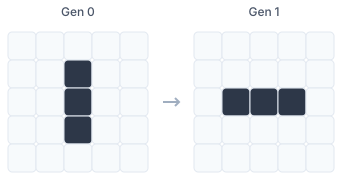
The blinker is a period-2 oscillator: three cells in a row that flip between horizontal and vertical orientations, then back again.
The block is a 2x2 square that never changes. Each live cell has exactly three neighbors, so all survive. No dead cell has exactly three live neighbors, so none are born.

The glider is the star of our show. It is a spaceship: a pattern that translates across the grid. After four generations, the glider has moved one cell diagonally.
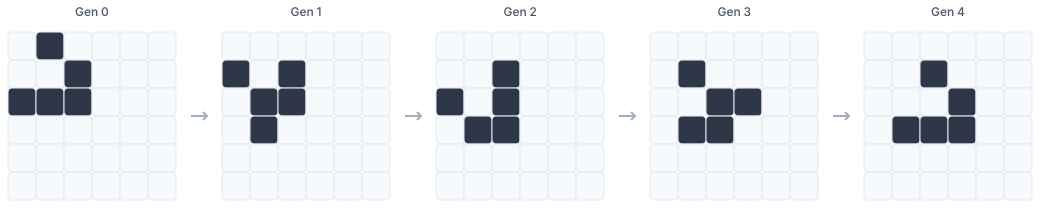
After generation 4, the pattern is identical to generation 0, but shifted one cell down and one cell right. The glider crawls across the grid forever.
-- John Conway (1937-2020) invented this cellular automaton in 1970.
def blinker : Grid := Grid.mk 5 5 fun i j =>
  (i.val, j.val) ∈ [(1, 2), (2, 2), (3, 2)]

def blinkerPhase2 : Grid := Grid.mk 5 5 fun i j =>
  (i.val, j.val) ∈ [(2, 1), (2, 2), (2, 3)]

def glider : Grid := Grid.mk 6 6 fun i j =>
  (i.val, j.val) ∈ [(0, 1), (1, 2), (2, 0), (2, 1), (2, 2)]

def gliderTranslated : Grid := Grid.mk 6 6 fun i j =>
  (i.val, j.val) ∈ [(1, 2), (2, 3), (3, 1), (3, 2), (3, 3)]

def block : Grid := Grid.mk 4 4 fun i j =>
  (i.val, j.val) ∈ [(1, 1), (1, 2), (2, 1), (2, 2)]
Here is where theorem proving earns its keep. We can prove that the blinker oscillates with period 2, that the block is stable, and that the glider translates after exactly four generations.
theorem blinker_oscillates : blinker.step = blinkerPhase2 := by native_decide

theorem blinker_period_2 : blinker.stepN 2 = blinker := by native_decide

theorem glider_translates : glider.stepN 4 = gliderTranslated := by native_decide

theorem block_is_stable : block.step = block := by native_decide
The native_decide tactic does exhaustive computation. Lean evaluates the grid evolution and confirms the equality. The proof covers every cell in the grid across the specified number of generations.
Think about what we have accomplished. We have formally verified that a glider translates diagonally after four steps. Every cellular automaton enthusiast knows this empirically, having watched countless gliders march across their screens. But we have proven it. The glider must translate. It is not a bug that the pattern moves; it is a theorem. (Readers of Greg Egan’s Permutation City may appreciate that we are now proving theorems about the computational substrate in which his characters would live.)
We can also verify that the blinker conserves population, and observe that the glider does too:
def Grid.population (g : Grid) : Nat :=
  g.foldl (fun acc row => row.foldl (fun acc cell => if cell then acc + 1 else acc) acc) 0

#eval blinker.population
#eval blinker.step.population
#eval glider.population
#eval glider.step.population
For visualization, we can print the grids:
def Grid.toString (g : Grid) : String :=
  String.intercalate "\n" <|
    g.toList.map fun row =>
      String.mk <| row.toList.map fun cell =>
        if cell then '#' else '.'

#eval IO.println blinker.toString
#eval IO.println blinker.step.toString
#eval IO.println glider.toString
#eval IO.println (glider.stepN 4).toString
The Verification Gap
Here is the sobering reality check. We have a beautiful proof that gliders translate. The Lean model captures Conway’s rules precisely. The theorems are watertight. And yet, if someone writes a Game of Life implementation in Rust, our proofs say nothing about it.
The Rust implementation in examples/game-of-life/ implements the same rules. It has the same step function, the same neighbor counting, the same pattern definitions. Run it and you will see blinkers blink and gliders glide. But the Lean proofs do not transfer automatically. The Rust code might have off-by-one errors in the wrap-around logic. It might use different integer semantics. It might have subtle bugs in edge cases that our finite grid proofs never exercise.
This is the central problem of software verification. Writing proofs about mathematical models is satisfying but insufficient. Real software runs on real hardware with real bugs. The gap matters most where the stakes are highest: matching engines that execute trades, auction mechanisms that allocate resources, systems where a subtle bug can cascade into market-wide failures. How do we bridge the gap between a verified model and a production implementation?
Verification-Guided Development
The interpreter example shows verification within Lean. But real systems are written in languages like Rust, C, or Go. How do we connect a verified specification to a production implementation?
The answer comes from verification-guided development. The approach has three components. First, write the production implementation in your target language. Second, transcribe the core logic into Lean as a pure functional program. Third, prove properties about the Lean model; the proofs transfer to the production code because the transcription is exact. This technique was developed by AWS for their Cedar policy language, and it applies wherever a functional core can be isolated from imperative scaffolding.
The transcription must be faithful. Every control flow decision in the Rust code must have a corresponding decision in the Lean model. Loops become recursion. Mutable state becomes accumulator parameters. Early returns become validity flags. When the transcription is exact, we can claim that the Lean proofs apply to the Rust implementation.
To verify this correspondence, both systems produce execution traces. A trace records the state after each operation. If the Rust implementation and the Lean model produce identical traces on all inputs, the proof transfers. For finite input spaces, we can verify this exhaustively. For infinite spaces, we use differential testing to gain confidence.
The Stack Machine
We demonstrate verification with a stack machine, the fruit fly of computer science. Like the fruit fly in genetics, stack machines are simple enough to study exhaustively yet complex enough to exhibit interesting behavior. The machine has five operations: push a value, pop the top, add the top two values, multiply them, or duplicate the top.
inductive Op where
  | push : Int → Op
  | pop : Op
  | add : Op
  | mul : Op
  | dup : Op
  deriving Repr, DecidableEq
The run function executes a program against a stack:
def run : List Op → List Int → List Int
  | [], stack => stack
  | .push n :: ops, stack => run ops (n :: stack)
  | .pop :: ops, _ :: stack => run ops stack
  | .pop :: ops, [] => run ops []
  | .add :: ops, b :: a :: stack => run ops ((a + b) :: stack)
  | .add :: ops, stack => run ops stack
  | .mul :: ops, b :: a :: stack => run ops ((a * b) :: stack)
  | .mul :: ops, stack => run ops stack
  | .dup :: ops, x :: stack => run ops (x :: x :: stack)
  | .dup :: ops, [] => run ops []
#eval run [.push 3, .push 4, .add] []
#eval run [.push 3, .push 4, .mul] []
#eval run [.push 5, .dup, .mul] []
#eval run [.push 10, .push 3, .pop] []
Universal Properties
The power of theorem proving lies not in verifying specific programs but in proving properties about all programs. Consider the composition theorem: running two programs in sequence equals running their concatenation.
theorem run_append (p1 p2 : List Op) (s : List Int) :
    run (p1 ++ p2) s = run p2 (run p1 s) := by
  induction p1 generalizing s with
  | nil => rfl
  | cons op ops ih =>
    cases op with
    | push n => exact ih _
    | pop => cases s <;> exact ih _
    | add => match s with
      | [] | [_] => exact ih _
      | _ :: _ :: _ => exact ih _
    | mul => match s with
      | [] | [_] => exact ih _
      | _ :: _ :: _ => exact ih _
    | dup => cases s <;> exact ih _
This theorem quantifies over all programs p1 and p2 and all initial stacks s. The proof proceeds by induction on the first program, with case analysis on each operation and the stack state. The result is a guarantee that holds for the infinite space of all possible programs.
Stack Effects
Each operation has a predictable effect on stack depth. Push and dup add one element; pop, add, and mul remove one (add and mul consume two and produce one). We can compute the total effect of a program statically:
def effect : Op → Int
  | .push _ => 1
  | .pop => -1
  | .add => -1
  | .mul => -1
  | .dup => 1

def totalEffect : List Op → Int
  | [] => 0
  | op :: ops => effect op + totalEffect ops

theorem effect_append (p1 p2 : List Op) :
    totalEffect (p1 ++ p2) = totalEffect p1 + totalEffect p2 := by
  induction p1 with
  | nil => simp [totalEffect]
  | cons op ops ih => simp [totalEffect, ih]; ring
The effect_append theorem proves that stack effects compose additively. If program p1 changes the stack depth by n and p2 changes it by m, then p1 ++ p2 changes it by n + m. This is another universal property, holding for all programs.
Program Equivalence
We can also prove that certain program transformations preserve semantics. Addition and multiplication are commutative, so swapping the order of pushes does not change the result:
theorem add_comm (n m : Int) (rest : List Op) (s : List Int) :
    run (.push n :: .push m :: .add :: rest) s =
    run (.push m :: .push n :: .add :: rest) s := by
  simp [run, Int.add_comm]

theorem mul_comm (n m : Int) (rest : List Op) (s : List Int) :
    run (.push n :: .push m :: .mul :: rest) s =
    run (.push m :: .push n :: .mul :: rest) s := by
  simp [run, Int.mul_comm]

theorem dup_add_eq_double (n : Int) (rest : List Op) (s : List Int) :
    run (.push n :: .dup :: .add :: rest) s =
    run (.push (n + n) :: rest) s := by
  simp [run]

theorem dup_mul_eq_square (n : Int) (rest : List Op) (s : List Int) :
    run (.push n :: .dup :: .mul :: rest) s =
    run (.push (n * n) :: rest) s := by
  simp [run]
These theorems justify program transformations. An optimizer that reorders pushes before adds is provably correct. The dup_add_eq_double and dup_mul_eq_square theorems show that push n; dup; add computes 2n and push n; dup; mul computes n². A compiler could use these equivalences for strength reduction.
What We Proved
The stack machine demonstrates verification of universal properties. We proved:
- Composition: Running concatenated programs equals sequential execution
- Effect additivity: Stack effects compose predictably
- Commutativity: Push order does not affect addition or multiplication
- Equivalences: Certain instruction sequences compute the same result
These are not tests of specific programs. They are theorems about the entire space of programs. The composition theorem alone covers infinitely many cases that no test suite could enumerate. This is the difference between testing and proving: tests sample behavior, proofs characterize it completely.
Closing Thoughts
Why do we prove properties rather than test for them? Rice’s Classes of Recursively Enumerable Sets and Their Decision Problems provides the fundamental answer: every non-trivial semantic property of programs is undecidable. You cannot write a program that decides whether other programs halt, are correct, never access null, or satisfy any interesting behavioral property. The proof reduces from the halting problem. Verification escapes this limitation by requiring human-provided proofs that the compiler can check, rather than trying to infer properties automatically.
Finding good verification examples is hard. The system must be small enough to specify cleanly, complex enough to have non-trivial properties, and simple enough that proofs are tractable. Too simple and the exercise is pointless; too complex and the proofs become intractable. The stack machine threads this needle. Six operations, a validity flag, and stack depth create enough complexity for interesting proofs without overwhelming the verification machinery.
The native_decide tactic makes finite verification automatic. For any decidable property on a finite domain, Lean evaluates both sides and confirms equality. This is proof by exhaustive computation, not sampling. The limitation is that it only works for concrete inputs. Universal statements over infinite domains require structural induction.
The key insight is that we do not verify the Rust code directly. Rust’s ownership system, borrow checker, and imperative features make direct verification impractical. Instead, we carve out the functional core, transcribe it to Lean, prove properties there, and transfer the proofs back through trace equivalence. The verification gap closes not through tool support, but through disciplined transcription and differential testing.
The techniques scale far beyond toy examples. Financial systems are a particularly compelling domain: matching engines, auction mechanisms, and clearing systems where bugs can trigger flash crashes or expose participants to unbounded losses. Expressive bidding, where market orders encode complex preferences over combinations of instruments, requires solvers for NP-hard optimization problems with precise economic properties. These mechanisms must satisfy strategy-proofness and efficiency; the theorems exist in papers, and the implementations exist in production. Verification-guided development bridges them. Somewhere, proven-correct code is already running markets.