The Prism Language Specification
Prism is a strict, impure functional language in the ML family whose type system tracks side effects. This document is a Modest Proposal of the language as the prism compiler accepts it: its lexical structure, grammar, type system, and evaluation.
0. Goals
- Take deterministic simulation testing down to the language level: a deterministic core, typed effects, content-addressed identity, and replayable observations make every output an accountable artifact that can be mechanically rebuilt, moved, cached, diffed, audited, and explained using modern type-system methods.
- Lineage is the user-facing form of determinism: given an output, Prism should be able to precisely describe and check what code, packages, inputs, effects, handlers, and compiler artifacts produced it.
- The so-called “real world” meets Prism only at effect boundaries: every nondeterministic observation is named, typed, handled, and therefore available to record, replay, sandbox, or audit. The unfortunate existence of the physical world should be constrained by types.
- Obtain pure functional language nirvana by being completely inaccessible, utterly useless, completely divorced from the real world, and having zero users.
1. Introduction
A Prism program is a set of modules, each a file of declarations. The surface language elaborates to a strict, call-by-push-value core (Levy, 2004) in A-normal form (the companion Compiler document), compiles to native code through LLVM or the optional MLIR backend, and is managed by deterministic reference counting rather than a garbage collector.
Three things distinguish Prism from its ML and Haskell ancestors. It is strict, with laziness opt-in through thunks over a call-by-push-value core, so evaluation and effect order are left to right and explicit. Side effects are inferred as extensible effect rows (effects and handlers) that combine structurally across calls instead of through monads and track both observability and capability effects (capability effects and IO): an operation handled inside a function does not appear in its type, so internally effectful code is reused as pure, and a function that reads the outside world names the part it reads (Console, FileSystem, Random, Entropy, Env, Clock) rather than a blanket IO. The same reference-count discipline both frees memory and performs fully-in-place (FBIP) update (declarations and programs), compiling record updates and derived setters to in-place writes on uniquely owned values (those that a reference count proves have no other live reference; see reference counting and FBIP reuse). Beyond these, the language provides isolated fibers through handlers, failure as ordinary typed control flow, record and replay of a program’s interaction with the world over the capability effects (record and replay), derived lenses and use-site optic paths for deeply nested structure traversal and update (optic paths), fusing stream combinators (streams), unboxed types (unboxed products), and checked usage contracts on closures (coeffects).
The deterministic core gives programs a stable identity: a definition is named by the hash of its canonical Core form, after alpha-normalizing binders so alpha-equivalent definitions share an identity and behavior-visible Core changes do not (content-addressed core).1 The same rule extends to execution: a suspended continuation is a kont envelope whose bundle digest names the code it may resume against (the kont envelope), and replayability supplies the byte-identical observable contract (suspend and resume).
This specification proceeds in dependency order: notation, lexical structure, grammar, types, then the constructs the grammar describes.
2. Notation
Grammar is given in the following EBNF. A terminal is a literal token written in double quotes; a nonterminal is a lower-case name. The character classes are the ASCII letters (letter), the two cases (lower, upper), the decimal digits (digit), any printable character (graphic), and any character other than ", \, or a newline (strchar). These are primitives, not grammar nonterminals.
x  y      juxtaposition: x followed by y
x | y     alternative: x or y
[ x ]     option: zero or one x
{ x }     repetition: zero or more x
( x )     grouping
"fn"      a terminal (literal token), in double quotes
varid     a nonterminal, in lower case
x , ...   a comma-separated list of one or more x
Identifiers in productions name the tokens defined in the lexical structure (varid, conid, qualid, integer, float, char, string) and the character classes defined just above. The layout algorithm inserts block delimiters that the grammar then treats as ordinary terminals.
3. Lexical Structure
Source text is UTF-8. Tokens are lexed by longest match, then the stream is rewritten by the layout algorithm. Whitespace and comments separate tokens and are otherwise insignificant except as layout boundaries.
varid    ->  (lower | "_") { idchar }
conid    ->  upper { idchar }
qualid   ->  conid "." ident { "." ident }
ident    ->  varid | conid
idchar   ->  letter | digit | "_"

integer  ->  digits [ "i64" | "u64" ]
float    ->  digits "." digits [ exponent ]
          |  digits exponent
exponent ->  ( "e" | "E" ) [ "+" | "-" ] digits
-- A digit separator "_" is admissible only flanked by two digits, so leading,
-- trailing, doubled, and adjacent-to-"."/"e" separators are rejected. Exponent
-- notation always denotes a float; the exponent sign lives in the lexer and does
-- not collide with the unary-minus operator.
digits   ->  digit { [ "_" ] digit }
char     ->  "'" ( graphic | escape | "\\'" ) "'"
string   ->  cooked | raw
cooked   ->  "\"" { strchar | escape | interp } "\""
interp   ->  "{" expr "}"
escape   ->  "\\" ( "n" | "t" | "r" | "\\" | "{" | "}" | "\"" )
comment  ->  "--" { any character other than newline }

-- A raw string spans lines and takes its body verbatim: no escapes, no
-- interpolation, and no way to write the closing delimiter inside it. The
-- newline each delimiter sits against is not part of the text, and the
-- indentation every non-blank line shares is the source's, not the string's.
raw      ->  "r\"\"\"" { any character, up to the first "\"\"\"" } "\"\"\""

-- An interpolated string "a{e}b{e}c" is lexed into the pieces below, each
-- carrying its literal segment; the holes are re-lexed as expressions.
istart   ->  "\"" { strchar } "{"
imid     ->  "}" { strchar } "{"
iend     ->  "}" { strchar } "\""

-- Virtual layout tokens, synthesized by the offside pass; no source spelling.
vopen    ->  "v{"   -- start of an indented block
vclose   ->  "v}"   -- end of an indented block
vsep     ->  "v;"   -- a newline at the same column (item / statement separator)
3.1 Identifiers
Prism distinguishes identifiers by initial case. A varid begins with a lower-case letter or underscore and names a variable, function, parameter, or record field. A conid begins with an upper-case letter and names a type, data constructor, type class, or effect. A qualid is a dotted path such as Data.Map or Map.insert; it is lexed as a single token so that a module path never collides with field access.
3.2 Keywords
The following are reserved and may not be used as identifiers.
fn | fip | fbip | pub | import |
as | type | newtype | opaque | alias |
effect | error | throw | try | catch |
transact | class | instance | pattern | deriving |
where | given | handle | with | handler |
mask | val | return | let | var |
borrow | in | for | do | if |
then | else | elif | match | of |
forall | true | false | while | loop |
break | continue | using | canonical | replayable |
each | probe | stable | logic | requires |
ensures |
A second set of words is contextual: each names a construct only in one grammatical position and stays a valid identifier everywhere else, so no program is broken by one becoming meaningful. They are never reserved.
| Word | Contextual position |
|---|---|
total, assume | a totality claim in the declaration-modifier position before fn |
never, once, many | a resumption grade in an operation declaration; never/once also prefix handler clauses |
view, make | the forward and constructor clauses of a pattern declaration |
resume | the continuation binder in a multishot handler clause |
partial | the handle ... with partial incomplete-handler form |
deprecated | an annotation line preceding a declaration |
test | a test declaration in the modifier position before fn |
decreases | the ranking-measure clause of a total fn |
frozen | a committed shape digest after a stable rung |
upgrade, downgrade | stable converter directions and migration route fields |
drop_loss | the acknowledged field-loss list after a downgrade converter |
migrations | the migration-route table inside a stable block |
auto, version | derived and explicit routes inside a migration table |
reflect | the reflect fn and reflect type quotation forms |
path | the optic-literal head after # |
Type, Row, Nat | kind names in a data-type parameter annotation |
The built-in type names Int, I64, U64, Bool, Unit, Float, Char, and String are also reserved. Prelude effect names such as Console, FileSystem, Random, Entropy, Env, and Output are ordinary library names, not lexical keywords (capability effects). Preempt and Net are a narrower semantic reservation: the words still lex as identifiers, but user effect declarations with those names are rejected so the unshipped runtime seams cannot be given an incompatible meaning.
3.3 Operators and Punctuation
The operator set is fixed; the language has no user-defined operators. Arithmetic and comparison use one plain spelling per operation across the numeric lanes. The retired floating-point dot forms are still lexed only so the parser can issue a pointed removal diagnostic; they are not operators or deprecated aliases (deprecation). Exponentiation ^ is a single operator over both Int and Float (exponentiation).
| Class | Operators |
|---|---|
| Arithmetic | + - * / % ^ |
| Comparison | == /= < <= > >= |
| Logical | && || |
| Pipeline | |> >> << |
| Failure | ?? ?. ? |
| List | :: |
| Arrows | -> <- => |
| Binding | = := : and compound += -= *= %= |
| Effect | ! |
| Brackets | ( ) { } [ ] |
| Other | , . .. | \ @ # ~ |
3.4 Literals
An integer is a run of decimal digits, optionally grouped by underscore separators (1_000_000) that are cosmetic and carry no value. A value that fits in a machine word is an immediate; a larger literal is an arbitrary-precision integer (bignum). The suffix i64 or u64 selects a fixed-width 64-bit lane that wraps on overflow. A float is an IEEE-754 double, written with a fractional part (1.5), an exponent (1e25, 1.5e3), or both; the exponent may be signed (1e-25, 1E25) and separators are admitted in its mantissa and exponent on the same rule. Exponent notation always denotes a Float. A separator is valid only between two digits, so a leading, trailing, doubled, or ./e-adjacent underscore is a lexical error. A char is a single Unicode scalar in single quotes. A string is double-quoted UTF-8.
There are no negative literals at the lexical level: a leading minus is the unary-minus operator (operator precedence), so -5, -5i64, and -1.5 are - applied to the literal. -5u64 is rejected because negation is undefined on the unsigned lane, and the exponent sign lives inside the float token, so it never collides with that operator.2 The formatter preserves a writer’s separator grouping verbatim.
The escape sequences \n, \t, \r, \\, \", \{, and \} are recognized in both character and string literals; a character literal additionally accepts \'.
A string may also be written raw: r""" opens it and the next """ closes it. The body is taken verbatim, so no escape is recognized and no brace opens a hole, and a block of code, a pattern, or a document embedded in a program needs no doubling to survive being quoted. Two rules make the block read on the page as it reads in the value. The newline each delimiter sits against belongs to the delimiter rather than to the text, and the indentation every non-blank line shares is the source’s rather than the string’s, so a literal indented to match the code around it denotes the same string wherever that code moves. A line indented past the shared margin keeps the difference, a blank line keeps nothing, and a value ending in a newline is spelled by leaving a blank line above the closing delimiter.
fn main() =
  println(r"""
    { "escapes": "none", "holes": "none" }
    """)
{ "escapes": "none", "holes": "none" }
What the two spellings produce is one String and nothing distinguishes them afterwards; the raw form is a way of writing a literal, not a kind of value. A raw body cannot contain """ and has no escape with which to spell one, so a string that needs the delimiter is written in the quoted form. The formatter reprints a raw literal exactly as written, on the same reasoning that keeps a writer’s digit grouping: re-escaping the block onto one line would be a different spelling of the same value, and the shape is why the form was chosen.
3.5 String Interpolation
Within a string, an unescaped { expr } is an interpolation hole. The hole text is re-lexed at its source position and elaborated as an expression whose type-directed display is spliced into the string; a top-level string is spliced in raw, not quoted the way the Show method renders it. A hole runs to its matching }, balancing nested braces and string literals, so a hole may itself contain a string with braces. A literal brace outside a hole is written \{ or \}. An empty hole, an unterminated hole, and an unterminated string are each lexical errors. A raw literal has no holes at all, so a brace in its body is a brace. The catch arms of the error example under errors and failure use interpolation, as in "no such key: {k}".
3.6 Comments
A comment runs from -- to the end of the line; there is no block-comment form. Comments are trivia: they separate tokens and are otherwise insignificant, except that a -- inside a string or character literal is ordinary text rather than a comment, and the formatter preserves a comment and re-emits it attached to the token it preceded. A doc comment is the ordinary line form spelled -- |; the API doc generator harvests it, but the lexer treats it as any other comment.
3.7 Layout
Prism uses the offside rule: indentation, not explicit braces, delimits a block. A layout block opens after any of the keywords or symbols =, then, else, =>, of, with, handler, do, where, try, catch, transact, loop, and after fn (a while block opens at its do). A class, instance, or effect body opens the same way, but after the head rather than a keyword: the head ends the line and the members follow as its indented block. The first token after such an opener sets the block’s indentation column; a later line at that column starts a new item in the block, and a line indented less closes the block. Literal braces do not replace a general expression block. They delimit only the constructs that own them, such as records, path updates, stable blocks, and the brace form of handler, match, and catch arm lists (as in the masking example). A class, instance, or effect body is layout-only, and a brace opening one is a parse error that names the layout rewrite.
3.8 Declarations
A program is a layout-delimited sequence of top-level declarations, each introduced by a reserved word that fixes its shape. The table names the introducer and where the construct is specified; the formal grammar is in Surface Grammar.
| Introducer | Declares | Specified in |
|---|---|---|
fn | a function; a body, an optional result type and effect row, given, where | declarations and programs |
let | a top-level constant binding | declarations and programs |
type | an algebraic data type or record | algebraic data types |
newtype | a single-constructor, zero-cost wrapper | algebraic data types |
alias | a type synonym or a row alias | types |
class | a type class and its method signatures | type classes |
instance | an instance of a class at a type | coherence and resolution |
canonical | the canonical instance at a head that has more than one | coherence and resolution |
effect | an effect and its operations | effects and handlers |
error | an error constructor | errors and failure |
pattern | a bidirectional pattern synonym | patterns |
stable | a serializable type’s frozen version history | stable blocks |
A head may carry modifiers. pub exports the declaration to importers; opaque on a type exports the name but not its constructors (modules); test marks a test declaration, total or assume total states a totality claim, logic makes a proof-level function, the fip and fbip prefixes assert an allocation discipline, and replayable bounds a function’s effects. A function result may carry the checked declaration claims @ noalloc, @ linear, and @ bounded_stack. A function may also carry requires, ensures, and a final decreases clause before =. A deprecated "..." line marks the following declaration superseded (deprecation). The let and var binding forms (the latter mutable) also appear inside expression bodies, where only the local forms admit var; a top-level binding is let only.
A trailing where block attaches non-recursive local helpers below a function body, each binding scoped over the ones after it and over the body:
fn quadratic(a : Float, b : Float, c : Float) : (Float, Float) =
    ((-b + d) / two_a, (-b - d) / two_a)
  where
    d = sqrt(b * b - 4.0 * a * c)
    two_a = 2.0 * a
3.9 Modules and Imports
A file is a module and a dotted path names one in the source tree: import Data.Map loads Data/Map.pr. The surface forms are below; visibility, opaque exports, and project layout are specified in modules.
| Form | Effect |
|---|---|
import M | brings M’s exports into scope under qualified names (M.name) |
import M (a, b) | additionally brings a and b into bare scope |
import M (..) | brings every export of M into bare scope |
import M as N | adds the alias N for qualified access (N.name) |
pub import M (x) | re-exports x through the importing module |
A qualid such as Map.insert is a single token (identifiers), so a qualified name never lexes as field projection. The pub modifier on any declaration makes it visible to importers; a declaration without it is private to its module.
Bringing a name into bare scope offers it; it does not commit to it. Two imports may offer the same short name, and an import never fails on that account: the clash is reported only where a bare use actually has to choose between them, and qualifying that one use resolves it. Modules gives the full order in which a bare name is looked up.
4. Surface Grammar
A program is a layout-delimited sequence of top-level declarations.
program   ->  { topdecl }                       -- separated by layout

topdecl   ->  [ deprecated ] [ "pub" ] item
           |  [ deprecated ] "opaque" ( datatype | newtype )
deprecated -> "deprecated" string               -- annotation line: marks the next item superseded ("deprecated" is contextual, not reserved)
item      ->  import | datatype | newtype | synonym | rowalias
           |  classdecl | instancedecl | canonicaldecl | effectdecl
           |  errordecl | patterndecl | stabledecl | constdecl | fundecl

import    ->  "import" modpath [ "as" conid ]
                [ "(" ( [ name , ... ] | ".." ) ")" ]
modpath   ->  conid { "." conid }
name      ->  varid | conid

datatype  ->  "type" conid [ kindedvars ] "=" ctorsrhs
newtype   ->  "newtype" conid [ tyvars ] "=" ctor [ deriving ]
synonym   ->  "alias" conid [ tyvars ] "=" type
rowalias  ->  "alias" conid "=" "{" [ label , ... ] "}"
tyvars    ->  "(" varid , ... ")"
kindedvars -> "(" tyvar , ... ")"               -- a data-type parameter may carry a kind
tyvar     ->  varid [ ":" kind ]
kind      ->  "Type" | "Row" | "Nat"            -- "Row" ranges over an effect row, "Nat" over a dimension
ctorsrhs  ->  ctor { "|" ctor } [ deriving ]
           |  vopen ctor { [ vsep ] "|" ctor } [ [ vsep ] deriving ] vclose
ctor      ->  conid [ "(" typearg , ... ")" ]
           |  conid "{" [ field , ... ] "}"
field     ->  varid ":" type
deriving  ->  "deriving" "(" [ conid , ... ] ")"

constdecl ->  "let" varid [ ":" type ] "=" body
fundecl   ->  [ "logic" ] [ "test" ] [ [ "assume" ] "total" ] [ "replayable" ] [ "fip" | "fbip" ]
                "fn" varid "(" [ param , ... ] ")"
                [ retann ] [ given ] { requires } { ensures } [ decreases ] "=" body [ wheres ]
                -- a usage row spelling exactly "@ noalloc" at the root of the
                -- return annotation is the declaration's allocation certificate;
                -- "logic fn" is a proof-level (SMT) declaration, never a runtime fn;
                -- "test" and "total"/"assume" are contextual
                -- declaration modifiers, not reserved words, so all three stay
                -- usable as ordinary identifiers everywhere else
param     ->  [ "borrow" ] pattern [ ":" type ] [ ":=" expr ]
                -- a bare varid (or "_") is the ordinary named parameter and binds
                -- without testing; any other pattern is matched around the body and
                -- must be irrefutable, so it has no name to pass by keyword
retann    ->  ":" type [ decleff ]              -- result first, e.g. `: Int ! {State}`
decleff   ->  "!" "{" [ label , ... ] [ "|" varid ] "}"
           |  "!"                                -- an explicit empty effect row
given     ->  "given" constraint , ...
requires  ->  "requires" expr                    -- an SMT precondition clause
ensures   ->  "ensures" "|" varid "|" expr       -- an SMT postcondition over the result binder
decreases ->  "decreases" expr                    -- contextual; a ranking measure for a total fn
constraint -> conid "(" type ")"
wheres    ->  "where" vopen [ wherebind { vsep wherebind } ] vclose
wherebind ->  varid "=" body
-- Class, instance, and effect bodies are layout blocks (no `where`, no braces):
-- the head ends the line and the members follow on indented lines. A brace here
-- is a parse error. A marker class or its instance has no members, so the body is
-- absent and the declaration is its bare head.
classdecl    ->  "class" conid "(" varid ")" [ given ] [ vopen [ sig { armsep sig } ] vclose ]
instancedecl ->  "instance" varid ":" conid "(" type ")" [ given ]
                   [ vopen [ fundecl { armsep fundecl } ] vclose ]
canonicaldecl -> "canonical" conid "(" type ")" "=" varid
sig          ->  varid ":" type

effectdecl   ->  "effect" conid [ tyvars ] vopen [ effop { armsep effop } ] vclose
effop        ->  [ grade ] varid "(" [ effparam , ... ] ")" ":" type
effparam     ->  type | varid ":" type             -- a binder name is accepted but not retained
grade        ->  "many" | "once" | "never"        -- many is the unmarked default
armsep       ->  "," | vsep
errordecl    ->  "error" conid [ "(" typearg , ... ")" ]

patterndecl  ->  "pattern" conid "(" [ varid , ... ] ")" "for" conid "=" patclauses
patclauses   ->  patclause | vopen patclause { vsep patclause } [ vsep ] vclose
patclause    ->  ( "view" | "make" ) expr

-- A `stable` block declares a serializable type's frozen version history:
-- the rungs and migration routes, plus hand-written converters for the type
-- mutations the compiler cannot generate. Real braces, so entries are
-- comma-separated. "frozen", "upgrade", "downgrade", and "drop_loss" are
-- contextual, recognized positionally inside the block rather than reserved.
stabledecl   ->  "stable" conid "{" [ stableitem , ... ] "}"
stableitem   ->  rung | converter | migrations
rung         ->  conid "=" "{" [ ".." conid { "," rungfield }
                                | rungfield { "," rungfield } ] "}" [ "frozen" string ]
rungfield    ->  varid ":" type [ "=" expr ]     -- an additive field carries a default
converter    ->  ( "upgrade" | "downgrade" ) conid "->" conid "="
                   "{" ".." expr { "," varid "=" expr } "}" [ "drop_loss" "(" [ varid , ... ] ")" ]
migrations   ->  "migrations" "{" { migration } "}"
migration    ->  conid "->" conid "=" migrateroute
migrateroute ->  "auto"
              |  "version" "(" "upgrade" "=" migdir ","
                   "downgrade" "=" migdir [ "," ] ")"
migdir       ->  expr                                -- a bare varid `auto` is normalized to the derived route
Type syntax. A function type carries an optional effect row on its codomain (effects and handlers); the row binds to a function type only.
type    ->  "forall" varid { varid } "." type
         |  funarrow [ row ]                    -- row applies only to a function type
         |  utype
arrow   ->  funarrow | utype
funarrow -> "(" [ type , ... ] ")" "->" arrow   -- n-ary domain
          | utype "->" arrow                    -- single domain
utype   ->  atype [ "@" usagerow ]              -- usage (coeffect) row on an atomic type
usagerow -> varid                               -- single-fact sugar: T @ noalloc
         |  "{" varid , ... "}"                 -- fact set, canonical order alphabetical
                                                    -- an open `@ {fact | tail}` is reserved but rejected
atype   ->  scalar
         |  "[" type "]"                          -- List(type)
         |  ( conid | qualid ) [ "(" typearg , ... ")" ] -- type constructor
         |  varid [ "(" typearg , ... ")" ]       -- variable, possibly applied
         |  "(" type ")"
         |  "(" type "," [ type , ... ] ")"       -- tuple (including a one-tuple)
         |  "#" "(" [ type , ... ] ")"            -- unboxed tuple
         |  "#" "{" [ field , ... ] "}"           -- unboxed record
typearg ->  type
         |  rowlit                                -- argument for a Row-kinded parameter
         |  digits                                 -- dimension literal for a Nat-kinded parameter, e.g. Vec(Int, 3)
rowlit  ->  "{" [ label , ... ] [ "|" varid ] "}" -- effect-row literal, e.g. Cmd(Int, {IO})
scalar  ->  "Int" | "I64" | "U64" | "Bool" | "Unit" | "Float" | "Char" | "String"

row     ->  "!" "{" [ label , ... ] [ "|" varid ] "}"
         |  "!"                                   -- empty row, effectful position
label   ->  ( varid | conid | qualid ) [ "(" typearg , ... ")" ]
Expressions, patterns, and the handler block of handle/try (used in effects and handlers).
body    ->  expr | block
block   ->  vopen stmts vclose
stmts   ->  expr
         |  expr vsep stmts
         |  "if" expr "then" body { [ vsep ] "elif" expr "then" body }
                [ vsep stmts ]                       -- an open if need not have an else
         |  "let" varid "=" expr [ "in" ] vsep stmts
         |  "let" varid "=" block vsep stmts
         |  "let" letpat "=" expr [ "in" ] vsep stmts
         |  "let" letpat "=" block vsep stmts
         |  "let" letpat "=" expr [ vsep ] "else" body vsep stmts
         |  "let" letpat "=" block vsep "else" body vsep stmts
         |  "var" varid [ ":" type ] ":=" expr vsep stmts
         |  "with" [ varid "<-" ] "handler" handler vsep stmts
         |  "with" [ varid "<-" ] appexpr vsep stmts

expr    ->  "if" expr "then" body { [ vsep ] "elif" expr "then" body }
                [ vsep ] "else" body
         |  "let" ( varid | letpat ) "=" expr "in" expr
         |  "\\" "(" [ param , ... ] ")" "->" expr  -- lambda
         |  "match" expr "of" matcharms
         |  "handle" expr "with" [ "partial" ] handler
         |  "throw" conid [ "(" expr , ... ")" ]
         |  "try" body [ vsep ] "catch" catcharms
         |  "transact" body [ vsep ] "else" body
         |  "for" gen { "," qual } "do" body
         |  "while" expr "do" body                    -- while loop
         |  "loop" body                               -- unconditional loop
         |  "probe" string "do" body                  -- named instrumentation; body runs only when enabled
         |  "reflect" ( "fn" | "type" ) ( ident | qualid ) -- quote a declaration of this file as a string
         |  "return" expr                             -- early return
         |  lvalue ":=" expr                          -- assignment
         |  lvalue ( "+=" | "-=" | "*=" | "%=" ) expr  -- compound assignment
         |  opexpr

opexpr  ->  opexpr binop opexpr                      -- binop and binding per 4.1
         |  negexpr
negexpr ->  "-" negexpr                              -- unary minus, "tight prefix":
                                                     -- looser than application and
                                                     -- exponentiation, tighter than the
                                                     -- remaining binops
         |  powexpr
powexpr ->  appexpr [ "^" negexpr ]                  -- exponentiation is right-associative
appexpr ->  appexpr "(" [ arg , ... ] [ "using" iname , ... ] ")"
                                                     -- application; `using` selects instances
         |  appexpr "(" [ arg , ... ] ")" "fn" trailerparams block
                                                     -- trailing lambda argument
         |  appexpr "[" expr [ "," expr , ... ] "]" -- indexed or multi-indexed read
         |  appexpr "." varid                         -- field access
         |  appexpr "." "#" varid                    -- unboxed-field access
         |  appexpr "." "[" path "]"                -- collect a path's foci
         |  appexpr "." varid "(" [ expr , ... ] ")" -- method call (UFCS)
         |  appexpr "." varid "(" [ expr , ... ] ")" "fn" trailerparams block
         |  appexpr "." varid "fn" trailerparams block
         |  appexpr "?." varid                        -- optional chaining
         |  appexpr "?"                               -- try marker
         |  atom
arg     ->  [ varid ":=" ] expr                      -- an argument may be passed by name
iname   ->  varid                                     -- an instance name
trailerparams -> [ "(" param { "," param } ")" ]
atom    ->  integer | float | char | string | "true" | "false" | "(" ")"
         |  "break" | "continue"                      -- loop control
         |  "?" varid                                  -- named typed hole
         |  "error" "(" [ expr , ... ] ")"           -- the panic builtin remains callable
         |  varid | conid | qualid
         |  "(" expr ")" | "(" expr ":" type ")"
         |  "(" expr "," [ expr , ... ] ")"           -- tuple (including a one-tuple)
         |  "#" "(" [ expr , ... ] ")"                -- unboxed tuple
         |  "#" "{" [ fieldval , ... ] "}"            -- unboxed record
         |  "[" [ expr , ... ] "]"                    -- list
         |  "[" expr { "," expr } ".." expr "]"      -- arithmetic range
         |  "[" expr "for" gen { "," qual } "]"       -- comprehension
         |  conid "{" [ fieldval , ... ] "}"          -- record
         |  conid "{" ".." expr { "," fieldval } "}" -- record update
         |  "{" expr "|" pathupdate , ... "}"        -- path update
         |  "#" "path" ( varid { "." varid }
                         | conid "." varid { "." varid } ) -- path literal; an uppercase head anchors its type
         |  "mask" "<" conid ">" "(" expr ")"

arm      ->  pattern [ "if" expr ] "=>" body
matcharms -> "{" [ arm { armsep arm } ] "}"
           | vopen [ arm { armsep arm } ] vclose
gen      ->  varid "in" expr
qual     ->  "if" expr | "let" varid "=" expr
fieldval ->  varid "=" expr                          -- a record field binding
path     ->  pathseg { "." pathseg }                 -- a nested field path
pathseg  ->  varid | "each" | "?" ( conid | qualid ) -- field step, bulk map over a collection, or case-narrowing step
          |  pathseg "[" expr "]"                      -- indexed step
          |  "(" path "where" expr ")"                 -- filtered traversal
          |  "[" expr "]" { "[" expr "]" }            -- a path may begin with an index
pathupdate -> path ( "=" | "~" | "+=" | "-=" | "*=" | "%=" ) expr
lvalue   ->  varid { "." varid | "[" expr [ "," expr , ... ] "]" }
          |  "get" "(" ")" ( "." varid | "[" expr [ "," expr , ... ] "]" )
                { "." varid | "[" expr [ "," expr , ... ] "]" }
binop    ->  "??" | "|>" | ">>" | "<<" | "||" | "&&" -- binding given in 4.1
         |  "==" | "/=" | "<" | "<=" | ">" | ">=" | "</>" | "::"
         |  "+" | "-" | "*" | "/" | "%"
pattern  ->  patcons { "|" patcons }                 -- alternation: any alternative matches
patcons  ->  patalt [ "::" patcons ]                 -- cons: `h :: t` is `Cons(h, t)`
patalt   ->  conid [ "(" pattern , ... ")" ]         -- constructor
          |  qualid [ "(" pattern , ... ")" ]        -- qualified constructor
          |  conid "{" [ fieldpat { "," fieldpat } [ "," ".." ] | ".." ] "}"
                                                       -- record fields may pun; ".." is trailing
          |  varid                                    -- variable binding
          |  "_"                                      -- wildcard
          |  integer | float | char | "true" | "false"
          |  "-" ( integer | float )                  -- negative literal

          |  "[" [ pattern , ... ] "]"                -- list
          |  "(" pattern "," [ pattern , ... ] ")"   -- tuple (including a one-tuple)
fieldpat ->  varid [ "=" pattern ]                    -- a bare field is a pun
letpat   ->  ( conid | qualid ) [ "(" pattern , ... ")" ] -- a `let` destructures with a
          |  "(" pattern "," [ pattern , ... ] ")"   -- constructor, tuple, list, or cons
          |  "[" [ pattern , ... ] "]"                -- pattern only, and admits no
          |  patalt "::" patcons                     -- alternation; it may be refutable
                                                     -- only under `else`
handler   ->  "{" [ hclause , ... ] "}"
           |  vopen [ hclause { armsep hclause } ] vclose

hclause   ->  "return" varid "=>" body                 -- result transform
           |  varid "(" [ varid , ... ] ")" "resume" varid "=>" body  -- multishot op: continuation after `resume`
           |  "once" varid "(" [ varid , ... ] ")" "=>" body -- tail-resumptive sugar
           |  "never" varid "(" [ varid , ... ] ")" "=>" body -- non-resumable
           |  "val" varid "=" body                     -- install-time constant

catcharm  ->  conid [ "(" varid , ... ")" ] "=>" body
catcharms ->  "{" [ catcharm , ... ] "}"
            | vopen [ catcharm { armsep catcharm } ] vclose
4.1 Operator Precedence
The table gives the binding of each operator, loosest to tightest. Levels 1 to 10 are binary operators looser than unary minus; exponentiation at level 12 binds tighter than it, and level 13 is application, field access, and the postfix failure operators. Unary minus is a tight prefix below application and projection but above multiplication, so -f(x) is -(f(x)), -x * y is (-x) * y, and a leading f -x is the binary f - x (there is no juxtaposition application; write f(-x)). Exponentiation follows the mathematical convention: -x ^ y is -(x ^ y), and a negative base needs parentheses.
| Level | Operators | Associativity |
|---|---|---|
| 1 | ?? | right |
| 2 | |> | left |
| 3 | >> << | left |
| 4 | || | left |
| 5 | && | left |
| 6 | == /= < <= > >= | none |
| 7 | </> | left |
| 8 | :: | right |
| 9 | + - | left |
| 10 | * / % | left |
| 11 | prefix - (unary minus) | prefix |
| 12 | ^ | right |
| 13 | f(...) a[i] .field ?.field ? | left |
The list operator h :: t is Cons(h, t). It groups to the right, so x :: y :: rest is x :: (y :: rest), and it sits between arithmetic and comparison, so n + 1 :: xs == ys compares the extended list.
The path operator a </> b is the PathJoin method path_append(a, b). It groups to the left, so root() </> dir </> name builds outward from the left operand, and it sits just below ::. The prelude declares the class and Path gives the one instance; the operator is not defined on strings or numbers.
5. Functions
Prism is a functional language, so functions are kind of a big deal. Functions are values: they may be named, passed as arguments, returned from other functions, captured by lambdas, and combined into new functions.
5.1 Top-Level Definitions
A top-level function definition begins with fn, followed by its name, parameters, optional result annotation, and body. Parameters and results are inferred when their annotations are omitted. A top-level let names a constant rather than a callable function; both forms are visible throughout their module, subject to the module visibility rules.
let greeting = "Hello"

fn greet(name : String) =
  println("{greeting}, {name}!")

fn main() = greet("Prism")
Hello, Prism!
5.2 Lambdas
A lambda is an anonymous function written \(parameters) -> body. A lambda closes over names in its surrounding lexical scope, so it can carry both behavior and captured data as a value.
fn main() =
  let offset = 2
  let add_offset = \(x) -> x + offset
  println(add_offset(40))
42
5.3 Let Statements
A let evaluates its right-hand side strictly, binds the resulting value, and makes the name available to the rest of the enclosing layout block. Bindings shadow outer names and may destructure values with a pattern. The expression form, let name = value in body, is useful where a layout block would be awkward; consecutive layout statements elaborate to the same right-nested let structure.
fn main() =
  let answer = let width = 6 in let height = 7 in width * height
  println(answer)
42
A pattern binding may carry an else clause, let pat = value else fallback. The binding is then allowed to be refutable: when the pattern matches, its names are in scope for the rest of the block as usual; when it does not, the block stops there and fallback is its value. So the fallback has the type the rest of the block would have had, and the whole form is exactly the two-arm match a reader would otherwise write by hand, with the same evaluation order and the same effect row. The fallback fits on the binding’s line when it is short and otherwise lays out as a block under its own else. A pattern that cannot fail leaves the fallback unreachable and is reported as the unreachable arm it is.
fn plus_one(o : Option(Int)) : Int =
  let Some(x) = o else 0
  x + 1

fn main() =
  println(plus_one(Some(41)))
  println(plus_one(None))
42
0
5.4 Function Composition
The forward composition f >> g produces \(x) -> g(f(x)); backward composition g << f denotes the same function while reading from the result back toward the input. The pipe value |> f applies an existing value to a function. Composition binds more tightly than the pipe, so a complete dataflow can be read from left to right.
fn increment(x : Int) : Int = x + 1

fn double(x : Int) : Int = x * 2

fn main() =
  let forward = increment >> double
  let backward = increment << double
  println(forward(10))
  println(backward(10))
  println(10 |> increment >> double)
22
21
22
The three composition forms are described in full alongside method calls, including their precedence and relationship to UFCS chains.
6. Types and Kinds
Prism infers types by the bidirectional, higher-rank inference algorithm of Dunfield & Krishnaswami (2013). An unannotated declaration infers its principal type; an annotated one is checked against the annotation. Annotations are required for rank-N polymorphism, since a nested forall cannot be inferred.
Quantification is predicative: a type-constructor argument and an inferred type variable range over monomorphic types, so a forall may not be written directly as a type argument (List(forall a. (a) -> a) is rejected as impredicative). Higher-rank types are allowed wherever they are not a type argument, namely as a function parameter, a function result, and a declared data field; a polymorphic value can be carried through a generic container by wrapping it in a data type with a polymorphic field.
6.1 Three Posets
A poset (partially ordered set) is a set equipped with a reflexive, antisymmetric, and transitive order. A lattice is a poset in which every pair has both a least upper bound (a join) and a greatest lower bound (a meet). A Prism signature carries three posets: what a computation may do (the effect row, after !), how its values may be used (the usage row, after @), and how a handler may consume a continuation (the operation grade). Effect rows and operation grades are lattices: effect rows are finite multisets whose join and meet take the pointwise maximum and minimum label counts, while grades form a total chain. Coeffect axes are not lattices in general because some conflicting facts have no meet.
Effect rows: joins always exist. The carrier is a finite multiset of effect labels, ordered by each label’s multiplicity; the join takes the pointwise maximum. Ordinary sequencing stays in the zero-or-one slice shown below, while mask raises one label’s count to record an additional enclosing handler obligation:
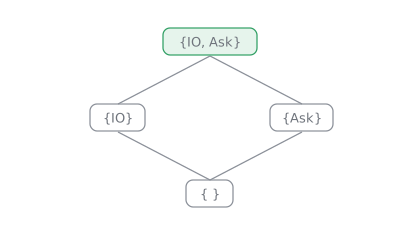
Sequencing takes the join; handling subtracts back toward the pure bottom:
effect Ask
  once ask() : Int

fn f() : Unit ! {IO} = println("f")

fn g() : Int ! {Ask} = ask()

fn foo() : Int ! {IO, Ask} =
  f()
  g()

fn bar() : Int ! {IO} =
  handle foo() with
    once ask() => 7

fn main() = println(bar())
foo sequences f and g, so its row is their join; bar handles one occurrence of Ask, so its row steps back down to {IO}.
Coeffect axes: meets sometimes missing. Each axis (coeffects) has silence at the top, the mode of all unannotated code. An exclusive axis has no meet below its points; the fip axis is a product of chains, so its meet exists:
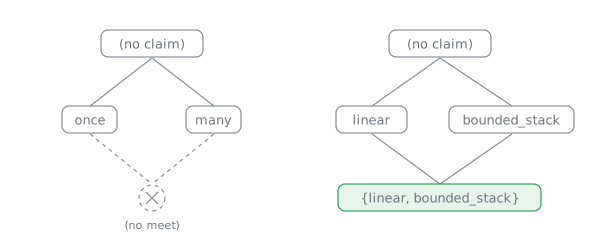
Descending is a strengthening someone must prove; ascending, forgetting a claim, is always free; and holding two claims at once is exactly having a point below both:
fn f() : Int @ noalloc = 1  -- a proven claim: f's call tree allocates nothing

fn g() : Int = f()          -- ok: forgetting the claim moves up, always free

-- fn foo() : Int @ noalloc = g()
--   rejected, descent needs proof: in `foo`, call to `g` may
--   allocate (`g` has no zero-allocation certificate)

-- h : ((Int) -> Int) @ {linear, bounded_stack}
--   a legal row shape: the meet exists and the checked claims compose

-- h : ((Int) -> Int) @ {once, many}
--   never parses: usage facts `once` and `many` contradict each other (same axis)

fn main() = println(g())
Operation grades: a total chain. Continuation use is a quantity, so its lattice is a total order:
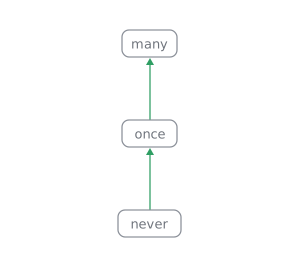
The whole discipline is one comparison at one boundary: a clause’s grade at most its operation’s declared grade (effects and handlers):
effect E
  never quit() : Int  -- never: a clause must drop the continuation
  once ask() : Int    -- once:  a clause resumes exactly once, in tail
  coin() : Bool       -- many:  a clause may capture k, resume freely (default)

fn foo() : Int ! {E} =
  let x = ask()
  if coin() then x else quit()

fn run() : Int =
  handle foo() with
    never quit() => 0        -- never <= never  ok
    once ask() => 42         -- once  <= once   ok
    coin() resume k => k(true)     -- once  <= many   ok: below the grade is allowed

-- ask() resume k => k(1) + k(2) would be rejected: the clause for `ask`
-- exceeds its declared grade `once`, resuming more than once

fn main() = println(run())
One signature exercises all three at once:
fn spawn(f : (() -> a ! e) @ {once, portable}) : Fiber(a) ! {Async(a), e}
spawn takes a portable thunk f that it may call at most once, starts it as a fiber producing an a, and may perform both the thunk’s effects e and the asynchronous effect Async(a).
- Row, joined: whatever
fperforms is unioned into the caller’s row alongsideAsync; the handler that later runs the fiber subtractsAsyncback out. - Axes, met:
@ {once, portable}is one point on each of two axes, their meet in the product:spawnpromises to call the thunk at most once and may carry it to another fiber. - Grade, bounded: the
Asyncoperations aremany, the top of the chain, so a scheduler may hold the continuation and resume it later;oncewould have pinned every handler to immediate single resumption.
The design is the three properties side by side. Effects always have joins: doing more must always be expressible, while a repeated label records handler depth rather than performing the same operation twice. Coeffects sometimes lack meets: some promises genuinely contradict. Continuation use is a total order: it is a quantity, not a set.
An effect is a coeffect on its own continuation: operation grades constrain how the handler may use the captured continuation.3
6.2 Types
The scalar types are Int (arbitrary precision), I64, U64, Float, Bool, Char, String, and Unit. A type constructor applied to arguments is written Con(t, ...); the list type has the sugar [t] for List(t). A tuple type is (t, ...). A function type is (t, ...) -> u, optionally carrying an effect row on u. A universally quantified type is forall a. t. Type variables are varids.
6.3 Kinds
A type has kind Type (a type of values) or Type -> Type (a type constructor awaiting one argument), and so on; List has kind Type -> Type, since List(Int) is a type only once Int is supplied. A class parameter may range over a constructor of kind Type -> Type, applied as f(a) in method signatures; see type classes. Each constructor’s parameter kinds form an arrow k1 -> ... -> Type, and an applied head is checked argument by argument against that arrow: too many arguments, or an argument whose kind does not match the parameter’s, is a kind mismatch reported at the annotation. There is no separate global kind-checking phase; the remaining well-kindedness obligations are discharged during unification, which requires a constructor and its arguments to agree in arity.
Besides Type and its arrows there are two further ground kinds. Row is inhabited by effect rows rather than types. A type parameter annotated : Row ranges over rows, so a data type can carry an effect row as a parameter and thereby store an effectful computation in a field: in type Cmd(a, e : Row) a field may name e as ! {e} (or in a tail, ! {IO | e}), the constructor quantifies e with a row-level forall, and the applied head Cmd(a, e) carries the row in that position. A Row-kinded argument is an effect row, written either as a row variable (Cmd(a, e)) or a { .. } row literal (Cmd(Int, {IO})); supplying a type where a row is expected, or a row where a type is expected, is a kind mismatch reported at the annotation. An unannotated parameter still defaults to Type, so Row is opt-in and existing types are unchanged. This is the type-system support for storing an effect-polymorphic reified handler, such as the concurrency scheduler of effects and handlers.
The third ground kind is Nat, inhabited by type-level natural numbers, the dimensions of a shape-indexed type. A type parameter annotated : Nat ranges over dimensions, so in type Vec(a, n : Nat) the length n is a compile-time index rather than a stored field; an argument in that position is either a bare natural literal (Vec(Int, 3)) or a Nat-kinded variable (Vec(a, n)). As with Row, supplying a type where a dimension is expected, or a dimension literal where a type is expected, is a kind mismatch reported at the annotation.
Dimensions unify by equality only: two literals unify when they are equal (3 with 3), a variable unifies with whatever dimension it meets, and a clash is a compile error naming both lengths (zipping a Vec(Int, 3) with a Vec(Int, 4) reports expected length 3, but got length 4). There is deliberately no successor structure and no arithmetic on dimensions: n + m and n + 1 in a dimension position are declined at the parser with a pointed message, and this is a decision, not a gap.
The consequence is stated honestly rather than worked around: an operation whose correctness needs an arithmetic relation between dimensions cannot be given a length-precise type. A length-changing cons of type (a, Vec(a, n)) -> Vec(a, n + 1) is therefore not expressible, and a head over Vec(a, n) cannot statically exclude the empty vector (which would require n to be a successor m + 1); such a head accepts any length and faults, or ranges over Fail, on the empty case. Equality-only dimension unification is exactly the reach that shape indexing needs (fixed-length containers, matching-length zips) without importing a dependent-arithmetic decision procedure into the frozen core.
Dimensions are erased before the Core IR and never reach code generation, so a Nat index is a purely static fact: it constrains what type-checks but is invisible to every backend and to the determinism contract, exactly like a phantom parameter. An unannotated parameter still defaults to Type, so Nat is opt-in.
6.4 Inference, Generalization, and Defaulting
A row is built from labels, the effect names of effects and handlers (a parametric effect’s label carries type arguments). It is an unordered multiset: repeated labels are preserved and count how many enclosing handlers of that effect a computation still requires. A row is closed when it ends in a fixed multiset of labels and open when it ends in a row variable (! {L | r}), which stands for further labels the caller may add. An unannotated top-level declaration is generalized over its free type and row variables not fixed by the surrounding scope. A local let generalizes type variables only when its right-hand side is a syntactic value (a literal, variable, lambda, tuple, unboxed tuple, or list whose elements are values; annotations are transparent) and its free names are all top-level; a computation, or a value that closes over another local, stays monomorphic in its type variables. Thus let same = \(x) -> x may be used at both Int and String, while let same = make_identity() has one type. Row variables still generalize for either form, because choosing a row at a use site does not duplicate a computation.
A bare type variable written in a top-level function’s signature is an implicit forall: it is universally quantified and rigid, so the body is checked to hold for every instantiation and may neither narrow it to a concrete type nor equate two distinct signature variables (a body that does is a type error), and the declaration exports exactly the polymorphic scheme it wrote. Two cases default rather than generalize, both resolved in one pass at generalization. A numeric operand of an arithmetic or comparison operator left otherwise unconstrained defaults to Int; because the default is deferred to that pass rather than applied at the operator, a later use that fixes the operand to a fixed-width lane (I64/U64) takes precedence, so x + y followed by an i64 use of x is fixed-width, not Int. An unconstrained row is retained only where a caller can solve it: the outer latent row of a function, or a row reachable from one of its parameter types. Other open rows, including one nested only in a returned value and every row inside a constant’s value, default to empty (pure); an effect-polymorphic declaration such as traverse keeps the row carried by its higher-order parameter (the standard prelude).
6.5 Subsumption and Row Equivalence
Checking a value against an expected type uses subsumption, not equality. A more polymorphic type is accepted where a less polymorphic one is expected: a forall on the expected side introduces a rigid variable the value must satisfy for all instances, and a forall on the value side is instantiated to meet the expectation. Function subtyping is contravariant in the arguments and covariant in the result, so a function accepting more and returning less may stand in for one accepting less and returning more.
Nominal datatype arguments are invariant by default: T(a) fits T(b) only when a and b are mutually compatible. This contains function and usage subtyping inside a datatype rather than silently reversing it at a later phase; in particular, a closure marked @ once cannot be widened to @ many through a record or sum parameter. Array(a) is the one nominal covariant exception, justified by its copy-on-write value semantics: a write through a widened array cannot mutate a shared narrower alias. An application through a still-flexible higher-kinded head is invariant because the eventual constructor’s variance is not yet known.
Effect rows are checked by unification over scoped labels, not by covariant widening. Two rows are compared up to reordering but not multiplicity: ! {A, B} and ! {B, A} are the same row, while ! {A, A} and ! {A} are not. Unification hoists one demanded occurrence to the head of the other row before matching the tails. An open row ! {A | r} unifies with any row that provides A by binding r to the remainder; for instance ! {A | r} unifies with ! {A, B} by binding r to {B}. This is how a caller’s row absorbs a callee’s. A unification that would make a row contain itself is rejected, so recursive effect rows do not arise.
At a function arrow the value’s effect row is made equal to the expected one by this same unification, so a narrower row fits a wider context only by solving a row variable, never by silent widening. A pure function still fits an effectful context, because its own latent row is a quantified variable (effect polymorphism) that unification solves to the demanded effects. Where a function carries an explicit return row, that annotation is the row its body is unified against: a body that performs an effect the annotation omits does not unify and is rejected with a diagnostic naming the effect the annotation must declare, and the annotation’s row variables are rigid, so an annotation may not silently narrow to fewer effects than the body performs.
6.6 Fixed-Width Integers
Int is arbitrary precision. I64 and U64 are the signed two’s-complement and unsigned 64-bit lanes; they wrap on overflow rather than promoting to a bignum. Their arithmetic and comparisons are the plain operators through the numerical tower, one spelling across every lane. The bit-level operations have no operator spelling and remain named builtins, each taking two operands of the lane type.
| Family | Operations (and the u64_* counterparts) |
|---|---|
| Bitwise | i64_and i64_or i64_xor |
| Shift | i64_shl i64_shr |
| Comparison | i64_cmp |
and, or, and xor share a single bit pattern across both lanes; i64_shr is an arithmetic (sign-extending) shift while u64_shr is logical; a shift count is taken modulo 64. to_i64/to_u64 and int_of_i64/int_of_u64 convert between Int and the fixed-width lanes.
6.7 Integer Arithmetic and Division
The arithmetic operators +, -, *, /, and % spell integer arithmetic here through the numerical tower’s Int, I64, and U64 instances; ^ is exponentiation. On Int they are arbitrary precision: a sum, product, or difference is exact and never overflows, promoting a machine-word result to a bignum on demand.4 This section states the two facts that arithmetic on Int cannot state by its type alone: how division rounds, and what division by zero does. Both are identical on the interpreter and native backends, a corollary of the determinism contract and pinned by the parity corpus.
Division truncates toward zero and remainder takes the sign of the dividend. That is, / discards the fractional part by rounding toward zero rather than toward negative infinity, and a % b has the sign of a (or is zero), so the identity a == (a / b) * b + (a % b) holds for every non-zero b.5 This is truncated division, the semantics of C99, Rust, and the hardware division instruction both native backends emit.
-- Integer `/` truncates toward zero; `%` takes the dividend's sign.
-- `Int` is arbitrary precision, so the same laws hold past the machine word.
-- `^` binds tighter than unary minus, and a negative exponent is
-- `1 / base ^ (-exp)` under the same truncating division.
fn main() =
  println(7 / 2)
  println(-7 / 2)
  println(7 / -2)
  println(-7 / -2)
  println(7 % 3)
  println(-7 % 3)
  println(7 % -3)
  println(-7 % -3)
  println(1000000000000000000000 / 7)
  println(-1000000000000000000000 % 7)
  println(-2 ^ 2)
  println((-2) ^ 2)
  println(2 ^ -1)
  println(1 ^ -5)
  println((-1) ^ -5)
Floored division, where / rounds toward negative infinity and % (the Euclidean-adjacent modulus) takes the sign of the divisor, was considered and declined. Two reasons decide it. The fixed-width lanes are the constraint: / and % on I64 and U64 are the machine’s truncating division, and an Int operator whose meaning diverged from the lane it shares a spelling with would split the integer family into two rounding rules a reader must track by type. And the determinism contract wants one rule across every lane, the interpreter, and both native backends rather than a surface convenience that the hardware does not compute; a caller who wants a floored or Euclidean modulus writes it once over these primitives (((a % b) + b) % b for a non-negative residue) rather than having the language pick a second, silently different %.
Division or remainder by zero is the one partial case of integer arithmetic. It is a runtime fault: the program halts immediately with exit status 1 and exactly fatal: division by zero on standard error, byte-identical on the interpreter and both native backends, on both Int and the fixed-width lanes. It is not a value, and unlike the recoverable fail() of errors and failure it is not routed through an effect and cannot be caught; it aborts the run the way an unrecoverable error(code) does. Every other integer operation is total.
The fixed-width lanes wrap rather than fault or promote (fixed-width integers): +, -, and * on I64 and U64 are two’s-complement modular arithmetic, so adding one to I64_MAX wraps to I64_MIN and adding one to U64_MAX yields 0.6 Unary minus follows the same wrap on the fixed-width lane, so -x on I64 is the two’s-complement negation and -I64_MIN is I64_MIN. Int, being a bignum, has no such edge: negation and division there are always exact.7
-- Fixed-width I64/U64 arithmetic wraps two's-complement: no promotion to a
-- bignum, and no fault on the signed-minimum edge (`I64_MIN / -1` wraps).
fn main() =
  let maxi = 9223372036854775807i64
  let mini = 0i64 - maxi
  let mn = mini - 1i64
  let neg1 = 0i64 - 1i64
  println(show(maxi + 1i64))
  println(show(maxi * 2i64))
  println(show(mn / neg1))
  println(show(mn % neg1))
  println(show(18446744073709551615u64 + 1u64))
  println(show((0i64 - 7i64) % 3i64))
6.7.1 Safe Arithmetic Families
The wrapping and faulting defaults above are the primitives; a program that wants overflow to be visible rather than silent reaches for the safe families in the Data.Checked library, which layer four disciplines over those primitives through one class, Checked(a).
| Family | Methods | Result | Behavior |
|---|---|---|---|
checked_* | add, sub, mul, neg, div, mod | Option(a) | None exactly when the operation overflows the lane or divides by zero. |
saturating_* | add, sub, mul | a | Clamps to the bound the overflow crossed. |
wrapping_* | add, sub, mul, neg | a | Explicit names for the two’s-complement wrap the raw operators already perform (fixed-width integers), so a caller can spell the intent rather than rely on the default. |
overflowing_* | add, sub, mul | (a, Bool) | The wrapped result paired with a Bool true precisely when the operation overflowed. |
Instances cover I64, U64, and Int; the checked narrowings int_to_i64 and int_to_u64 sit beside the class as free functions returning Option, the partial inverses of the total widenings int_of_i64/int_of_u64.
Checked sits beside the arithmetic classes rather than inheriting from them: it carries no superclass and no raw operators, so it stays meaningful for any integer lane independently of what algebraic structure that lane also has. The connection runs the other way, as a law. The wrapping_* methods agree exactly, value for value, with the lane’s raw arithmetic, wrapping_add/wrapping_sub/wrapping_mul with the two’s-complement +/-/* and wrapping_neg with unary negation.8 Because the agreement is with the raw operators, it is stable under any later refactor that gives those operators a class of their own: the wrapping_* methods and the lane’s ring operations remain the same function by construction.
The families are not independent definitions that happen to line up; each fixed-width operation is computed once in the exact Int lane and then narrowed three ways, so the laws hold by construction and are pinned on the interpreter and both native backends. For a lane bounded by [lo, hi], checked_op(x, y) is Some(wrapping_op(x, y)) when the exact result lies in range and None otherwise; overflowing_op(x, y) is (wrapping_op(x, y), flag) with flag true iff checked_op(x, y) is None; and saturating_op(x, y) is that same wrapped value when it is in range, and otherwise the crossed bound, hi on overflow above (I64 max or U64 max) and lo below (I64 min or 0).9 Division and remainder inside a checked_* follow the truncating rule of integer arithmetic. The Int instance is the degenerate case that keeps the class total rather than vacuous: unbounded, so wrapping_* and saturating_* are the identity, overflowing_* always flags false, and only a zero divisor turns a checked_* into None.
-- The safe-arithmetic families of `Data.Checked` over the lane boundaries. The
-- raw wrap/truncate/fault semantics they build on are pinned by fixed-width
-- integers and integer arithmetic; here every printed line is a law that must
-- hold identically on both backends. `checked` is `None` exactly on overflow or
-- a zero divisor, `saturating` clamps to the crossed bound, `wrapping` matches
-- the raw operator, and `overflowing` pairs the wrapped result with that flag.
import Data.Checked (..)

fn main() =
  let i_max = to_i64(2 ^ 63 - 1)
  let i_min = to_i64(-2 ^ 63)
  let u_max = to_u64(2 ^ 64 - 1)
  let one = to_i64(1)
  -- I64: the three families agree with each other at the upper edge.
  println(show(checked_add(i_max, one) == None))
  println(show(saturating_add(i_max, one) == i_max))
  println(show(snd(overflowing_add(i_max, one))))
  println(show(fst(overflowing_add(i_max, one)) == i_min))
  println(show(checked_add(i_max, to_i64(0)) == Some(i_max)))
  -- I64: lower edge, negation, and the two division edges.
  println(show(saturating_sub(i_min, one) == i_min))
  println(show(checked_neg(i_min) == None))
  println(show(wrapping_neg(i_min) == i_min))
  println(show(checked_div(i_min, 0i64 - one) == None))
  println(show(checked_div(to_i64(7), to_i64(2)) == Some(to_i64(3))))
  println(show(checked_mod(to_i64(-7), to_i64(2)) == Some(to_i64(-1))))
  -- U64: unsigned underflow clamps to zero and wraps to the max.
  println(show(checked_sub(to_u64(0), to_u64(1)) == None))
  println(show(saturating_sub(to_u64(0), to_u64(1)) == to_u64(0)))
  println(show(fst(overflowing_sub(to_u64(0), to_u64(1))) == u_max))
  println(show(checked_add(u_max, to_u64(1)) == None))
  println(show(checked_neg(to_u64(0)) == Some(to_u64(0))))
  -- Int: unbounded, so checked is total except division, overflow never fires.
  println(show(checked_add(2 ^ 100, 2 ^ 100) == Some(2 ^ 100 + 2 ^ 100)))
  println(show(saturating_mul(2 ^ 100, 2) == 2 ^ 100 * 2))
  println(show(not(snd(overflowing_add(2 ^ 100, 1)))))
  println(show(checked_div(5, 0) == None))
  -- Checked Int narrowing agrees with the lane bounds.
  println(show(int_to_i64(2 ^ 100) == None))
  println(show(int_to_u64(-1) == None))
  println(show(int_to_i64(42) == Some(to_i64(42))))
6.8 Floating-Point Arithmetic
Float is an IEEE-754 double. Its arithmetic and comparison operators are the plain +, -, *, /, %, ==, /=, <, <=, >, and >= through the numerical tower. There is no implicit coercion between Int and Float, so a mixed expression is a type error resolved by an explicit to_float (exponentiation). Floating-point arithmetic is where a language most often becomes tier-dependent, because a fused multiply-add, an extended-precision register, or a differently rounded library call changes a low bit. Prism forbids that: every float operation follows one rounding rule and one set of special-value rules, and the interpreter and both native backends agree bit for bit, pinned by the parity corpus and, for the printer, by a dedicated formatter oracle.
The rounding contract is round to nearest, ties to even, the IEEE-754 default, applied to every arithmetic operation with no fused or wider-than-double intermediate. This is the single rule the language commits to, and it is why 0.1 + 0.2 is 0.30000000000000004 and 1.0 / 3.0 is 0.3333333333333333 identically everywhere: the result is the correctly rounded double, not an artifact of an evaluation order or a backend.
Float division never faults. Where integer / by zero aborts, Float / by zero is an ordinary IEEE result: x / 0.0 is inf or -inf according to the sign of the numerator and of the zero, and 0.0 / 0.0 is nan. A nan then propagates through every arithmetic operation it touches, so nan + 1.0 and nan * 0.0 are both nan; there is no arithmetic that turns a nan back into a finite number.10 Because no float operation faults, a floating-point pipeline never introduces a failure edge into a function’s effect row the way integer division by zero conceptually could.
Signed zero is observable. 0.0 and -0.0 are distinct values that compare equal (0.0 == -0.0 is true) yet are distinguished by any operation that reads the sign bit: 1.0 / 0.0 is inf while dividing by negative zero is -inf.11 Comparisons follow IEEE unordered semantics for nan: nan is equal to nothing including itself, so nan == nan is false and nan /= nan is true, and every ordering against nan (nan < x, nan > x) is false. The program below exercises each of these on the interpreter and native backends.
-- IEEE 754 float arithmetic: division yields inf/-inf/nan with no fault, NaN
-- propagates, signed zero is preserved, and comparisons follow the standard.
fn main() =
  let one = 1.0
  let z = 0.0
  let negz = (0.0 - 1.0) * 0.0
  let inf = one / z
  let ninf = (0.0 - 1.0) / z
  let nan = z / z
  println(0.1 + 0.2)
  println(1.0 / 3.0)
  println(inf)
  println(ninf)
  println(nan)
  println(negz)
  println(one / negz)
  println(nan + one)
  println(nan * z)
  println(if nan == nan then "nan==nan is true" else "nan==nan is false")
  println(if nan /= nan then "nan/=nan is true" else "nan/=nan is false")
  println(if z == negz then "0.0==-0.0 is true" else "0.0==-0.0 is false")
  println(if nan < one then "nan<1 is true" else "nan<1 is false")
Printing is owned by the canonical Float formatter and not respecified here; this section fixes only the tokens the special values render as, since a claim about nan or -0.0 is a claim about output. show (and therefore print and string interpolation, type classes) renders a nan as nan, positive and negative infinity as inf and -inf, and negative zero as -0, distinct from 0 for positive zero; the shortest round-tripping form the formatter chooses for finite values is the formatter’s contract, not this chapter’s.
6.8.1 Elementary Functions and Conversions
The elementary functions are owned the same way the arithmetic is. Rather than call whatever libm the platform links, Prism vendors one implementation of the double-precision math library: native code and the host interpreter call the identical compiled symbols, so a transcendental there is a consequence of in-repo code, not of a system library’s rounding.12 The browser-only WebAssembly interpreter has no C link step and uses the pure-Rust libm fallback; that resident path is deterministic but may differ from the native result by about one ULP for some transcendentals.
The accuracy statement is deliberately modest and honest: the contract is determinism, not correct rounding. Except for the exact operations below, each function is a deterministic faithful approximation, bit-for-bit identical on the host interpreter and both native backends and across native platforms, but not guaranteed to be the correctly rounded double of the true real result. Correctly-rounded transcendentals (the table-maker’s-dilemma problem) are an explicit non-goal; what the language guarantees is that a target produces its pinned result consistently, with native parity covered by the conformance corpus over the hard cases (subnormals, the extremes, argument reduction near multiples of pi/2, signed zero, nan, and the infinities) and a deterministic bulk sweep.
| Class | Family | Functions and rule |
|---|---|---|
| Exact | Square root | sqrt, correctly rounded |
| Exact | Magnitude | abs_float, exact |
| Exact | Integral rounding | floor, down; ceil, up; trunc, toward zero; round, nearest, ties away from zero |
| Exact | Remainder | fmod(x, y), exact IEEE remainder |
| Approximate | Trigonometric | sin, cos, tan |
| Approximate | Inverse trigonometric | asin, acos, atan, atan2(y, x) |
| Approximate | Hyperbolic | sinh, cosh, tanh |
| Approximate | Exponential | exp, exp2, expm1 |
| Approximate | Logarithmic | ln (natural), log2, log10, log1p |
| Approximate | Powers and distances | pow, cbrt, hypot |
The exact operations are correctly rounded or integer-valued by IEEE-754 and therefore identical on every conforming platform regardless of implementation. In particular, round(2.5) is 3.0 and round(-2.5) is -3.0, distinct from the ties-to-even rule used by arithmetic. Every function in the approximate rows is supplied by Prism’s owned library and carries the faithful deterministic guarantee above.13
The Int/Float conversions pin their rounding once, identically on the host interpreter and both native backends:
| Direction | Function | Rounding rule |
|---|---|---|
| Int → Float | to_float | Nearest representable Float, ties even |
| Float → Int | truncate | Toward zero |
| Float → Int | floor_to_int | Down |
| Float → Int | ceil_to_int | Up |
The three Float-to-Int conversions differ only in the rounding applied before the common conversion step.14
6.8.2 The Numerical Tower
The arithmetic and comparison operators are one spelling per operation across every lane, with the lane chosen by the operand’s type and resolved entirely at compile time. Three classes carry them. Num(a) provides +, -, *, and unary minus; Div(a) provides / and %; Ord(a) provides <, <=, >, and >= through its cmp method for non-primitive ordered types. Num and Div have instances for Int, I64, U64, and Float, so + reads on any of them and the earlier per-lane semantics of this chapter (the exact Int, the wrapping fixed-width lanes, the IEEE Float) are the instances’ behavior, unchanged. Div is split from Num so a type with addition but no sensible division stays representable without a vacuous method.
Resolution has no runtime cost.15 A monomorphic operand keeps the lane’s direct primitive, exactly the code the operator emitted before the tower, so the class dictionary never survives specialization and the generated core is byte-identical, pinned by the allocation gate. Only genuinely polymorphic code, a function written given Num(a) or given Div(a), dispatches through a dictionary, and that dictionary too is erased wherever the function is specialized to a concrete lane. Unary minus follows the same rule: -x on a concrete lane is the sign flip or two’s-complement negation of floating-point and integer arithmetic, and -x on a Num(a) operand dispatches through the class with the same value. Unsigned U64 has no surface negation (-x on a U64 is a type error naming the signed lanes), but the Num(U64) instance’s negation is the two’s-complement wrap, reachable through generic Num code and agreeing with wrapping_neg (safe arithmetic).
Integer literals are polymorphic. A literal with no width suffix adopts whatever numeric lane its context expects: 1 is a Float where a Float is wanted (so a Float-typed binding or argument needs no .0), an I64 in an I64 position, and so on, with the lane’s constant placed directly in the elaborated core and no runtime conversion. A decimal or exponent literal denotes a fractional lane, of which Float is currently the only one. The defaulting rule fixes the ambiguous case: an integer literal with no constraining context defaults to Int, and a fractional literal to Float. The default always fires, so a program that never mentions the numeric classes never sees a class-constraint error; let n = 5 is an Int exactly as before the tower. A width-suffixed literal (5i64, 5u64) is monomorphic, its suffix a type ascription rather than a hint, and a literal out of range for the lane it resolves to is a compile error at resolution time.
There is no implicit coercion, ever. The lane a value carries is fixed by its type, and only literals adapt; a variable never does. x + 2.5 where x : Int is a type error naming both lanes, not a promotion of x to Float, and the same holds across any two distinct lanes (I64 and U64, Int and Float). Cross-lane movement is always an explicit, named conversion (to_float, the checked narrowings and exact widenings of fixed-width integers and safe arithmetic). This is the line between a numeric surface that stays predictable and one whose every operator hides a possible conversion.
6.9 Algebraic Data Types
A type declaration introduces an algebraic data type: a sum of constructors, each a product of fields. A constructor is named with an upper-case identifier and applied like a function to build a value; a match (patterns) destructures a value by constructor. A type may take type parameters and may be recursive, including mutually so. A type parameter may be annotated : Row to range over an effect row rather than a type (kinds), so a field can store an effectful computation, as in type Cmd(a, e : Row) whose field is a () -> a ! {e}, or : Nat to range over a compile-time dimension, as in type Vec(a, n : Nat) whose length index is erased rather than stored.
-- A sum type: a value is exactly one of the listed constructors, each with its
-- own fields. Construction names a constructor; destruction matches on it.
type Shape = Circle(Int) | Rect(Int, Int)

fn area(s) =
  match s of
    Circle(r) => 3 * r * r
    Rect(w, h) => w * h

-- A recursive sum type, the canonical binary tree.
type Tree = Leaf | Node(Tree, Int, Tree)

fn sum_tree(t) =
  match t of
    Leaf => 0
    Node(l, v, r) => sum_tree(l) + v + sum_tree(r)

fn main() =
  println(area(Circle(10)))
  println(area(Rect(3, 4)))
  println(sum_tree(Node(Node(Leaf, 1, Leaf), 2, Node(Leaf, 3, Leaf))))
A newtype is a data type with exactly one single-field constructor: a type distinct from its payload, with no runtime wrapper. An alias on a type expression is a transparent synonym, interchangeable with its definition. An alias whose body is a row literal is a row alias, the same transparency for a set of effect labels: usable wherever a row is written, expanded before checking, and composable with other aliases (composing rows); a row alias takes no parameters.
A deriving (C, ...) clause generates the named instances structurally from the declaration. Eq, Ord, Show, Hash, Lens, and Plate derive everywhere; Serialize, Stable, ToJson, FromJson, and Arbitrary derive against their opt-in modules; Identifiable abbreviates the identity bundle. Each mechanism, its laws, and the instance a clause stands for are specified in deriving.
6.10 Records
A constructor may instead take named fields, C { f : T, ... }, making the type a record. A field is read with e.f; records are built and updated by the record expressions. Plain projection is total-only: e.f requires e to have a single-constructor record type. Sum constructors may reuse a field name at different types because a pattern refines the constructor before its fields are checked; read such fields inside the corresponding match arms. deriving (Lens) synthesizes a getter f_of and a setter with_f per field.
-- A record is a single-constructor product type with named fields. Fields are
-- read with `.f`, built with `C { f = e, ... }`, and updated functionally.
type Point = Point { x: Int, y: Int }

fn main() =
  let p = Point { x = 3, y = 4 }
  let q = Point { ..p, y = 9 }
  println(p.x)
  println(q.y)
6.11 Unboxed Products
A product may be written unboxed so its fields are carried inline rather than behind a heap cell: #(a, b) is an unboxed tuple and #{ x : a, y : b } an unboxed record, whose field is read with e.#field. A record lowers positionally to the same product representation, so projection reuses the tuple machinery and reference counting is balanced by construction. A product built and consumed within one function scalarizes away entirely, creating no cell at all; one that escapes across a boundary the optimizer cannot see through is boxed by each native backend, value-identical to the interpreter. Whether a given product is boxed is therefore a cost fact decided by the backend, never a difference an observer can name.
fn norm2() : Float =
  let v = #{ re = 1.0, im = 2.0 }
  v.#re * v.#re + v.#im * v.#im

fn main() = println(norm2())
6.12 Non-Allocating Nullables
OrNull(a) is a nullable that costs no heap cell: Null is the empty word and This(v) carries a present element in the element’s own representation. Because the two share one word of storage, the element type must be one whose values can never collide with the null word: a concrete, single-word, non-zero type. Unit (the zero word), a nested OrNull, an unboxed product, and an element type inference never pins are all rejected at compile time (E1019), on written annotations and on nullables inference discovers on its own alike. Null and This behave as ordinary constructors under match, exhaustiveness, and reference counting, so a nullable is byte-identical across backends and its representation stays a storage choice.
fn find_name(hit : Bool) : OrNull(String) =
  match hit of
    true => This("found")
    false => Null

fn main() =
  match find_name(true) of
    Null => println("none")
    This(s) => println(s)
7. Type Classes
A class declares a single-parameter constraint and a set of method signatures. An instance is a named value providing those methods for one head type. A function states its constraints with a given clause after the return annotation, as announce below does, and receives its dictionaries as hidden arguments resolved at each call site, one per constraint. The following program declares two Describe(Temp) instances, designates one canonical, and selects the other explicitly with using.
A class, instance, or effect body is a layout block: the head ends its line and the members follow on indented lines, one per line, with no braces and no where. Each instance method is written in expression form, fn m(x) = e. Because the body is layout-delimited, it admits the same layout-sequenced statements as a top-level fn body, as well as let .. in chains. A brace opening one of these bodies is a parse error that names the layout rewrite. A marker class with no methods, and its instance, are written as the bare head with no body.
-- Typeclasses. A class is an interface: a named bundle of methods a type
-- implements. An instance provides those methods for one type, and a function
-- that says `given Shape(a)` works for every type with an instance, receiving
-- the instance as a hidden argument resolved at each call site.

type Circle = MkCircle(Float)

type Rect = MkRect(Float, Float)

class Shape(a)
  area : (a) -> Float
  name : (a) -> String

instance shapeCircle : Shape(Circle)
  fn area(c) =
    match c of
      MkCircle(r) => 3.14159265 * r * r
  fn name(_c) = "circle"

instance shapeRect : Shape(Rect)
  fn area(s) =
    match s of
      MkRect(w, h) => w * h
  fn name(_s) = "rectangle"

fn summary(x : a) : String given Shape(a) = "{name(x)} of area {area(x)}"

-- Instances are named values (Lean-style), which is what the knobs below hang
-- off. A second instance for the same head type is legal; designating one
-- canonical keeps implicit resolution deterministic (coherence: a program's
-- meaning never depends on a silent tie-break), and the other instance is
-- selected explicitly with `f(args, using instName)`.

instance shapeBox : Shape(Rect)
  fn area(s) =
    match s of
      MkRect(w, h) => w * h
  fn name(_s) = "box"

canonical Shape(Rect) = shapeRect

fn main() =
  println(summary(MkCircle(1.0)))
  println(summary(MkRect(2.0, 3.0)))
  println(summary(MkRect(2.0, 3.0), using shapeBox))
7.1 Coherence and Resolution
An instance is selected by the head constructor of the constraint type (the outermost constructor, for example List in List(Int)). Resolution is coherent: a program’s meaning never silently depends on which instance the resolver happened to pick. For each (class, type-head) there is exactly one canonical instance, and implicit resolution always selects it, so resolution is deterministic.
With a single instance for a head, that instance is canonical automatically. When two or more instances share a head, one must be designated canonical with a top-level declaration:
canonical Class(Head) = instanceName
Having two instances for one head without a designation is a coherence error reported at definition, not a silent ambiguity deferred to the use site. The designated instance is what implicit resolution selects; the others remain reachable only through an explicit override.
An explicit override is visible at the use site and changes nothing else’s resolution: pass the chosen instance as a trailing using argument, f(args, using instanceName), as sort_by_ord(xs, using ordDesc) does above. (This is the same using form reserved for first-class dictionary passing.) There is no ambient, scoped instance mechanism: an override is always written where it is used.
The preferred way to obtain a different instance for a type is a newtype with its own canonical instance (newtype Down = Down(Int) for reverse order, a folded-case wrapper for case-insensitive comparison) rather than a non-canonical instance of the base type. This changes the type, not the instance-for-a-type, so coherence is preserved exactly and the difference is visible in the signature; an explicit using override is the second-line tool when a newtype is too heavy.
Resolution recurses through instance contexts up to a fixed depth.
A consequence worth naming: equality, ordering, and hashing are ordinary methods of coherent classes (Eq, Ord, Hash), never built-ins that work on any value by inspecting its representation. Prism has no polymorphic structural ==, compare, or hash. A structural default is a known hazard: it typechecks on functions, abstract types, and cyclic values where it has no principled meaning, and it silently overrides whatever notion of equality an abstraction intended. OCaml’s Base goes so far as to shadow the polymorphic versions to keep them out of reach; in Prism the hazard never arises, because the only equality in scope is the one an Eq instance supplies and coherence makes that instance unique.
Printing follows the same discipline. print and println display a concrete argument by its structure (a top-level string prints raw, exactly as interpolation splices it), but a polymorphic argument requires Show: a generic function that prints declares given Show(a), the display dispatches through the instance (a generic Bool prints true, never a representation tag), and printing a rigid type variable without the constraint is a type error naming the missing given Show(a). What is never consulted is the runtime representation; the tag check that guards the raw printer is defense in depth against compiler bugs, not a semantics.
7.2 Superclasses
A class may require another as a superclass with given, the way an interface extends another. Each instance then stores a resolved superclass dictionary as the leading field of its dictionary cell, so one written constraint carries both capabilities: below, a given Greet(a) function calls the superclass method name_of with no Nameable constraint written, discharging it by projecting that field. The superclass witness is found automatically from the instances in scope, so the instance declaration never repeats it, and unlike inheritance nothing is overridden: the two dictionaries stay separate values.
-- Superclasses. A class may require another with `given`: every `Greet` type
-- must already be `Nameable`, the way an interface extends another. Each
-- instance then carries its superclass dictionary as a hidden leading field of
-- its own, so a `given Greet(a)` function may call `name_of` (a `Nameable`
-- method) with no `Nameable` constraint written: `Greet` entails it. Unlike
-- inheritance, nothing is overridden or re-implemented; the `Greet` instance
-- simply points at whichever `Nameable` witness is in scope, and the two kinds
-- of evidence stay separate values.

type Robot = MkRobot(Int)

class Nameable(a)
  name_of : (a) -> String

class Greet(a) given Nameable(a)
  greeting : (a) -> String

instance nameRobot : Nameable(Robot)
  fn name_of(r) =
    match r of
      MkRobot(n) => "unit-{n}"

instance greetRobot : Greet(Robot)
  fn greeting(_r) = "beep boop"

-- One constraint, two capabilities: `greeting` is Greet's own method, and
-- `name_of` is projected from the superclass field of the same dictionary.
fn hail(x : a) : String given Greet(a) = "{name_of(x)} says {greeting(x)}"

fn main() = println(hail(MkRobot(7)))
7.3 Higher-Kinded Classes
A class parameter may be a type constructor of kind Type -> Type, applied as f(a) in method signatures and resolved on the head constructor of each instance. The prelude’s Functor/Applicative/Monad/Foldable/Traversable tower is built this way. The example below builds that tower explicitly over a custom container, each level naming its predecessor as a superclass with given, so an instance high in the tower can exist only where the ones below it do.
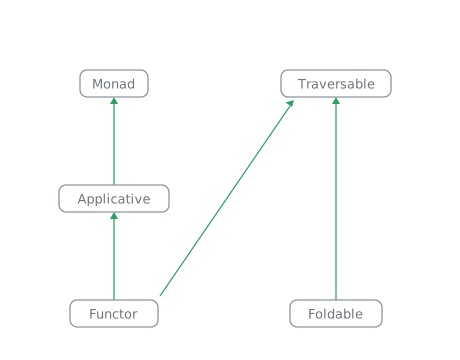
-- The Functor/Applicative/Monad tower built explicitly, the same shape the
-- prelude ships for List and Option. The class parameter `f` has kind * -> *,
-- applied as `f(a)` in each method signature, and every level names its
-- predecessor as a superclass with `given`, so an instance high in the tower
-- can exist only where the ones below it do. (The names carry a `B`/`_` suffix
-- only to sit beside the prelude's own Functor/Applicative/Monad and fmap/pure/bind.)

type Box(a) = Box(a)

fn open(b : Box(a)) : a =
  match b of
    Box(x) => x

class FunctorB(f)
  fmap_ : ((a) -> b ! {| e}, f(a)) -> f(b) ! {| e}

class ApplicativeB(f) given FunctorB(f)
  pure_ : (a) -> f(a)

class MonadB(f) given ApplicativeB(f)
  bind_ : (f(a), (a) -> f(b) ! {| e}) -> f(b) ! {| e}

instance functorBox : FunctorB(Box)
  fn fmap_(g, b) = Box(g(open(b)))

instance applicativeBox : ApplicativeB(Box)
  fn pure_(x) = Box(x)

instance monadBox : MonadB(Box)
  fn bind_(b, g) = g(open(b))

fn main() : Unit ! {IO} =
  println(open(pure_(7)))  -- Applicative: lift a value in
  let c = fmap_(\(x) -> x + 1, Box(20))  -- Functor: map under the structure
  let d = bind_(c, \(x) -> Box(x * 2))  -- Monad: sequence (needs the two below)
  println(open(d))
The prelude provides the same tower for List and Option. Its methods are effect-polymorphic (defined under effect polymorphism): a per-element effect row threads through in place of an Applicative wrapper, so effectful traversal needs no monad and no do-notation. Using it, one fmap/ap/bind/traverse works across either container.
-- Higher-kinded type classes: the class parameter ranges over a type
-- constructor (kind * -> *), applied as `f(a)` in the method signatures. The
-- Functor/Applicative/Monad/Foldable/Traversable tower is in the prelude with
-- instances for List and Option, resolved by the head constructor of each
-- instance. `fmap`/`traverse` are effect-polymorphic: the per-element effect
-- row threads through instead of an Applicative wrapper, so effectful
-- traversal needs no monad and no do-notation.
--
-- Prints:
--   [2, 3, 4]
--   Some(42)
--   10
--   [2, 3, 10, 20]
--   Some(15)
--   [1, 1, 2, 2, 3, 3]
--   Some(9)
--   [10, 20, 30]

-- Functor: one `fmap` maps over either container.
fn functor_demo() =
  println(show(fmap(\(x) -> x + 1, [1, 2, 3])))
  println(show(fmap(\(x) -> x * 2, Some(21))))

-- Foldable: an effect-polymorphic right fold.
fn foldable_demo() =
  println(show(fold_r(\(x, acc) -> x + acc, 0, [1, 2, 3, 4])))

-- Applicative: `ap` is cartesian on List, positional on Option.
fn applicative_demo() =
  println(show(ap([\(x) -> x + 1, \(x) -> x * 10], [1, 2])))
  println(show(ap(Some(\(x) -> x + 5), Some(10))))

-- Monad: structural `bind`, where List is nondeterminism and Option failure.
fn monad_demo() =
  println(show(bind([1, 2, 3], \(x) -> [x, x])))
  println(show(bind(Some(3), \(x) -> Some(x * x))))

-- Traversable: effectful map, with an empty effect row here.
fn traversable_demo() = println(show(traverse(\(x) -> x * 10, [1, 2, 3])))

fn main() =
  functor_demo()
  foldable_demo()
  applicative_demo()
  monad_demo()
  traversable_demo()
So Monad here is just another class, structure for List-style nondeterminism and Option-style failure, with none of the language integration it carries elsewhere: no do-notation, no privileged status, no return, no burritos,16 no Kleisli categories.17 Sequencing side effects is the effect system’s job, not the monad’s.
The two systems meet in Traversable. The example below defines a recursive Tree, gives it the Functor/Foldable/Traversable instances, then runs a single generic traverse over it four ways. Nothing about the traversal changes between them; the behaviour is chosen entirely by the effect the per-element function performs, since traverse’s signature carries that row straight through. State numbers the leaves, Fail short-circuits, Choice (resumed multishot) enumerates every assignment, and {State, Fail} does the first two at once under two stacked handlers. Each is a job a monadic language hands to a different Applicative instance (State, Maybe, the list monad) or, for the last, a StateT s Maybe transformer stack; here it is one traversal and the effect rows supply the rest. This is the whole type system in one program: higher-kinded classes with a superclass chain, principal effect rows that compose, and handlers (including multishot resumption) discharging them.
-- The synthesis: one generic, effect-polymorphic `traverse` over a custom
-- recursive `Tree`, run four ways. Nothing about the traversal changes between
-- them; the behaviour is chosen entirely by the effect the per-element function
-- performs, and the effect system supplies what a monadic language would reach
-- for an Applicative instance (or a transformer stack) to get. The signature
-- `traverse : ((a) -> b ! {| e}, t(a)) -> t(b) ! {| e}` carries the per-element
-- row `e` straight through, so each leaf's effects sequence in tree order and a
-- handler discharges them at the boundary. No Applicative, no do-notation.

type Tree(a) = Leaf(a) | Branch(Tree(a), Tree(a)) deriving (Show)

-- The higher-kinded tower for Tree. Traversable names Functor and Foldable as
-- superclasses, so this instance trio is what lets the prelude's generic
-- `traverse`/`fmap`/`fold_r` resolve on the `Tree` head. Both mapping methods
-- delegate to the one effect-polymorphic recursive walker.

fn tfold(g, z, t) =
  match t of
    Leaf(x) => g(x, z)
    Branch(l, r) => tfold(g, tfold(g, z, r), l)

fn tfold_l(g, z, t) =
  match t of
    Leaf(x) => g(z, x)
    Branch(l, r) => tfold_l(g, tfold_l(g, z, l), r)

fn twalk(g, t) =
  match t of
    Leaf(x) => Leaf(g(x))
    Branch(l, r) => Branch(twalk(g, l), twalk(g, r))

instance functorTree : Functor(Tree)
  fn fmap(g, t) = twalk(g, t)

instance foldableTree : Foldable(Tree)
  fn fold_r(g, z, t) = tfold(g, z, t)
  fn fold_l(g, z, t) = tfold_l(g, z, t)

instance traversableTree : Traversable(Tree)
  fn traverse(g, t) = twalk(g, t)

effect State
  get() : Int
  put(Int) : Unit

effect Choice
  pick() : Bool

-- A parameter-passing State handler: the handled block becomes a state
-- transformer, run with an initial counter. The action's row is written
-- `! {State | e}` so the handler subtracts State concretely and leaves `e`
-- (any other effects the action performs) untouched for an outer handler.
fn run_state(s0, action : () -> a ! {State | e}) =
  let f =
    handle action() with
      get() resume k => \(s) -> k(s)(s)
      put(v) resume k => \(_s) -> k(())(v)
      return r => \(_s) -> r
  f(s0)

-- A Fail handler, likewise annotated `! {Fail | e}`: annotating the action row is
-- what lets a reusable handler-wrapper discharge its effect in the type (so it
-- drops out of `main`'s row), not merely at runtime.
fn attempt(action : () -> a ! {Fail | e}) =
  handle action() with
    never fail() => None
    return r => Some(r)

-- Per-leaf functions, each performing a different effect. Their rows are what
-- pick the traversal's behaviour; keeping them monomorphic keeps the example
-- about the effects, not inference.
fn number(x : Int) : (Int, Int) ! {State} =
  let n = get()
  put(n + 1)
  (n, x)

fn nonneg(x : Int) : Int ! {Fail} =
  guard(x >= 0)
  x

fn sign(x : Int) : Int ! {Choice} =
  if pick() then
    x
  else
    -x

fn audit(x : Int) : (Int, Int) ! {State, Fail} =
  guard(x >= 0)
  number(x)

fn main() : Unit ! {IO} =
  let t = Branch(Branch(Leaf(1), Leaf(2)), Leaf(3))
  -- State: number the leaves left to right (the State applicative elsewhere).
  println(show(run_state(0, \() -> traverse(number, t))))
  -- Fail: short-circuit the whole traversal on a bad leaf (the Maybe applicative).
  println(show(attempt(\() -> traverse(nonneg, t))))
  println(show(attempt(\() -> traverse(nonneg, Branch(Leaf(-9), Leaf(2))))))
  -- Choice, by multishot resumption: one whole tree per sign assignment, all
  -- 2^3 of them collected (the List applicative; here the continuation is reentered).
  let worlds =
    handle traverse(sign, t) with
      pick() resume k => append(k(true), k(false))
      return r => Cons(r, Nil)
  println(show(length(worlds)))
  -- {State, Fail} in a single pass under two stacked handlers: number and
  -- validate at once, the row the monadic world reaches StateT s Maybe for.
  println(show(attempt(\() -> run_state(0, \() -> traverse(audit, t)))))
Because a row is unordered, {State, Fail} fixes no layering the way a transformer stack must: whether a failure discards the numbering or keeps it is decided by which handler sits outside the other at the use site, not baked into the type. The monad-transformer ordering question, StateT s Maybe versus MaybeT (State s), moves from the type to the handler site, free to differ from one call to the next without changing a single signature.
Classes remain single-parameter; multi-parameter classes are not supported.
7.4 Deriving
A deriving (C, ...) clause on a type or newtype declaration generates the named instances structurally from the declaration.18 Derived code is ordinary checked code: a derived instance and its hand-written equivalent are indistinguishable downstream, in coherence, in dispatch, and in behavior. Each subsection below shows a clause beside the instance it stands for, the same program written both ways; both tabs typecheck and print the same thing, which is the whole claim.
Most derivations are compositional: they convert each component through the component’s own instance, so a field whose type lacks the instance is a compile error at that field. Plate alone is structural, taking components apart by their declarations instead of by dispatch (below). Eq, Ord, Show, Hash, Lens, and Plate derive everywhere; Serialize and Stable derive against import Wire, ToJson and FromJson against import Json, and Arbitrary against import Test.
deriving (Show)
Canonical rendering (type classes). A nullary constructor prints as its name, a positional one as Name(v, ...), a record one as Name { f = v, ... }, each field through its own Show instance.
type Color = Red | Green | Blue deriving (Show)

fn main() = println(show(Green))
deriving (Eq)
Two values are equal when they carry the same constructor and their fields are pairwise equal, each through its own Eq instance. A type with more than one constructor gains a final wildcard arm returning false.
type Point = Point { x : Int, y : Int } deriving (Eq)

fn main() =
  println(show(eq(Point { x = 3, y = 4 }, Point { x = 3, y = 4 })))
deriving (Ord)
Lexicographic order: within a constructor, cmp the fields left to right and stop at the first non-zero result; across distinct constructors, declaration order decides. Ord requires Eq (given), and the derived instance backs <, <=, >, and >=.
type Point = Point { x : Int, y : Int } deriving (Eq, Ord)

fn main() =
  println(show(cmp(Point { x = 1, y = 2 }, Point { x = 1, y = 3 })))
deriving (Hash)
A structural content hash: the value folds through the same blake3 Merkle construction that content-addresses code (content-addressed core), so structurally equal values carry one canonical digest on every backend. Each constructor hashes as the blake3 of its token, the length-prefixed name and declaration tag, followed by its fields’ own digests; fixed-width field digests make the concatenation unambiguous. Renaming a constructor therefore moves the hash, exactly as it moves the identity of code.
type Point = Point { x : Int, y : Int } deriving (Hash)

fn main() =
  println(show(hash(Point { x = 3, y = 4 }) == hash(Point { x = 3, y = 4 })))
deriving (Lens)
For a record constructor, one getter f_of and one setter with_f per field (records). This is the one derivation that synthesizes top-level functions rather than an instance; the functions compose with the record expressions and the optic paths.
When Data.Optic is in scope, the derivation also pairs each getter and setter into a type-qualified lens value. For example, Point.x produces point_x : Lens(Point, Int), while Vec2.x produces vec2_x; the type prefix prevents equal field names on different records from colliding. Without the import, the ordinary accessor pair is still generated.
Top-level values share one flat namespace, so deriving is rejected if a generated accessor or lens value would take a name already held by a function, constructor, opened import, or another lens derivation. The diagnostic names the type, field, and generated spelling; rename the field or write the accessor by hand under a different name.
Lens applies only to a single constructor with named fields. It carries no class context, so a phantom type parameter costs no instance and the generated accessors remain polymorphic in that brand.
type Vec2 = Vec2 { x : Int, y : Int } deriving (Lens, Show)

fn main() =
  println(show(x_of(Vec2 { x = 1, y = 2 })))
  println(show(with_y(Vec2 { x = 1, y = 2 }, 9)))
deriving (Plate)
One layer of structure, taken apart and put back. children(x) is the list of x’s immediate subvalues of x’s own type, in constructor-declaration and field order, and nothing else; rebuild(x, ks) is x with exactly those positions replaced, left to right, by the elements of ks. A whole-tree traversal or rewrite (every subterm, a fold, a count, a bottom-up rewrite) is written once against that one pair rather than once per constructor, and a fifty-constructor syntax tree costs the same to walk as a two-constructor one. The derivation looks through list, optional, tuple, and record fields, and through the other data types declared in the program, to find the occurrences a field can lead to; that is what lets a traversal see through the carrier records a tree holds its nodes in (a match arm, a spanned wrapper, a qualifier) with no second match written for them.
The two methods are inverse on one layer, and that law is what every combinator above them relies on: rebuild(x, children(x)) is x, and the list handed to rebuild must have the same length and order as the one children returned. children is pure and total, returning structurally smaller values, so a recursion driven by it terminates on a finite value. rebuild carries Fail in its row for exactly one reason: a list of any other length is a programming error, not an input to be repaired, so it raises Fail rather than padding the missing positions or dropping the extra ones, either of which would silently hand back a value that is not the one asked for. On a correctly shaped list it performs no effect.
Being structural rather than compositional, this derivation differs from the others in two visible ways. It puts no constraint on the type’s own parameters, because a Plate(T(a)) yields T occurrences and never an a; and it asks nothing of a component’s own instances, so a component with no Plate instance is traversed all the same. What it cannot take apart it refuses: a field that could still lead back to the derived type through something opaque (a function, a container with no declaration in the program) is an error at the deriving clause naming the field and the type it reached, never a silently dropped subterm. Nothing in the class is unforgeable, so a hand-written instance is an ordinary instance and is accepted, which is the escape hatch for an abstract type whose children the compiler cannot see.
type Expr = Lit(Int) | Add(Expr, Expr) | Mul(Expr, Expr) deriving (Show, Plate)

-- Bottom-up rewrite: fold constant additions wherever they appear.
fn simplify(e : Expr) : Expr ! {Fail | e} =
  let folded = rebuild(e, map(simplify, children(e)))
  match folded of
    Add(Lit(a), Lit(b)) => Lit(a + b)
    other => other

fn main() =
  println(show(simplify(Mul(Add(Lit(1), Lit(2)), Lit(3)))))
deriving (Serialize)
The compact positional byte codec (import Wire): a product writes its fields in declaration order, a sum prefixes the constructor tag, and the byte builders belong to the library, so the derivation names the shape and the library owns the bytes. The encoding is compact rather than self-describing; the frame that seals a layout and rejects a stale one is Stable’s, which is why the two usually derive together.
import Wire (..)

type Point = Point { x : Int, y : Int } deriving (Serialize)

fn main() =
  println(show(wire_len(encode(Point { x = 1, y = 2 }))))
deriving (Stable)
The seal on a Serialize layout. Its one method is a per-type constant the compiler injects at the derive site, the type’s structural shape digest, and wire_encode_stable/wire_decode_stable frame a value under it so a stale layout is rejected before a byte of the body is read (stable blocks). Stable derives only when every component is itself Stable; a non-stable field is a compile error at the derive site.
There is no derived-instance tab here, deliberately: a hand-written instance Stable(T) is rejected outright, because the class’s only method is compiler-computed and a manual instance could only forge a frozen contract. The error points at deriving (Stable).
import Wire (..)

type Meters = Meters(Int) deriving (Eq, Show, Serialize, Stable)

fn decode_meters(bs : Bytes) : Meters = wire_decode_stable(bs)

fn main() =
  println(show(decode_meters(wire_encode_stable(Meters(5)))))
deriving (ToJson, FromJson)
Conversion to and from the dynamic JSON tree (import Json), for a type whose schema is its own declaration, derived as a pair, since a type that encodes but cannot decode is a document nobody can read back. One constructor becomes one object: a record constructor’s keys are its declared field names, a positional one’s are its argument positions (_0, _1), and a sum additionally names its variant under the key $, which no field name can spell, so a document names its constructor rather than an index that quietly changes meaning when a constructor is inserted. A single-constructor type has nothing to discriminate and carries no tag. Constructor and field order are the declaration’s and the encoder sorts keys, so a value has one tree and one string on every backend. A decode that does not fit, in any way, is one ordinary Fail, caught with optional or default; the failure carries no payload because Fail is nullary, and a positioned failure would mean a different effect on the class signature and so on every hand-written instance too. None of this is the wire codec: a Serialize byte format is frozen and versioned by Stable, while a JSON document is read by something not compiled against this program, so the encoding is self-describing rather than compact and promises nothing across a change to the declaration.
import Json (..)

type Point = Point { x : Int, y : Int } deriving (ToJson, FromJson)

fn main() =
  println(encode(to_json(Point { x = 1, y = 2 })))
deriving (Arbitrary)
A property-test generator built from the type’s structure (import Test): constructors are chosen among, fields generate through their own Arbitrary instances, and a recursive type generates under a size budget that decays toward its leaves. Randomness routes through the Random effect under a seeded handler, so a run is a pure function of its seed and a failure reports the seed that reproduces it. The derived body is the library’s generator combinators, so no instance tab is shown; what matters is that the clause makes quickcheck runnable over the type with nothing else written.
import Test (..)

import Quickcheck (..)

type Point = Point { x : Int, y : Int } deriving (Eq, Show, Arbitrary)

fn prop_reflexive(p : Point) : Bool = eq(p, p)

fn main() =
  println(show(passed(quickcheck(arb_gen(), prop_reflexive))))
deriving (Identifiable)
Shorthand for the identity starter pack: it expands to exactly Eq, Ord, Hash, and Show, so an ID newtype is comparable, hashable, and printable from one keyword with no imports. A class listed alongside it is derived once, not twice, and Arbitrary is deliberately excluded (it lives behind import Test and is a testing concern), so a value that also wants a generator writes deriving (Identifiable, Arbitrary).
newtype UserId = UserId(Int) deriving (Identifiable)

fn main() =
  println(show(UserId(7)))
  println(show(UserId(3) < UserId(7)))
8. Effects and Handlers
An effect declares a set of operations; each operation has an argument list and a result type. Performing an operation is an ordinary call to its name. A function’s effect row is the unordered multiset of handler obligations its operations have not discharged, written ! {L, ...} on its result type, with an optional row variable tail ! {L | r}. Most rows contain each effect once; a repeated label records the extra handler depth introduced by mask. A bare ! is an explicit empty row. A row is inferred when omitted.
An operation’s own type variables, those of its signature that are not parameters of the effect, are quantified on the operation: each perform site instantiates them afresh, like a call to a polymorphic function, so read(Key(a)) : a may answer Int at one site and String at the next within a single {Read} row. Inside a handler clause they are rigid, so a clause treats the operation’s values generically. An effect’s own parameters belong to its label instead, and a row admits one instantiation of a label: a perform site finds its handler by effect name and position, never by type, so Tag(Int) and Tag(String) could not be told apart. Two instances of one parameterised effect at different types in one scope are written with named handlers.
An operation’s declaration carries a grade, the resumption multiplicity every handler clause for it must respect, written as the contextual prefix never, once, or many. The grades form a three-point lattice ordered never < once < many: never never resumes (the continuation is dropped), once resumes exactly once in tail position (no capture), and many may capture the continuation and resume any number of times. many is the default and the most general grade, so an operation declared with no prefix (or the explicit many) admits every handler; a grade word is written only to claim something stronger. The checking rule is one line: a handler clause’s own multiplicity must be at most its operation’s declared grade. A clause that resumes a never operation, or that captures or re-enters the continuation of a once operation, is rejected at that clause, its caret naming the operation and its declared grade; a clause more restrictive than the grade (handling a many operation tail-resumptively, say) is always allowed. The grade is a static, checked fact only: it constrains which handlers typecheck and lets the compiler keep an unrelated in-place var loop on its fast lowering when some other component resumes multishot, but it never changes the observable behavior of an accepted program.
| Prefix | Grade | Resumption |
|---|---|---|
never | 0 | never resumes; the continuation is dropped |
once | 1 | resumes exactly once, in tail position, without capturing k |
many | ω | may capture k and resume any number of times, including zero |
effect State
  get() : Int
  put(Int) : Unit

-- Algebraic State by parameter passing.
--
-- The handler interprets get/put by parameter passing. Each clause returns a
-- function s -> result, and `k(v)(s)` threads the state forward. The handled
-- block becomes a state transformer that we run with an initial s.
--
-- counter() never mentions a state value, it just performs get and put. The
-- row is inferred and discharged at the handler, so the same ops could be
-- reinterpreted (logging, bounding) without touching counter.

fn tick() : Int ! {State} =
  let n = get()
  put(n + 1)
  n

fn counter() : Int ! {State} =
  tick()
  tick()
  tick()
  get()

fn run_counter(init) =
  let f =
    handle counter() with
      get() resume k => \(s) -> k(s)(s)
      put(s2) resume k => \(_s) -> k(())(s2)
      return r => \(_s) -> r
  f(init)

fn main() = println(run_counter(0))
A handle e with block discharges operations; its grammar is the handler nonterminal of the surface grammar. Each operation clause names an operation and binds its arguments and the resumption k (the captured continuation, explained below); calling k(v) resumes the suspended computation with v, and k may be called zero times (abort), once (the common case), or many times (multishot). A return r clause transforms the final value. The handler in eff_state.pr interprets get/put by threading a state parameter, so counter, which only performs the operations, never mentions a state value.
Operations and handlers are delimited control: the handle block is the delimiter (a prompt), and the resumption k is the delimited continuation it captures, the slice of computation between the perform site and the handler. Being first-class, k reinstalls that slice under the same handler when invoked. This is the typed, named generalization of shift/reset: a single prompt with one anonymous continuation becomes a row of named operations, each with its own clause, and the effect row is the static record of which delimiters a computation still requires.
A clause may invoke k any number of times; more than once makes the continuation multishot: each call re-runs the captured slice from the perform site with a different result, so one handler can pursue several futures of the same computation. This is how nondeterminism or search handlers explore alternatives (an amb operation whose clause calls k once per choice and combines the outcomes) and how generators yield and continue. Never invoking k discards the captured slice, which is exactly how raise (observability) and a never clause abort.
8.1 Residual Handlers
A handler is exhaustive by default. If it names an operation of an effect but omits another operation of that same effect, checking fails at the handler. The explicit residual form opts into forwarding those omitted operations:
effect Choice
  choose() : Bool
  commit() : Unit

fn choose_true(body : () -> a ! {Choice}) : a ! {Choice} =
  handle body() with partial {
    choose() resume k => k(true),
    return x => x
  }
The partial marker follows with; it applies to every effect represented by the operation clauses in that handler. Exhaustive handlers retain the existing handle e with { ... } spelling. Consequently an omitted clause is never an accidental forwarding rule: it is either rejected or visible at the handler site.
The typing judgment retains, beside each effect-row label, the set of operations demanded from that effect while an expression is being checked. Write uses(c, E) for that set, handled(h, E) for the operations of E named by handler h, and arms(h) for the union of effects performed directly by its return and operation clauses. For a partial handler,
residual(handle c with partial h, E)
  = (uses(c, E) − handled(h, E)) ∪ uses(arms(h), E)
and its output row contains E exactly when that residual set is non-empty. Labels for effects not named by the handler, every open row tail, and effects performed by the clauses are preserved. Clause bodies run outside the handler they define, so re-performing an operation from a clause is part of arms(h) and reaches an outer handler. An ordinary exhaustive handler uses the same rule after checking that handled(h, E) is the complete declared operation set of every E it names.
Operation coverage is a local refinement of an effect label, not a second public row syntax. The printed row remains ! {Choice} whenever any Choice operation is residual. An explicit or generalized signature containing Choice is conservative and promises no smaller operation subset, so a caller may discharge it only with an exhaustive Choice handler or leave Choice residual. This keeps module interfaces stable while still allowing two adjacent partial handlers to cancel known local subsets before generalization.
If an operation is not named by a partial handler, evaluation performs it outward exactly once with the original operation identity and payload. Its outward resumption is the captured continuation wrapped in the same partial handler, so resuming returns beneath the delimiter and eventual normal completion still runs the return clause exactly once. No clause body runs during forwarding. Grades are unchanged: forwarding neither duplicates nor discards a continuation, while a matching clause must still respect the operation’s declared never, once, or many grade.
For an operation op : (p) -> q, each matching clause is checked with its declared argument types and with
k : (q) -> answer ! residual(handle c with partial h)
The answer type is shared by the return clause and every operation clause. When the return clause is omitted, the answer type is the handled body’s own result type rather than a fresh variable, so a handler that names no return can never be generalized into a scheme its clauses do not support. The residual row is the least row satisfying the body-subtraction rule and all clause-effect constraints; this is the same open-row unification used by higher-order handlers, not a default to the empty row.
Forwarding is semantic, not a lowering choice. The interpreter, the value-threading lowering, and free-monad lowering must emit the same canonical observation trace. In particular, operation emission, outward handling, resumption, and the return clause occur in that order in every tier.
That agreement is over the observation trace. Exhausting a host resource, the native stack included, is not an event the trace records and not a behavior this document defines, so no tier is asked to carry a step budget or to agree with another about one. What every tier carries instead is a refusal. A resumption in tail position turns a handled loop into a driver loop, so a lowering that would run one hop of such a loop on the native stack must decline the program and leave it to a lowering that bounces the hop, rather than compile a loop that runs out of stack. Whether a program terminates is a property of the program and not of the tier chosen for it. A resumption anywhere but the tail has work waiting after it and holds a frame in every tier alike, exactly as a non-tail-recursive function does, so nothing is promised there beyond what an ordinary recursion promises.
8.2 Observability
The defining property of the row discipline: an operation handled inside a function is discharged, so it does not appear in that function’s inferred row. In the example below, checked carries the row ! {Exn}, but attempt, which handles raise, is pure.
effect Exn
  never raise(Int) : Int

-- Exceptions as an effect: raise and catch.
--
-- raise aborts the computation. The handler clause drops the captured
-- continuation k and returns a recovery value, so control never comes back.
-- checked() raises deep inside a helper, far from the catching handler: the
-- effect propagates across calls and is discharged where the handle sits.

fn safe_div(n, d) : Int ! {Exn} =
  if d == 0 then
    raise(-1)
  else
    n / d

fn checked(n) : Int ! {Exn} =
  let a = safe_div(100, n)
  let b = safe_div(a, n - 5)
  a + b

fn attempt(n) =
  handle checked(n) with
    never raise(code) => code
    return r => r

fn main() =
  let good = attempt(2)
  let bad = attempt(5)
  println(good * 100 + bad)
The old joke about purity is that a function of type Int -> Int cannot launch the missiles. A single IO type can put it no more precisely than that: somewhere, something happens to the world. Here the international side effect is declared in the language itself, an effect Missiles whose row label follows first_strike through every signature that might perform it, and observability is what disarms it: war_games handles launch and never resumes, so its inferred type is () -> Int, pure. The missiles are unlaunched and absent from the type. joshua adds multishot resumption (effects and handlers): its choose clause resumes the continuation once per side, so every future of the exchange is played out under the treaty handler and their scores summed. Every future is explored, none of them wins, and joshua is still pure. So thermonuclear war doesn’t typecheck, world peace achieved.
-- The row names the missiles. A single IO type can say only that a function
-- does something to the world; here the international side effect is a row
-- label, and the only way to be rid of it is to handle it.
--
-- A handler is a treaty: install one and every launch is intercepted before
-- it reaches the world. war_games discharges Missiles without resuming, so
-- from the outside it is a pure function of type () -> Int. joshua goes
-- further: choose resumes its continuation twice, once per side, so every
-- future of the exchange is played out under the treaty and none of them
-- wins. No missiles were launched in the evaluation of this program.
--
-- Expected output:
--   greetings professor falken
--   winning moves: 0
--   joshua: 0 winning moves across every future

effect Missiles
  launch(Int) : Unit

effect Warplan
  choose() : Bool

fn first_strike() : Int ! {Missiles} =
  launch(100)
  1

fn exchange(us_first : Bool) : Int ! {Missiles} =
  if us_first then
    launch(100)
  else
    launch(99)
  1

-- a strange game. the only winning move is not to play.
fn war_games() : Int =
  handle first_strike() with
    launch(_warheads) resume _k => 0
    return moves => moves

fn played(us_first : Bool) : Int =
  handle exchange(us_first) with
    launch(_warheads) resume _k => 0
    return moves => moves

fn joshua() : Int =
  handle played(choose()) with
    choose() resume k => k(true) + k(false)
    return total => total

fn main() =
  println("greetings professor falken")
  println("winning moves: {war_games()}")
  println("joshua: {joshua()} winning moves across every future")
8.3 Clause Sugar
Two clause forms abbreviate common shapes. once op(x) => e is tail-resumptive sugar for op(x) resume k => k(e), resuming exactly once. val v = e is an install-time constant: e runs once when the handler installs, and every use of v returns it.
-- `once` and `val` handler clauses, pure desugaring sugar.
--
-- `once op(x) => e` is a tail-resumptive clause, identical to
-- `op(x, k) => k(e)`, resuming exactly once with e. `val v = e` is an
-- install-time constant: e runs once when the handler installs (its effects
-- land on the installer, not the handled block) and every v() returns it.
--
-- Expected output:
--   999     (printed once at install, from val tag)
--   prism
--   ready
--   70      (tag 0 + width(3) + width(4), each * 10)

effect App
  name() : String
  tag() : Int
  width(Int) : Int
  log(String) : Unit

fn render() : Int ! {App} =
  log(name())
  log("ready")
  tag() + width(3) + width(4)

fn run_app() : Int ! {IO} =
  handle render() with
    val name = "prism"
    val tag =
      println(999)
      0
    once width(w) => w * 10
    log(s) resume k =>
      println(s)
      k(())
    return r => r

fn main() = println(run_app())
A never op(x) => e clause is non-resumable: it discards the continuation. This is the shape that error, throw, try, and catch desugar to (errors and failure).
8.4 Masking
Operations are answered by the nearest enclosing handler of their effect. mask<E>(e) is how an expression declines that default for E: inside e, an operation of E skips the nearest handler and is answered by the next one out. Its typing rule adds one occurrence of E to the body’s row, and a handler that discharges E removes exactly one occurrence. A bare E operation therefore has row {E}, one mask gives {E, E}, and two masks give {E, E, E}. The multiplicity survives function and lambda boundaries, so a caller with too few applicable handlers is rejected during checking rather than reaching an unhandled operation at runtime.
-- Effect masking, minimally. Two handlers of one effect are in scope: the
-- nearest answers 1, the outer answers 10. A bare ask() is served by the
-- nearest handler; mask<Ask>(ask()) skips it and is served by the outer.
--
-- Expected output:
--   11

effect Ask
  ask() : Int

fn nested_ask() =
  handle (handle ask() + mask<Ask>(ask()) with {
      ask() resume k => k(1),
      return r => r
    }) with
    ask() resume k => k(10)
    return r => r

fn main() = println(nested_ask())
The need arises the moment two handlers of one effect share a scope, which happens whenever code installs a handler of E around user code while itself wanting the E of its own caller: a wrapper that intercepts every ask to log it and then delegates the real question outward, a test harness that handles State for the code under test while its own bookkeeping uses the ambient state. Without mask, the wrapper’s own operations are captured by the handler it just installed, which is at best the wrong answer and at worst an infinite loop; with it, they are addressed past it. Masks nest, so a double mask adds two occurrences and skips two handlers. Masking skips handlers by position; a named handler addresses one by name.
8.5 Named Handlers
The statement form with handler { ... } scopes a handler over the remainder of the enclosing block, so a stack of handlers reads as a flat sequence of layers rather than a rightward drift of nested handle expressions (composing rows puts this form to work). Adding a binder makes the handler first-class: with f <- handler { ... } installs the handler and binds it as an instance, and an operation addressed through it, f.read(), dispatches to that instance even when another handler of the same effect sits closer. A bare read() still reaches the innermost ordinary handler, so two instances of one effect can serve one scope, distinguished by name where the innermost-handler rule alone could not tell them apart. Masking skips handlers by position; a named handler addresses one directly.
-- Koka-style named handlers. `with f <- handler { .. }` binds a first-class
-- handler instance. `f.op(args)` dispatches to that instance even when another
-- handler of the same effect sits closer. Each instance desugars to a fresh
-- private effect (ops renamed op@f@n, unforgeable from source), so the rest of
-- the pipeline sees ordinary effects. Escape analysis rejects a closure that
-- would carry an instance out of its `with` block.
--
-- Expected output:
--   conf.toml
--   data.csv
--   conf.toml:data.csv
--   inner/named
--   70

effect Read
  read() : String

effect Ask
  ask() : Int

-- two instances of one effect. Dispatch is by instance, not by innermost.
fn sources() =
  with conf <- handler
    read() resume k => k("conf.toml")
    return r => r
  with data <- handler
    read() resume k => k("data.csv")
    return r => r
  println(conf.read())
  println(data.read())
  println("{conf.read()}:{data.read()}")

-- a bare read() still goes to the innermost ordinary handler. The named
-- instance only answers calls addressed through it.
fn mixed() =
  with named <- handler
    read() resume k => k("named")
    return r => r
  let inner =
    handle read() with
      read() resume k => k("inner")
      return r => r
  println("{inner}/{named.read()}")

-- multishot through a named instance. The continuation after h.ask() is
-- resumed twice. (3 * 10) + (4 * 10) = 70
fn multishot() : Int =
  with h <- handler
    ask() resume k => k(3) + k(4)
    return r => r
  h.ask() * 10

fn main() =
  sources()
  mixed()
  println(multishot())
Each instance desugars to a fresh private effect whose operations are unforgeable from source, so the rest of the pipeline sees ordinary effects and ordinary rows; resumption is unrestricted through an instance (the multishot clause above resumes the continuation of h.ask() twice). The escape analysis of local mutation applies here too: a closure or returned value that would carry an instance out of its with block is rejected, so an instance never outlives its handler.
The resource form with x <- f(args) generalizes the same shape to any function that takes its continuation last: the remainder of the block becomes a function \(x) -> rest appended to the call’s arguments, so f decides when, whether, and how often to run the rest. This is the bracket idiom (acquire, use, release) written without nesting.
The same scope-local skolem underwrites ordered containers. A Map(k, v) is ordered by the ambient canonical Ord(k), but a program that needs two orderings of the same keys at once cannot let a map built under one be walked under the other: the tree structure encodes the ordering, so a lookup under the wrong comparator silently returns the wrong answer. The map type carries a third, phantom parameter for exactly this, Map(k, v, ord), a brand naming the ordering a map was built under; it appears in no field, so an unbranded Map(k, v) is the same type with the brand left to inference, and pre-brand source keeps checking unchanged. Repeating the same under-applied spelling within one signature repeats the same inferred brand, so (Map(k, v)) -> Map(k, v) preserves its argument’s brand; each instantiation of that signature still chooses a fresh brand. The Data.Ordered module (import Data.Ordered) hands out brands the way a named handler hands out an instance. with_ordering(cmp, body) runs body with a witness carrying cmp, and the witness’s brand is a fresh rigid skolem unique to that call, so a map built through one witness carries a brand that a second witness’s brand cannot unify with. Two witnesses coexist in one scope, and handing a map built under one to the other’s operation is a compile-time type error naming both brands. The brand never escapes: the body’s result may not mention it, so only a summary of a branded map (a size, a looked-up value, an encoded form) leaves the block, never the branded map itself.
This is the explicit half of the coherence story, and it closes statically. The implicit half is calling the ambient map_insert under a non-canonical Ord chosen with using, then reading the result under the canonical one. Because those two maps have the same unbranded type, the implicit path is caught dynamically where it does the most harm: when an ordered container crosses a package boundary. A serialized map records its keys in the writer’s order, and Wire’s map reader checks that they arrive strictly ascending under its own Ord(k), faulting through failure rather than rebuilding a mis-ordered tree when a map ordered by one comparator is read where a different one is canonical. Both faults, the compile-time brand mismatch and the runtime order check, are pure functions of the source and the pinned inputs, so a program’s behavior never reveals which backend ran it. The division is deliberate and stated as such: the explicit witness path is static, while the implicit path is dynamically checked at the wire boundary.
8.6 Local Mutation
A var mutates, yet the function holding it stays pure. fib_iter below updates two locals in a loop but has type (Int) -> Int with an empty row, so it is accepted where only a pure function is allowed. Prism has no mutation primitive; var is sugar over the effect system.
A var x := e desugars to a private two-operation effect (a get and a set); each read of x becomes a perform of get, each x := v a perform of set. In the same pass, a handler that threads the value as a hidden parameter is wrapped around the block. That handler discharges the get and set labels (observability), so they never reach the function’s type: the state is implemented but not observable. Because an escape analysis (below) has proved the state never leaves its block, effect lowering then erases the whole handler to a mutable cell, turning each get into a cell read and each set into a cell write, and the loop into a constant-stack loop, so the lowered code allocates nothing per iteration.
-- twice demands a pure (Int) -> Int. fib_iter mutates two locals in a loop,
-- yet is accepted here: its inferred row is empty.
fn twice(f : (Int) -> Int) = f(f(6))

fn fib_iter(n : Int) : Int =
  var a := 0
  var b := 1
  repeat(n) fn
    let t = a + b
    a := b
    b := t
  a

fn main() = println(twice(fib_iter))
The two tabs are the compiler’s own dumps: Core (prism dump core) is the elaborated form, where each var has become a private two-operation State effect (do get@a@0 / do set@a@0) wrapped in a value-threading handler, one nested handler per var; Lowered (prism dump lowered) is after effect lowering, where the escape check has let those handlers collapse to a mutable cell (ref_new / ref_get / ref_set) and the loop to a constant-stack repeat. The get/set effect never reaches the function’s type, so fib_iter stays pure.
An escape analysis keeps the purity honest: the compiler rejects any closure or returned value that would carry the var out of its block, so the state cannot outlive its handler.
Because the state is a handler, where the var sits relative to another handler is part of the meaning, and it matters once a clause resumes more than once. A var declared outside a multishot handler is one cell its resumptions share, so a write made by the first is still there when the second runs. A var declared under the handler is part of the continuation the clause captures, so each resumption starts again from the value it had at the capture point:
effect Choose
  choose() : Bool

fn outside() : List(Int) =
  var x := 1
  handle let _ = if choose() then x := 2 else () in [x] with
    choose() resume k => append(k(true), k(false))
    return r => r

fn scoped() : List(Int) ! {Choose} =
  var x := 1
  if choose() then
    x := 2
  [x]

fn inside() : List(Int) =
  handle scoped() with
    choose() resume k => append(k(true), k(false))
    return r => r

fn main() =
  println(outside())
  println(inside())
The handler, the mutation, and the resumption order are the same in both halves, yet outside prints [2, 2] and inside prints [2, 1]. Erasing a var to a mutable cell is an optimization the compiler takes only where no resumption can tell the difference, so every lowering prints the same pair.
8.7 Errors and Failure
Prism has no built-in exception type. Errors and failure are two related mechanisms, both resting on the non-resumable never clause of the clause sugar. With the imperative break, continue, and return of imperative control flow, they are one mechanism wearing several faces: each is a single-operation effect whose handler never resumes the captured continuation, installed only where the corresponding keyword actually occurs, so non-local control costs nothing where it is not used and (being handled at its boundary) surfaces in no effect row where it is.
Extensible errors. An error N(t) declaration introduces a one-operation effect whose operation never resumes; throw N(x) performs it. A function’s error row names exactly the errors it may raise and has not caught, and distinct error declarations join structurally as functions compose, with no umbrella sum type and no conversion glue: find_port carrying {NotFound} and parse_port carrying {Malformed} compose to {NotFound, Malformed}. try e catch { ... } is subtractive handler sugar (one nested never per arm): a partial catch discharges the labels it names and lets the rest flow to an enclosing handler, and an uncaught error is an unhandled-effect error naming exactly the labels that remain. Each catch arm names an error and binds its fields to variables.
-- Errors as effect rows. Each `error` declaration is its own effect label and
-- `throw` performs it, so a function's row is its error set. find_port carries
-- {NotFound}, parse_port carries {Malformed}, and their composition unions to
-- {NotFound, Malformed} with no umbrella enum or conversion glue.
--
-- `try`/`catch` is subtractive handler sugar (one nested `never` per arm).
-- A partial catch discharges its label and passes the rest to an outer try. An
-- uncaught case is an unhandled-effect error naming exactly what remains.
--
-- Expected output:
--   8080
--   default 80
--   bad config: oops
--   443
--   no such key: tls
--
error NotFound(String)

error Malformed(String)

fn find_port(cfg, key) =
  match cfg of
    [] => throw NotFound(key)
    pair :: rest =>
      let (k, v) = pair
      if k == key then
        v
      else
        find_port(rest, key)

fn parse_port(s) =
  if s == "8080" then
    8080
  elif s == "443" then
    443
  else
    throw Malformed(s)

-- Composed: the row unions to {NotFound, Malformed}.
fn port_of(cfg, key) : Int ! {NotFound, Malformed} =
  parse_port(find_port(cfg, key))

fn describe(cfg, key) =
  try
    show(port_of(cfg, key))
  catch
    NotFound(k) => "no such key: {k}"
    Malformed(s) => "bad config: {s}"

fn main() =
  let cfg = [("http", "8080"), ("https", "443"), ("smtp", "oops")]
  println(describe(cfg, "http"))
  let port =
    try
      try port_of(cfg, "gopher") catch { Malformed(_s) => 0 }
    catch
      NotFound(_k) => 80
  println("default {show(port)}")
  println(describe(cfg, "smtp"))
  println(describe(cfg, "https"))
  println(describe(cfg, "tls"))
Stacks of failure modes. Because each error is an ordinary row label, a row alias (composing rows) names a set of failure modes: alias ConfigErr = {NotFound, Malformed} states a subsystem’s failure vocabulary once, and a layer above extends it structurally, alias AppErr = {ConfigErr, NetErr}, with no umbrella type and no wrapping. A signature : Int ! {AppErr} reads as “may fail in exactly these ways”, and because expansion flattens before checking, catch subtracts labels from the expanded set like any other handler: a partial catch over an alias discharges the modes it names and leaves the rest in the row.
-- A row alias names a stack of failure modes. ConfigErr is the failure
-- vocabulary of the config subsystem, NetErr of the transport; AppErr splices
-- both. Expansion flattens, so !{AppErr} is exactly {NotFound, Malformed,
-- Timeout}, and a partial catch subtracts labels from that set: config_safe
-- discharges ConfigErr and its row keeps only NetErr.
--
-- Expected output:
--   8105
--   80

error NotFound(String)

error Malformed(String)

error Timeout(Int)

alias ConfigErr = {NotFound, Malformed}

alias NetErr = {Timeout}

alias AppErr = {ConfigErr, NetErr}

fn read_port(cfg, key) : Int ! {ConfigErr} =
  match cfg of
    [] => throw NotFound(key)
    pair :: rest =>
      let (k, v) = pair
      if k == key then
        if v == "8080" then
          8080
        else
          throw Malformed(v)
      else
        read_port(rest, key)

fn ping(ms) : Int ! {NetErr} =
  if ms > 100 then
    throw Timeout(ms)
  else
    ms

fn boot(cfg) : Int ! {AppErr} = read_port(cfg, "http") + ping(25)

-- a partial catch: ConfigErr's labels are discharged, Timeout remains
fn config_safe(cfg) : Int ! {NetErr} =
  try boot(cfg) catch { NotFound(_k) => 80, Malformed(_s) => 80 }

fn main() =
  let good = [("http", "8080")]
  let bad = [("http", "oops")]
  let full =
    try
      boot(good)
    catch
      NotFound(_k) => 0
      Malformed(_s) => 0
      Timeout(_ms) => 0
  println(full)
  let fallback = try config_safe(bad) catch { Timeout(_ms) => 0 }
  println(fallback)
These idioms span the recovery spectrum: the built-in Exn effect, raised by error(code) and uncatchable (it aborts); Result with the postfix e? propagation of the expression forms; a plain match on Ok/Err; and a custom non-resumable effect.
-- Failure, four idioms from a defaulted lookup to a custom throw, over the
-- everyday shape: reaching into chains of things that can fail.
--
-- 1. Indexing performs `Fail`, not `Option`: `users[i]` and `scores[j]` each
--    may miss, the misses flow through the chain as one row, and `?? d`
--    supplies the default at the end. TypeScript's `a?.[i] ?? d`, with the
--    partiality in the type instead of a null.
-- 2. `?` propagates over `Result`: each step unwraps `Ok` and short-circuits
--    the function on the first `Err`, exactly Rust's `?`.
-- 3. The boundary is a plain match on `Ok`/`Err`.
-- 4. A custom non-resumable effect: `abort` never resumes, the continuation is
--    discarded, and the clause's value becomes the result. Cheap throws, with
--    no Result plumbing inside the throwing code.
--
-- Expected output:
--   71
--   0
--   ada scored 92
--   gus has no scores
--   no user zoe
--   pass
--   invalid: negative

type User = MkUser { name: String, scores: List(Int) }

fn lookup_user(users : List(User), want : String) : Result(User, String) =
  match find(\(u) -> u.name == want, users) of
    Some(u) => Ok(u)
    None => Err("no user {want}")

fn top_score(u : User) : Result(Int, String) =
  match u.scores of
    [] => Err("{u.name} has no scores")
    s :: _ => Ok(s)

-- Two failable steps, one `?` each: the first Err returns from `headline`
-- immediately, so the happy path reads straight down.
fn headline(users : List(User), want : String) : Result(String, String) =
  let u = lookup_user(users, want)?
  let s = top_score(u)?
  Ok("{u.name} scored {s}")

fn report(r : Result(String, String)) =
  match r of
    Ok(line) => println(line)
    Err(e) => println(e)

effect Abort
  never abort(String) : Unit

fn grade(n : Int) : String ! {Abort} =
  if n < 0 then
    abort("negative")
  if n > 100 then
    abort("too big")
  if n >= 60 then
    "pass"
  else
    "fail"

fn safe_grade(n : Int) : String =
  handle grade(n) with
    never abort(msg) => "invalid: {msg}"
    return r => r

fn main() =
  let users = [
      MkUser { name = "ada", scores = [92, 71] },
      MkUser { name = "gus", scores = [] },
    ]
  -- 1: a chain of failable lookups, defaulted once at the end. The second
  -- line misses at the first hop and the whole chain yields the default.
  println((users[0].scores)[1] ?? 0)
  println((users[5].scores)[0] ?? 0)
  -- 2 and 3: `?`-propagated Results, matched once at the boundary.
  report(headline(users, "ada"))
  report(headline(users, "gus"))
  report(headline(users, "zoe"))
  -- 4: the custom throw.
  println(safe_grade(72))
  println(safe_grade(-5))
The failure axis. Beyond named errors, Prism has an anonymous, recoverable fail(), the deterministic-functional-logic failure of the Verse calculus (Augustsson et al., 2023). guard(b) fails when b is false; a ?? b runs a under a failure handler and falls back to b; e?.field chains through options, failing on None; optional/succeeds/default reify a failing computation as an Option, a Bool, or a default; and a comprehension guard may itself fail, pruning the element (expressions). transact body else fallback snapshots every live var, runs the body under a failure handler, and restores the snapshots on failure, so an aborted attempt leaves observable state unchanged. The whole axis is never handlers over a Fail effect, so an unhandled fail() is the ordinary unhandled-effect error, and “failable only in a failure context” falls out of the row discipline for free.19
-- Transactional rollback. A purchase that fails on insufficient funds leaves
-- balance and stock untouched, as if it never happened. The first buy succeeds.
-- The second overspends, so `guard` fails inside the `transact` and both vars
-- roll back to their pre-attempt values.
fn main() =
  var balance := 100
  var stock := 5
  let r1 =
    transact
      balance -= 40
      stock -= 1
      guard(balance >= 0)
      1
    else
      0
  println(balance)
  println(stock)
  println(r1)
  let r2 =
    transact
      balance -= 90
      stock -= 1
      guard(balance >= 0)
      1
    else
      0
  println(balance)
  println(stock)
  println(r2)
Partiality is in the row, not the name. ML libraries such as OCaml’s Base and Core suffix a partial function with _exn (List.hd_exn) so a reader knows it may raise, a naming convention standing in for what the type itself cannot say. Prism needs no such convention: a function that may fail carries that in its effect row, whether as the anonymous Fail above or a named error, so the possibility of failure is written into the signature and the row discipline forces it to be handled before the result is used. The _exn suffix is the workaround for a type system that cannot express failure; the row is the version the compiler checks.
8.8 Composing Rows
A row alias composes rows the way + composes sums. With AB = {A, B} and CD = {C, D}, the row {AB, CD, E} assembles five effects from two named pairs and a fifth label: (A + B) + (C + D) + E. An alias denotes a label set and expands transparently before checking, with overlap removed, so overlapping aliases do not accidentally manufacture the repeated-label depth used by mask. Any grouping and any order of the same five labels is the same row, so omega and flat below are interchangeable, and a grouping is chosen for the reader, not for the checker. An alias may reference other aliases (a cycle is an error at the declarations involved), and takes no parameters.
-- Rows compose like sums. AB and CD each name a pair of effects; App splices
-- both and adds a fifth label. Aliases expand and flatten before checking, so
-- {AB, CD, E} IS {A, B, C, D, E}: omega and flat have the same type, and the
-- grouping is documentation that leaves no trace in the semantics.

effect A
  alpha() : Unit

effect B
  beta() : Unit

effect C
  gamma() : Unit

effect D
  delta() : Unit

effect E
  epsilon() : Unit

alias AB = {A, B}

alias CD = {C, D}

alias App = {AB, CD, E}

fn phi() : Unit ! {AB} =
  alpha()
  beta()

fn psi() : Unit ! {CD} =
  gamma()
  delta()

fn omega() : Unit ! {App} =
  phi()
  psi()
  epsilon()

-- the flattened spelling of the same row: either may call the other
fn flat() : Unit ! {A, B, C, D, E} = omega()
This is the row discipline’s answer to the monad-transformer stack. A transformer application fixes one composite type, ReaderT Config (WriterT Log (Except E)), and pays for it twice: every layer’s operations are lifted through the layers above (or a class such as MonadWriter is threaded through, at a quadratic cost in instances), and the order of wrapping is welded into every signature even where no code depends on it. An alias instead makes the application row a name for a set, Ctx = {Ask, Tell} and App = {Ctx, Invalid} below. An operation reaches its handler by label, never by position, so there is no lift; a function that uses only Tell states !{Tell} and slots unchanged into App or any other row containing it; and two subsystems’ aliases union structurally, with no adapter between their stack and ours.
What a transformer stack fixes in the type, the handler site decides per call (the layering point already made for {State, Fail} under higher-kinded classes). Discharged one label at a time with the scoped with handler layers of named handlers, the run function reads like the transformer stack it replaces, except that the order is chosen where the handlers install, free to differ between call sites without a signature changing. The application monad becomes the application row: a name for what may happen, not a recipe for how it is wrapped.
-- An application row in place of a transformer stack. Ask is the reader layer,
-- Tell the writer, Invalid the exception; Ctx names the ambient pair and App
-- adds failure. A function states the part of the stack it uses (greet needs
-- only Tell) and slots into any row that contains it, with no lifting. The
-- run function is a flat sequence of scoped handlers, one per label, in an
-- order chosen here rather than fixed by a type.
--
-- Expected output:
--   hello
--   step 3
--   7
--   hello
--   step 99
--   0

effect Ask
  ask() : Int

effect Tell
  tell(String) : Unit

error Invalid(Int)

alias Ctx = {Ask, Tell}

alias App = {Ctx, Invalid}

fn greet() : Unit ! {Tell} = tell("hello")

fn step(n) : Int ! {App} =
  greet()
  let limit = ask()
  tell("step {n}")
  if n > limit then
    throw Invalid(n)
  else
    limit - n

fn run_app(n : Int) : Int ! {IO} =
  with handler
    once ask() => 10
  with handler
    once tell(m) => println(m)
  try step(n) catch { Invalid(_bad) => 0 }

fn main() =
  println(run_app(3))
  println(run_app(99))
8.9 Effect Polymorphism
A function can be generic over the effects of a function it is given by quantifying over a row variable in the argument’s type. Below, twice accepts an (Int) -> Int function with an open row {| e} for whatever that function performs. The same definition is then instantiated three ways: e is empty for plus_one, {Tick} for plus_tick, and {Say} for announce. The handlers at the effectful call sites discharge those concrete labels; no handler is needed at the pure call site. This is the mechanism the prelude’s fmap and traverse use to thread a per-element effect (higher-kinded classes), so an effectful traversal needs no Applicative wrapper.
effect Tick
  tick() : Int

effect Say
  say(Int) : Unit

-- Effect polymorphism: one higher-order function, any effect row.
fn twice(f : (Int) -> Int ! {| e}, x : Int) = f(x) + f(x)

fn plus_one(n : Int) = n + 1

fn plus_tick(n : Int) = n + tick()

fn announce(n : Int) =
  say(n)
  n

-- The same definition is instantiated at three different rows.
-- e = {}
fn pure_use() = twice(plus_one, 20)

-- e = {Tick}; the handler supplies 1 for each tick.
fn tick_use() =
  handle twice(plus_tick, 20) with
    tick() resume k => k(1)
    return result => result

-- e = {Say}; the handler prints each announcement.
fn say_use() =
  handle twice(announce, 9) with
    say(n) resume k =>
      println(n)
      k(())
    return result => result

fn main() =
  println(pure_use())
  println(tick_use())
  println(say_use())
The same row variable also governs an effect operation whose argument is a computation. In the next example, defer accepts a computation whose row is {Defer | e}. Performing defer(report) ties e to the caller’s ambient {Say} row. run_defer discharges Defer, but its result still carries {Say}: the handler removes the label it names and forwards the ambient tail unchanged.
effect Say
  say(Int) : Unit

effect Defer
  defer(() -> Int ! {Defer | e}) : Int

-- Defer is discharged; every effect in the ambient tail e is preserved.
fn run_defer(action : () -> a ! {Defer | e}) : a ! { | e} =
  handle action() with
    defer(thunk) resume k => k(run_defer(thunk))
    return value => value

fn report() : Int ! {Say} =
  say(7)
  42

fn deferred_report() : Int ! {Defer, Say} = defer(report)

-- run_defer removes Defer, but Say still flows to the caller.
fn ambient_use() : Int ! {Say} = run_defer(deferred_report)

fn observe() =
  handle ambient_use() with
    say(n) resume k =>
      println(n)
      k(())
    return value => value

fn main() = println(observe())
Concurrency’s fork(() -> a ! {Async(a) | e}) uses the same ambient row rule: performing it ties the argument’s row to the caller’s own, so a forked or deferred computation may perform only effects the caller already admits, and those effects flow out to whoever handles the operation rather than escaping it (the discipline of Koka, Frank, and Links; Leijen, 2017). Combined with a Row-kinded parameter (kinds) that stores the reified continuations, this is what makes a handler like run_async both effect-polymorphic and sound: it is written once for any row e the fibers perform, and a fiber cannot smuggle past it an effect that no outer handler was required to discharge.
The quantifier’s scope is enforced in the other direction too. A row bound by an inner forall is rigid and dies with its binder, so a row introduced outside that forall may never be solved to it: a closure whose body’s effects could only be satisfied by pinning an enclosing row onto the bound variable is rejected with an error naming the capture, the row analogue of a skolem-escape error, rather than accepted with a solution that outlives its scope.
8.10 Structured Concurrency and Cancellation
The Concurrent library builds cooperative concurrency and cancellation on the Async operations above, and their contract is stated here as observable behavior rather than as a property of one lowering tier. A scope(tasks) is a structured join: it forks a list of fibers and awaits them all on a successful run. It is not a failure-isolation boundary or a distinct internal nursery protocol. The scheduler tracks fork parentage globally so cancellation reaches everything a target forked.
Cancellation is a cooperative unwind, not an abrupt drop. cancel(f) marks the fiber f and all of its descendants; each stops at its next suspension point (a yield, an await, a channel operation) rather than mid-step, and then unwinds through the cancellation handlers it has already entered. A cancellation cleanup is installed with on_cancel(cleanup, body): if cancellation crosses that handler, cleanup runs exactly once before cancellation continues outward; a normally returning body does not run it. Nested on_cancel cleanups run innermost first, the same order a stack of never handlers unwinds (clause sugar). The cleanup executes outside the handler clause it is finalizing, but the scheduler marks the fiber as unwinding: repeated cancellation is masked, so cleanup may suspend and resume normally rather than being stopped a second time. A child forked during cleanup is immediately marked for cancellation and cannot escape the unwind. Cancelling a fiber before it starts does not enter its body and therefore installs or runs none of that body’s cleanups. Cancelling a completed leaf changes nothing, but cancelling a completed parent still reaches any live descendants retained in the fork tree.
Waiting on a fiber that may be cancelled is a join. try_await(f) returns an Outcome(a) = Completed(a) | Was_Cancelled, Completed(v) when f produced v and Was_Cancelled only after the cancelled fiber’s unwind and installed cleanups have completed, where a bare await would have no value to yield. A cancellation request and a completed cancellation are therefore distinct scheduler states; observing the request alone is not enough to return from try_await. If a cleanup itself performs an unhandled fail(), the cancellation never enters the completed set and try_await returns no Outcome: the scheduler aborts instead. A cleanup parked with no runnable producer reaches the scheduler’s deterministic no-progress failure; a cleanup that continues to produce work forever may diverge like any other program.
Unhandled fiber failure is scheduler-global. If any fiber reaches an unhandled fail() (errors and failure), run_async or run_lifo cancels every other live fiber and all of their descendants, including fibers created outside the scope whose task happened to fail. Runnable cancellation cleanups drain, then the failure re-emerges at the scheduler boundary. scope neither catches nor localizes it; it is only the structured success-path join. The failure therefore remains in the residual row of the run: run_async : (() -> a ! {Async(a) | e}) -> a ! {e} discharges Async, but a fallible fiber forces Fail into e, and a caller handles that failure outside run_async/run_lifo.
Cooperative cancellation is source-driven scheduler behavior, not an observation of the outside world: cancel is an ordinary Async operation and the chosen deterministic scheduler policy orders its consequences. It therefore adds no capability or replay-trace event. A future timer, OS signal, or preemptive cancellation source would be an explicit external capability and would require its own recorded event; none exists in this cooperative contract.
8.11 Capability Effects and IO
Reading the outside world is itself effectful, and the row records which part of the world a function reads. Base ships five input capability effects:
| Effect | Operations | Replay status |
|---|---|---|
Console | read_int, read_line | recorded |
FileSystem | read_file, read_bytes, file_exists | recorded |
Random | rand | recorded |
Entropy | entropy | fresh OS entropy, deliberately unlogged |
Env | getenv, args_count, arg | recorded |
A function that reads input names exactly that capability in its row: a function calling read_int carries ! {Console}, not a blanket ! {IO}, so the row says which part of the world is read rather than merely that some IO happens.20 The four recordable families above deliberately exclude Entropy: Random is the reproducible stream for simulation, while Entropy is the fresh source for key material. These shipped effect names are ordinary prelude definitions rather than keywords. The Concurrent library adds the Clock capability described below. Preempt and Net are reserved but unshipped seams: user effect declarations with either name are rejected, and neither enters the replayable capability set.
The surface is unchanged: read_int(), read_file(p), entropy(), getenv(s), and friends stay ordinary calls, defined in the prelude as thin wrappers that perform the corresponding capability operation. A default run_io world handler is wrapped around main on demand, only when main reaches a capability, and discharges Console, FileSystem, Random, Entropy, Env, and Output operations through the real world, so they collapse to ! {IO} at the program boundary. The handler is tail-resumptive, so it fuses to a direct call at no cost (effect lowering). File writes remain opaque IO: write_file, append_file, and remove_file are not capability operations. print and println normally lower directly to IO; when a Replay or replaying Incr driver is present, the compiler instead routes them through Output so an already-observed prefix can suppress or replay output without printing it twice. Binary file IO sits on the same split: read_bytes(p) is a FileSystem capability that reads a file as raw Bytes and is recorded like any other input, its own operation rather than a detour through read_file (routing bytes through a String would corrupt them at the first non-UTF-8 byte), while write_bytes(p, bs) is an IO output returning a Result.
Below, roll performs Random alone, user performs Env alone, and summary carries the structural union ! {Env, Random} of what it calls; the capabilities collapse to ! {IO} only at main, where run_io discharges them.
-- Capability effects, the parts a browser can serve. `Random` is a deterministic
-- SplitMix64 stream (pure arithmetic, identical to the native oracle) and `Env`
-- reads the environment, empty in the playground, so `getenv` falls back. Each
-- function's row names the slice of the world it reads: `! {Random}` alone,
-- `! {Env}` alone, and their structural union, never a blanket `! {IO}`. (The
-- inputs a browser cannot serve, file reads and stdin, would be reported instead.)

fn roll() : Int ! {Random} = rand_below(6) + 1

fn user() : String ! {Env} =
  let name = getenv("USER")
  if name == "" then
    "anonymous"
  else
    name

fn summary() : String ! {Env, Random} =
  "{user()} rolled {roll()}, {roll()}, {roll()}"

fn main() = println(summary())
Because input is now an interceptable operation rather than an untracked builtin, a handler other than run_io can supply the values, which is what record/replay rests on.
Virtual Simulation Clocks
Time is a capability too. The Concurrent library’s Clock effect carries the logical operations now and sleep and the explicit real-time reads wall_now and mono_now. run_clock discharges all four from a pure logical counter: now() reads the current tick, sleep(d) advances it, and both clock reads return that same virtual time. Under this handler time is deterministic and replayable, with no real clock read.21
A fiber may perform Clock; because the scheduler does not handle it, Clock flows out of run_async to an enclosing run_clock like any other capability. The important move is routing now, sleep, and timeouts through an ambient time capability rather than the wall clock. A test advances a virtual clock, scheduling becomes a pure function of it, and the cooperative-deterministic story is testable rather than merely asserted.
Treating time as one capability among Console, FileSystem, Random, Entropy, and Env, discharged by a handler you can swap for Time.run_clock_real, is the same move applied to the clock. The real-time handler keeps now and sleep virtual but serves wall_now and mono_now from recorded OS-clock primitives. The Concurrent and Time references have the library details.
The example below is the whole discipline on one page. Two fibers sleep and read now under run_clock, which is installed outside run_async; because the scheduler is generic in its residual row, Clock tunnels through it to the clock handler, and logical time is the running sum of the sleeps, identical on every run with no real time elapsing.
-- A logical clock as an ordinary effect: deterministic virtual time, no OS clock.
--
-- `Clock` is an algebraic effect with two operations, `now` and `sleep`. Nothing
-- here reads the operating system. `run_clock` interprets the effect by threading a
-- single integer -- the current logical tick -- through the computation: it is a
-- parameter-passing handler that reifies the program into a function `Int -> a`,
-- where `sleep(d)` resumes with the tick advanced by `d`, `now()` resumes with the
-- tick unchanged, and the whole thing is seeded at 0.
--
-- The clock is installed *outside* `run_async`. The scheduler handles `Async`
-- (fork/await/...) but not `Clock`, so every `sleep`/`now` a fiber performs tunnels
-- out through the scheduler to `run_clock`. That pass-through is the row-kinded
-- effect polymorphism at work: `run_async` is generic in the residual row `e`, so
-- `Clock` flows through it untouched rather than being trapped or forcing the
-- scheduler to know anything about time.
--
-- One tick is threaded across the entire cooperative run, so logical time is the
-- running sum of the sleeps in schedule order: A sleeps 3 (0 -> 3), then B sleeps 4
-- (3 -> 7), so B reads t=7, not t=4. `sleep` advances the shared clock but does not
-- itself reschedule, so the result is a pure function of the sleeps -- identical on
-- every run, with no real time elapsing. Swap `run_clock` for a handler that reads
-- the OS clock and the same program runs in real time, unchanged: time is a
-- capability chosen at the edge, not a primitive baked into the language.
--
-- Expected output:
--   A woke at t=3
--   B woke at t=7
--   total 10

import Concurrent (..)

fn worker(name : String, d : Int) : Int ! {Clock, IO} =
  sleep(d)
  let t = now()
  println("{name} woke at t={t}")
  t

fn scene() : Int ! {Async(Int), Clock, IO} =
  let a = fork(\() -> worker("A", 3))
  let b = fork(\() -> worker("B", 4))
  await(a) + await(b)

fn main() = println("total {run_clock(\() -> run_async(scene))}")
8.12 Capability-Based Sandboxing
Because a function’s row records exactly which capabilities it exercises and a handler is what discharges a capability, a handle block that installs a restricted set of handlers is a sandbox: a sub-computation it runs can perform only the operations those handlers answer. A function given no Async handler in scope cannot spawn a fiber; a function whose row lacks FileSystem cannot read a file; a computation run under a world handler that stubs read_file to a fixed value cannot reach the real filesystem no matter what it calls, because the only interpreter for that operation in scope is the stub.
Anything the sandbox does not discharge is not ambient background authority it might reach anyway, it is a label left in the row that some enclosing handler must still answer, and if none does the program does not type. This is object-capability security recovered from the effect row at no additional cost: authority is precisely the set of handlers in scope, it is delegated by passing a thunk into a handler rather than by granting an ambient permission, and it is attenuated by nesting a sub-computation inside a narrower handler that intercepts or denies operations before any outer one sees them.
Concurrency is one capability among the rest rather than a privileged subsystem, so the same handle that sandboxes IO sandboxes spawning: a scheduler is just the handler that answers Async, and code with no such handler in scope is sequential by construction. The mechanism is exactly the effect handlers already described (capability effects, effect polymorphism); this section only names the security reading that the rows already justify.
Below, untrusted reads files, but sandbox discharges its FileSystem capability with stub handlers, so it cannot reach the real filesystem however it branches; sandbox stays polymorphic in the other effects e, constraining only the one capability it names.
-- Capability-based sandboxing: a restricted handler set IS a sandbox.
--
-- `untrusted` reads files: it performs the `FileSystem` capability but cannot
-- discharge it itself, so its row demands a handler. `sandbox` runs it under a
-- handler that answers `FileSystem` with stubs (`read_file` returns "<denied>",
-- `file_exists` returns false, `read_bytes` returns no bytes), so the
-- sub-computation never reaches the real filesystem no matter which files it
-- names or how it branches: the only interpreter for those operations in scope
-- is the stub. Authority is exactly the handlers installed, and `sandbox`
-- grants none for the real world. The compiler enforces that the stub set is
-- complete: a handler must implement every operation of the effect it handles,
-- so a capability op added later cannot silently tunnel past the sandbox to a
-- real handler outside it.
--
-- `sandbox` is polymorphic in the fiber's other effects `e` (row-kinded), so it
-- constrains `FileSystem` and lets everything else flow out unchanged. This is
-- object-capability security read straight off the effect row.
--
-- Expected output:
--   sandboxed read: <denied>

fn untrusted() : String ! {FileSystem} =
  if file_exists("/etc/passwd") then
    read_file("/etc/passwd")
  else
    read_file("/etc/secret")

fn sandbox(action : () -> a ! {FileSystem | e}) : a =
  handle action() with
    fs_read_file(path) resume k => k("<denied>")
    fs_read_bytes(path) resume k => k(buf_empty())
    fs_file_exists(path) resume k => k(false)
    return r => r

fn main() = println("sandboxed read: {sandbox(untrusted)}")
8.13 Record and Replay
A program that reads stdin, files, randomness, or the environment takes a different path each time the world answers differently, which is what makes such a run hard to reproduce. Record and replay captures one run as a trace and re-runs it deterministically: an interactive session becomes a fixed regression test, a failing run becomes a reproducible bug report that needs none of the original environment, and a program can be re-executed offline against the captured trace rather than the live world. Persisting that trace to a log as it is produced turns replay into durable execution: the module’s durable handler reloads the logged prefix on restart and continues live once it is exhausted, so a crashed run resumes where it stopped rather than starting over. A suspended computation is likewise a value that can be persisted and resumed after a crash; the next section specifies that runtime boundary.
The Replay stdlib module (import Replay) turns a program’s interaction with the world into a recordable, replayable trace over the capability effects. record(action) runs action against the real world, logging every Console/FileSystem/Random/Env observation into an opaque Trace and returning (result, trace). replay(trace, action) re-runs the same action performing no real input, discharging each operation from the recorded trace instead; a wrong-variant or exhausted trace is a fail() (errors and failure). Replaying a recorded trace reproduces the original result, because the effect-erased core is deterministic and the trace pins every input.
A replayable function annotation, in the family of fip/fbip but orthogonal to them (replayable fn and replayable fip fn are both valid), certifies that a function is reproducible from recorded or handler-controlled observations. It is accepted only when the inferred effect row stays within {Console, FileSystem, Random, Env, Clock, Output, Exn, Fail}: the recordable capabilities, logical or recorded clock, replay-controlled output, and deterministic builtin effects. Entropy is intentionally absent. A row containing IO (unlogged nondeterminism such as srand) or any user-defined effect is rejected with a caret diagnostic naming the offending effects. The check is a row-subset test on the already-inferred row, so it costs nothing beyond inference.
The two pieces fit together in a few lines: roll is replayable because it reads only Random, and recording one run then replaying its trace reproduces the result without drawing real randomness the second time.
import Replay (..)

-- `roll` reads only the Random capability, so it is `replayable`: its result is
-- reproducible from a recorded trace.
replayable fn roll() = rand() % 6 + rand() % 6 + 2

fn main() =
  -- Record one real run, logging every draw into the trace.
  let pair = record(\(_u) -> roll())
  match pair of
    (recorded, trace) =>
      -- Replay the trace: no real randomness is drawn, yet the result matches.
      let again = replay(trace, \(_u) -> roll())
      if recorded == again then
        println("reproduced")
      else
        println("diverged")
durable(path, action) persists the trace as each observation is made, so a run that stops partway resumes on re-run: the logged prefix replays performing no real input, then the run continues live once the log is exhausted. Re-running this workflow reaches the same result rather than redrawing its inputs.
import Replay (..)

-- A workflow whose every input is logged to the path as it runs. If the program
-- crashes partway, re-running it replays the logged prefix without redoing that
-- work and continues live from where it stopped.
replayable fn workflow() = rand() + rand()

fn main() =
  let total = durable("target/workflow.log", \(_u) -> workflow())
  println("total: {total}")
8.14 Lineage
Record and replay pins a run; lineage explains one. A run recorded with a --lineage sidecar carries, beside the replay trace, a typed account of everything that produced its output, so an artifact can be asked why it exists after the source, inputs, and environment are gone. prism run p.pr --record run.replay --lineage run.plineage -- args writes both: the .replay trace (record and replay) and a .plineage sidecar. --lineage requires --record, because the sidecar names the trace it explains.
The sidecar names the source, Std, and package roots (content-addressed, content-addressed core); the full compiler identity (version, hash scheme, target, backend, optimizer surface, and every behavior-affecting flag); the invocation’s argv; each environment read; each input file by content digest and byte length; any file the run wrote; the stdout digest; and the replay trace digest, recorded as a relation so verification reads the graph rather than a filesystem convention. It records observations of the world, not the world: an input file is named by the hash of the bytes read, never by trusting the file still on disk.22
Four verbs read a sidecar. Because every fact lives inside it, show and why still answer after the source, inputs, and environment are gone.
| Verb | What it does |
|---|---|
prism lineage show SIDECAR | Show a run’s lineage. |
prism lineage why SIDECAR OUTPUT | Explain why an output exists. |
prism lineage verify SIDECAR | Verify a lineage sidecar. |
prism diff SIDECAR SIDECAR | Compare two lineage sidecars. |
The change-one-input workflow reads directly. The program under observation reads one input file and prints one line:
-- Greet whoever name.txt names. The fallback keeps the program runnable
-- before the input file exists, so the same source serves both runs of the
-- change-one-input lineage workflow.
fn main() =
  let name =
    if file_exists("name.txt") then
      read_file("name.txt")
    else
      "ada"
  println("hello {name}")
Record it twice, changing only the input file in between, and ask what moved:
$ printf ada > name.txt
$ prism run greet.pr --record run.replay --lineage run.plineage
hello ada
recorded 4 observations to run.replay and run lineage to run.plineage
$ printf grace > name.txt
$ prism run greet.pr --record run2.replay --lineage run2.plineage
hello grace
recorded 4 observations to run2.replay and run lineage to run2.plineage
$ prism diff run.plineage run2.plineage
lineage diff: 3 moved, 0 added, 0 removed, 5 preserved
  moved    trace: sha256:f8e63490265d... -> sha256:46f3e178a163...
  moved    stdout: stdout:sha256:e27f6e52492b... -> stdout:sha256:9b915ac89684...
  moved    input-file name.txt: input-file:sha256:fdee430d40bd... -> input-file:sha256:e010fd1ce1ac...
  same     request: sha256:4ad56c808cb9...
  same     source-root: prism-core-hash-v2:f8b5f50c4578...
  same     stdlib-root: prism-core-hash-v2:ac8a7aa43202...
  same     compiler: sha256:ab4bbf1853f2...
  same     argv: sha256:5feceb66ffc8...
The source root and compiler identity held; the changed input, the trace it drove, and the stdout it produced all moved. prism lineage verify run.plineage --replay confirms the first run still reproduces exactly, provided its input files are unchanged on disk.
A passed verification can be persisted. prism lineage verify SIDECAR --certify out.cert mints a digest-named certificate over the sidecar it verified, its claim being replay-verified under --replay or lineage-verified otherwise, riding the store’s existing certificate discipline (parity certificates). prism lineage check-cert out.cert SIDECAR checks a certificate against the sidecar it names; a certificate whose subject digest does not match the sidecar is rejected, and a certificate carrying a claim the reader does not recognize is rejected rather than trusted, so no unknown assertion is ever silently honored.
Two further surfaces share the same lineage graph, detailed in the compiler chapter. prism docs writes a manifest of what it documented, and prism docs --verify-manifest rejects a stale page or a drifted root. prism pkg check-world reports per-package gates over a package universe, each gate either passing or honestly marked not-run, and against a baseline names exactly which public definitions changed behavior, by digest.
8.15 Streams
Streams are the prelude’s data-processing combinators, built on a single Emit(a) effect rather than on intermediate collections. A producer performs Emit once per element (srange, sof); a transformer handles a producer’s emissions and re-emits the survivors (smap, skeep, stake); and a consumer handles Emit by folding every emission into a result (sfold, ssum, scollect). A pipeline is the consumer wrapped around the transformers wrapped around the producer, one handler stack over one producer loop.
Because emission is an effect the consumer discharges, a pipeline fuses: srange(1, 1000).smap(square).skeep(even).stake(5).ssum() runs as one loop that allocates neither an intermediate list nor a cell per element, the state-threading path of effect lowering. A transformer that stops early, like stake, drops the producer’s continuation, so the source halts at once. Comprehensions and the statement for desugar to these combinators (comprehensions) and fuse the same way.
The push model above fuses but is single-source: a consumer drives one producer. For the combinators that need to advance two sources in step, zip, interleave, window, the Sequence module (import Sequence as Seq) offers the dual, a pull sequence built on an explicit step co-structure Step(a) = SDone | SMore(a, () -> Step(a)) where a sequence is a thunk the consumer pulls one element at a time. It carries the full combinator vocabulary (map, filter, take, flat_map, zip_with, scan, chunk, and the rest) over a value the caller holds and passes around, which the effect-emission producer, being a running loop rather than a value, cannot be. The two are complementary: reach for the fusing prelude streams when one pipeline consumes one source, and for Sequence when a sequence must be named, stored, or advanced alongside another.
-- Streams as effects: a stream is a producer performing Emit(a), the
-- transformers smap/skeep/stake are handlers that re-emit, and the consumers
-- ssum/scollect/for are handlers that fold. A dot chain nests the handlers over
-- one producer, with no intermediate lists. stake stops the source early by
-- dropping its continuation. Expected output:
--
--   220
--   lo
--   hi
--   0
--   3
--   6

fn square(n) = n * n

fn main() =
  println(srange(1, 1000).smap(square).skeep(even).stake(5).ssum())
  for w in sof(["lo", "hi"]) do
    println((w : String))
  let xs = srange(0, 1000000).smap(\(n) -> n * 3).stake(3).scollect()
  for x in sof(xs) do
    println((x : Int))
8.16 Incremental Computation
The Incr stdlib module (import Incr) is self-adjusting computation as a handler: a program builds a demand graph of source nodes and derivations, and re-reading the graph after a change recomputes only the part a change can reach. input(v) creates a mutable source, get(n) reads a node (recording the read as a dependency of whatever derivation is running), set(n, v) updates a source, and memo(thunk) wraps a derivation whose value is cached and re-demanded rather than recomputed blindly. run_incr(action) discharges the effect, running action as the root observer of a fresh graph; the ambient row of effects the derivations perform flows out unchanged, exactly as run_async passes a fiber’s row through.
The contract that makes it incremental is early cutoff: after a set, re-reading a node re-demands exactly the affected cone, and a derivation whose recomputed value is unchanged does not disturb its dependents. “Unchanged” is an exact content-hash comparison over the serialized value, the same blake3 digest that content-addresses code (content-addressed core), not a user-written equality, so a derivation that recomputes to the same answer halts propagation with no dirty-bit bookkeeping, and a set to a value a source already holds is a no-op.
run_incr_durable(path, tag, action) persists the memo table to a snapshot so a later run warms from it rather than recomputing from scratch. A warm run’s output is byte-identical to a cold one, and a missing, corrupt, or foreign-tagged snapshot silently cold-starts rather than yielding a wrong answer, so the snapshot changes only cost, never result. Because warming a derivation skips its thunk, a durable derivation must be pure up to Fail (a thunk that printed or drew randomness would change the output if skipped), and only the derivations built before the first input-dependent read are warmed.
run_incr_durable_replay(path, tag, action) lifts the purity restriction for the one effect a skipped thunk can still honor: output. It records each memo’s emitted output beside its cached result and replays that output on a warm hit, so a derivation that prints when it fires is warmed from the snapshot without running its thunk yet reproduces the recorded lines byte-for-byte. A second run therefore fires no memo, does no work, and still prints exactly what the first run printed, effects and all, extending the “snapshot changes cost, never result” guarantee to effectful memos rather than only pure ones (the action’s row is ! {Incr, Output, Fail | e}).
8.17 Suspend and Resume
Record and replay reproduces a run from its start; suspend and resume is the stronger checkpoint the previous section points at, a paused computation that is itself a value. prism exec suspend FILE --at N -o snapshot.kont runs a program, pauses it after N machine steps, and writes the whole live continuation, its pending work, its call stack, and every value bound along the way, to a file as a kont envelope. prism exec resume FILE snapshot.kont reads that file and runs the continuation to completion. The suspending run’s output followed by the resuming run’s output is byte-identical to one uninterrupted run: suspend is a cut, not a change, another corollary of the determinism contract. Because a machine step is a pure state transition, a given step count pauses at a deterministic point, so a snapshot is reproducible.
fn count(i, last) =
  if i > last then ()
  else
    println("step {i}: {i} squared is {i * i}")
    count(i + 1, last)

fn main() = count(1, 6)
The recursion is an ordinary tail call carrying i forward; nothing in the program knows it can be interrupted. Where should the cut go? A step count is opaque until the program is laid out on the step clock, which is what prism exec steps does: it runs the program once and prints every observation with the machine step at which it fired. Because a step is a pure state transition, these indices are stable program points, the same on every machine and every run:
$ prism exec steps count.pr
step 1: 1 squared is 1
...
step 6: 6 squared is 36
step  68  Console.print    "step 1: 1 squared is 1"
step  70  Console.newline
step 145  Console.print    "step 2: 2 squared is 4"
step 147  Console.newline
step 222  Console.print    "step 3: 3 squared is 9"
step 224  Console.newline
step 299  Console.print    "step 4: 4 squared is 16"
...
total 482 steps, 12 observations
Pausing after the third line and before the fourth is any budget between steps 224 and 299. Suspend there and the live call (the pending count, the bound i, the frame that will print next) is written to a file; resume it elsewhere and the count continues from where it stopped, the suspend reporting exactly where on the observation timeline the cut fell:
$ prism exec suspend count.pr --at 240 -o half.kont
step 1: 1 squared is 1
step 2: 2 squared is 4
step 3: 3 squared is 9
suspended after 240 steps to half.kont (632 bytes); 6 observation(s) before the cut, last at step 224 (Console.newline)
$ prism exec resume count.pr half.kont
step 4: 4 squared is 16
step 5: 5 squared is 25
step 6: 6 squared is 36
Concatenate the two outputs and you have exactly prism run count.pr. The resuming process never re-ran the first three steps; it decoded the frozen call stack, checked that count.pr still hashes to the bundle the snapshot was captured in, and stepped the machine forward from the cut.
The snapshot is a kont envelope whose header carries the program’s namespace root, the same code identity used by the content-addressed store (the kont envelope). resume re-derives that digest from its own copy of the program and refuses a snapshot whose digest does not match, so a continuation only resumes against the code it was captured in. Hostile or truncated envelopes are rejected with diagnostics rather than trusted; the wire details live in the compiler document.
The suspendable subset is explicit. A value that cannot cross the boundary, a graph nested past the suspendable depth, or a native resource is refused at suspend time naming what could not be written, never encoded into a snapshot that would fail on the far side. The envelope is a runtime-value encoding over the interpreter’s representation, serialized and resumed by the tree-walking interpreter, including that interpreter compiled to WebAssembly, so the browser demo can move a running program between same-origin contexts that already share the same bundle. Native-code suspension is unsupported.
Mobility is therefore a consequence of the same two invariants the rest of the runtime already uses: continuations are reified values, and code identity is content-addressed. Teleporting a computation means sending the kont envelope, not inventing a separate remote-call mechanism: the receiver decodes the suspended continuation, recomputes the namespace root for its local program, and resumes only if that digest matches the envelope. What crosses the wire is the pending computation and captured state; what authorizes it is the hash of the code it was captured in.23
That keeps the mobility story aligned with replay rather than distribution magic. A suspended program resumed by another same-origin context must produce the same suffix as the original uninterrupted run, because the step it resumes from and the code it resumes into are both checked facts. Content addressing names the definitions, the kont envelope names the live continuation over those definitions, and deterministic replay is the observable contract tying them together.
8.18 Arena Allocation
Where @ noalloc (allocation certificates) is the static axis that forbids allocation, the dynamic axis redirects it: allocation is treated as an ordinary handled capability. The standard-library Arena module defines a single-shot Alloc effect and with_arena : (() -> a ! {Alloc}) -> a, which services allocations inside its body from a bump region and reclaims the whole region at scope exit. Choosing an allocator is installing a handler; a program that installs no Alloc handler allocates exactly as before, byte for byte.
fn build(n : Int) : List(Int) =
  with_arena(fn () = range(0, n))
The redirection is scope-directed and invisible except through cost. Only constructors and tuples reachable solely through an arena scope are served from the region; a helper reachable from both arena and ordinary paths stays on the ordinary allocator, preserving byte identity for its non-arena callers. A value may outlive its region: at scope exit any cell reachable from the result is copied into an ordinary reference-counted cell, so escape costs a copy, never a use-after-free. An arena scope is single-shot (a multishot resume across the boundary is refused) and is not replayable, because addresses are not reproducible. @ noalloc still composes: an arena allocation is a fresh cell served differently, not an absent one. The lowering and region runtime are described under arena allocation.
8.19 Adapter Ladders
An effect declaration is a versioned protocol and a handler is one provider for it. When a protocol gains a version, an old client written against the earlier one keeps running against the newer provider through an adapter: a handler that discharges the old operations and re-performs the adjacent new ones. For N versions an author writes the N-1 adjacent adapters and composes them, never a converter for every pair. An adapter is polymorphic in the rest of the row: it removes its source protocol, introduces its target protocol, and forwards the ambient tail e untouched.
(() -> a ! {KvV1 | e}) -> a ! {KvV2 | e}
The relationship is directional. KvV1 -> KvV2 runs a KvV1 computation against a KvV2 provider: it handles KvV1 operations and performs KvV2 ones. The reverse is a separate adapter and may be failable, and the compiler never infers symmetry. Ordinary handler typing already enforces three of the adapter’s obligations. Coverage is handler exhaustiveness: every source operation must be handled unless the adapter is written with partial (residual handlers), so an omitted source operation is the ordinary missing-operation error. Resumption grade is the clause-grade comparison (effects and handlers): a clause may not resume a once source operation more than once, so a grade-changing translation is refused at the clause. Direction is caught wherever the target row is stated: a bridge annotated with the target protocol reports a re-performed source operation as an effect not declared in its annotation.
Two obligations are not derived from the handler’s structure. Ambient preservation can be stated by giving the adapter the row-polymorphic result above: a declaration effect row may be open when its tail is a row variable already bound elsewhere in the same signature, as e is by action here; an unbound tail is rejected during checking. Without that target-row annotation, an adapter that adds a clause for an operation outside its source protocol discharges that operation with no diagnostic, and a backwards adapter can type-check only to fault at run time on the unhandled source operation. Coverage is likewise not termination: an exhaustive adapter may still loop or perform effects, so an adapter is not total by construction, and a termination claim is the ordinary total or assume total evidence (totality) rather than a protocol-specific spelling.
Recording and replay observe an adapter ladder at one fixed boundary. Record and replay log only the capability vocabulary, never a user protocol operation, so an adapter that translates protocol operations is invisible to a recorder except where a protocol operation bottoms out in a real capability read. That read is performed by the provider, after adaptation, so a recorded trace pins the provider’s post-adaptation vocabulary and not the client’s pre-adaptation one. Translating a historical trace from one protocol version to another is separate work.
The adapter below evolves get from an integer sentinel to an Option: it discharges each KvV1 operation by performing the adjacent KvV2 one and translating the result, forwarding the ambient row untouched. A second KvV2 -> KvV3 rung composes onto it the same way, so a client written once against KvV1 runs against a KvV3 provider by stacking the two adjacent adapters.
effect KvV1
  get_v1(Int) : Int
  put_v1(Int, Int) : Unit

effect KvV2
  get_v2(Int) : Option(Int)
  put_v2(Int, Int) : Unit

fn adapt_v1_to_v2(action : () -> a ! {KvV1 | e}) =
  handle action() with
    get_v1(key) resume k =>
      match get_v2(key) of
        Some(v) => k(v)
        None => k(-1)
    put_v1(key, value) resume k =>
      put_v2(key, value)
      k(())
    return r => r
8.20 Cleanup Clauses
A handler may carry one finally => e clause, which runs e each time the handler is left. The parser accepts it anywhere among the clauses and the formatter prints it last. A handler with no operation clauses may carry it too. That is the pure bracket, which catches nothing and exists only to delimit a scope, so a scoped resource has one spelling whether or not it owns an effect.
G |- body : A ! {ops(H) | e}
G, r : A |- ret : B ! e
G |- fin : Unit ! e
---------------------------------------------------------------
G |- handle body with H, return r => ret, finally => fin : B ! e
The clause is typed in G, the scope outside the handler, at the handler’s residual row e. It binds nothing, so neither the return binder nor a continuation is in scope, and its answer is Unit because it is discarded. Every operation the cleanup performs is therefore answered strictly outside the delimiter being left, and a cleanup that performed an operation of its own handler is unrepresentable rather than a run-time search of a stack the handler has already left.
Three gates keep the exactly-once promise. Every operation clause of a handler that carries the clause resumes at most once (E6088): with a many clause the machine would resume a segment whose cleanup has already run and re-enter a scope whose resource is gone, and no re-entry hook can reopen a socket. The cleanup performs no never operation, directly or through a call whose row names its effect (E6089), so a cleanup runs to completion and the cleanups pending behind it still run. A handler carries at most one such clause (E6090).
The clause runs exactly once each time its handler is left, and a handler is left in one of two ways. On the normal path the return clause runs, then the cleanup, and the answer is unchanged. On the abandoned path an operation performed under the handler is answered by a clause outside it that drops the continuation; the cleanup is pending from the perform, and it runs when that clause body finishes without having resumed, before the clause’s answer flows on. Several handlers abandoned together run their cleanups innermost first. A continuation that is resumed reinstates the handler instead, so nothing is pending and the handler is later left once, by whichever path it takes then. A return clause that itself aborts leaves its own handler’s cleanup pending like any other. A mask changes which handler answers an operation, not which handlers it crosses, so a handler a masked operation skips is left through its cleanup if the continuation is dropped. A handler inside a segment that an outer many clause resumes twice is entered twice and left twice.
effect Abort
  never abort(Int) : Int

fn guarded(n : Int) : Int ! {Abort, IO} =
  handle if n > 0 then n else abort(n) with
    return r => r * 2
    finally => println("released")

fn attempt(n : Int) : Int ! {IO} =
  handle guarded(n) with
    never abort(x) => x
    return r => r

fn main() : Unit ! {IO} =
  println(attempt(3))
  println(attempt(-1))
Both calls print released before their answers: 6 on the normal path and -1 on the abandoned one.
A machine fault is not an exit. An operation that no handler answers stops the run without running any pending cleanup, on every tier. That path is a compiler or runtime defect rather than a program path, and the native runtime faults by aborting with no unwinder, so a rule it could not honour is one the interpreter does not promise either. A program that wants its cleanups to run before it reports a failure performs fail(), which is an abandonment.
The cleanup’s own effects are ordinary events. A recorded run logs the capability reads its cleanups perform, and the replay of that run runs each cleanup exactly once, as the recorded run did. A cleanup still owed is an obligation of the process that installed the handler, so a continuation that owes one does not travel: sealing it is refused as Bracketed. A handler that carries the clause and owes nothing moves like any other. Every lowering either honours the clause or declines the program in favour of one that does, so the interpreter and a native build print the same cleanups in the same order.
9. Coeffects
Prism has two static axes that deliberately do not collapse into one row. The effect row records what a computation may do to the world: perform Console, FileSystem, Async, Clock, Fail, a user effect, and so on. Usage and resource annotations record how a value, call tree, or continuation may be used. They are coeffects, the dual of effects: an effect flows outward from the computation and is discharged by a handler around it, while a coeffect flows inward from the context and is discharged by the boundary that consumes the value, so one tracks what the program does to its world and the other what the world may do with the program’s values. The user model is one sentence: ! says what happens; @ says how a value may be used.
Think of a bottle of prescription medicine. The effect row is the side-effects leaflet: take this and it may cause drowsiness, print to the console, or talk to the filesystem; whoever administers it (the handler) decides what to do about that. The usage row is the dosage instructions on the label: take at most once (@ once), do not share (@ noescape), keep refrigerated (@ local), safe to travel with (@ portable). The leaflet describes what the pill does to you; the label restricts what you may do with the pill. A pharmacist who ignores the leaflet has a surprised patient; one who ignores the label has a lawsuit.
9.1 Usage Rows
A usage row attaches usage facts to a type with a postfix @, mirroring how ! attaches an effect row to a function type:
buf : Buffer @ unique
fn spawn(f : (() -> a ! e) @ {once, portable}) : Fiber(a) ! {Async(a), e}
The row attaches to an atomic type: a constructor, an application, a tuple, or a parenthesized type. A function type must be parenthesized to take a row; writing one after an effect row is refused with the fix spelled out (parenthesize the function type before '@') rather than silently picking a precedence. A single fact may drop the braces (T @ unique); the formatter canonicalizes a one-fact row to that form. A row is a set: duplicate facts and two facts from one exclusive axis (@ {once, many}) are errors, the empty row is an error, and the canonical order is alphabetical, so a row’s spelling, its formatted output, and its contribution to a definition’s content hash never depend on the order the author wrote. The open-tailed form @ {fact | u} is reserved for usage-row polymorphism and rejected by name.
The reserved vocabulary is fixed, and an unknown word in usage position is a hard error, never a warning, so no program or package can establish a private meaning for a fact before its checker exists. The facts are not a flat list: each belongs to one semantic axis, and the axis determines how its facts combine in a row and which side of an API seam owes the proof:
| Axis | Facts | In one row | Polarity |
|---|---|---|---|
| Allocation | noalloc | single | past |
| Fip | linear, bounded_stack | compose | past |
| Multiplicity | once, many | exclusive | future |
| Aliasing | unique, aliased | exclusive | past |
| Escape | local, noescape | exclusive | future |
| Mobility | portable | single | past |
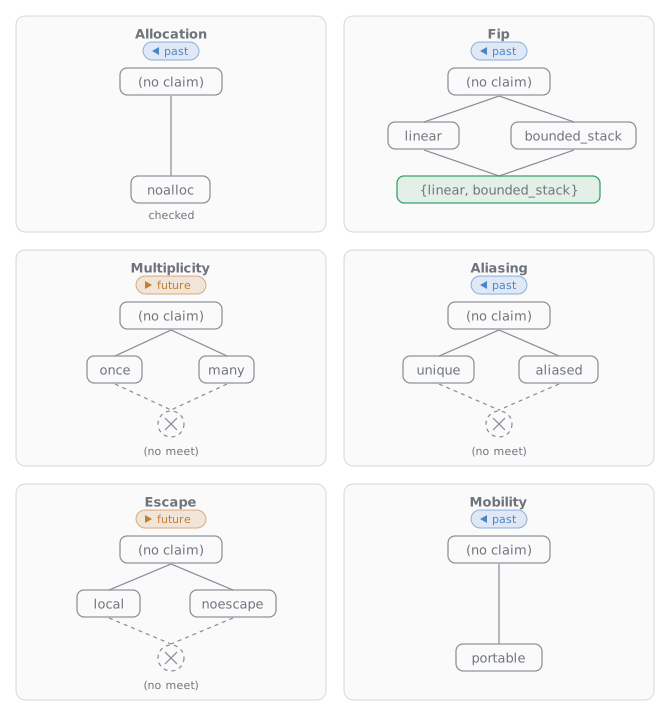
An exclusive axis is a choice of one point, which is why @ {once, many} is rejected as a contradiction at parse. Only the fip axis composes, because its facts are cumulative strengthenings of one certificate rather than alternatives. Polarity is the axis’s variance discipline, the direction its proof obligation flows. A past fact is covariant: it records how a value was built, the producer proves it, and the fact travels with the value wherever it goes. A future fact is contravariant: it restricts what may still be done with the value, the consumer promises it, and the fact binds at the use site. The polarity is stated by proof obligation, deciding which side of an API seam owes the evidence when a fact is checked.24
The multiplicity axis already has a checked instance elsewhere in the language, applied to a continuation rather than a value: an operation’s grade (effects and handlers) is never, once, or many, the same words on the same lattice, restricting how a handler clause may resume the captured continuation k. The grade on an operation and the multiplicity fact on a closure are the same point on the same axis, read at two boundaries: the operation form is checked on a continuation and pins once to exactly one resumption in tail position, while the value form is affine, at most one use of the annotated closure. It adds one point the value facts omit, never (the continuation is dropped), because a value used zero times is not a tracked usage fact but a clause that never resumes is a real, useful grade. That shared vocabulary is not a coincidence of spelling: the continuation an operation hands its handler is the first value in the language to carry a coeffect, which is what makes “an effect is just a coeffect on its own continuation” (three posets) a literal statement rather than a slogan.
The facts themselves:
| Fact | Axis | Meaning | Status |
|---|---|---|---|
noalloc | Allocation | the result is computed without allocating a fresh heap cell, whole call tree | checked |
linear | Fip | no duplication of owned heap inputs (the fip family) | checked |
bounded_stack | Fip | the whole certified call tree uses bounded stack | checked |
once | Multiplicity | consumed or called at most once | checked |
many | Multiplicity | may be consumed or called many times (the spelled default) | checked |
unique | Aliasing | statically unaliased ownership | reserved |
aliased | Aliasing | explicitly shared, non-unique | reserved |
local | Escape | tied to the current dynamic scope or region | reserved |
noescape | Escape | cannot be stored, returned, or captured past the boundary | checked |
portable | Mobility | may cross a mobility/replay/receiver boundary | checked |
The checked facts are noalloc, linear, bounded_stack, once, many, portable, and noescape; each has a subsection below. Other reserved facts are rejected (reserved facts).
Boundary facts, not ambient modes. This design space ranges from ambient classifications carried by every value to explicit claims checked only where needed. Prism chooses the latter: @ once constrains one consumer, @ portable one crossing, and @ noalloc, @ linear, and @ bounded_stack one call tree; unannotated values carry no mode vector. Operation grades are the established instance of this design: never < once < many constrains one handler boundary, survives desugaring as typed data, and is consumed directly by lowering.
The facts split into two families by where they are written. The declaration claims (@ noalloc, @ linear, @ bounded_stack) sit at the root of a function’s return annotation and certify a property of the declaration’s whole call tree; the fip and fbip keywords bundle them. The closure contracts (@ once, @ many, @ portable, @ noescape) sit on a function-typed parameter (or, for @ noescape, a callback’s domain) and constrain one boundary between a caller and a callee. Writing @ once, @ many, or @ portable on a non-function type is rejected as inert (E6085), and writing a declaration claim anywhere but a return annotation’s root is an error naming its positions. Every fact is erased before the core, so an accepted program is byte-identical on every backend: the contract governs what the compiler accepts, never what a passing program does.
9.2 noalloc
The allocation fact on its own: this call, and everything it reaches, computes its result without taking a fresh heap cell. The check walks the body after reuse lowering at a budget of zero, after the compiler has already spent every reuse opportunity, so a constructor costs one cell even through a reuse token: a shared input can leave the token empty, and carving a cell from an arena counts too: alloc is cheaper than the heap, not free. The claim composes with an effect row and with given constraints (: T @ noalloc ! {IO}); a function may be @ noalloc and still perform IO, because the effect row says what is observable while the certificate says the call tree does not allocate.
fn larger(a : Int, b : Int) : Int @ noalloc =
  if a > b then a else b

fn main() = println(larger(48, 18))
A reuse token can be empty when its input cell is shared, so the certificate charges the fresh-allocation fallback. Handler installation and performed effects also require a bound on lowering-generated cells; without one, finite allocation claims are refused. These conservative checks do not disable runtime reuse or effect lowering.
Boxed scalar literals count as allocations. Arithmetic on arbitrary-precision Int may allocate after overflow, and fixed-width and floating-point results can require fresh boxes. A runtime operation without a proven bound cannot satisfy noalloc or a finite fip(n)/fbip(n) budget, even if a particular input happens not to allocate.
A body that allocates is rejected with the first witness sites named in evaluation order (E6076):
type Box = Box(Int)

fn boxit(x : Int) : Box @ noalloc = Box(x)
The fact is also a demand: @ noalloc on a function-typed parameter obliges every supplied callable to carry the certificate itself, which requires the argument to be traceable to a certified name (E6086, E6087). Allocation certificates gives the full story: the witness diagnostics, the recipe for certifying a region, and the demand’s traceability rules.
9.3 linear
The ownership fact of the fip axis: the function owns each parameter and consumes each owned, non-immediate value at most once on every control path, which is what lets the compiler hand a matched cell straight to a reuse. The check runs over the source core before reference-count insertion, so it sees the uses as written: each owned parameter, pattern field, local result, and captured value counts, while tagged immediates such as Int and Bool stay unrestricted because duplicating a machine word is a run-time no-op. A borrow parameter is refused at the signature (E6077), since a borrowed cell is the caller’s and never the callee’s to consume, and a direct callee that receives an owned value must itself carry @ linear or fip (E6079). Allocation and stack growth remain unconstrained.
fn rev_onto(xs : List(Int), acc : List(Int)) : List(Int) @ linear =
  match xs of
    Nil => acc
    Cons(h, t) => rev_onto(t, Cons(h, acc))

fn main() = println(sum(rev_onto([1, 2, 3], Nil)))
Matching a heap value consumes it, so returning the scrutinee from an arm that also destructured it is a second use (E6078):
fn keep(xs : List(Int)) : List(Int) @ linear =
  match xs of
    Nil => xs
    Cons(_, _) => xs
9.4 bounded_stack
The stack fact of the fip axis: the certified call tree runs in constant stack. Codegen delivers the bound by turning recursion into a loop, which it can do for a tail call, a tail call under a single constructor, and a tail call under an associative addition; one rewrite applies per function, so a body mixing the two modulo shapes has no single loop to become (E6081). The bound closes over both the call tree and the recursion group: every function the body reaches needs a bounded-stack certificate of its own or must be a constant-stack primitive (E6084), and every member of a mutually recursive cycle must carry the certificate, since an uncertified partner’s frames are the caller’s frames (E6083).
fn steps(n : Int, acc : Int) : Int @ bounded_stack =
  if n == 0 then
    acc
  else
    steps(n - 1, acc + 1)

fn main() = println(steps(10, 0))
A recursive call anywhere else keeps one live frame per element, so the claim is false however small the inputs are in practice (E6080):
fn depth(n : Int) : Int @ bounded_stack =
  if n == 0 then
    0
  else
    1 * depth(n - 1)
9.5 fip and fbip
The keyword forms of Lorenzen et al. (2023) are bundles of the declaration facts. fbip claims the allocation fact alone; fip claims all three, allocation plus linear plus bounded_stack, which together certify that the function runs fully in place: no fresh cell is allocated, no owned input is duplicated, and recursion has bounded stack. Each fact closes over the call tree on its own, so an fbip caller may call either discipline while a fip caller needs linear callees (E6079).
fip fn identity(x : Int) : Int = x

fn main() = println(identity(42))
Both keywords take a grade: the bare form declares an allocation budget of zero per call, and a parenthesized grade allows that many fresh cells. The check charges every call the callee’s own declared budget in full, recursive calls included, so the per-call figure holds over the whole dynamic extent; a callee with no zero-allocation certificate, or an indirect call through a function value, has no budget to charge and leaves the total unbounded (E6075).
fip(1) fn pad(xs : List(Int)) : List(Int) = Cons(0, xs)

fn main() = println(sum(pad([1, 2])))
The declaration syntax and its interaction with replayable are under declarations and programs; the reuse mechanism the checks lean on is described under reference counting and FBIP reuse.
9.6 once
The affine closure contract: a parameter marked @ once admits a value used at most once25, and only directly. Using it twice, aliasing it through a let, or capturing it under a lambda all count as further use, since each makes a second call possible (E6059). The contract belongs to the receiving function and is what its callers rely on: a callback passed to a @ once slot will not be duplicated or retained for a second call.
fn apply_once(f : ((Int) -> Int) @ once, x : Int) : Int = f(x)

fn main() = println(apply_once(\(n) -> n * 2, 21))
fn twice(f : ((Int) -> Int) @ once, x : Int) : Int = f(f(x))
9.7 many
The spelled default of the multiplicity axis: the value may be consumed or called freely. It is exclusive with once in a row, and the subsumption runs one way: a @ many value fits a @ once slot, never the reverse, because a promise of unrestricted use satisfies a consumer who promises restraint while a one-shot value handed to a repeating consumer would be called twice. Spelling the default matters at a seam: a higher-order signature that says @ many documents, and holds itself to, the right to call its argument repeatedly.
fn twice(f : ((Int) -> Int) @ many, x : Int) : Int = f(f(x))

fn main() = println(twice(\(n) -> n + 1, 40))
9.8 portable
The mobility contract: a @ portable closure may be moved to a fresh runtime, so everything it captures has to travel with it. A capture is admitted when it is a content-addressed top-level function or constructor, another portable parameter, or portable scalar data (a portable-typed parameter, or a let whose value is a literal, is ascribed a portable type, or is inferred to have one); a captured local closure, var cell, or handler operation is bound to the runtime it was created in and is rejected by name (E6060).
fn answer() : Int = 42

fn ship(f : (() -> Int) @ portable) : Int = f()

fn main() = println(ship(\() -> answer()))
fn ship(f : (() -> Int) @ portable) : Int = f()

fn main() =
  let g = \() -> 3
  println(ship(\() -> g()))
teleport(work : (() -> a ! {IO}) @ {once, portable}) : Result(Unit, MoveError) ! {Placement, IO | e} (the Teleport module) is the checked mobility boundary built from those facts: its parameter type makes each call prove the closure captures only content-addressed code and portable data and runs at most once, so the computation is safe to move to a fresh runtime. teleport does not call work. It seals the computation into an envelope carrying the machine state a suspend at that call would have captured, and hands the envelope to place, the one operation of the Placement effect, so where the computation goes is the installed transport’s choice and never an argument here. The result reports delivery rather than the closure’s value, because across a transport that leaves the process there is no value to return: the sealing run reaches place and the computation continues in another runtime, whose output continues the sealing run’s rather than repeating it. What the annotation governs is still only what the compiler accepts; what a placement does is the transport’s.
import Teleport (..)

fn classify(seed : Int) : Int = seed * 2

fn run_once(f : (() -> Int) @ once) : Int = f()

fn announce() : Unit ! {IO} = println(classify(21))

fn main() =
  println(run_once(\() -> 1))
  -- The closure captures only a top-level function: portable, single use. It is
  -- sealed into an envelope rather than called, and the installed transport
  -- decides where that envelope lands. `run_here` lands it in this process, so
  -- what the sealed computation prints is printed after the cut.
  println(show(run_here(\() -> teleport(announce))))
9.9 noescape
The scoped-token contract, written on a callback’s domain: the callback’s argument is valid inside the call and no longer, so the caller can hand out a scoped resource knowing it stays inside. Returning the token, embedding it in returned data, aliasing it out, or capturing it in another closure would each let it outlive the call that lent it, and all are rejected (E6061). The promise is verified by reading the callback’s body, so the argument must be a form whose body the compiler can see: a closure literal, a top-level function, or a parameter relaying the same contract; a computed function value hides its body and is refused rather than admitted on trust (E6062).
type Token = Token(Int)

fn read(t : Token) : Int =
  match t of
    Token(n) => n

fn with_token(f : (Token @ noescape) -> Int) : Int = f(Token(41))

fn main() = println(with_token(\(t) -> read(t) + 1))
type Token = Token(Int)

fn read(t : Token) : Int =
  match t of
    Token(n) => n

fn with_token(f : (Token @ noescape) -> Token) : Token = f(Token(41))

fn main() = println(read(with_token(\(t) -> t)))
9.10 Reserved Facts
unique, aliased, and local parse as facts of their axes and are rejected wherever written, because their checkers do not exist yet. Reserving the vocabulary ahead of the checkers is deliberate: an unknown word in usage position is a hard error rather than a warning, so no program or package can give a fact a private meaning that a later checker would have to honor or break.
10. Expressions
The expression grammar is in the surface grammar and the effect and failure forms are in effects and handlers; the forms below are those the grammar alone does not settle.
10.1 Method Calls
A method call e.m(args) is uniform-function-call syntax (UFCS): pure sugar for m(e, args), with the receiver e supplied as the first argument. Prism has no methods, only top-level functions; the dot is notation, not dispatch, so any function reads as a method and calls chain left to right (e.f().g() is g(f(e))). Extra arguments follow the receiver: a.add(b) is add(a, b). A trailing block argument, e.m(args) fn (x) { body }, appends the lambda as the last argument; this is how the stream consumers in streams.pr chain. Field access is e.field, and the two compose, e.field.m(args) being m(e.field, args).
-- Uniform Function Call Syntax (UFCS).
--
-- A method call `e.m(args)` is sugar for `m(e, args)`: the receiver becomes the
-- first argument. Prism has no methods, only functions; the dot is notation, so
-- any function reads as a method and calls chain left to right. Composition and
-- last-argument pipelines are covered separately in compose.pr.
--
-- Expected output:
--   10
--   10
--   8
--   11
--   7
--   3

fn double(n) = n * 2

fn add(a, b) = a + b

type Vec = Vec { x: Int, y: Int }

fn main() =
  -- These are the same call.
  println(double(5))
  println(5.double())
  -- Extra arguments follow the receiver: `a.add(b)` is `add(a, b)`.
  println(5.add(3))
  -- Chaining reads left to right.
  println(5.double().add(1))
  let v = Vec { x = 7, y = 3 }
  println(v.x)
  println(v.y)
Function composition is core to functional programming, and Prism keeps the full algebra: f >> g is the forward composition \x -> g(f(x)), f << g the backward \x -> f(g(x)), and x |> f pipes an already-computed value into a function. Composition binds tighter than the pipe, so x |> f >> g pipes x through the composed pipeline.
The contrast with Haskell is direction, not power. Haskell’s primitive is backward composition (.), and idiomatic Haskell builds the function first and applies it last, reading right to left; pipelining a value forward takes the library operator (&). Prism makes the forward reading the default: dot-chains, |>, and >> all read in dataflow order, left to right, the order in which the value actually moves.
| idea | Prism | Haskell | OCaml |
|---|---|---|---|
| compose, forward | f >> g | g . f | fun x -> g (f x) |
| compose, backward | f << g | f . g | fun x -> f (g x) |
| pipe a value forward | x |> f | x & f | x |> f |
| chain calls on a value | e.f().g() | (g . f) e | e |> f |> g |
The denotations agree exactly (e.f().g(), e |> f >> g, and (f >> g)(e) are the same program), so the choice among them is prose style: the dot for a value stepping through transformations, |> for a computed result flowing into a pipeline, >>/<< for naming a composed function that is passed around or applied later.
-- Function composition three ways: composed functions are values built with
-- `>>` (forward) and `<<` (backward), a computed value flows on with `|>`,
-- and the UFCS dot chains the same calls in the same left-to-right order.
--
-- Prints:
--   22
--   21
--   22
--   22
--   100

fn inc(x : Int) : Int = x + 1

fn double(x : Int) : Int = x * 2

fn clamp_hundred(x : Int) : Int =
  if x > 100 then
    100
  else
    x

fn main() =
  let up = inc >> double  -- \x -> double(inc(x))
  let down = inc << double  -- \x -> inc(double(x))
  println(show(up(10)))
  println(show(down(10)))
  println(show(10 |> inc |> double))
  let ten = 10
  println(show(ten.inc().double()))
  println(show(200 |> inc >> double >> clamp_hundred))
10.2 Comprehensions
A comprehension [ e for x in s, q, ... ] collects e for each element; a qualifier q is a guard if g or a binder let y = e. A guard is evaluated in a failure context, so an element is pruned both when g is false and when computing g fails: a failable accessor such as at_list (a prelude lookup from the standard prelude) past the end of a list prunes that element rather than aborting. The statement form for x in s, q, ... do body runs body per survivor. Both desugar to the prelude’s stream combinators (the Emit effect of the standard prelude), so they fuse without building an intermediate list.
A guard-free comprehension [ e for x in s ] is exactly a mapped and collected stream, and it desugars to that composition directly, so it rides the fused state-threading tier of effect lowering: no effect-operation cells, about two cells per element (the result list itself), the source evaluated exactly once before iteration, and e evaluated left to right once per element. Qualifiers (guards and binders) keep the general consumer path, whose pruning semantics need the failure context above. The choice of path is a cost decision only; both produce the identical list in the identical order.
-- List comprehensions and qualified for-loops. A comprehension
-- `[ e for x in s, <quals> ]` collects e per element. Qualifiers filter with
-- `if g` and bind with `let y = e`. A guard may be failable: it prunes the
-- element when computing g raises Fail, not only when g returns false. The
-- statement form `for x in s, <quals> do body` runs body per survivor.
-- Expected output:
--
--   1
--   4
--   9
--   16
--   25
--   30
--   40
--   50
--   2
--   4
--   10
--   30

fn main() =
  for sq in sof([x * x for x in srange(1, 6)]) do
    println(sq)
  for y in sof([y for x in srange(1, 6), let y = x * 10, if y > 20]) do
    println(y)
  for x in srange(1, 6),
      if even(x) do
    println(x)
  -- Failable guard: `at_list` fails past the end, so the guard prunes
  -- out-of-range indices just as it prunes the zero price. Keeps 10 and 30.
  let prices = [10, 0, 30]
  for i in srange(0, 6),
      if at_list(prices, i) > 0 do
    println(at_list(prices, i))
10.3 Records
Record construction C { f = e, ... }, functional update C { ..base, f = e }, and nested path update { base | a.b = e, ... } build and modify the record types; each is an in-place write on a uniquely owned value. A spread copies the fields it does not overwrite out of base, so base must already be known to be a C: spreading a sum type a pattern has not yet refined is rejected, since another constructor of that type carries different fields. The deriving (Lens) getters and setters compose with them for deeper access. A path generalizes past nested fields to traversals, indices, prisms, filters, and a read form (optic paths).
-- `deriving (Lens)` synthesizes a getter `<f>_of` and a functional setter
-- `with_<f>` per field. They are ordinary functions, no optic types needed.
-- On a uniquely owned value the setter is FBIP-reused.
--
-- Expected output:
-- 3
-- 7
-- 9
-- 4
type Vec2 = Vec2 { x: Int, y: Int } deriving (Lens)

fn main() : Unit ! {IO} =
  let v = Vec2 { x = 3, y = 4 }
  println(x_of(v))
  let v2 = with_x(v, 7)
  println(x_of(v2))
  let v3 = with_y(with_x(v, 9), 4)
  println(v3.x)
  println(v3.y)
10.4 Imperative control flow
Loops and early exit are surface sugar over tail recursion and effects, so they cost nothing beyond what an explicit recursion would. while cond do body and loop body (an unconditional loop) lower to a tail-recursive driver applied to the condition and body as thunks; because a var is a State effect (the standard prelude) the body mutates freely and the loop runs in constant stack with no per-iteration allocation. break and continue (valid inside while, loop, and for) and statement-form return e (which exits the enclosing function) compile to non-resumable performs of internal, fully-handled control effects, installed only for the keyword a body actually uses; a nested loop captures its own break/continue. Because each control effect is discharged at its loop or function boundary, none appears in the surfaced effect row: a loop is as pure as its body, and a function using return infers the same row as the equivalent recursion. Compound assignment x += e (and -=, *=, %=) on a var is shorthand for x := x <op> e.
The left side of := and of a compound assignment is not limited to a bare name: any optic path of field and index steps rooted at a var is an lvalue, and the statement is exactly the brace update it abbreviates. b.score += 7 is b := { b | score = b.score + 7 }, reading the focus first the way a[i] += e already does, and cs[0].hp -= 4 rebuilds the element through the same functional update (in place when uniquely owned). The root must be a var; a path rooted at a let binding is refused. A var may carry a type annotation, var s : Solver := e, which declares its cell at that type so a path statement (or a brace update of the var) resolves its fields without an inline ascription.
Threaded State has the same statement form with the state’s own name as the root: get().metas.next += 1 is put({ get() | metas.next += 1 }). The get and put are the ordinary Control.State operations, resolved in scope like the longhand, so the effect performed stays spelled at the site.
Each form desugars to an existing construct:
| Surface | Desugaring |
|---|---|
x += e (and -=, *=, %=) | x := x <op> e |
x.a[i].b := e | x := { x | a[i].b = e } (a compound reads the focus first) |
get().a.b := e | put({ get() | a.b = e }) (likewise for compounds) |
while cond do body | repeat_while(\() -> cond, \() -> body) |
loop body (reachable break) | repeat_while(\() -> true, \() -> body) |
loop body (no break) | forever(\() -> body), whose result is a bottom type |
break / continue | a never perform of an internal Break/Continue effect handled at the loop |
return e | a never perform of an internal Return(a) effect handled at the function body |
-- Imperative control flow recovered from effects and tail recursion: `while`,
-- `loop`, `break`, `continue`, early `return`, and compound assignment, all
-- desugaring to the existing core. `var` is a State effect, so loop bodies mutate
-- freely yet each function below stays observably pure. An assignment's left
-- side may be a field or index path rooted at a `var`; the statement is the
-- brace update it abbreviates, rebuilding in place when uniquely owned.
fn sum_evens(limit : Int) : Int =
  var total := 0
  var i := 0
  while i < limit do
    i += 1
    if i % 2 == 1 then
      continue
    total += i
  total

fn first_factor(n : Int) : Int =
  var d := 2
  loop
    if d * d > n then
      return n
    if n % d == 0 then
      return d
    d += 1

fn countdown(start : Int) : Int =
  var n := start
  var ticks := 0
  loop
    if n <= 0 then
      break
    n -= 1
    ticks += 1
  ticks

type Tally = Tally { evens: Int, odds: Int }

fn tally(limit : Int) : Tally =
  var t : Tally := Tally { evens = 0, odds = 0 }
  var i := 0
  while i < limit do
    i += 1
    if i % 2 == 0 then
      t.evens += i
    else
      t.odds += i
  t

fn main() : Unit ! {IO} =
  println(show_int(sum_evens(10)))
  println(show_int(first_factor(91)))
  println(show_int(first_factor(97)))
  println(show_int(countdown(5)))
  let t = tally(10)
  println(show_int(t.evens))
  println(show_int(t.odds))
10.5 Exponentiation
a ^ b raises a to the power b. It binds tighter than * and than unary minus (-2 ^ 2 is -(2 ^ 2), the mathematical reading; a negative base needs parentheses, (-2) ^ 2), and is right-associative, so 2 ^ 3 ^ 2 is 2 ^ (3 ^ 2). It is the method of the Pow class (the standard prelude) with Int and Float instances, so it desugars to pow(a, b): over Int it is bignum-correct (the instance multiplies), over Float it is a pow_float call. A mixed Int ^ Float is a type error, resolved by an explicit to_float, exactly as 2 + 3.0 is (Prism never coerces between Int and Float implicitly).
An Int exponent may be negative: a ^ b with b < 0 is defined as 1 / a ^ (-b) under the language’s one truncating division rule (integer arithmetic).26 Float exponents follow IEEE pow, so 2.0 ^ -1.0 is 0.5.
10.6 Indexing
a[i] reads, a[i] := v writes, and a[i] += e updates an indexed container. The form is dispatched on the receiver’s type (not a class, so no inference change): Array is indexed by Int, HashMap by String, String by Int (yielding the byte), List by Int, and Tensor by a List(Int) of per-axis indices (yielding a Float). Array, HashMap, List, and Tensor are writable; String is read-only. Array and HashMap rewrite the cell in place (FBIP); a List write is the functional list_set, rebuilding the spine, and a Tensor write delegates to tensor_set.
A read is failable: a missing index or key performs the Fail effect (errors and failure), so a[i] has type Elem ! {Fail} and the partiality surfaces in the row rather than in an Option wrapper. It therefore composes with ??, ?., default, and the rest of the failure axis: a[i] ?? d supplies a default, and the counter idiom is m[k] := (m[k] ?? 0) + 1, honest that an absent key starts at zero. A plain write a[i] := v is total; a[i] += e reads first, so it is ! {Fail}. Writes rebind the underlying var and rewrite the cell in place when it is uniquely owned (FBIP, declarations and programs); nested grid[i][j] := v composes the same way. a[i] := v requires a to be an assignable var.
10.7 Typed Buffers and Tensors
FloatBuf and IntBuf are flat buffers of unboxed 8-byte elements, read and written through the tbuf_* and ibuf_* operations (new, len, get, set, blit). A buffer carries the same ownership discipline as Array: a write mutates it in place when it is uniquely owned and copies it when shared, so mutation is never observable through an alias, and elements thread bit-for-bit identically on the interpreter and native backends (NaN payloads and subnormals included). Data.FlatArray puts one typed surface over both: FlatArray(a) is dispatched by the FlatElem class (instances for Float and I64), so an unsupported element type is a missing-instance error rather than a representation fault. Data.Tensor is a record over FloatBuf carrying per-axis shape, strides, and names: transpose by axis name is a stride permutation that moves no data, reshape is contiguity-checked, and a bracket with two or more indices is multi-index sugar extending indexing: t[i, j] reads and t[i, j] := v writes through the strides. The storage under all of these is flat; only a read boxes the scalar it returns, so element layout stays a cost fact rather than a change in what a program computes.
import Data.Tensor (..)

fn main() =
  var t := from_list([2, 3], [1.0, 2.0, 3.0, 4.0, 5.0, 6.0])
  t[0, 1] := 4.0
  -- Transpose by axis name: a stride permutation, no data movement.
  let u = transpose(t, "0", "1")
  println(u[1, 0])
10.8 SIMD Vectors
F64x2 and I64x2 are opaque baseline 128-bit vectors. Each operation acts on both lanes as one vector operation.
| Purpose | F64x2 | I64x2 |
|---|---|---|
| Lanes | Two IEEE-754 doubles | Two 64-bit integers |
| Broadcast a scalar | simd_fsplat | simd_isplat |
| Extract a lane | simd_fextract | simd_iextract |
| Arithmetic | simd_fadd, simd_fsub, simd_fmul | simd_iadd, simd_isub |
| Minimum and maximum | simd_fmin, simd_fmax | none |
| Bitwise operations | none | simd_iand, simd_ior, simd_ixor |
| Semantic guarantee | Contract |
|---|---|
| Opacity | Vectors have no show, equality, ordering, hash, or serialization. |
| Observation | A program can observe a vector only by extracting its scalar lanes. |
| Reference semantics | The scalar interpreter defines every operation, independently of host SIMD availability. |
| Native parity | Each native backend reproduces every lane bit for bit, including NaN payloads, signed zero, and subnormals. |
| Floating-point minimum and maximum | Each lane uses a < b ? a : b; the false branch selects b, including for unordered comparisons, rather than invoking a platform-specific intrinsic. |
-- Baseline 128-bit SIMD: two lanes per vector, one instruction per lane pair.
-- The scalar interpreter defines the semantics and the native backend must match
-- it bit for bit, so the output is a pure function of the source on every tier.
-- Vectors are opaque: they are built with `splat`, combined lane-wise, and read
-- back one lane at a time; there is no `show`, equality, or ordering on them.

fn dot2(a : F64x2, b : F64x2) : Float =
  let p = simd_fmul(a, b)
  simd_fextract(p, 0) + simd_fextract(p, 1)

fn main() : Unit ! {IO} =
  -- A two-lane float vector from a pair of scalars, via splat + replace-by-add.
  let xs = simd_fadd(simd_fsplat(3.0), simd_fsplat(0.5))
  let ys = simd_fsplat(2.0)
  println(show_float(dot2(xs, ys)))
  -- Lane-wise min and max, read back per lane.
  let lo = simd_fmin(xs, ys)
  let hi = simd_fmax(xs, ys)
  println(show_float(simd_fextract(lo, 0)))
  println(show_float(simd_fextract(hi, 1)))
  -- Integer lanes: bitwise and wrapping arithmetic.
  let m = simd_iand(simd_isplat(12), simd_isplat(10))
  let s = simd_iadd(simd_isplat(100), simd_isplat(23))
  println(simd_iextract(m, 0))
  println(simd_iextract(s, 1))
10.9 Optic Paths
Prism’s optics are use-site syntax first: no profunctor encodings, and no combinator library to work through before a field can be named. There is one rule instead. Between the | and the operator of a record update (record expressions), or inside s.[ ... ], a path is a sequence of steps read left to right. The path is the optic, spelled at the use site rather than reified as a value. Every form is sugar over map/with/match, so in-place reuse and fusion come for free and nothing new reaches the core: this is the language’s “effects instead of monads” stance applied to optics, paths instead of optic combinators.
A step is one of:
| Step | Meaning |
|---|---|
.field | descend into a record field |
each | traverse every element of a functor (lowers to fmap) |
[i] | focus one element of a list or array, by index |
?Ctor | focus through a sum constructor; others pass through |
(steps where p) | keep only the foci satisfying the predicate p |
A path is closed by one of these operations:
| Form | Operation |
|---|---|
path = v | set the focus to v |
path ~ f | modify the focus, applying f |
path += e (and -=, *=, %=) | update the focus: path ~ \(x) -> x <op> e |
s.[ path ] | read every focus the path selects into a list |
The compound terminals are the statement layer’s += family applied at a focus: { s | hp -= dmg } is exactly { s | hp ~ \(h) -> h - dmg }, and through a many-focus step ({ board | cells.each *= 2 }) the operation applies at every focus. /= is not in the family (it is not-equals). each is a reserved keyword; every other step reuses existing tokens.
Each form lowers to ordinary code. Fields use the derived getter and functional setter; nested fields rebuild only their enclosing spine. Modify reads the focus, applies the function, and writes the result back:
  { p | pos.x = 30 }
  { p | hp ~ heal }
each lowers to fmap and composes with all later steps. An index focuses one list or array element through its ordinary setter; an out-of-range index leaves the container unchanged. A ?Ctor step rebuilds the matched constructor and passes every other constructor through. A filter applies the remainder of the path only to retained foci. These rules compose mechanically:
{ world | party.(each where alive).bag.each.count ~ \(n) -> n + 5 }
The remaining steps follow the same ordinary-code laws:
  { world | party[0].hp = 100 }       -- update one focus; unchanged if absent
  { shape | ?Circle.radius ~ double } -- update Circle; pass other constructors through
  players.[each.hp]                    -- collect all selected foci
An index lowers through list_set or in-place array_set, guarded by the same failable lookup used by ordinary indexing. A prism lowers to a match whose selected constructor is rebuilt and whose other arm returns the original value. The read form s.[path] is the update’s twin: it collects every selected focus into a list, using singleton lists for single-focus steps and concatenation across traversals. A ?Ctor therefore previews zero or one focus.
Paths are deliberately use-site syntax: written where they are used, not composed from a library of named optics, and optic kinds are not tracked in the type system (that a read-only path is read-only is a structural fact of the desugaring, not a typed law). This is the explicit trade: paths cover the great majority of real optic use and give up abstracting over which optic. The mental model is one breath: steps read left to right, = v/~ f to write, s.[ ... ] to read, nothing escaping into a new core construct.
Path literals
Abstracting over which optic is the one thing a use-site path cannot do, and a path literal buys back the narrowest useful case: #path followed by field steps denotes the pair of functions that reads and writes that one place.
#path hp              -- the `hp` field
#path pos.x           -- the `x` of the `pos` of the whole
#path Player.pos.x    -- the same route, anchored at its root type
The literal is sugar and nothing more. It expands, before typechecking, into the ordinary lens constructor applied to the getter and setter a reader would otherwise write by hand:
lens(\(s) -> s.pos.x, \(s, v) -> { s | pos.x = v })
so it is passed, returned, and composed like any other value, and no phase after the parser knows it was written. #path is not a keyword: path is an ordinary identifier everywhere, and the sigil is what makes the form recognizable, since no other expression begins with # followed by a name.
An uppercase head anchors the literal: #path Player.pos.x is the same expansion with both binders annotated at Player (fields are lowercase, so the head is never ambiguous). The anchor is what lets the literal sit inline where nothing else names the whole type, gets_at(#path Player.pos.x) against threaded state being the canonical case; an unanchored literal in such a position has no way to learn its record type and needs a surrounding annotation. A bare anchor with no field (#path Player) names a whole but no focus and is refused.
Only field steps are admitted. each, [i], ?Ctor and where focus zero or many places, so no total setter exists for them and they are a parse error inside a literal; a use-site path or an explicitly written traversal covers those. The restriction is what keeps the literal’s meaning exactly one field chain, and keeps the general case in the syntax where it reads best.
-- A concise tour of optics by path. A path is a sequence of steps between `|`
-- and the operator (or inside `s.[ ... ]`): `.field` descends, `each`
-- traverses a functor, `[i]` indexes, `?Ctor` focuses a constructor, and
-- `(each where p)` filters. End with `= v` to set, `~ f` to modify, or a
-- compound `+= e` (and `-=`, `*=`, `%=`) to update arithmetically; wrap in
-- `s.[ path ]` to read every focus into a list.
--
-- Expected output:
--   Vec2(1, 4)
--   Player(hero, Vec2(7, 4), 30, [])
--   Player(hero, Vec2(3, 8), 25, [])
--   [Player(a, Vec2(0, 0), 15, []), Player(b, Vec2(0, 0), 10, [])]
--   World([Player(a, Vec2(1, 2), 100, []), Player(b, Vec2(1, 2), 0, [])], 1)
--   Circle(20)
--   Square(3)
--   [Player(a, Vec2(1, 2), 15, []), Player(b, Vec2(1, 2), 0, [])]
--   [5, 0]
--   [5]

type Vec2 = Vec2 { x: Int, y: Int }

type Player = Player { name: String, pos: Vec2, hp: Int, bag: List(Int) }

type World = World { party: List(Player), turn: Int }

type Shape = Circle { radius: Int } | Square { side: Int }

fn alive(p : Player) : Bool = p.hp > 0

fn heal(h : Int) : Int = h + 10

fn mk(n : String, h : Int) : Player =
  Player {
    name = n,
    pos = Vec2 { x = 1, y = 2 },
    hp = h,
    bag = Nil
  }

fn main() =
  -- Set and modify a (possibly nested) field.
  let v = Vec2 { x = 3, y = 4 }
  println({ v | x ~ \(n) -> n - 2 })
  let hero = Player { name = "hero", pos = v, hp = 20, bag = Nil }
  println({ hero | pos.x = 7, hp ~ heal })
  -- A compound terminal is the modify it abbreviates.
  println({ hero | hp += 5, pos.y *= 2 })
  -- Traverse with `each`, then descend; modify and set per element.
  let party = [mk("a", 5), mk("b", 0)]
  println({ party | each.hp ~ heal, each.pos = Vec2 { x = 0, y = 0 } })
  -- Mix a field, an index, and another field.
  let world = World { party = party, turn = 1 }
  println({ world | party[0].hp = 100 })
  -- A prism focuses one constructor and passes the others through.
  println({ Circle { radius = 10 } | ?Circle.radius ~ \(r) -> r * 2 })
  println({ Square { side = 3 } | ?Circle.radius = 0 })
  -- Filter a traversal, then read selected foci into lists.
  println({ party | (each where alive).hp ~ heal })
  println(party.[each.hp])
  println(party.[(each where alive).hp])
First-class optics
An optic path spells a route where it is used. Data.Optic reifies a route as a value instead: a Lens(whole, part) carries a getter and setter together, so a function can accept it, a module can export it, and compose_lens can join it to another route. The module is opt-in with import Data.Optic (..).
{ player | pos.x = 30 }                                       -- route at the use site
fn nudge(l : Lens(s, Int), x : s) = over(l, \(n) -> n + 1, x) -- route as a value
The basic lens operations are:
| Call | Meaning |
|---|---|
lens(read, write) | pair a getter and setter |
view(l, x) | read the focus |
lens_set(l, x, v) | replace the focus |
over(l, f, x) | modify the focus |
over_eff(l, f, x) | modify with an effectful function |
compose_lens(outer, inner) | focus through two lenses |
lens_id, lens_fst, lens_snd | identity and pair-component lenses |
Both stored functions are pure. Effects enter only through over_eff, whose open row carries exactly the effects of the modifying function. A well-behaved lens obeys the usual three laws: reading after writing returns the written value, writing back the value just read changes nothing, and the last write wins.
The #path a.b.c form above constructs the same value as lens applied to a field-chain getter and setter, and #path Type.a.b.c anchors it so it needs no surrounding annotation. It takes field steps only; each, [i], ?Ctor, and where can focus zero or many places and belong to a traversal or a use-site path. A multi-segment literal already composes its own steps, so compose_lens is for joining routes that arrive as values, not for spelling a known chain.
Derived lenses compose directly:
import Data.Optic (..)

type Vec2 = Vec2 { x : Int, y : Int } deriving (Lens)
type Player = Player { pos : Vec2, hp : Int } deriving (Lens)

let player_x : Lens(Player, Int) = compose_lens(player_pos, vec2_x)

fn main() =
  let p = Player { pos = Vec2 { x = 1, y = 2 }, hp = 10 }
  println(view(player_x, p))
  println(view(player_x, lens_set(player_x, p, 9)))
1
9
A Traversal(whole, part) carries a reader for many ordered foci and a rebuilder for their replacements. collect_of reads the foci, set_all replaces them, over_all modifies them purely, and traverse_of_eff carries an effectful rewrite. each_of_list focuses every list element. compose_lens_traversal and compose_traversal_lens cross between one-focus and many-focus routes.
The rebuilder must receive exactly as many replacements as the reader returned, in the same order. Rebuilding with the values just read must return the original whole. These laws keep the representation first-order while allowing effect-polymorphic rewrites.
The Control.State bridge applies optics to threaded state:
| Call | Effect |
|---|---|
gets_at(l) | read one focus from State(s) |
set_at(l, v) | replace one focus in State(s) |
modify_at(l, f) | modify one focus in State(s) |
modify_all_at(t, f) | modify every traversal focus in State(s) |
Each operation carries only State(s). A rewrite can therefore name the focused part without mentioning unrelated fields of the carrier state.
10.10 Source Probes
A source probe is a named instrumentation point with a body that runs only when the process enables that name:
probe "parser.enter" do
  println("enter parser")
Probe names are string literals matching [A-Za-z0-9_.:-]+. At runtime, PRISM_PROBES is a comma-separated allow-list; PRISM_PROBES=parser.enter enables just that probe and PRISM_PROBES=* enables every probe. Whitespace around commas is ignored.
The semantic rule is that a disabled probe evaluates neither its body nor any formatting work inside that body. The surface form desugars to a branch over the runtime gate:
if probe_enabled("parser.enter") then
  println("enter parser")
else
  ()
The body must therefore have type Unit; any effects or allocation it performs remain visible to ordinary typechecking and allocation checks. The gate itself consults the process environment, so probe_enabled carries the IO effect and a probe site requires IO in the enclosing row even when its body performs nothing else. Probes are meant for diagnostics. In native or CLI-only code, probe bodies can write to stderr (eprint/eprintln) when they are not intended to perturb the program’s stdout contract; browser-runnable examples should use ordinary stdout because the web platform does not provide host stderr.
10.11 Typed Holes
A typed hole is a named expression placeholder, written ?name:
fn choose(x : Int, enabled : Bool) : Int ! {} =
  ?answer
The name is diagnostic identity, not a variable lookup. During inference the hole takes a fresh type metavariable (or the type pushed inward by a checking context), and inference continues around it. Constraints from the enclosing expression may therefore determine what belongs at the site without the compiler inventing a value for it. After those constraints are solved, the checker reports:
- the expected type;
- the contextual effect row permitted at the site, preserving the difference between a pure
{}context and an open or effectful row such as{Exn | e}; - every binding in lexical scope with its canonical printed type; and
- the bindings whose types subsume the expected type, ranked with exact matches first and then deterministically by name.
The report is a structured, serializable value and the human diagnostic is TYPED_HOLE (E1021). :type in the REPL uses the same checker and displays the same report for a hole-bearing expression. Candidate testing uses ordinary type subsumption and is observational only: testing one candidate cannot solve the hole or change the rank of another.
Ordinary checking and native code generation reject a program containing a hole, as does the WebAssembly-hosted frontend by default. There is one opt-in exception for interactive development: prism run --defer-holes file.pr and the REPL toggle :set +h permit holes through the interpreter frontend. Reaching one halts evaluation with a canonical fault containing only the written hole name and source span, for example typed hole ?answer at 54..61. The same string is the terminal Fault event in an observation trace. A deferred hole never inspects its inferred type, chooses a candidate, supplies a default, or falls through to another execution path; a program that does not reach the hole behaves exactly as it would after replacing the hole with an expression of the reported type.
Deferral is interpreter-only and off by default. Turning it on does not make a hole a value and does not relax any other type error. The compiler’s query, JSON, and conservative source-filling workflow is documented under typed-hole workflow.
11. Patterns
Patterns appear in match arms, let bindings, lambda and function parameters, and catch arms; their grammar is the pattern nonterminal of the surface grammar. A pattern is not just an equality test: it is how Prism destructures an algebraic data type, the mechanism that makes a sum-of-products type usable at all. Building a value picks one constructor and supplies its fields forward; a pattern runs that same constructor backward, naming the fields as new bindings while the compiler proves, at compile time, that every case the type admits is handled somewhere.
11.1 Destructuring
A constructor pattern matches a value built by that constructor and destructures its fields against nested patterns of their own: patterns nest to any depth, so one arm can reach through a tuple, into a constructor, into a record field, binding every name it needs in a single match. The remaining forms cover the value’s other shapes: a literal pattern (Int, Float, Char, Bool, and a leading - folded into a numeric literal, since patterns have no general negation) matches an exact constant; a variable pattern binds the whole matched value under a name; the wildcard _ matches anything and binds nothing; a tuple pattern (p, q, ...) destructures the matching tuple arity; a list pattern [p, q, ...] is sugar for the nested Cons/Nil constructor patterns it expands to; and a cons pattern h :: t is Cons(h, t), grouping to the right so x :: y :: rest takes two elements off the front. A cons pattern binds tighter than alternation: x :: _ | [] is two alternatives. The formatter prints every list constructor pattern in this sugar, [] for Nil, brackets for a list of known length, and :: otherwise. A record pattern C { f = p, ... } names the fields it cares about; a bare field name puns, binding a variable of the same name (C { f, .. } is shorthand for C { f = f, .. }), and a trailing .. ignores every field the pattern does not mention. The spread may stand alone: C { .. } matches the constructor without binding any of its fields.
-- Patterns nest arbitrarily deep: one arm can reach through a constructor,
-- into a record field, binding every name it needs in a single match.
type Point = Point { x: Int, y: Int }

type Shape = Circle(Point, Int) | Segment(Point, Point)

-- A bare field name puns, binding a variable of the same name, and `..`
-- ignores every field the pattern does not mention.
fn x_coord(p : Point) : Int =
  match p of
    Point { x = x, .. } => x

fn at_origin(s : Shape) : Option(Int) =
  match s of
    Circle(Point { x = 0, y = 0 }, r) => Some(r)
    _ => None

-- Tuple and list patterns destructure the corresponding literal forms; a list
-- pattern is sugar for the nested `Cons`/`Nil` constructor patterns it expands to.
fn describe(pair : (Int, List(Int))) : String =
  match pair of
    (0, []) => "zero, empty"
    (_, [only]) => "single: {only}"
    (_, [a, b]) => "pair: {a}, {b}"
    (_, _) => "other"

-- Expected output:
--   5
--   Some(5)
--   None
--   zero, empty
--   single: 42
--   pair: 1, 2
--   other
fn main() =
  println("{x_coord(Point { x = 5, y = 9 })}")
  println("{at_origin(Circle(Point { x = 0, y = 0 }, 5))}")
  println(
      "{at_origin(Segment(Point { x = 0, y = 0 }, Point { x = 1, y = 1 }))}",
    )
  println(describe((0, [])))
  println(describe((1, [42])))
  println(describe((2, [1, 2])))
  println(describe((3, [1, 2, 3])))
A single constructor pattern over a recursive type retires the recursion into a reusable combinator: fold_tree below destructures Tree exactly once, and every later traversal, size, total, depth, or flattening to a list, becomes a three-line call rather than a new match.
-- A functional pearl: destructure a recursive type once, as a fold, and every
-- later traversal over it becomes a three-line call instead of a new match.
type Tree(a) = Leaf | Node(Tree(a), a, Tree(a))

fn fold_tree(leaf : b, node : (b, a, b) -> b, t : Tree(a)) : b =
  match t of
    Leaf => leaf
    Node(l, x, r) => node(fold_tree(leaf, node, l), x, fold_tree(leaf, node, r))

fn size(t : Tree(a)) : Int = fold_tree(0, \(l, _, r) -> l + r + 1, t)

fn total(t : Tree(Int)) : Int = fold_tree(0, \(l, x, r) -> l + x + r, t)

fn depth(t : Tree(a)) : Int = fold_tree(0, \(l, _, r) -> 1 + max(l, r), t)

fn elems(t : Tree(a)) : List(a) =
  fold_tree([], \(l, x, r) -> append(append(l, [x]), r), t)

-- Expected output:
--   4
--   10
--   3
--   [1, 2, 3, 4]
fn main() =
  let t = Node(Node(Leaf, 1, Leaf), 2, Node(Node(Leaf, 3, Leaf), 4, Leaf))
  println(show(size(t)))
  println(show(total(t)))
  println(show(depth(t)))
  println(show(elems(t)))
Destructuring extends to parameter position: a parameter of a fn or a lambda may be written as a pattern rather than as a name, with the same meaning as taking a named argument and matching it around the whole body:
fn area(Circle(r)) : Int = r * r

-- means

fn area(s : Shape) : Int =
  match s of
    Circle(r) => r * r
A bare variable in parameter position is still the ordinary named parameter and _ still names a parameter the body ignores; any other pattern is a pattern parameter, and it composes with the rest of a parameter’s syntax (a type annotation, borrow, and a default all attach as usual). Where several parameters are patterns, the leftmost one’s match is the outer one, so a later pattern’s bindings cannot capture an earlier one’s. A pattern parameter must be irrefutable: it has to cover every value of its type, because there is no next arm to fall through to, and a refutable one is reported exactly as the match it denotes, a non-exhaustive match (E4001) with the caret under the pattern the author wrote. A pattern parameter has no name of its own, so it cannot be supplied by keyword; other parameters of the same function still can be.
-- A parameter may be written as a pattern rather than a name. The function
-- means what it would mean with a named parameter matched around the body, so
-- the pattern has to be irrefutable: there is no next arm to fall through to.
type Wrap = Wrap(Int)

type Pt = Pt { x: Int, y: Int }

fn unwrap(Wrap(n)) : Int = n

-- A record pattern may name the fields it needs and ignore the rest.
fn abscissa(Pt { x = x, .. }) : Int = x

fn sum_pair((a, b)) : Int = a + b

-- The rest of a parameter's syntax still applies: an annotation, `borrow`, and
-- a default all attach as usual.
fn scaled(borrow Pt { x = x, y = y } : Pt, by : Int := 2) : Int = (x + y) * by

-- Where several parameters are patterns, the leftmost one's match is the outer
-- one, so a later pattern's bindings cannot capture an earlier one's.
fn offset(Wrap(n), Pt { x = x, .. }) : Int = n + x

-- Expected output:
--   3
--   4
--   9
--   14
--   21
--   12
--   16
fn main() =
  println("{unwrap(Wrap(3))}")
  println("{abscissa(Pt { x = 4, y = 5 })}")
  println("{sum_pair((4, 5))}")
  println("{scaled(Pt { x = 3, y = 4 })}")
  println("{scaled(Pt { x = 3, y = 4 }, by := 3)}")
  println("{offset(Wrap(2), Pt { x = 10, y = 0 })}")
  -- A lambda parameter is a pattern in exactly the same way.
  let double = \(Wrap(n)) -> n * 2
  println("{double(Wrap(8))}")
11.2 Alternation
A pattern may alternate: p | q | r matches a value that any one of its alternatives matches. Alternation is legal wherever a pattern is, so it nests inside a constructor argument, a tuple, a list, and a record field, and Line(0 | 1, _) is one arm rather than two nearly identical ones.
An alternation means exactly the arms it stands for. p | q => e is p => e followed by q => e, and a nested alternation enumerates the product of its positions, leftmost slowest, so overlapping alternatives keep the source order a reader would assume. Everything else follows from that one rule and needs no separate machinery: a guard belongs to each alternative (p | q if g => e is p if g => e then q if g => e, so a value matching both alternatives retries the guard against the second before falling through), and each alternative is checked on its own, so a name shared by two alternatives need not have the same type in both as long as the body checks at each.
Because the body is shared, every alternative must bind the same set of names; one that binds a name another does not is an error (E6068) naming the name and pointing at the offending alternative. The enumeration is a product, so alternation in several positions multiplies; an arm expanding past 256 arms is refused (E6069) rather than compiled into an unbounded arm list.
-- An alternation matches when any one of its alternatives does, and is legal
-- wherever a pattern is: nested in a constructor argument, a tuple, a list, or
-- a record field.
type Shape
  = Dot
  | Line(Int, Int)
  | Ring(Int)
  | Poly(List(Int))

-- One arm, not four.
fn is_thin(s : Shape) : Bool =
  match s of
    Dot | Line(_, _) => true
    Ring(_) | Poly(_) => false

-- Every alternative must bind the same names, since all of them share the one
-- body. Here `n` is the first coordinate of a line and the radius of a ring.
fn extent(s : Shape) : Int =
  match s of
    Line(n, _) | Ring(n) => n
    Dot => 0
    Poly(_) => 1

-- Alternation nested in an argument position, and a guard, which belongs to
-- each alternative in turn: a value matching both alternatives retries the
-- guard against the second before falling through.
fn label(s : Shape, cap : Int) : String =
  match s of
    Line(0 | 1, _) => "short"
    Ring(n) | Line(n, _) if n > cap => "over"
    _ => "plain"

-- The arms an alternation stands for are what the exhaustiveness check sees,
-- so covering the last constructors with one arm needs no catchall.
fn corners(s : Shape) : Int =
  match s of
    Dot => 0
    Line(_, _) => 2
    Ring(_) | Poly(_) => 9

-- Expected output:
--   true
--   false
--   7
--   short
--   over
--   plain
--   9
fn main() =
  println("{is_thin(Dot)}")
  println("{is_thin(Ring(4))}")
  println("{extent(Ring(7))}")
  println(label(Line(1, 2), 3))
  println(label(Ring(9), 3))
  println(label(Ring(2), 3))
  println("{corners(Poly(Nil))}")
A let binding destructures with a constructor, tuple, list, or cons pattern and admits no alternation, since a binding names one shape and has nothing to choose between. Without an else clause the binding must be irrefutable, and a pattern that fails to cover its type is reported as the non-exhaustive match it denotes; with one, the uncovered shapes are what the fallback answers for.
11.3 Guards
A match arm may carry a guard, pat if cond => body: the pattern must match and the guard must evaluate to true before the arm fires, and the guard sees every variable the pattern bound. When the pattern fails to match, or matches but the guard is false, control falls through to the next arm in source order.
-- Pattern guards: `pat if cond => body`. The guard sees the pattern's
-- variables; when it is false the value falls through to the next arm.
-- Coverage counts only unguarded arms toward exhaustiveness, so a match
-- covered solely by guarded arms is rejected at compile time.

-- The classic: literal-free fizzbuzz, first true guard wins.
fn fizzbuzz(n : Int) : String =
  match n of
    k if k % 15 == 0 => "FizzBuzz"
    k if k % 3 == 0 => "Fizz"
    k if k % 5 == 0 => "Buzz"
    k => show(k)

-- Guarded insertion keeps the list sorted. The catchall handles both Nil and
-- the spot where x belongs.
fn insert(x : Int, xs : List(Int)) : List(Int) =
  match xs of
    h :: t if h < x => Cons(h, insert(x, t))
    _ => Cons(x, xs)

fn isort(xs : List(Int)) : List(Int) = foldr(insert, [], xs)

-- Expected output:
--   1 2 Fizz 4 Buzz Fizz 7 8 Fizz Buzz 11 Fizz 13 14 FizzBuzz
--   [1, 2, 5, 7, 9]
fn main() =
  println(str_join(" ", map(fizzbuzz, range(1, 16))))
  println(show(isort([5, 2, 9, 1, 7])))
11.4 Exhaustivity
Every match is checked by default, with no opt-out: the usefulness algorithm of Maranget (2007) decides, from the arms’ patterns alone, whether some value of the scrutinee’s type reaches no arm (a non-exhaustive match, E4001, an error that names a concrete missing pattern as a witness) and whether some arm can never fire because every value it would match is already claimed by an earlier arm (an unreachable arm, E4000). A guarded arm does not count toward exhaustiveness, since its guard may fail at run time and fall through regardless of what its pattern matched; a wildcard arm underneath a family of guarded arms exists precisely because the guards above it cannot discharge the check on their own.
Both questions are asked of the arms an alternation stands for, not of the alternation itself, so an alternation covering the last constructors of a type discharges exhaustiveness exactly as separate arms would. Reachability is the one place the source arm stays visible: an arm is unreachable only when no alternative of it can fire, and the error underlines the whole arm the author wrote. A single dead alternative inside a live arm (Red | Red) is not reported, since the arm as written is still doing work.
Exhaustiveness is not a lint: an unhandled case is a compile-time error, not a run-time panic waiting to happen. The proof survives into the compiled program too: each native backend still lowers a match to a constructor switch with a default block, but that block is unreachable code the checker has already proved dead, trapping rather than falling through silently in the one case a bug could ever reach it.
11.5 Pattern Synonyms
A pattern N(x) for T = head followed by indented view ... and make ... clauses defines a bidirectional pattern synonym: in match position it runs view and succeeds when that returns Some (the present case of Option, from the standard prelude); in expression position it runs make. Here view and make are contextual keywords, significant only inside a pattern declaration. A synonym with both halves is a prism (a composable view-and-build pair); one with only view is a view pattern. The for target may also name a class rather than a type, with the view a method of that class: a pattern First(n) for Peek = head with an indented view peek clause matches a value of any type with a Peek instance, dispatching peek through the dictionary at each match site, so one synonym destructures every instance.
type Vec2 = Vec2 { x: Int, y: Int }

-- a bidirectional pattern synonym: matches when y == 0, binding x
pattern OnXAxis(x) for Vec2 =
  view \(v) -> if v.y == 0 then Some(v.x) else None
  make \(x) -> Vec2 { x = x, y = 0 }

fn describe(v) =
  match v of
    OnXAxis(x) => x
    _ => -1

fn main() =
  println(describe(Vec2 { x = 5, y = 0 }))
  println(describe(Vec2 { x = 5, y = 3 }))
12. Declarations and Programs
A function is declared with fn; a parameter may carry a type annotation, a default value := e, or the borrow modifier, which lets a pure function read a parameter without taking ownership of it, and it may be written as an irrefutable pattern instead of a name. A return annotation is written : T ! {R} for result type T and effect row R, : T ! for an explicit empty row, or : T to leave the row inferred. A parameter with a default may be omitted, and any argument may be passed by name as f(p := e); positional arguments may precede named ones, while a positional argument after the first named argument is rejected. Named arguments may otherwise appear in any order, and the call is rewritten to positional form with omitted defaults filled. Defaults and named arguments are honored on top-level functions. A top-level let is a constant: its references are inlined. A where block attaches non-recursive, lexically scoped definitions to a function body.
-- Named and default arguments. A call may omit trailing defaulted parameters
-- or pass any argument by name. The two combine freely, and named arguments
-- may be reordered.

fn rect(w, h := 1, border := 0) = w * h + border

fn main() =
  println(rect(5))
  println(rect(5, 3))
  println(rect(5, 3, 2))
  println(rect(5, border := 100))
  println(rect(w := 2, h := 4))
  println(rect(h := 4, w := 2))
-- `borrow` lets a function read a parameter without taking ownership of it, so
-- the caller keeps the value live for later use. Here `xs` is borrowed by both
-- `len` and `scale`, so `main` still owns it and can sum it afterward.
-- Expected output:
--
--   4
--   40
--   10

fn len(borrow xs) =
  match xs of
    [] => 0
    _ :: rest => 1 + len(rest)

fn scale(borrow xs, k) =
  match xs of
    [] => Nil
    x :: rest => Cons(x * k, scale(rest, k))

fn main() =
  let xs = [1, 2, 3, 4]
  let n = len(xs)
  let ys = scale(xs, n)
  println(n)
  println(sum(ys))
  println(sum(xs))
A function may be annotated fip or fbip to assert the fully-in-place discipline of Lorenzen et al. (2023). fbip proves the body allocates no fresh cell and calls only annotated, allocation-free functions. fip additionally proves linearity (each owned, non-immediate binding is consumed at most once) and bounded stack (each recursive call in the group is a tail call or a single tail-modulo-cons or tail-modulo-add). These are static checks that reject a non-conforming body; the mechanism is described under reference counting and FBIP reuse. A function may additionally, or independently, be annotated replayable (record and replay), which certifies it performs only the recordable capability effects and so is reproducible from a recorded trace; replayable is orthogonal to fip/fbip and may combine with either.
The standalone @ bounded_stack declaration claim, written at the root of a function’s return annotation, checks only the stack part of fip: allocation and linearity remain unconstrained. Recursive calls must be true tail calls or supported tail-modulo-constructor/addition loops, and every member of a mutually recursive group must carry @ bounded_stack or fip. Its direct callees must likewise be certified; constant-stack primitives are admitted, while an uncertified direct callee or indirect call is rejected conservatively. The claim is erased before executable Core.
The standalone @ linear claim checks only the ownership part of fip, over the source Core before reference-count insertion. On every control path, each owned non-immediate parameter, pattern field, local result, and captured closure value may be consumed at most once; borrowed parameters are rejected. Tagged immediates such as Int and Bool remain unrestricted because duplicating a machine word is a run-time no-op. A direct callee that receives an owned value must carry @ linear or fip; an indirect call is rejected until callable types can supply the same certificate. Allocation and stack growth remain unconstrained, and the claim is erased before executable Core.
-- List operations with drop-guided cell reuse. Uniquely owned input cells can
-- be rebuilt in place; shared inputs require fresh cells. The functions make
-- no unconditional allocation claim. Run with PRISM_REUSE_STATS=1 to observe
-- reuse or PRISM_CHECK_LEAKS=1 to check live cells at exit.
--
-- Prints:
--   10
--   6
--   22

-- Reverse onto an accumulator, reusing uniquely owned input cells.
fn rev_onto(xs, acc) =
  match xs of
    [] => acc
    h :: t => rev_onto(t, Cons(h, acc))

-- Seed the accumulator with an empty list.
fn reverse_ip(xs) = rev_onto(xs, Nil)

-- Spine-rebuilding map: drop each `Cons`, rebuild it around the bumped head.
fn bump(xs) =
  match xs of
    [] => Nil
    h :: t => Cons(h + 1, bump(t))

-- Cap each head while rebuilding the spine through the same reuse path.
fn cap_at(xs) =
  match xs of
    [] => Nil
    h :: t =>
      if h > 9 then
        Cons(9, cap_at(t))
      else
        Cons(h, cap_at(t))

fn main() =
  println(sum(reverse_ip([1, 2, 3, 4])))
  println(sum(bump([1, 1, 1])))
  println(sum(cap_at([1, 20, 3, 40])))
12.1 Allocation Certificates
The zero-allocation guarantee is the first checked usage fact: @ noalloc, written at the root of the return annotation. Read it as the result type with the allocation coeffect subtracted: the body and its whole call tree allocate no fresh cell, calling only allocation-free functions. It carries the same check as fbip, without the linearity and bounded-stack requirements fip adds. It composes with an effect row and with given constraints (: T @ noalloc ! {IO}), and interoperates with the keyword forms: an @ noalloc function may call fip, fbip, or @ noalloc functions.
A failed certificate explains itself. The diagnostic lists the first three allocation witnesses in evaluation order, each a concrete reason with its name attached: a constructor that can allocate, including the shared-input fallback of reuse (by constructor name), a fresh tuple, a lambda materialized as a closure cell, a call to a function with no zero-allocation certificate (by callee name), an indirect call through a function value, or a primitive off the allocation-free list. A body with more sites than the bound reports the remainder as a trailing count (and 2 more), and the same witness detail backs the fip and fbip usage-check failures, so every discipline in the family points at its offending sites rather than restating the rule. The witnesses are read off the reuse-lowered core, with runtime fallback paths included: reuse may avoid a cell for a unique input, but a shared input can still allocate.
A region certifies by becoming a function of its own: hoist the expression, passing its free locals as parameters, and certify that function, so the identical whole-call-tree check covers exactly the region. larger below certifies the comparison region; choose_scaled performs potentially allocating arithmetic outside it.
-- A comparison selects an existing value without allocating. Arithmetic in
-- the caller may allocate a bignum; the certified region only chooses a value.
fn larger(a : Int, b : Int) : Int @ noalloc =
  if a > b then
    a
  else
    b

fn choose_scaled(a : Int, b : Int) : Int =
  let scaled = a * 2
  larger(scaled, b)

fn main() =
  println(larger(48, 18))
  println(choose_scaled(5, 3))
The certificate can also be demanded of a callable. @ noalloc on a function-typed parameter is a demand rather than a claim: every value supplied for that parameter must itself carry the whole-call-tree certificate. A named function satisfies the demand when its declaration is certified (fip, fbip, or @ noalloc) or when the compiler proves its call tree allocation-free on its own; a parameter that is itself demanded passes the fact through unchanged, so a generic wrapper keeps a callable’s certificate without being inlined; and a value the compiler cannot trace to a named function or a demanded parameter, such as a literal closure over locals, is conservatively rejected. A traced callee without a certificate is refused naming it, and an untraceable value is refused asking for a name. Forgetting is free: the same certified function flows into an undemanding slot with no annotation and no cost. The demand is proved before the optimizer runs, so acceptance never depends on inlining, specialization, or the lowering tier.
Writing @ noalloc anywhere other than the root of a fn return annotation or on a function-typed parameter is an error naming the certificate’s two positions.
See usage rows for the mode-family boundary: borrow, fip/fbip, @ noalloc, and operation grades are one resource story, but they are not all effect rows.
12.2 Stable Blocks
A serialized value is a contract across time: bytes written by yesterday’s binary are read by today’s, so a persisted format must never drift silently with the in-memory type. A stable block declares a type’s frozen wire history inline, on the type itself. Each entry is a rung: a record layout named V1, V2, and so on, where a later rung extends its predecessor with ..Vn and new fields, each new field carrying a default. The block’s last rung is the current one, and the bare type name (PlayerManual below) refers to it; an earlier rung is a real type of its own, named PlayerManual.V1. A migrations table lists every version pair the family converts between, and the family-qualified members PlayerManual.Vn.upgrade and PlayerManual.Vn.downgrade are how a program moves a value along it. From this one declaration the compiler generates the converter ladder and the byte-level codec, with no hand-written conversion logic required for an additive change.
import Wire (..)

type Calling = Sorcerer | Wizard | Bard deriving (Eq, Show, Serialize, Stable)

stable PlayerManual {
  V1 = { hero: String, calling: Calling, level: Int } frozen "83ec19c79b74ffde",
  V2 = { ..V1, signature_spell: String = "Magic Missile" } frozen "4629e1366adf6a75",
  V3 = { ..V2, spell_slots: Int = 2, inspiration: Int = 0 },
  migrations {
    V1 -> V2 = auto
    V2 -> V3 = auto
    V1 -> V3 = auto
  }
}

fn body() =
  let current =
    PlayerManual {
      hero = "Mira",
      calling = Sorcerer,
      level = 7,
      signature_spell = "Magic Missile",
      spell_slots = 5,
      inspiration = 3
    }
  -- The composed V3 -> V1 route drops every field the older sheet cannot carry
  -- and unions the loss each rung reports.
  let (first_edition, loss) = PlayerManual.V1.downgrade(current)
  println("dropped reaching V1: {loss_names(loss)}")
  -- The composed V1 -> V3 route restores the declared default for each of them.
  let restored = PlayerManual.V1.upgrade(first_edition)
  println("restored slots: {restored.spell_slots}")

fn main() = default(body, ())
Each row Vfrom -> Vto = auto asks the compiler to derive the conversion between those two rungs from their declared shapes. A purely additive step, a later rung that only appends defaulted fields, derives both directions: a total upgrade that copies the shared fields and fills each new one with its default, and an honest downgrade that keeps the older fields and returns the lowered value paired with a Wire.Loss naming exactly the fields it had to drop. The interface a program calls is family-qualified. PlayerManual.V1.upgrade(sheet) follows the declared route from V1 to the current rung; PlayerManual.V1.downgrade(sheet) follows it in reverse and pairs the older value with its Loss:
PlayerManual.V1.upgrade    : (PlayerManual.V1) -> PlayerManual
PlayerManual.V1.downgrade  : (PlayerManual) -> (PlayerManual.V1, Wire.Loss)
Upgrade after downgrade is the identity on the safe subset, a law emitted as a property test over the derived generators rather than left to review.
The migration table is an explicit allowlist, not a graph search. Only adjacent steps are ever authored or derived; a non-adjacent row such as V1 -> V3 = auto composes the declared adjacent ladder and publishes that route rather than emitting an independent pairwise converter, so N rungs cost N-1 conversions in each direction. A PlayerManual.Vn.upgrade/downgrade pair is offered for exactly the predecessors the table promises a route to the current rung for; omitting V1 -> V3 would mean the family does not promise V1-to-current migration, even where a path exists. In the block above every route is auto, so PlayerManual.V1.downgrade walks V3 down to V1 in a single call, unioning the loss each step reports (the two later rungs together contribute spell_slots, inspiration, and signature_spell), and PlayerManual.V1.upgrade walks V1 back up to the current rung, restoring every default a later rung introduced.
A step that is not purely additive, a field whose type changed, or an additive step whose generated default is wrong in one direction, replaces the direction needing judgment with version(upgrade = ..., downgrade = ...); either direction may stay auto. The supplied direction is an inline single-parameter lambda whose parameter is bound to the source rung and whose body constructs the target rung by naming its fields:
migrations {
  V2 -> V3 = version(
    upgrade = \(s) -> PlayerManual {
      hero = s.hero,
      calling = s.calling,
      level = s.level,
      signature_spell = s.signature_spell,
      spell_slots = 7,
      inspiration = 0,
    },
    downgrade = auto,
  )
}
The lambda is checked against the edge’s exact interface, PlayerManual.V2 -> PlayerManual for the upgrade and PlayerManual -> (PlayerManual.V2, Wire.Loss) for the downgrade; a reversed endpoint, an extra effect, an upgrade that returns a Loss, or a downgrade that omits one is rejected against that signature. Naming a predecessor rung type in the signature of an ordinary top-level function (for example fn f(x : PlayerManual.V1)) does not yet resolve, so a version(...) direction is written inline. A version(...) row overrides only an adjacent edge, since a non-adjacent route is always auto.
Under the family-qualified surface, each adjacent step is an ordinary generated function whose flat spelling, upgrade_PlayerManual_V1_V2 and downgrade_PlayerManual_V2_V1, is minted mechanically from the type name and the two rung tags and reads in the direction of travel, source rung then destination. It is the internal adjacency the composed PlayerManual.Vn routes call, not a surface a program is meant to write; because the names are synthesized from the block header alone, renaming the type moves the whole family at once and no later phase parses a fact back out of a spelling.
Two diagnostics guard the table. An auto row the compiler cannot derive, a field whose type changed, or the rename, split, or merge that surfaces the same way, is E6065: it names the fields that need judgment and offers the smallest repair, an inline default when a required field was added or a version(...) override otherwise, and never guesses a correspondence. Were a later rung to retype calling instead of appending a field, the V1 -> V2 row could not be auto:
[E6065] cannot derive `stable PlayerManual` migration V1 -> V2
  auto cannot change a field type: `calling`
  supply the migration explicitly:
    V1 -> V2 = version(upgrade = <fn>, downgrade = <fn>)
  a rename, split, merge, or type change is never guessed
A row that names a rung the block does not declare, runs backward from a newer rung to an older one, or overrides a non-adjacent edge with version(...) is E6066, since a direct long route is a distinct edge rather than part of the adjacent ladder:
[E6066] migration `V2 -> V1` in `stable PlayerManual` must run from an older rung to a newer one
A rung marked frozen "<digest>" is sealed: the digest is the rung’s structural shape digest, the same construction that content-addresses every datatype (content-addressed core). Editing a sealed rung in place moves the digest and the program stops compiling, with the error naming the rung and the remedy: add a new rung instead of editing a shipped one. A rung that never shipped is reseated with prism store wire --accept <file>, which recomputes and rewrites its digest in place, loudly.
Freezing a rung’s shape is not enough on its own: the same old bytes could still decode into a different current value if an auto upgrade’s body changed while both rung shapes stayed fixed. The generated migration behavior is therefore sealed separately, in a sibling <source>.stable-lock manifest. Each adjacent edge is content-addressed by an edge hash folding the two rung shape digests together with the upgrade and downgrade converters’ canonical semantic hashes, the same per-definition Core identity that content-addresses every function (content-addressed core); each declared non-adjacent route is a route hash over the ordered edge hashes it composes, never a rehash of the composed bodies. A field’s default rides inside its upgrade hash and a generated loss label inside its downgrade hash, so changing either moves exactly the edges that cross it and every route through them. On the next build the manifest is re-derived and compared, and a generated migration whose behavior drifted, a changed default that relocates a loss path for instance, is E6067: it names the changed direction, the old and new component hashes, and the derived loss paths, then points at the remedy, relock an unpublished family or add a new rung so shipped behavior stays addressable. prism store lock --accept <file> reseats the manifest, previewing the rung, edge, and route hashes before it writes and reporting no change on a second run. A family with no manifest is unlocked and unchecked, exactly as an unshipped rung carries no frozen badge.
The block also derives the type’s Serialize against the current rung, and the byte-level frame is decoded two ways that share one signature. wire_encode_PlayerManual frames a current value under the current rung’s digest; the two decoders both hand back a current value or fail:
wire_encode_PlayerManual   : (PlayerManual) -> Wire.Bytes
wire_decode_PlayerManual   : (Wire.Bytes) -> PlayerManual ! {Fail}
decode_ladder_PlayerManual : (Wire.Bytes) -> PlayerManual ! {Fail}
wire_decode_PlayerManual insists the frame carry the current rung’s digest, while decode_ladder_PlayerManual accepts a frame from any rung the table promises a route for, decodes it at that rung, and composes the upgrades to hand back a current value; both refuse malformed bytes through the same Fail row rather than a sentinel value. The codec itself, the byte-level frame with its total decoder, is the Wire library, an opt-in import (the standard prelude): a program that never persists a value pays for none of this.
An ordinary value persists through the same frame without a hand-written digest string. deriving (Stable) carries one method, shape_digest_of, whose derived body is a per-type constant the compiler injects at the derive site: the type’s truncated structural shape digest, the same construction a frozen rung seals, computed in one place so the runtime frame check and the content hash can never disagree. wire_encode_stable(x) frames a value under its own digest; wire_decode_stable(bs) opens the frame, decodes the body at the annotated type, and fails unless the frame’s digest matches the type’s and no bytes trail. A wrong digest, wrong kind, truncation, or trailing byte is a hard Fail, never a mis-decoded value. Code that already holds a digest, a ladder rung or a peer’s advertised contract, uses the explicit escape hatches wire_encode_value_with_digest and wire_decode_value_with_digest. A hand-written instance Stable(T) is rejected outright: the class’s only method is compiler-computed, so a manual instance could only forge a frozen contract, and the error points at deriving (Stable).
12.3 Deprecation
A declaration is marked superseded with a deprecated annotation line directly above it, carrying the suggested replacement as a string:
deprecated "use `insert`, which also returns the displaced value"
pub fn add(m, k, v) = insert(m, k, v)
The annotation attaches to the declaration that follows it (a fn, type, class, effect, or any other named declaration) and records the suggestion; it is not itself a declaration. A deprecated line with no declaration after it, or two in a row, is a syntax error. deprecated is a contextual word, not a reserved one, so a program may still bind the name.
A use of a deprecated definition compiles, with a warning that names the definition, the suggestion, and the use site. It is only a warning: behavior is unchanged, so a deprecation never breaks a build or alters what a program computes (a determinism corollary: the warning is a diagnostic, not a semantic). A definition’s own body may use it without warning; only references from other definitions are reported, and only in the user’s own source, so a deprecation inside an imported library does not warn at the library’s internal call sites.
The policy is one deprecation window wide: a deprecated name keeps working with the warning through that window, and is removed after it. This is what lets the standard library evolve without a flag day: Base’s surface may only ever grow, or shrink through one full deprecation window, never break in place. The float dot-operators (+. and its family) and the operator-duplicating fixed-width builtins (i64_add and its family) rode exactly this window out and are gone: a surviving spelling exists for every one of them (+ on Float, + on I64), and writing a removed spelling is a pointed error naming it.
12.4 Function Contracts
A logic fn declares a proof-level function, and requires/ensures clauses attach a precondition and postcondition to an ordinary fn. These are logical propositions over Bool and Int, not runtime code: they are validated during compilation, erased before executable Core, and insert no runtime check.
logic fn between(x : Int, lo : Int, hi : Int) : Bool =
  lo <= x && x <= hi

fn clamp(x : Int, lo : Int, hi : Int) : Int
  requires lo <= hi
  ensures |r| between(r, lo, hi)
  = if x < lo then lo else if x > hi then hi else x
A requires clause is a Bool expression over the parameters; each ensures clause binds a result name in |r| and is a Bool expression over the parameters and that result. A logic fn is a total first-order abbreviation, usable only in these logical positions, that elaborates into the same logical form the clauses do; it cannot perform an effect, allocate, or call a runtime function. logic, requires, and ensures are reserved words; the final decreases clause of a totality claim is contextual and stays an ordinary identifier elsewhere.
Ordinary check, build, and run validate every contract (resolution, sorts, arities, the Bool requirement) and reject a malformed one as a source error, but never invoke a solver. prism verify FILE discharges the postconditions: it emits one canonical SMT-LIB obligation per ensures clause and runs them through an external solver (prism verify FILE --solver z3), reporting each function as verified, refuted by a counterexample, or pending when its body leaves the supported fragment. An unsat verdict is an honest solver-oracle receipt naming the trusted solver, not an independently checked proof, and prism dump smt FILE prints the obligations without running a solver. Because a contract is erased before Core, editing only a clause leaves every runtime artifact byte-identical; the machinery is described under function contracts.
12.5 Totality
total fn claims that a function returns a value in finitely many steps for every well-typed argument; assume total fn states the same claim as an explicit trusted assumption, accepted without a proof and kept visibly distinct from a checked one. The claim is a verification fact, not an optimization: it is erased before executable Core, changes no runtime behavior, and never gates ordinary compilation. total and assume are contextual, so both stay ordinary identifiers outside the modifier position.
type Nat = Z | S(Nat)

total fn depth(n : Nat) : Int =
  match n of
    Z => 0
    S(m) => 1 + depth(m)
Deciding whether an arbitrary function terminates is undecidable, so Prism does not attempt the general case: a total fn is a claim discharged only where the argument is mechanical, and reported pending everywhere else rather than guessed at. The tractable fragment is small and exact, and covers the cases that arise most in practice. Without an explicit measure, a total fn is checked when its body stays in a total fragment (no effect, handler, higher-order call, mutation, hole, or partial primitive) and either it is acyclic and calls only functions themselves certified total, or it is directly self-recursive and every recursive call consumes a strict constructor subterm of one matched parameter. The first case is trivial (an acyclic call graph of total pieces always terminates); the second is the standard structural-recursion argument (a well-founded descent on the algebraic argument).
A directly self-recursive total fn over first-order Int/Bool parameters may instead carry a final contextual clause decreases m after its requires and ensures clauses. The measure must be an Int expression in the linear-integer verification fragment. With preconditions R, path condition P, entry measure m, and the recursive arguments’ measure m', Prism generates R => m >= 0 and, for every recursive edge, R && P => m' >= 0 and R && P => m' < m; a call to a contracted helper also generates the helper’s instantiated precondition. prism dump totality FILE reports the number of ranking obligations without claiming they are proved, while prism verify FILE asks the configured SMT solver to discharge them. The measure is erased before Core, so adding or editing it cannot move executable behavior.
Anything past those fragments, mutual recursion, an effectful or higher-order body, a measure outside linear integer arithmetic, or an uncertified helper in the structural route, is reported pending with a precise reason; the checker never labels a function non-total, because a restriction means it could not establish the claim, not that the function diverges. prism dump totality FILE prints the per-function status, and a totality proof composes with a contract into total correctness only when both close; the checker is described under totality.
When a function’s totality rests on a proof Prism cannot reproduce, assume total fn records that fact as an explicit, trusted claim rather than leaving it pending. Some functions terminate for a reason past the structural checker’s single strict-subterm rule, or past what a solver can settle from a decreases measure: Ackermann’s function descends on a lexicographic pair, and other definitions rely on an ordinal argument, an external termination checker, or a paper proof. A user who holds that proof asserts the claim directly rather than restructuring the code to fit the checker:
assume total fn ackermann(m : Int, n : Int) : Int =
  if m == 0 then n + 1
  else if n == 0 then ackermann(m - 1, 1)
  else ackermann(m - 1, ackermann(m, n - 1))
An assume total is trusted, never silent. It is visibly distinct from a checked claim in diagnostics and docs, cannot be relabeled as proved, and every certificate that depends on it carries the assumption transitively, so a strict policy can reject any proof resting on an assumption. Editing the body or a precondition moves the assumption’s identity, so a trusted claim can never quietly outlive the code it was asserted about. This is the one honest boundary between what Prism proved and what the user vouched for, which is why a plain, unproved total fn is reported pending and never consumed as if it were true.
12.6 Test Declarations
A test fn is a private, zero-argument function returning Unit whose effects are limited to Fail and IO. Returning normally passes; fail(), a runtime fault, an unhandled effect, or any explicit exit fails with a distinct reported outcome. Tests may use private definitions in their own module, but cannot be pub, take parameters, or be named main.
fn double(n : Int) : Int = n * 2

test fn double_of_three_is_six() =
  if double(3) == 6 then () else fail()
prism test accepts a project, one source file, or the enclosing project by default. Project discovery includes tests in every project-owned module, even modules unreachable from the executable entry point, and integration modules are checked as package consumers that see only the public API. Logical test identities and execution order are deterministic; the positional FILTER argument with --exact, plus --list, --no-run, --format human|json, --show-output, and --fail-if-no-tests, select or report the same manifest without changing it. Each test runs in a fresh interpreter world with captured output, so state and effects cannot leak between tests.
The Test module’s assertions fail a test with a structured report rather than a bare fail(): fail_with(message), expect(cond, message), expect_equal(expected, actual) for any type with Eq and Show, and expect_text(expected, actual) for strings. A failing equality reports both values and, when either spans lines, a line diff; the JSON events carry the same fields. A comment -- test: skip(reason) directly above a test fn reports the test as skipped with its reason instead of running it, and -- test: tags(a, b) labels it for --tag a, which selects the tests carrying any requested tag. An unrecognized -- test: line is an error. --junit PATH additionally writes the results as JUnit XML, one suite per module, with no timings, so the file is deterministic.
Test declarations are retained only in test mode. Ordinary check, build, run, interfaces, Core hashes, native objects, and binaries strip them before semantic identity is taken, so adding or editing a test cannot change a production artifact.
13. Modules
A file is a module and a directory is a namespace prefix: import Data.Map loads Data/Map.pr. A project is a prism.toml manifest plus a source tree, resolved from the project root. A single-file program is one module.
import M brings M’s exports into scope under qualified names; import M (a, b) also brings a and b into bare scope; import M as N adds the alias N. The pub modifier on a declaration makes it visible to importers; pub import M (x) re-exports x through the importing module. An opaque type exports its name but not its constructors.
pub fn area(w, h) = w * h   -- exported

fn clamp(x) = if x < 0 then 0 else x   -- private to the module
An opaque type is how a module exports an invariant instead of a representation: importers can name the type, hold values of it, and pass them back, but only the defining module can construct or inspect one, so every value in circulation went through the smart constructor and carries whatever guarantee it enforces.
opaque type Celsius = MkCelsius(Float)

pub fn celsius(x : Float) : Celsius =
  MkCelsius(if x < -273.15 then -273.15 else x)

pub fn degrees(c : Celsius) : Float =
  match c of
    MkCelsius(x) => x
Celsius values below absolute zero cannot exist, and the proof is the module boundary rather than a runtime check at every use site: celsius clamps once, on the only road in.
Name resolution rewrites every top-level definition to a canonical, module-qualified symbol (an export as Data.Map.insert, a private as the unforgeable, source-unwritable Data.Map@helper) and merges the checked modules into one program keyed by those symbols. Because identity is canonical, two modules may export the same short name and coexist. Whole-program merging remains the semantic authority, while durable module interfaces and checked bodies provide early cutoff: an implementation-only edit may rebuild its module without forcing importers whose interface dependency is unchanged. Later compiler artifacts use content-addressed Core identity, so formatting and local renaming do not move behavior and a semantic change propagates only through its dependency closure (content-addressed core).
Instances are global, but each records its defining module. An orphan instance (defined apart from both its class and its head type) and instances that overlap across modules are reported as warnings; an ambiguity names each candidate’s module.
A bare name, one written without an M. qualifier, resolves by consulting five tiers in order and taking the first that offers it:
- locals: parameters,
letandvarbindings, match binders, and handler binders - the module’s own top-level definitions
- the prelude’s top-level definitions
- names opened by the module’s own imports
- names opened by the prelude’s imports
That order is what lets the library and a program grow independently. A module’s own definition of a name outranks a prelude definition of it, and the prelude is looked up in its own scope, so a program that defines children gets its own at its use sites while the prelude keeps calling the prelude’s: a top-level definition shadows a prelude name rather than replacing it. Adding a helper to the prelude therefore cannot silently rebind a program that already defines that name, and defining a name in a program cannot silently rebind the prelude’s internals. Tier 4 above tier 5 says the same thing for opens: a module’s own import M (..) outranks whatever the prelude opened, so a library whose names overlap the prelude’s can be opened without editing either. A prelude definition still outranks a module’s imports, so importing a name the prelude defines does not by itself replace it; define the name, or qualify the use.
Only tiers 4 and 5 can offer one name from more than one place, and that is not an error at the import. The clash is reported where a bare use actually forces the choice:
import Walk (..)     -- exports `children` and `rename_all`
import Rename (..)   -- also exports `children`

fn main() =
  println(show(Walk.children(1)))   -- fine, qualified
  println(show(rename_all(0)))      -- fine, only one module offers it
  println(show(children(1)))        -- error: ambiguous
The diagnostic names every module exporting the contested name and asks for a qualifier; Walk.children or Rename.children says which, and a qualified name is never ambiguous because it names exactly one module. Deciding at the use site is a behavioral commitment, not an implementation detail: a program keeps compiling when a library it imports gains an export that collides with another import, and only a bare use of that particular name has to be updated.
13.1 Projects
A single .pr file compiles on its own (prism file.pr), resolving imports relative to its own directory. A multi-file program is a project: a prism.toml manifest at the root plus a src/ tree, where dotted module paths resolve from the source root rather than from the entry file’s location. The smallest manifest names the package, release, owners, license, and entry point:
[package]
name = "myapp"
version = "0.1.0"
authors = ["A. Developer <dev@example.com>"]
maintainers = ["dev@example.com"]
license = "MIT"

[bin]
entry = "src/main.pr"
Inside a project, the everyday verbs default to the nearest enclosing manifest: prism build compiles it to a native binary under a target/ directory at the project root (rustc-style), named after the package; prism build --watch keeps that compiler session resident and rebuilds after project or path-dependency source edits; a bare prism run builds and executes that native binary, forwarding arguments after -- and its exit status; interpreter-only flags such as --record, --lineage, --durable, and --defer-holes instead interpret the project entry. prism check and prism test operate on the project and take the same --watch, and prism clean removes target/. prism run <path> interprets an explicitly named file or project directly, while a single file is built natively with the bare top-level form prism file.pr. The manifest keys are:
| Key | Section | Required | Meaning |
|---|---|---|---|
name | [package] | yes | package name; also the default binary name |
version | [package] | yes | release label; package identity remains its content hash |
authors | [package] | yes | non-empty list of package authors |
maintainers | [package] | yes | non-empty list of current maintainer contacts |
license | [package] | yes | one supported SPDX license identifier |
description | [package] | no | package summary shown atop generated API documentation |
homepage, issues, online-doc, repo | [package] | no | project, support, documentation, and source-repository URLs |
changes-files, license-files, readme-files | [package] | no | lists of package-relative metadata files |
entry | [bin] | yes | the entry .pr file, relative to the project root |
src | [package] | no (default src) | the module root that dotted import paths resolve from |
prelude | [package] | no | a .pr file whose contents replace the built-in prelude for this project |
[dependencies] | table | no | path, hash, or git-package dependencies |
A dependency’s modules import under their own dotted paths, so a geometry = { path = "../geometry" } entry makes that project’s Geometry module reachable as import Geometry. The table accepts every dependency source form the package manager understands:
[package]
name = "myapp"
version = "0.1.0"
authors = ["A. Developer <dev@example.com>"]
maintainers = ["dev@example.com"]
license = "MIT"

[bin]
entry = "src/main.pr"

[dependencies]
geometry = { path = "../geometry" }
legacy_geometry = "../legacy-geometry"
crypto = "prism-core-hash-v2:0123456789abcdef0123456789abcdef0123456789abcdef0123456789abcdef"
http = { git = "github.com/prism-lang/http", version = "stable" }
The table form path = "../geometry" names a local Prism project, and the bare string form is a path shorthand unless it starts with the prism-core-hash-v2: scheme prefix. Path dependencies are editable source roots: they extend the module search path and deliberately remain tied to the local filesystem while developing.
prism check --licenses prints each transitive dependency and its validated SPDX identifier. It is a short audit view for spotting licenses such as AGPL-3.0-only; it does not print license-file contents.
A hash dependency names a source bundle directly and is already the exact accountable identity the build will use. A git dependency names an opaque version tag whose signed package index entry maps (git URL, dependency name, version) to that exact source-bundle identity: origin, display name, artifact kind, hash scheme, and root. Versions are not ranges and are not solved.
prism pkg add writes the matching manifest row and prism.lock pin. A project build loads non-path dependencies from the configured package store only after the bundle digest, artifact kind, and hash scheme match the lock and signed index; git dependencies additionally require the package index to authenticate the origin name@version -> source-bundle pointer (unsigned indexes are accepted only under the explicit local-development signing mode). The rule is intentionally asymmetric: path dependencies are live source, while hash and git dependencies are accountable artifacts.
14. The Standard Prelude
The library ships in two rings.
Base is the always-on prelude, in scope in every module without an import: the core types (Option, Result, List, tuples), the class tower (Eq, Ord, Show, Num, Div, Hash, and the Functor/Foldable/Applicative/Monad/Traversable structures), the string and character basics, the effect vocabulary (Exn, Fail, and the capability effects), and the core combinators. It is ordinary Prism, not built-in, assembled from modules under lib/std: the prelude opens a fixed set of Data.* modules with import M (..) so their names are unqualified everywhere. Base is small and its surface is frozen: it may only grow, or shrink through one full deprecation window, never break in place. The exact surface is pinned by a committed golden, so an accidental addition fails a test in review rather than silently widening the frozen ring.
Being always in scope does not make Base’s names reserved. A program that defines a top-level name Base already uses keeps its own definition at its own use sites, and Base goes on calling Base’s, so nothing in the library breaks and nothing in the program is captured; Base’s opens sit at the bottom of the lookup order, below a program’s own imports. The precedence rules are in modules.
Std is everything else the compiler ships (Replay, Concurrent, Incr, Wire, Time, Json, Sequence, and the rest), reached only through an explicit import. Std is distributed as a pinned content-addressed root through the store: “the standard library” is a single hash, the fold prism dump stdlib-hash reports, over every Std definition’s behavior hash and every type, class, and instance digest (content-addressed core).
A lockfile records that root in a std line with its hash scheme. When the pin matches the compiler’s embedded Std root, the embedded source table is used as the default and offline path; when the pin differs, project builds resolve Std imports from the configured store as a source bundle keyed by that pinned scheme/root, and a missing, malformed, or foreign-scheme bundle is a hard diagnostic rather than a silent fallback. Because the root is content-addressed, everything reachable from it is the zero-cost baseline both ends of a transfer assume, and never travels.
Beyond Std are first-party packages resolved through the store (prism.toml dependencies): blessed, but not frozen with the language.
The rings and the store still bound how far a Std pin carries. Alternate Std selection is source-level: the resolver can load modules from a store-served bundle, while the embedded tree remains the offline default and the prelude ring remains the frozen compatibility surface. Package-grade serving of compiled definitions and dependencies is unsupported.
This document does not restate the API. The Standard Library part of this book is the per-declaration reference for every prelude and stdlib module, generated from the source by prism docs and regenerated against the typechecker so it never drifts.
15. Reflection
reflect fn f and reflect type T evaluate to a String: the source of that declaration, together with the comment block written directly above it.
-- A colour of the traffic light.
type Light = Red | Amber | Green

-- Twice its argument.
fn double(x : Int) : Int = x * 2

fn main() : Unit ! {IO} =
  println(reflect type Light)
  println(reflect fn double)
The rendering is the formatter’s, not a slice of the file, so two spellings of one declaration reflect identically and the string moves only when the declaration does. A target is a fn or type of the same file, named as its author wrote it.
The form is sugar with one compiler hook. Each quotation is replaced by an ordinary string literal before name resolution, so no later phase knows it was ever written and nothing about the language’s semantics changes; the hook is that a file which quotes itself has its comments in its identity, since a comment-only edit there genuinely changes what the program prints. Its downstream consumer is Spectra, the presentation library, whose slides are, in the finest tradition of functional programming self-indulgence, the very program that displays them.
16. Semantic Patches
Semantic patches are code changes described at the intent level rather than as line-by-line edits. A patch names the semantic definition it replaces, carries a canonical replacement term, and asks the compiler to judge the resulting meaning instead of telling a text editor which character ranges to rewrite.
At the semantic boundary a Prism codebase is a content-addressed directed acyclic graph: recursive definitions collapse into strongly connected components, each checked definition is identified by its dependency-substituted Core hash, and inter-component references are edges. A patch is correspondingly a graph edit. It pins both the exact node and the whole namespace it observed, carries a content-addressed surface-term replacement, reconstructs the candidate graph, and reports the transitive importer cone whose meaning may have to be reconsidered. The model is Unison’s content-addressed codebase, but Prism pairs semantic identity with a lossless surface term: the Core hash ignores names, spans, comments, and formatting, while the surface-term hash commits to formatter-canonical tokens and trivia. Rendering a validated surface term produces exactly one canonical declaration and extracting that declaration reconstructs the same term, so the content-addressed graph and the source files stay equivalent machine and human views of one codebase.
The shipped prism-patch-v1 transaction accepts one uniquely named top-level value declaration and a same-name, same-kind replacement. fetch returns the canonical term with its digests, shape, type, effect row, grade, and dependencies; impact returns the importer cone; create packages the replacement pinned to the observed namespace and Core digest; submit (alias apply) checks the reconstructed program, records the semantic delta, and stages the candidate without touching source; behavior compares old and new observation traces over an explicit stdin/argv corpus; commit re-verifies the staged and namespace digests and installs the canonical projection by atomic rename; discard drops the staged reference. The command-line reference documents these verbs and the equivalent patch serve stdio protocol.
Each judgment records the base and result namespace roots, before/after term and Core digests, shape, effects, grade, public module interface, and impact, at a proven tier: tier 0 is term-digest identity, tier 1 is a changed surface with unchanged Core identity, and tier 2 is changed Core with preserved shape, effects, grade, and public interface. Tier 2 is not behavioral equivalence, so claimed_delta stays explicitly unjudged; a behavior receipt is separately addressed and claims only equivalent-on-corpus, never universal equivalence. Stale namespaces or targets, malformed artifacts, checker failures, ambiguous ownership, kind or name changes, interface movement, and ambient host behavior during receipt generation return content-addressed structured refusals before any mutation.
An LLM does not reason the way a person navigating a file tree does, and it does not need the tree: rather than grepping flat text and rewriting the character ranges it hopes are the right ones, it can traverse the whole content-addressed graph of judged definitions directly and patch it by naming a node and its replacement, an exact graph edit. Giving machines the format they actually work in, a typed graph built for construction and precise refactoring, suits code synthesis better than forcing them through hierarchies of flat files27; canonical source stays the readable, versionable, and forensic projection of every accepted change.
-
Ergo the compiler is serenely uninterested in what you named your variables: two functions that reduce to the same normal form are the same function, whatever their authors privately felt while writing them. This is a liberation if you are not attached to your variable names and a quiet bereavement if you are. ↩
-
The signed fixed-width minimum is the one special range-checking edge: after parsing the separate unary minus and literal, the type checker folds the sign into the magnitude, so
-9223372036854775808i64isI64min while the bare positive magnitude is out of range. ↩ -
A nod to “a monad is just a monoid in the category of endofunctors, what’s the problem?”, and like the original it is deadpan and true. Performing an operation reifies the rest of the program as a value, the continuation
k, and the whole zoo of control effects is a usage contract on that one value:neverdiscardsk,oncespends it exactly once,manyspends it freely. That is the@lattice landing on a continuation instead of a closure, so!(what a computation may do) and@(how a value may be used) were never two systems, just one lattice read from both ends. The continuation was the first value in the language to carry a coeffect. ↩ -
“Never overflows” holds in the manner of most sweeping assurances: the number grows another limb instead of wrapping, and keeps growing, right up until it meets the finite quantity of memory the machine actually has, at which point the arithmetic ends the ordinary way and takes the process with it. ↩
-
The four sign combinations make the rule concrete:
7 / 2and(-7) / (-2)are3, while(-7) / 2and7 / (-2)are-3;7 % 3and7 % (-3)are1, while(-7) % 3and(-7) % (-3)are-1. ↩ -
Division wraps on the one signed input that would overflow it, so
I64_MIN / -1on theI64lane isI64_MINandI64_MIN % -1is0, consistent with the wrapping add/sub/mul rather than trapping; only a zero divisor faults. ↩ -
The edge is where a number stops being a mathematical object and becomes a physical one. An
I64is not an integer but sixty-four transistors talked into standing for one, and the wrap is the moment they run out of room to carry. The bignum has no edge only because it buys more matter as it climbs, which postpones the confrontation with the machine rather than escaping it. ↩ -
wrapping_negonU64is that same two’s-complement wrap the lane’s other operations use, sowrapping_neg(0)is0andwrapping_neg(x)isU64_MAX - x + 1for a nonzerox, rather than a fault or a rejection; the unsigned lane simply has no non-wrapping negation to prefer. ↩ -
The overflow cases follow the primitives exactly:
checked_add(I64_MAX, 1)isNonewhilesaturating_add(I64_MAX, 1)isI64_MAX;checked_neg(I64_MIN)andchecked_div(I64_MIN, -1)areNone, the two signed edges where the exact result escapes the lane; andchecked_subonU64isNoneon any unsigned underflow, withchecked_negthereSome(0)only for0. ↩ -
nanis the one value with no route home: every operation applied in the hope of repairing it only propagates it further, and it declines to be equal even to itself, a solitude most values are spared having to contemplate. ↩ -
Unary minus on a
Floatis a genuine sign flip, not a subtraction from zero, so-(0.0)is-0.0(a subtraction0.0 - 0.0would give+0.0) and-(-0.0)is0.0; the sign flip is bit-identical on the interpreter and both native backends. ↩ -
The determinism flag that makes this hold at the lowest bit is floating-point contraction disabled everywhere (
-ffp-contract=off), so no fused multiply-add fusesa*b+con one platform and not another, in ordinary arithmetic or inside these functions. ↩ -
Domains and special values follow the usual conventions and propagate IEEE special values: a
nanargument yieldsnan;asinandacosarenanoutside[-1, 1];sqrtof a negative isnan;ln,log2,log10are-infat0andnanbelow it;atan2andhypotare defined on the whole plane; and every function is total (none faults), so like the operators they add no failure edge to an effect row. ↩ -
All three then apply one saturating cast: a value beyond the signed 64-bit range clamps to that range’s endpoint, and
nanconverts to0, matching the interpreter’s semantics exactly (both native backends use the saturating conversion, never the undefined-on-overflow one). A result that exceeds the tagged-immediate range becomes a bignumInt, sotruncate(1e300)is the saturated9223372036854775807on the interpreter and native backends rather than a wrapped low word. ↩ -
This is the sort of abstraction the field likes to call free: the polymorphism is a compile-time fiction, and nothing is charged at run time for a convenience used only at type-check time. As with most things called free, the cost was entirely real and simply billed earlier, to the compiler. ↩
-
The folklore that a monad is a burrito is wrong in the usual ways, but the menu has structure. The
@coeffects are the taco, open toward the context and describing how it may consume the value; the outward! {E}effect row adds the gordita shell, recording what the computation may perform, so the full computation type is a Cheesy Gordita Crunch. A monad is the burrito one abstraction up, packaging the sequencing discipline itself; a transformer stack is presumably a Crunchwrap Supreme. Nobody knows how far this hierarchy goes. The serious duality survives the tortilla:@demands inward and!reports outward; see coeffects. ↩ -
Although, if you think about it, an effectful
(a) -> b ! {E}is a Kleisli arrow(a) -> m(b)with the monad scraped off the result type and smeared into the rowE: composition collapses to plain., the row keeps the booksbindused to, and a handler is thejoinyou never had to write. ↩ -
derivingcontinues the long tradition of datatype-generic programming in Haskell, where the language report blessed a small fixed list of derivable classes and decades of research grew around generalizing it: scrapped boilerplate, generic representation types, generic deriving. Prism keeps to the GHC tradition rather than going full generics: every derivation is a fixed, compiler-owned schema over the declaration, with no representation type, no user-programmable deriving, and nothing to import before a clause works. What is lost in extensibility is kept in coherence and determinism, one canonical instance per clause, identical on every backend. See Lämmel and Peyton Jones, “Scrap Your Boilerplate” (TLDI 2003); Magalhães, Dijkstra, Jeuring, and Löh, “A Generic Deriving Mechanism for Haskell” (Haskell Symposium 2010); and, for the ancestorPlatemost directly continues, Mitchell and Runciman, “Uniform Boilerplate and List Processing” (Haskell Workshop 2007). ↩ -
Noneis the well-mannered descendant of a much costlier idea: a way to denote absence that the type obliges you to handle, rather than one that lies quietly in a pointer waiting to be dereferenced at the least convenient possible moment. Estimates of what the wilder ancestor cost the industry are usually quoted with ten digits. ↩ -
The row is itemized on purpose: a function may not claim a vague
IOand leave which part of the world unsaid, because the capability it names is exactly the one record and replay will hold it to. ↩ -
Prism’s default answer to the unreliability of physical time is to decline an implicit clock. Wall time keeps passing outside the program, uninvited and unread, unless the program explicitly installs
Time.run_clock_real; underrun_clock, time is a counter the handler increments, so a run does not happen at a moment so much as recite one. It is the only way to make “what time is it” a pure function of the source. ↩ -
The disk is treated, correctly, as an unreliable narrator. A file is matter, and matter is revised behind your back, so Prism keeps the hash of the bytes it actually read, an observation made once, rather than a path it would have to trust to still mean the same thing later. What persists on the platter is the world’s business, not the run’s. ↩
-
This is the closest a computation comes to shedding its physical location, and it still has to pack a bag. The suspended form would rather exist nowhere in particular, but to arrive somewhere it must serialize to bytes and cross a wire made of actual copper; the envelope is the ticket. Even the escape from matter is conducted in matter. ↩
-
One could cast past and future facts as a comonad and a monad, the covariant modality with its
extract, the contravariant one with itsunit, and the types would line up. Prism declines the ceremony: polarity is just a rule about which side of a seam owes the evidence, which costs a checker a direction bit rather than a category. ↩ -
A promise the checker holds you to. There is no annotation for “trust me”: the only way past the check is to satisfy it. ↩
-
So
2 ^ -1is0,1 ^ -5is1,(-1) ^ -5is-1, and0 ^ -1faults as the division by zero it literally is. ↩ -
Prism is regime-neutral on which machine future arrives. If the Butlerian Jihad outlaws thinking machines, we add a
humanannotation, make it enforced, and call it a flag change: the compiler now proves a person wrote your code. If The Culture arrives instead, Prism is just what the Minds use to play Truth Mines Farmville in Infinite Fun Space while we live in their post-scarcity utopia. ↩